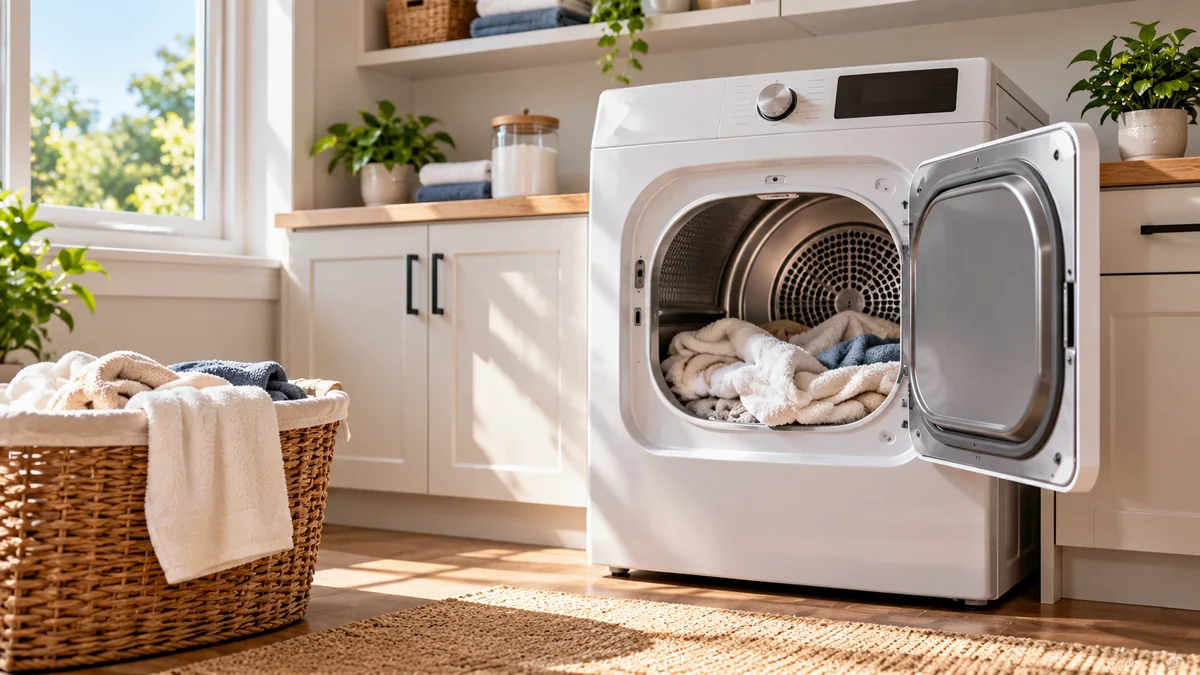
A dryer running cost USA estimate is most useful when you calculate from the energy the dryer actually uses per cycle or per year, then multiply that by the electricity rate that applies to your home. A clothes dryer’s nameplate wattage can be useful for understanding power demand, but it does not tell you by itself how long the heating elements, motor and controls operate during a complete load.
Using the latest U.S. residential electricity price available from the U.S. Energy Information Administration, 18.31¢/kWh for July 2026, an electric dryer that uses 3 kWh for one load would cost about $0.55 per load in variable electricity charges. Four such loads per week would use about 624 kWh per year and cost about $114.25 per year at that benchmark. Your own result can differ because dryer efficiency, load size, cycle choice, moisture level and local electricity prices all matter. For a household-specific estimate, use the HomeBillLab U.S. Appliance Running Cost Calculator.
Table of Contents
How much does an electric dryer cost per load?
The basic calculation is:
kWh used per load × electricity rate in dollars per kWh = cost per load
EIA’s July 2026 electricity price table reports a U.S. residential average of 18.31¢/kWh. That is $0.1831 per kWh. At that national benchmark, the arithmetic looks like this:
| Electricity used per load | Cost per load at 18.31¢/kWh | Cost for 4 loads/week |
|---|---|---|
| 1.5 kWh | $0.27 | About $4.76/month |
| 2.0 kWh | $0.37 | About $6.35/month |
| 3.0 kWh | $0.55 | About $9.52/month |
| 4.0 kWh | $0.73 | About $12.70/month |
| 5.0 kWh | $0.92 | About $15.87/month |
These are calculation examples, not claims about what every dryer uses. The correct kWh-per-cycle value depends on the dryer and the way you use it. If your model documentation gives annual energy use instead of kWh per cycle, use the annual figure directly rather than converting from wattage.
Why dryer wattage alone can overstate running cost
Electric clothes dryers have high-power heating components, so it is tempting to multiply a rated wattage by the full cycle time. That can be misleading because the heating element does not necessarily run at full output every second of the cycle. Thermostats and electronic controls cycle the heat, while the drum motor and blower have different power requirements. Automatic cycles can also end early when sensors determine that the load is dry.
The U.S. Department of Energy’s consumer clothes dryer program distinguishes electric dryers, where electricity provides the heat, from gas dryers, where gas is the heat source and electricity still powers components such as the drum and blower. DOE also maintains test procedures and federal efficiency standards for covered dryer types. For a running-cost estimate, model-specific kWh-per-cycle or annual energy data is more useful than assuming the maximum electrical input runs continuously.
Dryer cost per month and per year
Once you know the energy per load, usage frequency becomes the next major variable. A household that dries two loads a week will spend roughly half as much on dryer electricity as the same household drying four otherwise identical loads per week.
| Scenario | Annual dryer energy | Annual cost at 18.31¢/kWh |
|---|---|---|
| 2 kWh/load × 3 loads/week | 312 kWh/year | $57.13/year |
| 3 kWh/load × 4 loads/week | 624 kWh/year | $114.25/year |
| 4 kWh/load × 5 loads/week | 1,040 kWh/year | $190.42/year |
| 5 kWh/load × 7 loads/week | 1,820 kWh/year | $333.24/year |
If your dryer has a tested annual kWh figure, you can skip the load-frequency estimate and multiply the annual kWh directly by your electricity rate. That is often the cleaner method when comparing two dryers because it avoids guessing how much of a cycle the heating system spends at full output.
Moisture sensors can reduce unnecessary drying time
Automatic termination matters because over-drying wastes energy and can increase wear on fabrics. The Department of Energy’s current home-upgrade guidance recommends looking for a clothes dryer with a moisture sensor that shuts the machine off when clothes are dry. The same DOE guidance says ENERGY STAR clothes dryers use about 20% less energy than conventional models and notes that heat-pump dryers can save still more energy in suitable applications.
That percentage should not be turned into a fixed dollar saving for every home. To compare two specific dryers, use each model’s tested annual kWh or other official energy-use information and apply the same electricity rate to both. The difference in annual kWh, multiplied by your rate, gives a transparent estimate of the annual operating-cost difference.
How heat-pump dryers change the calculation
A conventional electric dryer generally heats air with electric resistance and exhausts warm, moist air through a vent. A heat-pump dryer instead recirculates air through a closed-loop system, removing moisture and reusing heat. ENERGY STAR’s clothes dryer guidance explains that heat-pump models can use substantially less energy than conventional dryers and that certified dryers include moisture-sensing features.
For cost comparisons, focus on the exact annual kWh of the models you are considering rather than assuming one universal percentage. Heat-pump models can have different cycle times, capacities and purchase prices, while local electricity rates determine the dollar value of each kilowatt-hour saved.
Electric dryer versus gas dryer running cost usa
The cost structure is different for gas dryers. An electric dryer uses electricity for its main heat source, motor, fan and controls. A gas dryer uses natural gas for most of the drying heat but still uses electricity for the motor, blower, ignition and controls. That means a gas-dryer estimate needs both the gas consumed and the electricity consumed during the cycle.
Do not compare an electric dryer’s kWh-only cost directly with a gas dryer’s electricity use and call the cheaper number the total cost. For a fair comparison, include the relevant local natural-gas rate, gas consumption, electricity use and any material differences in cycle performance. Fixed utility customer charges are normally not assigned to one appliance unless the appliance is the reason you incur that fixed charge.
Why lint filters and vent condition matter
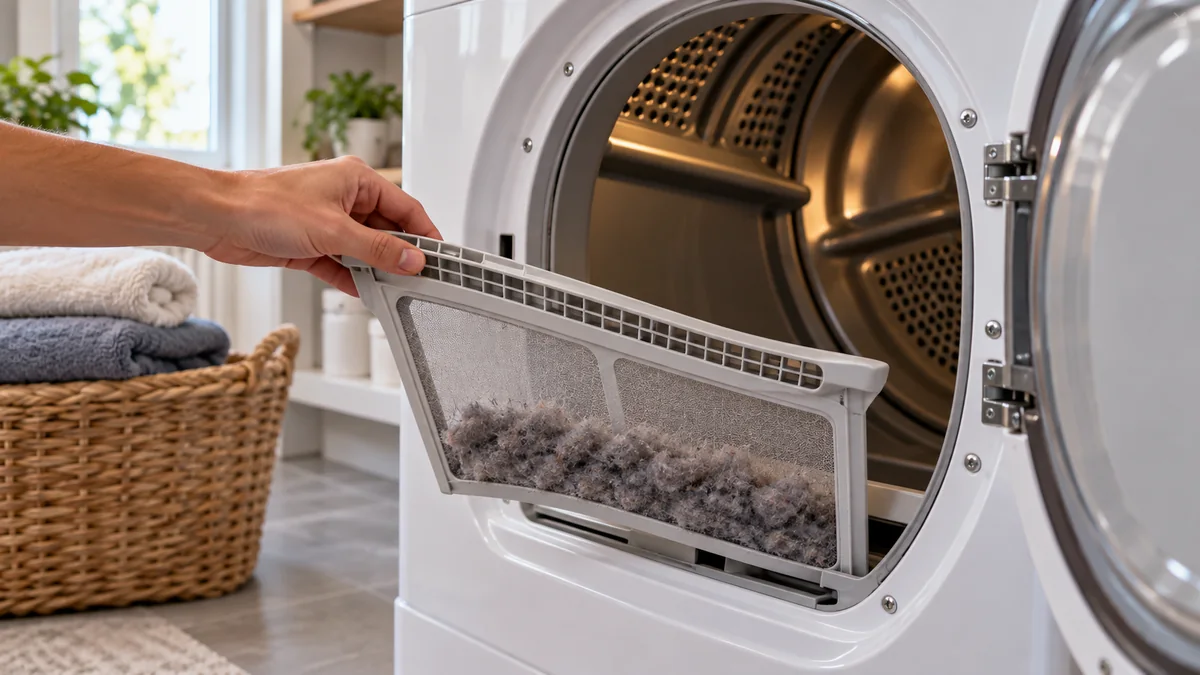
A dryer’s airflow path is part of normal operation. Clean the lint filter according to the manufacturer’s instructions and keep the exhaust system in proper condition. Restricted airflow can lengthen drying and may create a safety problem. If drying times become noticeably longer than normal, inspect the lint screen, ducting and exterior vent rather than assuming that higher electricity use is simply unavoidable.
HomeBillLab does not use a blanket energy-savings percentage for lint cleaning because the effect depends on the dryer and the severity of the restriction. The practical point is simpler: a dryer that needs extra runtime to finish the same load will generally consume more energy than it would under normal airflow conditions.
Electricity price can matter as much as dryer efficiency
The same dryer can cost very different amounts to run in different parts of the United States because residential electricity prices vary by state, utility and tariff. A 3 kWh load costs about $0.38 at 12.72¢/kWh, $0.55 at the July 2026 U.S. average of 18.31¢/kWh, $0.72 at 24.16¢/kWh and $1.01 at 33.61¢/kWh.
For your own calculation, use the variable electricity rate that actually applies to additional kWh consumption. If your bill separates supply and delivery and both vary with energy use, include both variable components. The HomeBillLab U.S. electricity cost per kWh guide explains how to distinguish a state benchmark from the rate structure on your own bill.
How to calculate your own dryer running cost usa
- Find the best energy input. Use measured or tested kWh per cycle, or a model-specific annual kWh figure if available.
- Use your own electricity rate. Convert cents per kWh to dollars by dividing by 100.
- Calculate one load. Multiply kWh per load by dollars per kWh.
- Scale to your household. Multiply by loads per week and by 52 for an annual scenario.
- Keep gas separate. For a gas dryer, add the gas cost to the electricity cost instead of treating electricity as the whole bill.
- Recalculate when usage changes. A larger household, wetter loads or more frequent cycles can change annual cost significantly.
The U.S. Appliance Running Cost Calculator supports wattage-and-runtime, annual-kWh and kWh-per-cycle methods. For a dryer, the kWh-per-cycle method is especially useful when you have a per-load energy figure and know roughly how many loads you dry each week.
Dryer running cost USA FAQ
How much does a dryer cost to run for one hour?
An hourly cost is only meaningful if you know the average electrical input during that hour. A dryer with cycling heat does not necessarily draw its maximum rated wattage continuously. For most households, cost per load or annual kWh is a more useful basis than a maximum-wattage hourly estimate.
Does a shorter cycle always cost less?
Not automatically. A shorter cycle can reduce energy use, but cycle temperature, load moisture, dryer design and heater operation also matter. Compare actual or tested kWh per cycle when possible.
Is a heat-pump dryer always cheaper to own?
Not necessarily. Heat-pump dryers can use less electricity, but total ownership cost also depends on purchase price, local energy prices, how often you dry clothes, maintenance and how long you keep the appliance. Use model-specific annual kWh to quantify the operating-cost side of the comparison.
Bottom line
For a practical dryer running cost USA estimate, start with kWh per load or annual kWh, then apply your own electricity rate. At the July 2026 U.S. residential average of 18.31¢/kWh, a 3 kWh electric-dryer load costs about $0.55, while the same load costs more or less as the local rate changes. Moisture sensors, efficient dryer design, proper airflow and the number of weekly loads can all affect the final annual cost.
Reviewed: 29 September 2026. EIA’s July 2026 electricity data were released 24 September 2026; the next EIA Electric Power Monthly release is scheduled for 23 October 2026. Explore more U.S. appliance running-cost guides or review the HomeBillLab methodology for how formulas, rates and source updates are handled.