A washing machine running cost USA estimate is easiest to understand when you separate the washer’s own electricity use from the energy used to heat the water. The washer motor, pump and electronics use electricity at the appliance, but a large share of laundry energy can come from the home’s water heater when you choose warm or hot water. That means a simple plug-in wattage reading can be useful, but it may not show the whole household energy cost of a wash cycle.
Using the latest U.S. residential electricity-price benchmark from the U.S. Energy Information Administration, 18.31¢/kWh for July 2026, a cycle that accounts for 0.5 kWh of electricity would cost about $0.09 in electricity. A 1.0 kWh cycle would cost about $0.18. These are calculation examples, not typical values for every washer. For a household-specific estimate, enter the kWh per cycle or annual kWh from your own machine into the HomeBillLab U.S. Appliance Running Cost Calculator.
Table of Contents
How much does a washing machine cost per load?
If you already know the electricity used for one completed wash, the arithmetic is simple:
kWh per load × electricity rate in dollars per kWh = electricity cost per load
EIA’s July 2026 electricity-price table reports a U.S. residential average of 18.31 cents per kWh. Converted to dollars, that is $0.1831/kWh. At that benchmark, the examples below show how the result changes as energy per load changes.
| Electricity attributed to one load | Cost per load at 18.31¢/kWh | Cost at 5 loads/week |
|---|---|---|
| 0.15 kWh | $0.03 | About $7.14/year |
| 0.30 kWh | $0.05 | About $14.28/year |
| 0.50 kWh | $0.09 | About $23.80/year |
| 0.75 kWh | $0.14 | About $35.70/year |
| 1.00 kWh | $0.18 | About $47.61/year |
Your utility rate can be well above or below the national figure. EIA’s state table shows large geographic differences, so the rate on your actual bill is normally the better input. You can also use the HomeBillLab guide to electricity cost per kWh in the USA if you need help translating cents per kWh into appliance running cost.
Why washer electricity at the plug is not always the full cost
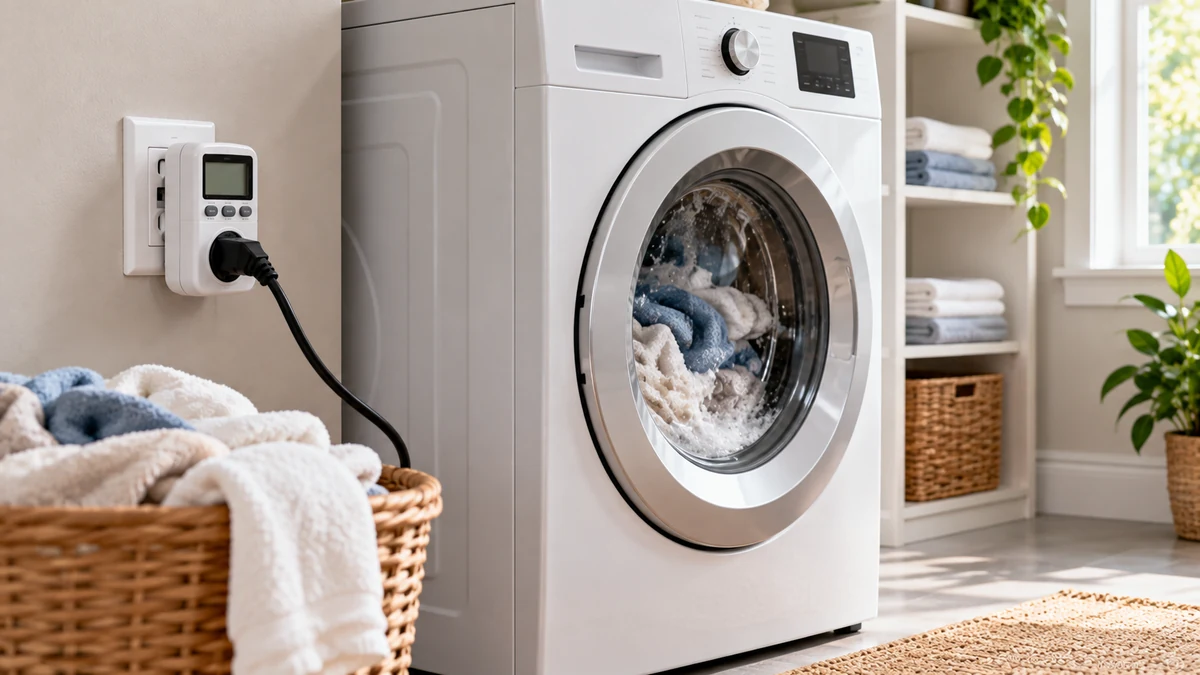
A plug-in electricity monitor can measure the electricity drawn directly by many standard clothes washers. That is useful for comparing cycles on the same machine and for checking how much electricity the washer itself consumes. But it does not automatically measure the energy used by a separate water heater to produce hot water for the cycle.
ENERGY STAR’s current clothes-washer guidance says water heating accounts for about 90% of the energy associated with operating a clothes washer. It also recommends cold-water washing where appropriate and notes that switching from hot to warm can cut wash energy use substantially. The exact household savings depend on your washer, temperature setting, inlet-water temperature and water-heating system.
This distinction matters especially in homes with a gas water heater. The washer may show only a modest electrical draw while the hot-water portion of the cycle creates a separate gas cost. For that reason, a plug meter is best treated as a measurement of the appliance’s direct electricity use, not automatically the total utility cost of doing laundry.
Use EnergyGuide annual kWh when comparing washer models
For model-to-model comparisons, the yellow EnergyGuide label is often more useful than nameplate watts. The Federal Trade Commission’s Energy Labeling Rule requires EnergyGuide information for clothes washers and other covered appliances. The label presents estimated annual energy use and operating cost, along with a comparison range for similar models.
The annual dollar figure on the label is a standardized estimate, not a quote for your home. Your own electricity price, number of loads, cycle choices and water-heating fuel can produce a different result. If the label gives annual kWh, you can create your own cost estimate by multiplying that annual energy figure by your local electricity rate.
For example, a washer with a tested annual figure of 100 kWh would represent about $18.31 per year at 18.31¢/kWh. A washer rated at 150 kWh/year would represent about $27.47 per year at the same electricity price. Those examples isolate the electricity calculation; local water and sewer charges are separate and can materially change the total cost of doing laundry.
Why nameplate wattage can mislead
Multiplying a washer’s maximum rated watts by the entire cycle duration can overstate energy use because the motor, pump and controls do not all run at maximum power for every minute. A wash cycle moves through filling, washing, pausing, draining, rinsing and spinning. Some models also have internal heaters or specialty cycles that change the power profile.
The U.S. Department of Energy maintains the federal consumer clothes-washer test procedure and efficiency standards used for regulated residential products. DOE’s test procedure is designed to compare equipment under defined conditions, which is one reason standardized annual energy data is usually a cleaner comparison tool than a single wattage figure from the product nameplate.
Cold, warm and hot cycles can have very different energy costs
The washer’s mechanical work may be similar from one temperature setting to another, but the energy needed to heat water can change sharply. ENERGY STAR recommends washing in cold water for suitable loads because water heating is the dominant energy component of many wash cycles. Cold-water washing does not mean every load must always be cold; heavily soiled items, hygiene requirements and garment-care instructions can justify warmer settings.
From a cost-estimating perspective, the practical rule is to compare like with like. If you are testing your washer with a plug meter, record the cycle, load size and temperature setting. If you are comparing EnergyGuide labels, use the standardized annual kWh figures rather than mixing them with a one-off meter reading from a different operating condition.
Front-load versus top-load: focus on tested energy data
Washer design can affect both energy and water use. ENERGY STAR notes that certified front-load washers are generally more energy- and water-efficient than traditional top-load agitator machines, while modern top-load impeller designs can also improve on older agitator layouts. But the most reliable way to compare two models is still to use the tested annual energy and water information for those exact products.
ENERGY STAR also states that certified clothes washers use about 20% less energy and about 30% less water than regular washers. Treat those figures as program-level context rather than a guaranteed saving for a specific replacement. A household replacing an already-efficient washer may see a smaller difference than a household replacing an older, less-efficient model.
How many loads per week changes annual running cost
Once the energy per cycle is known, frequency is straightforward. Multiply the per-load energy by the number of loads per week and by 52 weeks. ENERGY STAR says the average American family washes about 300 loads of laundry per year, but your household may be far above or below that level.
| Example usage | Annual loads | Annual electricity at 0.5 kWh/load | Annual cost at 18.31¢/kWh |
|---|---|---|---|
| 3 loads/week | 156 | 78 kWh | $14.28 |
| 5 loads/week | 260 | 130 kWh | $23.80 |
| 7 loads/week | 364 | 182 kWh | $33.32 |
| 10 loads/week | 520 | 260 kWh | $47.61 |
Again, 0.5 kWh per load is only a calculation example. Use your washer’s tested or measured energy instead. If the machine has an annual-kWh value, you do not need to estimate load frequency at all unless you want to adjust the label assumption to your household’s actual usage.
Do water and sewer charges belong in washing-machine running cost?
Yes, if your goal is the total household cost of washing clothes, but they should be kept separate from the electricity calculation. Water and sewer rates vary widely by utility and location, and some homes use private wells or septic systems instead of a conventional municipal bill. A washer that uses less water can reduce both water-heating energy and metered water use, but the dollar impact depends on the rates that apply to your home.
HomeBillLab therefore treats appliance electricity as one transparent component. Use the U.S. Appliances hub for other appliance-cost guides, including the separate dryer running cost guide, because dryer energy should not be silently folded into the washer result.
Ways to reduce washing-machine energy use
- Use cold water for suitable loads when garment-care and hygiene needs allow.
- Run full loads when practical rather than many lightly filled cycles.
- Use a high spin speed when appropriate so less water remains in clothes before drying.
- Compare annual kWh and water use when replacing a washer instead of relying only on purchase price.
- Avoid unnecessarily hot specialty cycles when a standard cycle will do the job.
These steps come from the same principle used throughout this guide: reduce the physical quantity of energy or hot water required, then apply the rate that actually applies to your home. See the HomeBillLab Methodology for how running-cost calculations, source updates and example rates are handled.
Washing machine running cost USA FAQs
Is a washing machine expensive to run?
The washer’s direct electricity cost can be modest, especially on cold-water cycles, but the complete household energy cost can be higher when the cycle uses hot water. Use model-specific annual kWh or a measured kWh-per-cycle value, and remember that water heating may be a separate utility cost.
Can I estimate cost from the washer’s watts?
You can make a rough estimate if you know the actual average power and operating time, but maximum nameplate watts can overstate use because the washer changes operating modes throughout the cycle. Measured kWh per cycle or tested annual kWh is generally better.
Does a cold wash really save energy?
Usually yes, because less energy is needed to heat water. ENERGY STAR specifically recommends cold-water washing for suitable loads and identifies water heating as the dominant energy component of clothes washing.
Should I use the national electricity average?
Use it only as a benchmark. For your own washing machine running cost USA estimate, the electricity price on your utility bill is the better input because rates differ substantially by state, utility and rate plan.