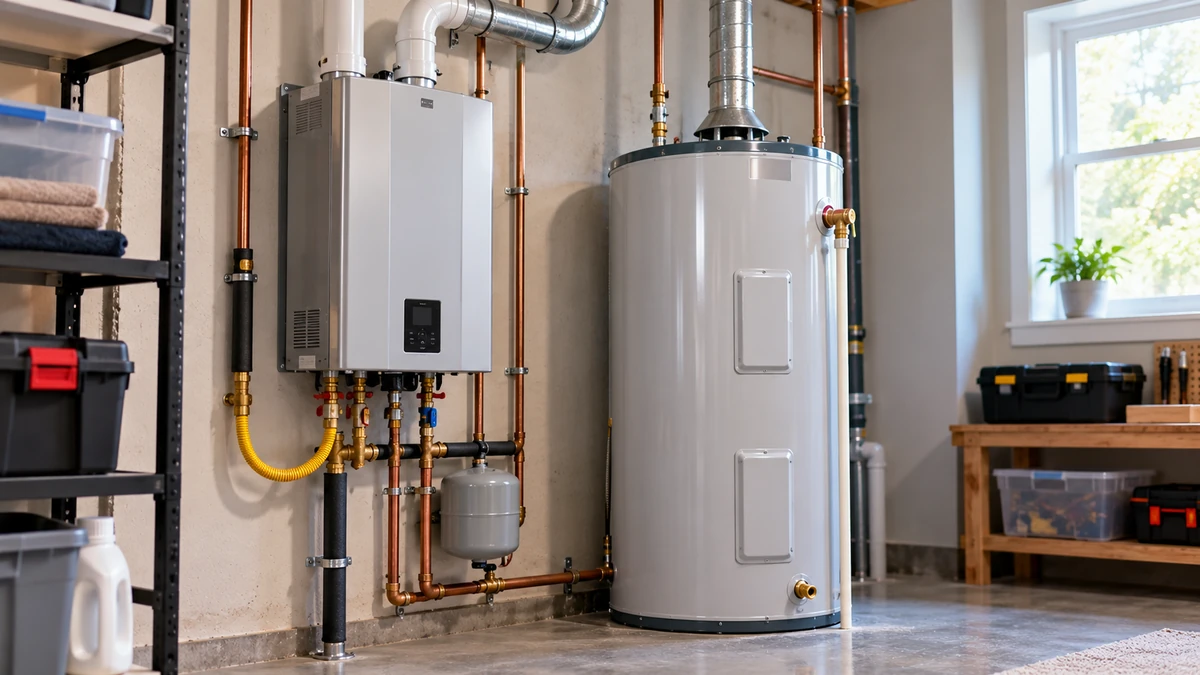
Tankless vs tank water heater running cost depends on fuel type, efficiency, hot-water demand, local utility prices and installation conditions. The biggest mistake is comparing “tankless” and “tank” without first separating gas from electric. A gas tankless unit can be materially more efficient than a gas storage tank, while an electric tankless unit still uses electric resistance and mainly saves the standby losses associated with storing hot water.
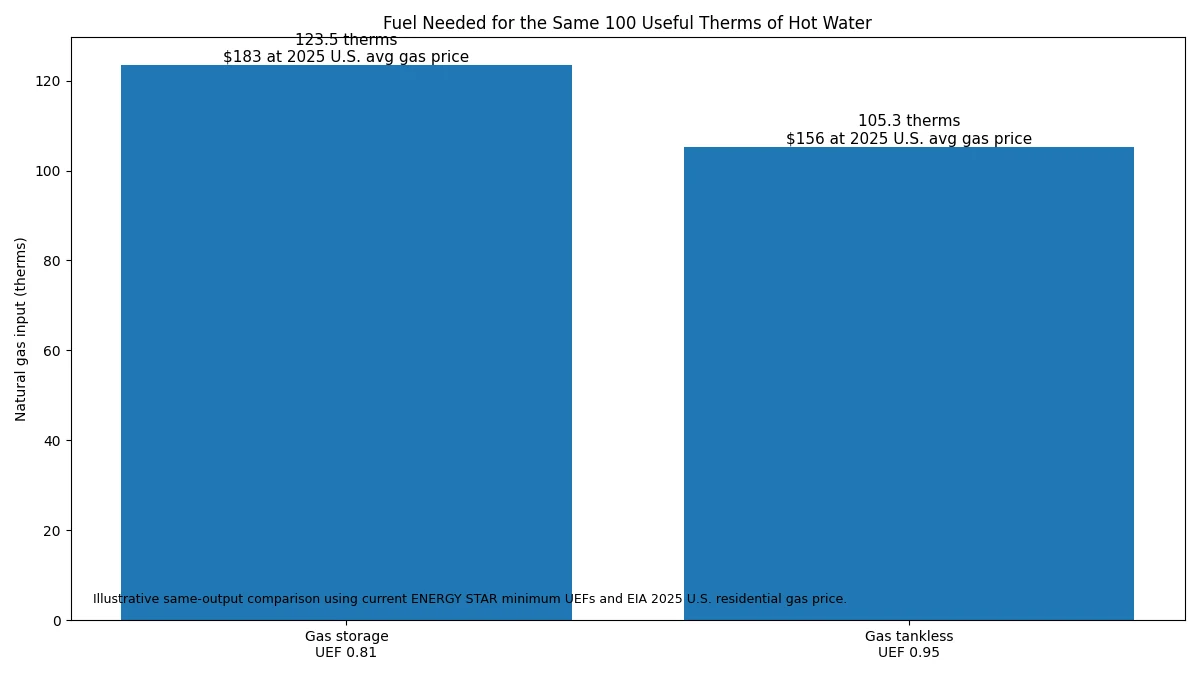
For gas water heaters, current ENERGY STAR criteria make the efficiency gap easy to see. A certified gas storage water heater of 20–55 gallons must reach at least UEF 0.81 for the medium draw pattern, while a certified gas instantaneous or tankless unit must reach at least UEF 0.95. Using the 2025 U.S. residential average natural-gas price of about $1.48/therm, the tankless example uses about 14.7% less fuel input than the storage example for the same useful hot-water output.
That efficiency advantage does not automatically mean the lowest total ownership cost. Tankless equipment can cost more to install, may require venting or gas-line changes, and needs enough flow capacity for simultaneous showers and fixtures. Use the HomeBillLab U.S. Hot Water Running Cost Calculator with your own rates and model data before deciding.
Table of Contents
Tankless vs tank water heater: which uses less energy?
For the same fuel, tankless water heaters generally reduce energy use because they avoid keeping a tank of water hot all day. The size of the savings depends on how much hot water the household uses.
DOE’s Energy Saver guide says gas on-demand water heaters can be 24%–34% more energy efficient than conventional storage water heaters in homes using 41 gallons or less of hot water per day. At high use around 86 gallons/day, the advantage narrows to about 8%–14%.
Those percentages are broad technology guidance, not a guaranteed bill reduction. The real result depends on the exact tank UEF, tankless UEF, fuel price, standby losses, usage pattern and installation.
How tank and tankless water heaters work differently
A storage water heater heats water and keeps a reservoir ready for use. When hot water is drawn, cold water enters the tank and the heater recovers the stored temperature. Even when nobody is using hot water, the tank loses some heat to the surrounding room.
A tankless or instantaneous unit heats water only when flow is detected. DOE’s Building Science Education page on gas-fired tankless water heaters explains that a flow sensor activates the burner or heating device when a tap opens and shuts it off when flow stops. The same page notes that many high-efficiency gas tankless units can provide roughly 2–5 gallons per minute.
Tankless therefore removes most storage standby loss, but it must create heat fast enough to serve water in real time. Storage reverses that trade-off: it has a reservoir available for short high-demand periods but spends energy keeping that reservoir hot.
Why DOE’s tankless savings are bigger at lower hot-water use
Standby loss is relatively important when a household uses little hot water. A storage tank still loses heat between draws, so the fixed standby penalty is spread over fewer gallons. At higher daily hot-water use, more of the storage heater’s energy goes directly into useful hot water, so the percentage advantage of tankless shrinks.
That is why DOE’s guidance gives a much larger efficiency advantage at 41 gallons/day or less than around 86 gallons/day. The tankless unit still avoids most storage loss, but storage loss becomes a smaller fraction of the total energy budget as water use rises.
Gas tankless vs gas storage: running-cost comparison
Current ENERGY STAR residential water-heater criteria require a gas storage unit of more than 20 and up to 55 gallons to reach at least UEF 0.81 for the medium draw pattern, while a certified gas-fired instantaneous water heater must reach at least UEF 0.95 and deliver at least 2.8 GPM over a 67°F temperature rise.
To isolate the efficiency difference, suppose both heaters must deliver 100 therms of useful hot-water energy over a period. The UEF 0.81 storage model needs about 123.5 therms of gas input. The UEF 0.95 tankless model needs about 105.3 therms.
EIA reports a 2025 annual average residential natural-gas price of $15.34/Mcf in its residential gas price series. Using EIA’s average 2025 heat-content conversion of 10.37 therms per Mcf, that is about $1.48/therm. The 100-useful-therm example therefore costs about $183 for storage gas versus $156 for tankless gas.
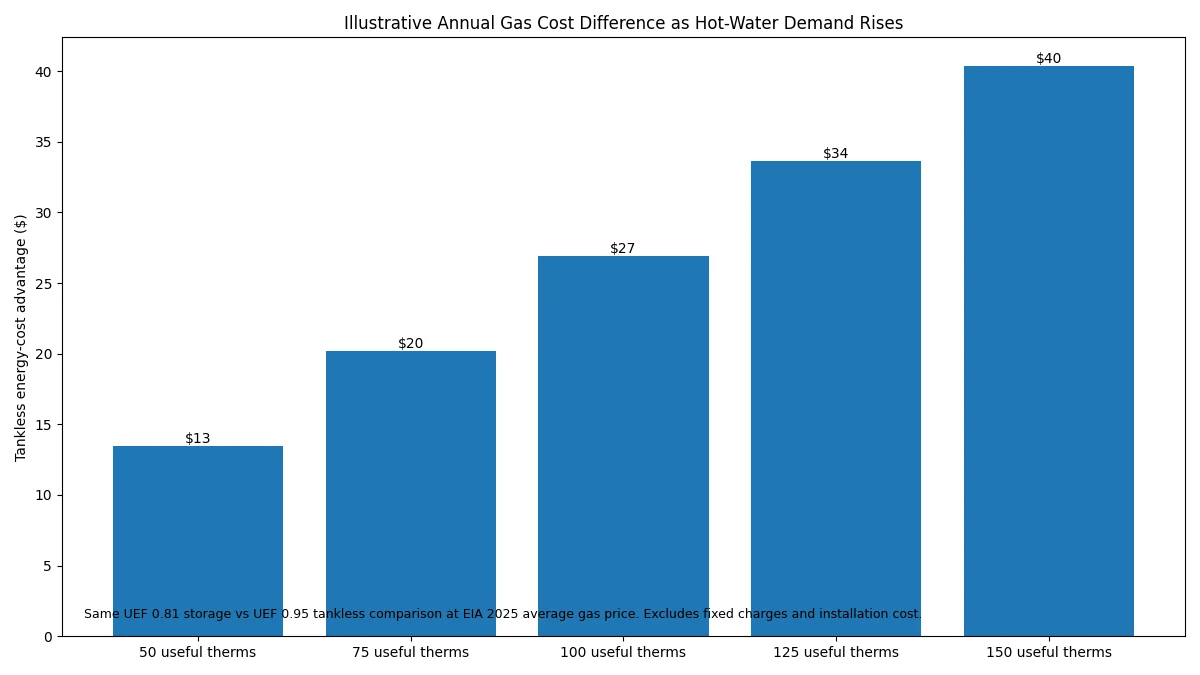
The dollar difference is only an energy-cost comparison. It excludes fixed gas customer charges, installation, venting, maintenance and financing.
Electric tankless vs electric storage: the savings work differently
Both conventional electric storage and electric tankless heaters use resistance heating. Electric tankless does not have the large thermodynamic efficiency jump of a heat pump water heater. Its main operating advantage is avoiding storage standby losses.
DOE/FEMP’s residential water-heater guidance uses a conventional electric storage benchmark of 3,437 kWh/year at UEF 0.95. A tankless resistance unit can avoid tank standby loss, but the household still has to supply essentially all of the heat electrically when hot water is flowing.
This means electric tankless can reduce kWh in some households, but it should not be confused with a heat pump water heater, which can have UEF above 3 by moving heat instead of creating it entirely with resistance elements.
Electric tankless also needs high instantaneous electrical power to heat water on demand. A whole-home installation may require large branch circuits or electrical-service upgrades. Check the manufacturer’s circuit requirements and have an electrician verify panel capacity before assuming it is a simple swap.
UEF is more useful than the words “tank” or “tankless”
Uniform Energy Factor is the federal efficiency metric for residential water heaters. Higher UEF means more useful hot-water service per unit of input energy under the DOE test method.
Comparing UEF lets you distinguish a modern condensing gas tankless model from a lower-efficiency tankless unit, and a high-efficiency storage tank from an older storage design. The technology label alone does not tell you annual energy use.
For shopping, use the model’s yellow EnergyGuide information in addition to UEF. The FTC’s EnergyGuide guidance explains that estimated annual operating cost is standardized and that your actual cost depends on local energy prices and how much hot water you use.
Flow rate is the main tankless comfort constraint
A storage tank can deliver a large amount of hot water quickly until the stored supply is depleted. A tankless unit has no stored reserve, so its limit is how many gallons per minute it can heat through the required temperature rise.
ENERGY STAR requires certified residential gas tankless units to deliver at least 2.8 GPM over a 67°F rise. Larger models can deliver more, but simultaneous showers, dishwashing and laundry can still exceed a unit’s capacity.
In cold climates, incoming water is colder, so the heater must create a larger temperature rise. The same tankless unit may therefore deliver fewer GPM in winter than in warm weather.
Tank standby losses are real, but modern tanks are better insulated
Storage tanks lose heat through the tank wall, fittings and connected pipes. The burner or heating elements periodically turn on even when nobody is using hot water. This is the standby loss that tankless avoids.
Modern storage models use better insulation and efficiency controls than older tanks, so the gap between a high-efficiency storage heater and a high-efficiency tankless heater can be smaller than the gap between tankless and an old conventional tank.
This is visible in the current ENERGY STAR criteria: UEF 0.81 gas storage versus UEF 0.95 gas tankless is a meaningful difference, but smaller than DOE’s broad 24%–34% low-use comparison against conventional storage equipment.
Tankless installation can cost more
A tankless water heater is compact and frees floor space, but a retrofit is not always simple. Gas tankless models can require a larger gas supply, new venting, condensate drainage for condensing units and changes to the water piping.
Electric tankless units can require substantial electrical capacity because they must supply a large amount of heat instantly. A service-panel or wiring upgrade can outweigh several years of energy savings.
For this reason, compare installed price, not only the appliance price. A like-for-like replacement of an existing storage tank can be cheaper even when the tankless unit has lower annual energy use.
Maintenance and hard water matter more with tankless
Mineral scale can reduce heat-transfer performance in tankless heat exchangers, especially in hard-water areas. Manufacturers may require periodic flushing or descaling. Storage tanks also need maintenance, including checking the anode rod where applicable and flushing sediment.
Do not ignore maintenance when comparing lifetime cost. A highly efficient tankless heater that is never descaled in hard-water conditions may lose performance or need repairs earlier than expected.
Current 2026 federal standards context
The current DOE Consumer Water Heaters page has an important 2026 update: DOE’s December 2024 final rule that would have amended standards for gas-fired instantaneous water heaters was withdrawn on May 20, 2025 after Congressional Review Act disapproval. In other words, do not rely on older articles claiming those withdrawn tankless standards will take effect in 2029.
DOE’s separate 2024 final rule for several other consumer water-heater classes remains on the page with compliance required beginning May 6, 2029. Those future standards do not force homeowners to replace existing 2026 equipment; they affect products manufactured under the future compliance requirements.
Which type fits which home?
- Choose tankless when: floor space is limited, standby losses matter, the household’s simultaneous flow fits the unit, and the installation cost is reasonable.
- Choose storage when: upfront cost is the priority, the existing setup is easy to replace like-for-like, or the household needs short bursts of high hot-water flow.
- For gas homes: compare UEF, local $/therm and the tankless retrofit cost.
- For all-electric homes: compare electric tankless with a heat pump water heater, not only with conventional electric resistance.
- For high-demand households: verify GPM or First Hour Rating before focusing on annual energy cost.
For fuel-choice context, see Gas vs Electric Water Heater Cost USA. For conventional electric storage cost, see Electric Water Heater Running Cost USA. For the high-efficiency electric alternative, see Heat Pump Water Heater vs Electric Water Heater.
HomeBillLab’s treatment of fuel prices, UEF, standardized test data and illustrative calculations is documented in the HomeBillLab Methodology. Browse the U.S. Hot Water hub for related guides.
Tankless vs tank water heater FAQ
Does a tankless water heater always cost less to run?
No. Tankless generally reduces standby energy loss, but actual cost depends on fuel price, model UEF, hot-water use and installation. A high installation cost can outweigh years of operating savings.
How much more efficient is gas tankless than gas storage?
DOE’s broad consumer guidance says gas tankless can be 24%–34% more energy efficient than conventional storage in low-use homes and 8%–14% more efficient around 86 gallons/day. Comparing current ENERGY STAR minimums alone, UEF 0.95 tankless requires about 14.7% less fuel input than UEF 0.81 storage for the same useful output.
Is electric tankless much cheaper than an electric tank?
Not necessarily. Both use electric resistance, so the tankless advantage mainly comes from avoiding standby losses. A heat pump water heater has a much larger efficiency advantage because it moves heat rather than producing all of it with resistance.
Can one tankless water heater run two showers at once?
It depends on the model’s GPM at your required temperature rise. Add the simultaneous fixture flow rates and compare them with the manufacturer’s performance table for your incoming-water temperature.
Does tankless mean unlimited hot water?
It means the unit does not run out of stored hot water as long as fuel, water flow and capacity are available. But it can still be overloaded if simultaneous flow exceeds its heating capacity.
Bottom line
For tankless vs tank water heater running cost, tankless usually uses less energy because it avoids storage standby loss, but the size of the advantage depends on usage and fuel. With current ENERGY STAR gas criteria, UEF 0.95 tankless uses about 14.7% less fuel input than UEF 0.81 storage for the same useful hot-water output. DOE’s broader guidance shows larger percentage savings in low-use households. Compare model UEF, local fuel price, flow capacity and installed cost before deciding. Use the U.S. Hot Water Running Cost Calculator for your own scenario.