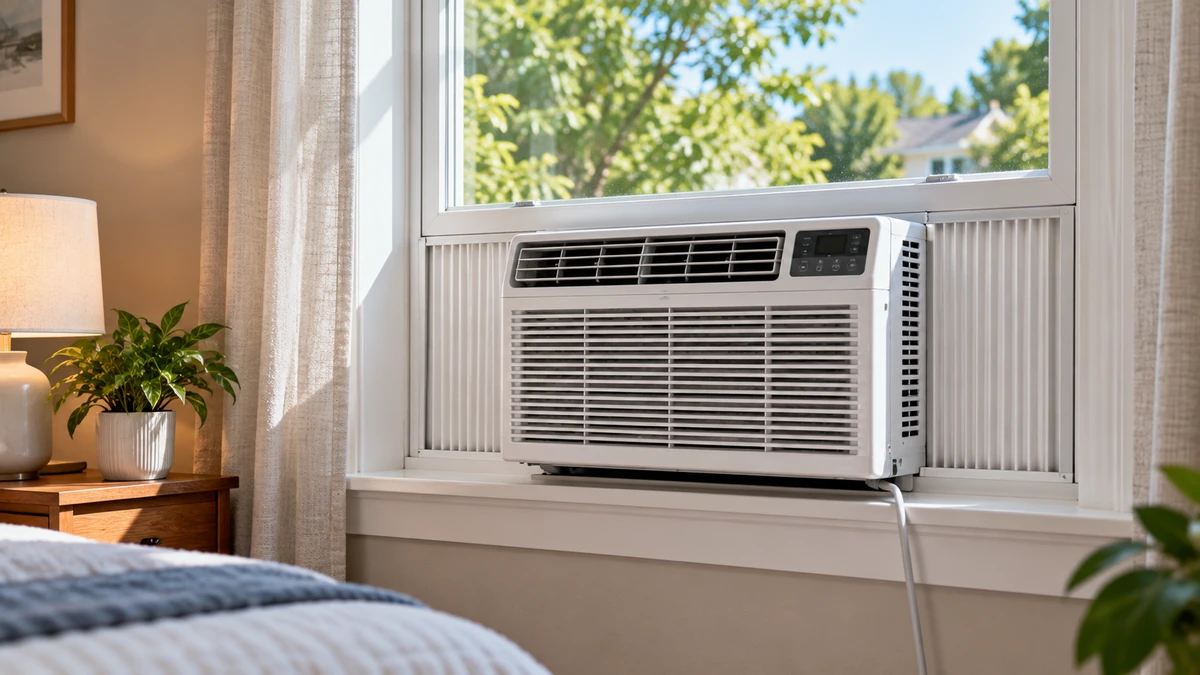
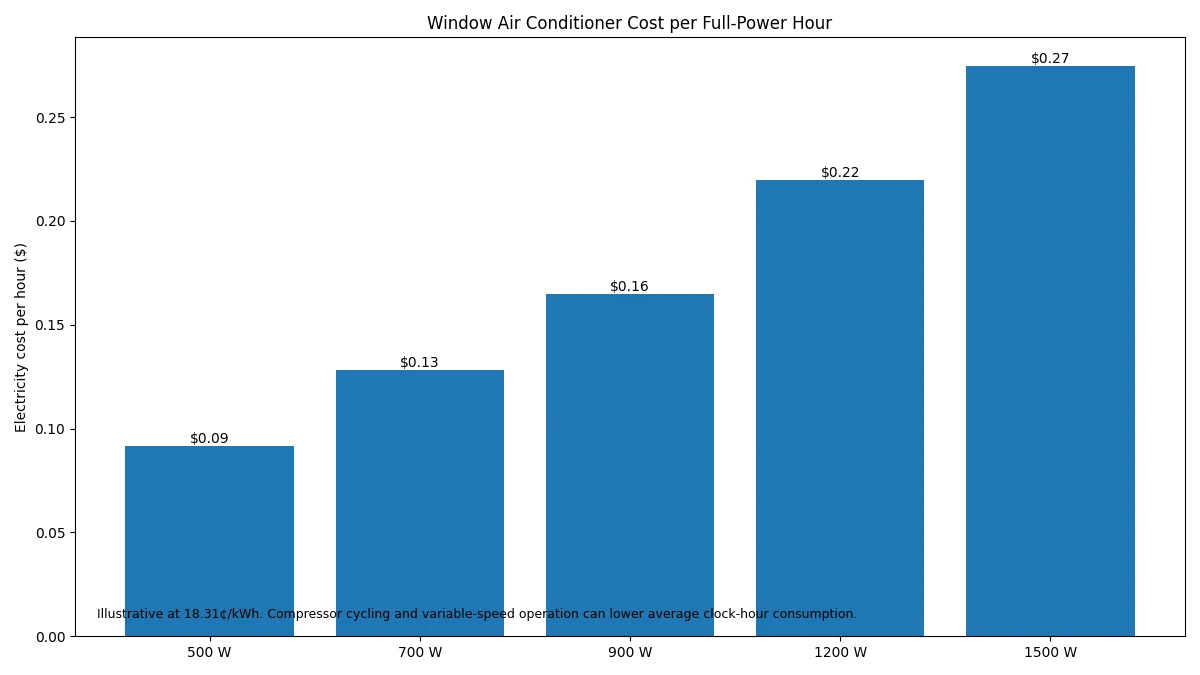
Window air conditioner running cost USA depends on electrical input, compressor runtime and your electricity price. At the U.S. Energy Information Administration’s July 2026 residential average of 18.31¢/kWh, a 500-watt window AC costs about $0.09 per full-power hour, a 900-watt unit about $0.16, and a 1,500-watt unit about $0.27.
The phrase full-power hour matters. A room air conditioner cycles its compressor as the room approaches the thermostat setting, so eight clock hours of use may represent fewer than eight equivalent full-power hours. Inverter or variable-speed models can also reduce power instead of simply switching fully on and off.
Use the HomeBillLab U.S. Air Conditioner Running Cost Calculator with the unit’s actual watts, measured kWh or EnergyGuide information and your local electricity price.
Table of Contents
Window air conditioner running cost USA: cost per hour
The simplest formula is:
Hourly cost = watts ÷ 1,000 × electricity price per kWh.
| Illustrative input | Electricity per full-power hour | Cost at 18.31¢/kWh |
|---|---|---|
| 500 W | 0.50 kWh | $0.09 |
| 700 W | 0.70 kWh | $0.13 |
| 900 W | 0.90 kWh | $0.16 |
| 1,200 W | 1.20 kWh | $0.22 |
| 1,500 W | 1.50 kWh | $0.27 |
These are calculation scenarios, not a claim that every window AC of a particular cooling capacity uses exactly one of these wattages. Use the model’s actual rated or measured power when possible.
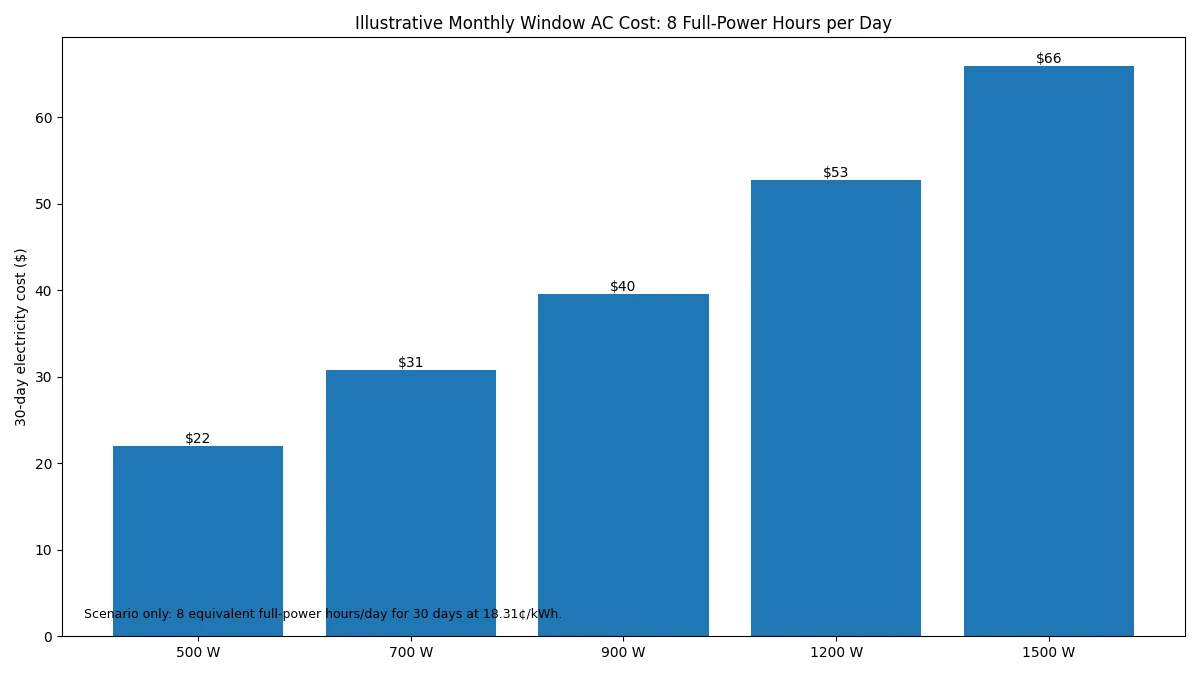
How much does a window AC cost per month?
For an illustrative 30-day month at eight equivalent full-power hours per day:
| Illustrative input | Monthly electricity | Monthly cost |
|---|---|---|
| 500 W | 120 kWh | $21.97 |
| 700 W | 168 kWh | $30.76 |
| 900 W | 216 kWh | $39.55 |
| 1,200 W | 288 kWh | $52.73 |
| 1,500 W | 360 kWh | $65.92 |
A 900-watt unit under that deliberately simple scenario costs about $40/month. If the compressor is energized only half of the eight-hour period on average, the actual energy portion would be roughly half of the full-power scenario.
Window AC running-cost formula
Use three steps:
- Convert watts to kilowatts: watts ÷ 1,000.
- Calculate energy: kW × equivalent full-power hours.
- Calculate cost: kWh × your electricity price.
Example: a 700-watt room AC operating for five equivalent full-power hours uses 3.5 kWh. At 18.31¢/kWh, that costs about $0.64 for the day.
CEER: the efficiency rating used for room air conditioners
Room air conditioners use Combined Energy Efficiency Ratio, or CEER. ENERGY STAR’s current room air conditioner criteria list CEER requirements by cooling capacity and configuration.
For example, current ENERGY STAR criteria for many units with louvered sides use a CEER base of 14.7 in the 8,000–10,999 Btu/h range. Different capacities, reverse-cycle units and casement designs have different requirements.
Higher CEER indicates more cooling delivered for the electricity consumed under the standardized test procedure. Do not compare CEER directly with central-air SEER2; they are different metrics for different product categories.
How much more efficient is an ENERGY STAR window AC?
ENERGY STAR’s current room air conditioner page states that certified room air conditioners are at least 19% to 36% more energy efficient than the applicable federal minimum standards, depending on product type and capacity.
That does not mean every certified unit saves exactly the same percentage on your bill. The percentage refers to standardized efficiency criteria, while household cost also depends on runtime, room heat gain and electricity price.
Correct sizing can matter as much as the efficiency label
DOE/FEMP’s current room air-conditioner purchasing guidance, updated in December 2024, warns against oversizing. An oversized room AC can cost more to buy, use more energy and remove humidity poorly because it cycles on and off too quickly.
A smaller unit that is properly matched to the room may run longer but maintain more stable temperature and humidity. Room area, ceiling height, sun exposure, insulation, window area and occupancy all affect sizing.
Why actual clock-hour cost is usually lower than rated-watt math
Rated input is useful for a worst-case full-power estimate, but air conditioners are thermostatically controlled. Once the room approaches setpoint, the compressor may cycle off or reduce output.
If a nominal 900-watt unit is available for eight hours but averages a 60% full-power equivalent duty cycle, daily electricity is about 4.32 kWh rather than 7.2 kWh. At 18.31¢/kWh, that is about $0.79/day.
Very hot weather, direct afternoon sun, poor air sealing or an undersized unit can push the duty cycle higher. Mild evenings and a well-insulated room can push it lower.
Use the EnergyGuide label when shopping
The Federal Trade Commission’s EnergyGuide labeling guidance confirms that room air conditioners are covered by the federal Energy Labeling Rule. EnergyGuide information is designed to show energy cost or efficiency information and help shoppers compare similar models.
The printed annual dollar estimate uses standardized assumptions and national energy-price inputs, so your actual bill may differ. For HomeBillLab calculations, use the model’s disclosed efficiency or energy-use information and reprice it with your own electricity rate.
Window AC vs portable AC running cost
A window AC rejects heat directly outdoors through the portion of the cabinet outside the window. A single-hose portable AC sits inside the room and exhausts hot air through a hose, which can create different real-world performance and test metrics.
That is why the two product types should not be compared only by advertised Btu/h. For the portable category, see Portable Air Conditioner Running Cost USA. For whole-home equipment, see Central Air Conditioner Running Cost USA. For a ductless room-by-room alternative, see Mini Split Running Cost USA.
How to reduce window air conditioner running cost
- Choose the right capacity. Oversizing can cause inefficient short cycling.
- Seal the side panels and window gaps. Outdoor air leakage increases cooling load.
- Clean the filter. Restricted airflow can reduce performance.
- Shade the room where practical. Blinds or exterior shading can reduce solar heat gain.
- Use Energy Saver mode. ENERGY STAR notes that certified room ACs include energy-saving controls that can limit unnecessary fan operation.
- Raise the thermostat slightly. A smaller indoor-outdoor temperature difference usually reduces runtime.
- Use measured kWh. A compatible plug-in energy monitor can show actual consumption over hot and mild days.
DOE’s Consumer Room Air Conditioners page confirms that window and through-the-wall room ACs are federally regulated products with current DOE energy-conservation standards and test procedures.
The EIA’s July 2026 Electric Power Monthly summary reports the national residential electricity price of 18.31¢/kWh used in this guide. Replace it with your utility rate for a household estimate.
HomeBillLab’s treatment of appliance watts, equivalent runtime and electricity-rate examples is documented in the HomeBillLab Methodology. Browse the U.S. Air Conditioning hub for related guides.
Window air conditioner running cost USA FAQ
How much does a 500-watt window AC cost per hour?
At 18.31¢/kWh, a 500-watt unit costs about $0.09 per full-power hour. Thermostat cycling can lower average clock-hour cost.
How much does a 900-watt window AC cost per month?
At eight equivalent full-power hours per day for 30 days, 900 watts uses 216 kWh and costs about $40/month at 18.31¢/kWh.
Does a window AC use its rated watts all the time?
No. Compressor cycling, thermostat setting and variable-speed operation can reduce average power over a clock hour. Rated watts are most useful for a full-power scenario.
What is a good CEER for a window air conditioner?
There is no single threshold for every size and design. ENERGY STAR requirements vary by cooling capacity, reverse-cycle capability and cabinet type. Compare CEER among similar units.
Bottom line
For window air conditioner running cost USA, multiply actual kW by equivalent full-power hours and your electricity rate. At 18.31¢/kWh, a 500-watt unit costs about $0.09/full-power hour, a 900-watt unit about $0.16, and a 1,500-watt unit about $0.27. Use the U.S. Air Conditioner Running Cost Calculator with the exact model’s watts, measured kWh or EnergyGuide data.