
How much does a fridge cost to run in Australia? The clearest estimate comes from the annual energy consumption on the fridge’s Energy Rating Label and the electricity usage rate on your bill. Multiply annual kilowatt-hours by your tariff in dollars per kWh.
Quick answer: at an illustrative tariff of 32c/kWh, a fridge labelled at 200kWh per year costs about $64 a year. A 350kWh model costs about $112, while a 500kWh model costs about $160. These are calculation scenarios, not Australian averages or promises for a particular fridge size.
Enter your model’s annual kWh and your own tariff in the Energy Rating Label mode of the Appliance Running Cost Calculator. This is usually more useful for a fridge than treating its rated watts as though the compressor runs continuously.
Fridge running cost Australia: example scenarios
The table holds the electricity rate at 32c/kWh so the effect of annual energy use is easy to see. Monthly values are annual cost divided by 12, and daily values are annual cost divided by 365.
| Annual energy use | Cost per year | Average per month | Average per day |
|---|---|---|---|
| 200kWh | $64.00 | $5.33 | $0.18 |
| 350kWh | $112.00 | $9.33 | $0.31 |
| 500kWh | $160.00 | $13.33 | $0.44 |
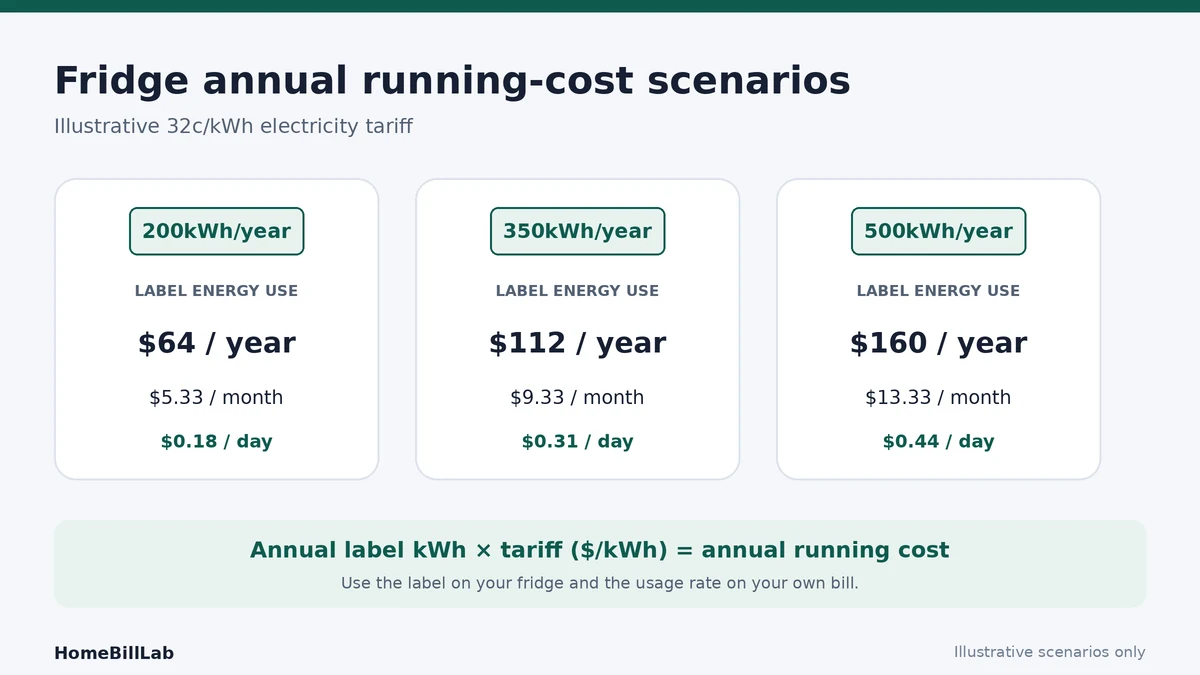
The 500kWh row is not automatically a large fridge and the 200kWh row is not automatically a small one. Capacity, configuration, efficiency and test conditions all matter. Compare the annual kWh on real labels rather than assigning one consumption figure to every fridge in a size band.
How to calculate fridge running cost from the label
The official Energy Rating Label guide gives the basic formula:
Annual running cost = annual energy consumption (kWh) × electricity tariff ($/kWh)
- Find the annual energy consumption number in kWh on the label.
- Copy the variable electricity rate from your bill.
- Convert cents to dollars by dividing by 100.
- Multiply annual kWh by the dollar tariff.
For example, 350kWh × $0.32/kWh = $112 per year. The arithmetic follows the transparent approach in the HomeBillLab Methodology: every input remains visible and can be replaced with a better number.
Why rated watts multiplied by 24 hours can mislead
A fridge is connected all day, but its compressor does not necessarily draw the same power every minute. It cycles in response to cabinet temperature and operating conditions. Lights, fans, controls, defrost functions and ice-making features can also contribute at different times.
Multiplying a rated or maximum wattage by 24 hours assumes continuous operation at that power. That can overstate normal energy use. For a labelled model, annual kWh already provides a standardised starting point for model comparison. A watts-and-hours calculation is more appropriate when you have a defensible average power measurement for the period.
Use the correct electricity tariff
The Australian Energy Regulator explains that electricity’s variable charge is shown on the bill in cents per kilowatt-hour. The AER energy-bill guide also notes that more than one variable charge may apply.
On a single-rate plan, use the general usage rate. For a time-of-use plan, a fridge consumes energy across peak, shoulder and off-peak periods, so one rate is an approximation. A bill-based blended rate can be used if it is clearly labelled, or you can build a range using the lower and higher applicable rates.
Do not add the daily supply charge to the fridge calculation. That fixed charge generally remains payable whether the fridge is operating or not. The fridge running cost Australia estimate should focus on electricity consumption that changes with the appliance.
What the Energy Rating Label tells you
The star rating shows relative energy efficiency compared with other appliances in the relevant category, while annual kWh is the consumption figure used for cost calculations. Australian Government Energy Ratings guidance explains that more stars indicate greater efficiency when products are compared appropriately.
Start with the capacity and configuration that meet the household’s needs, then compare annual kWh and stars among suitable models. A small fridge and a much larger fridge do not provide the same service, so the star rating should not be used without considering size and features.
The official Energy Rating Calculator for fridges and freezers can compare model-level energy use, annual running cost and longer-term ownership cost. Use your tariff where the tool permits rather than assuming its suggested rate matches your plan.
What changes the actual cost in your home?
- Room temperature: a fridge in a hot room or garage can face a different workload from one in a conditioned kitchen.
- Ventilation: restricted airflow around the appliance can make heat rejection more difficult.
- Temperature setting: setting the cabinet colder than needed requires more energy.
- Door opening: frequent or prolonged opening allows warm air to enter.
- Door seals: damaged or poorly closing seals can allow ongoing air leakage.
- Frost build-up: excess frost can reduce freezer efficiency.
- Food loading: adding large amounts of warm food creates a temporary cooling load.
- Features: ice makers, water dispensers and automatic defrost systems can affect consumption.
- Age and condition: performance can differ from the standardised figure if components, seals or controls are no longer operating as intended.
Actual use can therefore be above or below the label estimate. Treat the label as a consistent comparison tool, then use measured household information if a more specific result is needed.
Practical ways to control fridge electricity use
Australian Government guidance for renters recommends setting a fridge between 3°C and 5°C and a freezer between −15°C and −18°C. It also recommends leaving a 5–8cm ventilation gap and removing frost build-up. Check the manufacturer’s installation instructions because the required clearances for your model take priority.
- Keep doors open only as long as needed.
- Check that containers and shelves do not prevent the door from closing properly.
- Inspect seals for damage and follow the manufacturer’s cleaning or replacement advice.
- Allow hot food to stop steaming before refrigerating it, while still following safe food-handling practices.
- Keep ventilation openings clear and do not crowd the required space around the cabinet.
- Review whether a lightly used second fridge is worth its annual electricity cost.
The Australian Government’s household appliance guidance says fridges and freezers account for around 10% of household energy bills and recommends choosing an efficient model that meets your needs. That figure is broad context, not a substitute for calculating your own appliance.
Should you replace an old fridge to save electricity?
Do not decide from running cost alone. Compare the old fridge’s measured or estimated annual cost with the label cost of a suitable replacement, then consider purchase price, expected use, repair condition, delivery and disposal. A lower annual cost does not guarantee a short payback.
For example, if one scenario costs $160 a year and another costs $96, the difference is $64 per year at the chosen tariff. That is an operating-cost comparison, not a recommendation to replace a working appliance. The calculation should be updated if the tariff, usage or model changes.
Frequently asked questions
How much does a fridge cost to run per day?
Calculate annual cost from label kWh and your tariff, then divide by 365. At 32c/kWh, fridges using 200kWh, 350kWh and 500kWh per year average about $0.18, $0.31 and $0.44 per day respectively.
How much electricity does a fridge use?
Check the Energy Rating Label for the model’s estimated annual kWh. Consumption varies with capacity, configuration and efficiency, so one universal figure is not reliable.
Does a fridge use electricity 24 hours a day?
It remains connected, but major components such as the compressor usually cycle rather than drawing one fixed power continuously. Annual kWh is therefore generally a better labelled starting point than rated watts multiplied by 24 hours.
Does a higher star rating always mean lower cost?
Use stars to compare suitable products in the relevant category, then check annual kWh. Size, configuration and features matter, so a larger high-star model may still use more total electricity than a smaller appliance.
Is a second fridge expensive to keep?
Calculate it separately from its annual kWh or measured energy use. A second fridge adds its full variable electricity cost even when lightly stocked, and a hot garage can produce different real-world consumption from a kitchen location.
Bottom line
A reliable fridge running cost Australia estimate starts with annual kWh from the Energy Rating Label and the variable electricity tariff on your bill. Use the Appliance Running Cost Calculator to convert that figure into annual and monthly cost, then compare only fridges that meet the same practical needs. Browse the Appliances guide hub for the next household running-cost guides.
Reviewed: 22 August 2026. This guide provides transparent calculations and illustrative scenarios, not a quote or guarantee for a particular fridge, electricity plan or household.