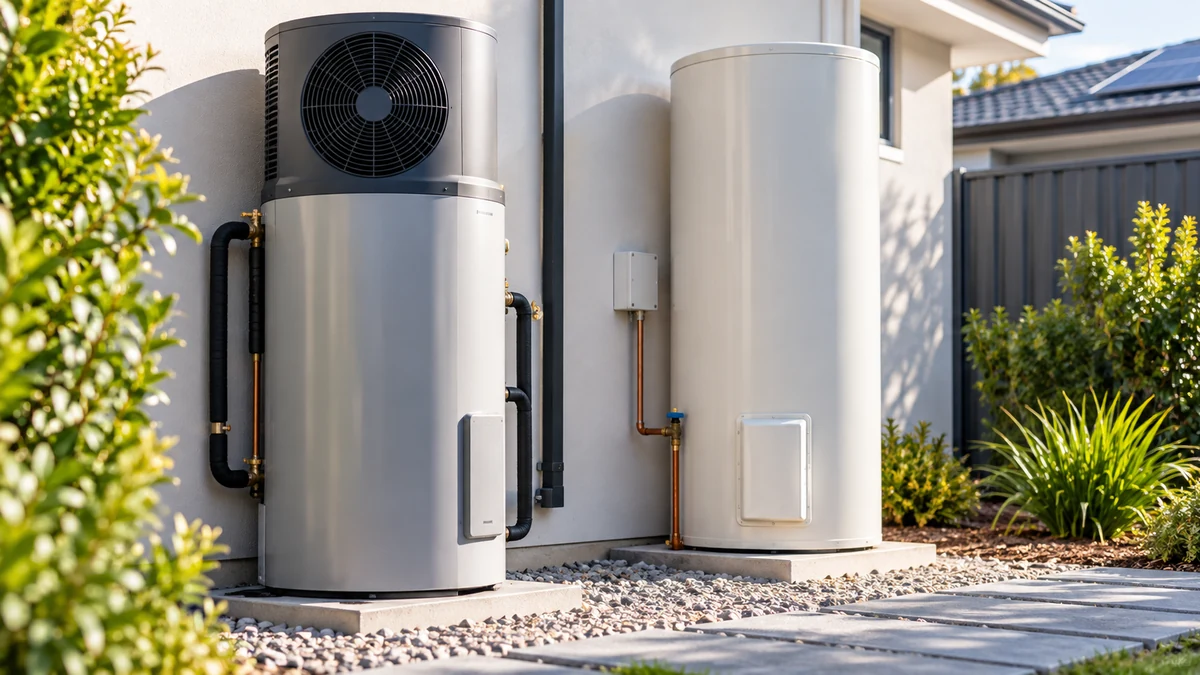
For most Australian homes that have a suitable installation location, a heat-pump water heater will use substantially less electricity than a conventional electric storage water heater to deliver the same amount of hot water. The trade-off is that a heat pump usually costs more upfront, needs suitable airflow and drainage, has a compressor and fan that make some noise, and its performance can change with climate and operating conditions.
The comparison is not simply “electric versus non-electric”: a heat pump is also an electric hot-water system. The real difference is how the electricity is used. A standard electric storage tank heats water directly with a resistance element, while a heat pump uses electricity to move heat from the surrounding air into the tank. Australian Government hot-water guidance says heat-pump water heaters use about 30% of the energy of a conventional electric hot-water system.
If you want to compare your own numbers, start with the HomeBillLab Hot Water Running Cost Calculator. Keep hot-water demand and temperature assumptions consistent, then change the system type, efficiency and tariff rather than comparing unrelated examples.
Table of Contents
Heat pump vs electric hot water Australia: the quick comparison
| Factor | Heat-pump hot water | Conventional electric storage |
|---|---|---|
| How it heats water | Transfers heat from surrounding air into the tank | Resistance element converts electricity directly into heat |
| Electricity use | Usually much lower for the same useful heat | Higher because the element supplies the heat directly |
| Upfront cost | Usually higher; incentives may reduce net cost | Usually lower and often simpler for like-for-like replacement |
| Climate sensitivity | Efficiency and recovery can vary with ambient conditions and model design | Less affected by outdoor air temperature at the heating element |
| Noise and airflow | Fan/compressor and airflow need suitable placement | No heat-pump fan or compressor |
| Tariff flexibility | Can benefit from suitable scheduling, time-of-use pricing or daytime solar where controls allow | Large storage units are often used with controlled-load/off-peak arrangements where available |
| Best fit | Households prioritising lower electricity use where the site and budget suit | Simple replacement, lower upfront budget, or situations where heat-pump placement is unsuitable |
This table is a decision framework, not a universal winner. Your household size, hot-water use, tank size, incoming-water temperature, climate, tariff, rooftop solar, installation constraints and quote can all change the result. The YourHome hot-water systems guide similarly recommends choosing a system that suits household size and climate rather than selecting on technology name alone.
Why a heat pump can use much less electricity
A resistance element works like a large kettle element. Electricity is converted directly into heat inside the tank. A heat pump instead runs a refrigeration cycle: its compressor, fan and heat exchanger collect heat from the surrounding air and transfer that heat into the stored water.
The useful concept is coefficient of performance, or COP. A COP of 3.5 means that, under the conditions represented by that figure, 1 kWh of electricity moves enough heat to provide about 3.5 kWh of heat to the water. YourHome notes that heat-pump COP can vary substantially with ambient air temperature, starting-water temperature and test conditions, and gives a broad COP range of around 3–5 for heat-pump water heaters. It also notes that a booster element, where fitted, adds electricity use that is not captured by the heat-pump COP alone.
That is why the same litre figure can produce very different electricity use. The physics of the water does not change; the system changes how much purchased electricity is needed to supply the required heat.
Worked running-cost comparison
Use a like-for-like hot-water load. The basic thermal energy needed to raise water temperature is:
Thermal energy (kWh) = litres × 4.186 × temperature rise (°C) ÷ 3,600
For an illustrative household using 200 litres of hot water per day with a 45°C temperature rise, the useful thermal requirement is about 10.47 kWh per day. This is deliberately an example, not a recommended household consumption figure.
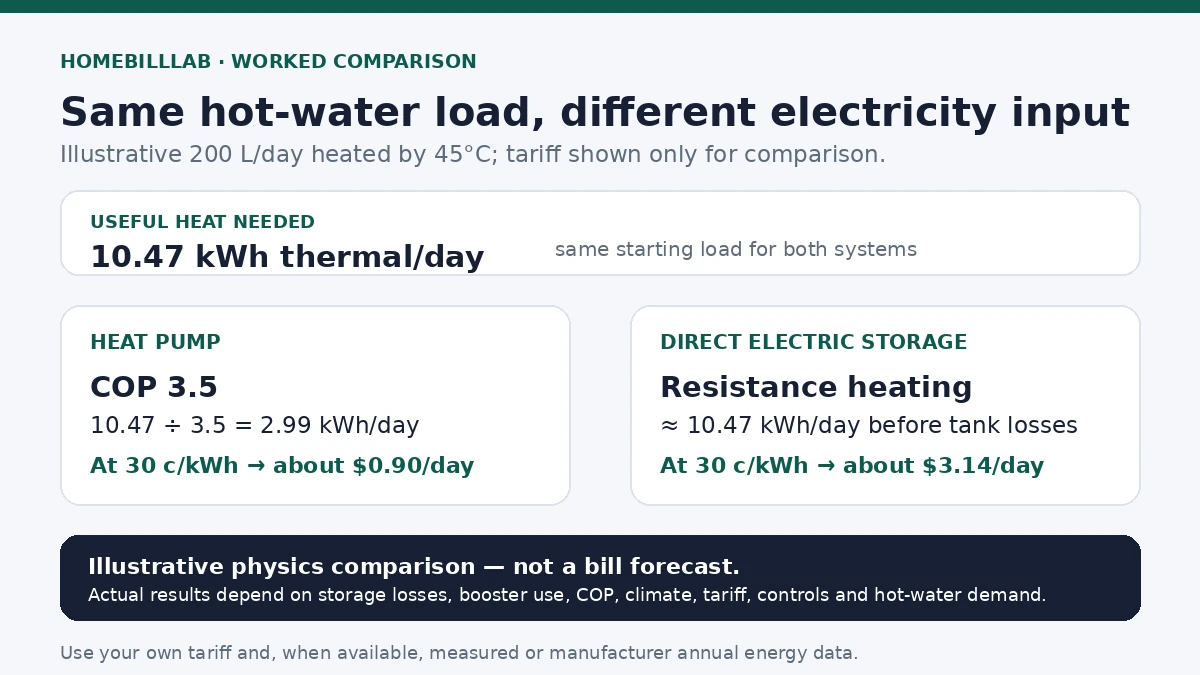
With an illustrative heat-pump COP of 3.5, 10.47 ÷ 3.5 = about 2.99 kWh of electricity before allowing for additional losses or booster operation. At an illustrative 30 c/kWh tariff, that is about $0.90 per day.
For a simplified direct-resistance comparison, supplying 10.47 kWh of useful heat requires roughly 10.47 kWh of electricity at the element before tank and distribution losses. At the same illustrative 30 c/kWh tariff, that is about $3.14 per day. The comparison therefore shows the effect of the heating method while holding hot-water demand and tariff constant.
Do not turn those numbers into a guaranteed annual saving. Real storage losses, pipe losses, thermostat control, heat-pump COP, booster use, maintenance, seasonal temperatures and user behaviour can all change actual consumption. When you have a reliable annual kWh figure from monitoring, a product document or another appropriate source, comparing annual energy use can be more useful than modelling every litre. See the HomeBillLab Methodology for how we separate measured inputs from illustrative assumptions.
Electric storage can still compete on tariff and simplicity
Lower energy use does not automatically mean every heat pump has the lowest total cost for every household. Conventional electric storage is mechanically simpler and often cheaper to buy. If you are replacing a failed electric tank with a similar unit, the installation pathway may also be more straightforward than changing technology, although site-specific electrical and plumbing work still matters.
Electric storage can also use cheaper electricity where a suitable controlled-load or off-peak arrangement exists. Energy.gov.au notes that electric storage systems can be switched to an off-peak tariff so the water is heated when the applicable electricity price is lower. This changes the cost per kWh, not the amount of electricity needed to heat the water.
For example, an electric storage system using 10 kWh in a day at 20 c/kWh costs $2.00 for that energy, while the same 10 kWh at 35 c/kWh costs $3.50. Those rates are hypothetical. Your actual controlled-load and general-use rates come from your plan and can vary by retailer, network and location. The separate electric hot-water running cost guide explains how to calculate this without assuming one Australian tariff.
Solar can change the comparison — but solar electricity is not automatically free
Rooftop solar can improve the economics of either electric technology when the system can operate during periods of surplus generation. A heat pump needs fewer kWh for the same useful heat, so it can require a smaller amount of solar energy to cover a similar hot-water load. A conventional electric storage tank can also be scheduled or controlled to absorb daytime solar where the equipment and electrical arrangement support it.
The correct comparison is not “solar equals zero cost”. If surplus solar would otherwise be exported for a feed-in credit, using it for hot water gives up that export value. If the household would otherwise import electricity, self-consumption can avoid the relevant retail usage charge. Treat the difference between those values as an economic input rather than assuming every self-consumed kWh has no value.
Also separate timing from efficiency. A heat pump running at a favourable tariff can have both an energy-efficiency advantage and a price-per-kWh advantage. An electric tank on a controlled load may have a lower tariff than a heat pump on a general-use rate. Model the two factors independently so you can see which one is driving the result.
Climate, noise and installation location matter more for a heat pump
Heat pumps need access to surrounding air because that air is the heat source. The compressor and fan also create noise, and the unit produces condensate that must be managed by the installation. Energy.gov.au advises that not every model is designed for cold locations where winter temperatures regularly fall below 5°C. That does not mean heat pumps cannot work in colder Australian climates; it means model selection and cold-weather performance need to match the site.
The Australian Government’s Energy Rating water-heating guidance similarly says households in cold climates should choose a heat pump designed for those conditions. Compare manufacturer performance information under relevant test conditions, not only a headline COP measured under favourable conditions.
Placement can therefore be a genuine decision factor. A conventional electric tank does not need a heat-pump fan and compressor, which may make it easier where airflow, noise sensitivity or physical clearance is difficult. Conversely, if there is a suitable outdoor or ventilated location, the heat pump’s lower electricity use may outweigh that added installation complexity.
Tank size, recovery and booster use
Both systems need enough stored hot water and recovery capacity for the household’s demand. A tank that is too small can run out; a system that is oversized may increase standing losses or upfront cost. Do not use household headcount alone as a final sizing rule. Shower flow, bath use, appliance use, timing and climate all matter.
A heat pump may include an electric resistance booster to help meet high demand, cold-weather operation or recovery requirements. When the booster runs, part of the system behaves more like conventional direct electric heating and electricity use can rise. Ask how the proposed model controls its compressor and booster, and how its recovery performance changes under local conditions.
For a detailed energy-only estimate, our existing heat-pump hot-water running cost guide shows how litres, temperature rise and COP feed into the calculation. Use known annual kWh instead if you have reliable real-world data.
Upfront cost, STCs and rebates
Heat-pump systems generally cost more to purchase and install than basic electric storage, so the decision should compare net installed cost as well as annual running cost. Do not use a generic “rebate” amount in the comparison because support depends on the product, location, installation date and program rules.
Eligible air-source heat-pump water heaters can participate in the federal Small-scale Renewable Energy Scheme. The Clean Energy Regulator’s solar water heater and air-source heat-pump guidance explains the system category, while the current register and certificate rules determine whether a particular model and installation qualify. Most households use a registered agent and receive the STC value as an upfront discount rather than creating certificates themselves.
State and territory support can change as well. For example, the Australian Government rebate directory currently links to a Victorian hot-water rebate for eligible heat-pump or solar hot-water systems. That does not mean the same support exists nationally. Check the current official program for your location and confirm eligibility before treating any amount as part of the purchase price.
HomeBillLab keeps changing support information separate from evergreen system physics. Use the Australian home energy rebates finder to locate current official programs, then enter only a confirmed quote and confirmed support amount into the Energy Rebate & Upgrade Cost Calculator.
What about electric instantaneous and gas hot water?
This guide uses “electric hot water” to mean conventional electric storage because that is the closest like-for-like comparison with a storage heat pump. Electric instantaneous water heaters are different: they heat water on demand, avoid tank standing losses and can require very high electrical input. YourHome notes that larger instantaneous units can require three-phase supply and may be exposed to the tariff applying at the exact time hot water is used.
Gas is another separate comparison. If you are replacing gas, include gas disconnection or meter implications, new electrical work, ventilation changes and the future use of other gas appliances. Do not choose a hot-water system from fuel price alone; compare the whole installed and operating arrangement.
Which system is likely to suit you?
A heat pump is usually the stronger energy-efficiency choice when you have a suitable location, can afford the net installed cost, and want to reduce electricity consumption for water heating. It becomes especially attractive when a household has significant hot-water demand or can operate the system at favourable times without compromising the manufacturer’s requirements.
Conventional electric storage can still make sense when the main priority is a simple, lower-upfront-cost replacement, when the site is unsuitable for a heat-pump unit, or when the household has low hot-water demand and an advantageous controlled-load arrangement. The correct answer is the one that survives your own calculation, quote and site constraints.
- Choose heat pump to investigate first if lower electricity use is a priority and airflow, noise, climate and budget suit the installation.
- Keep electric storage in the comparison if upfront simplicity, an existing controlled load or difficult heat-pump placement materially changes the decision.
- Use measured or documented annual kWh when available rather than relying only on generic household examples.
- Compare net installed cost after confirmed support, not an advertised rebate headline.
FAQ about Heat Pump vs Electric Hot Water Australia
Is a heat pump cheaper to run than electric hot water?
It often uses much less electricity than conventional electric storage for the same useful hot-water load, so it can have lower running costs. The actual dollar difference depends on COP, booster use, storage losses, tariff, hot-water demand and timing.
Does a heat pump use electricity?
Yes. It uses electricity to run the compressor, fan and controls, but it transfers heat from surrounding air instead of supplying all heat directly with a resistance element.
Can electric storage be cheaper if it uses off-peak electricity?
A lower controlled-load tariff can reduce the cost of each kWh used by an electric storage system. It does not make the resistance element more energy efficient, so compare both energy use and tariff rather than only one of them.
Are heat pumps suitable in cold parts of Australia?
They can be, but model selection matters. Check the product’s cold-weather operating range, performance data and recovery capability for your climate instead of assuming every heat pump behaves the same way.
Do rebates make a heat pump automatically the better buy?
No. Incentives can reduce upfront cost, but eligibility and values change. Compare the confirmed net installed price, expected energy use, household demand, maintenance considerations and the period you expect to keep the system.
Compare your own hot-water numbers
The most defensible heat pump vs electric hot water Australia comparison starts with the same hot-water demand and then changes only the system efficiency, tariff and operating assumptions you actually want to test. Use the Hot Water Running Cost Calculator, then browse the Hot Water hub for the system-specific guides behind the comparison.
For product selection, installation, electrical and plumbing requirements, use a licensed professional and the current manufacturer instructions. HomeBillLab provides calculation and comparison information; it does not determine compliance, system sizing or rebate eligibility.
Reviewed: 10 September 2026. Review cadence: quarterly review of official hot-water guidance, tariff examples and incentive links; sooner after material program or standards changes. Next scheduled editorial review: December 2026.