A dishwasher running cost USA estimate is easiest to calculate from the energy used for one cycle or from the annual kWh shown for the specific model. The basic electricity calculation is simple, but the result still depends on the cycle selected, drying method, how often the machine runs and the electricity price that applies to your home.
Using the latest U.S. Energy Information Administration residential benchmark of 18.31¢/kWh for July 2026, a dishwasher cycle that uses 0.8 kWh would cost about $0.15 in electricity, while a 1.2 kWh cycle would cost about $0.22. These are calculation examples rather than typical values for every dishwasher. For a household-specific estimate, enter your model’s kWh per cycle or annual kWh into the HomeBillLab U.S. Appliance Running Cost Calculator.
Table of Contents
How much does a dishwasher cost per cycle?
If you know the energy used for one completed cycle, use:
kWh per cycle × electricity rate in dollars per kWh = electricity cost per cycle
EIA’s July 2026 state electricity-price table reports a U.S. residential average of 18.31 cents per kWh. Converted to dollars, that is $0.1831/kWh. The examples below show how energy use changes the electricity portion of dishwasher running cost at that benchmark.
| Electricity per cycle | Cost per cycle at 18.31¢/kWh | Annual cost at 5 cycles/week |
|---|---|---|
| 0.5 kWh | $0.09 | About $23.80 |
| 0.8 kWh | $0.15 | About $38.08 |
| 1.0 kWh | $0.18 | About $47.61 |
| 1.2 kWh | $0.22 | About $57.13 |
| 1.5 kWh | $0.27 | About $71.41 |
Your own rate can be much lower or higher than the U.S. average because electricity prices vary by state, utility and rate plan. Use the rate on your bill whenever possible. The HomeBillLab U.S. electricity cost per kWh guide explains how to translate cents per kWh into appliance cost.
Use annual kWh when you have an EnergyGuide label
The yellow EnergyGuide label is usually a better starting point than nameplate watts when you are comparing dishwasher models. The Federal Trade Commission’s Energy Labeling Rule covers dishwashers and requires estimated annual energy information and operating-cost context so consumers can compare similar products.
ENERGY STAR’s current dishwasher guidance likewise recommends checking the EnergyGuide label to compare energy use and estimate annual operating cost. The label’s dollar figure is based on standardized assumptions, so it is not a utility quote. If the annual kWh is available, multiply that figure by your own local electricity price for a more household-specific electricity estimate.
For example, 200 kWh/year at 18.31¢/kWh equals about $36.62 per year in electricity. At 240 kWh/year, the same rate gives about $43.94 per year. If your local electricity price is 30¢/kWh, those same annual energy figures become $60 and $72 per year. This is why the same dishwasher can have a different running cost in different parts of the country.
What current ENERGY STAR dishwasher criteria mean
ENERGY STAR’s current dishwasher criteria, effective July 19, 2023, set maximum qualification levels for standard models of 240 kWh/year and 3.2 gallons per cycle. Compact certified models are limited to 155 kWh/year and 2.0 gallons per cycle. These are certification limits, not claims that every certified dishwasher uses exactly those amounts.
The same criteria page explains that dishwashers use energy to operate the machine, heat water and dry dishes. It also states that the DOE test method uses an average of 215 cycles per year. That standardized framework helps compare products, while your actual household use can differ because of cycle selection, soil level, drying settings, water temperature and how often you run the machine.
Why heated drying can change running cost
Drying is one of the parts of a dishwasher cycle that can materially affect energy use. Some models use an electric heating element, while others rely more on condensation, fan-assisted drying or automatic door opening. ENERGY STAR notes that shoppers can look for models that allow heated dry to be turned off and that cycle options can help match energy and water use to the load.
For your own machine, the most useful comparison is to measure or compare complete cycles rather than trying to estimate drying cost from one component’s wattage. A normal cycle with heated dry and the same cycle with a no-heat option may have different total kWh even though the wash portion is similar.
Run full loads when practical
ENERGY STAR says dishwashers use about the same amount of energy and water regardless of the number of dishes inside, so running fuller loads generally makes better use of each cycle. That does not mean overloading the racks; dishes still need correct placement so spray arms can reach them and so the machine can clean effectively.
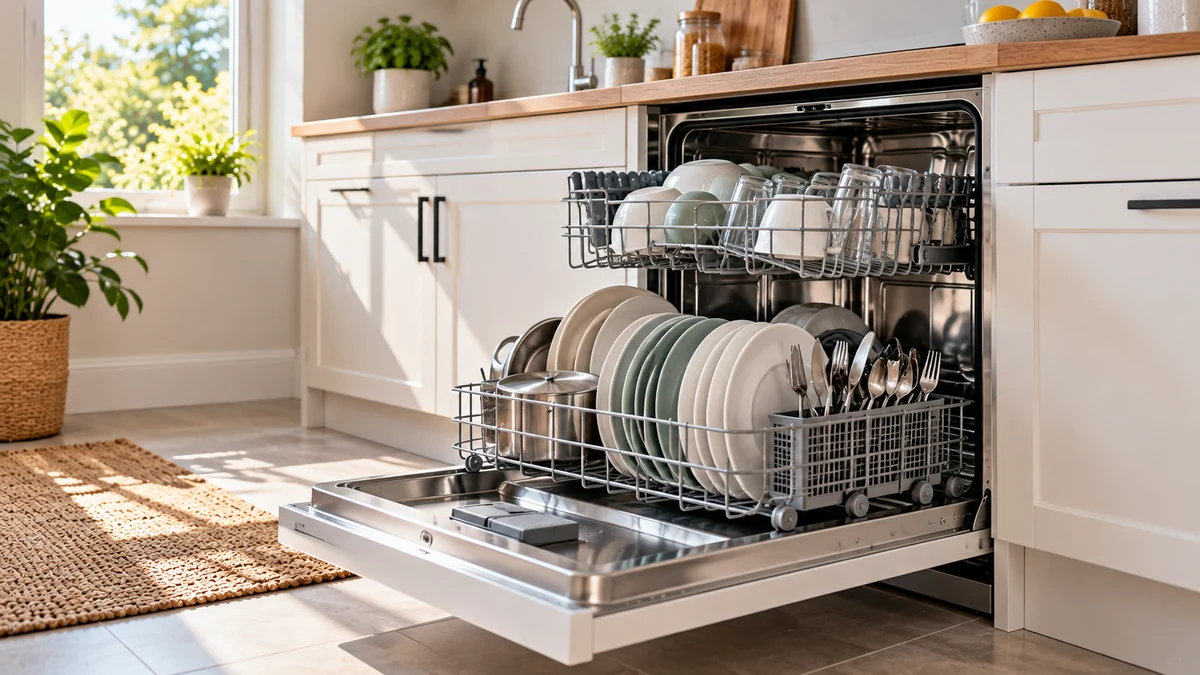
If a household runs two half-full cycles where one properly loaded cycle would have been enough, the annual number of cycles rises and so does electricity and water use. Frequency therefore matters just as much as the cost of one cycle when you estimate yearly dishwasher running cost.
Do you need to pre-rinse dishes?
ENERGY STAR recommends scraping food from dishes rather than rinsing them under the faucet before loading. Modern dishwashers and detergents are designed to do the washing, and pre-rinsing adds water use and can also add water-heating energy if hot tap water is used.
This matters because the dishwasher’s electricity cost is only one part of total dishwashing utility cost. Municipal water and sewer charges vary by location, and pre-rinsing at the sink creates water use that will not appear in the dishwasher’s own annual kWh figure.
Why nameplate watts are not the best shortcut
A dishwasher does not usually draw one constant power level for the whole cycle. Pumps, controls and heaters switch on and off at different stages. Multiplying a maximum wattage by the full cycle time can therefore overstate or misrepresent actual energy use.
The U.S. Department of Energy maintains the federal consumer dishwasher test procedure and efficiency standards used for regulated residential products. Standardized annual energy data from that testing framework is generally more useful for model comparison than a single maximum wattage printed on a rating plate.
How cycle choice can affect energy use
Normal, auto, heavy, quick and eco-style cycles can use different amounts of water, heat and drying energy. A heavily soiled load may need more wash time or hotter water, while an auto-sensing cycle can adjust operation based on soil level. ENERGY STAR specifically highlights soil sensors and multiple cycle options as features that can help match the wash to the load.
When comparing your own cycles, keep the electricity rate the same and record the kWh used for each completed cycle if you have reliable measured data. For purchase comparisons, use the standardized annual energy figure rather than assuming that a shorter cycle must always be the cheapest.
Estimate yearly dishwasher cost from weekly use
If you know kWh per cycle, annual electricity is:
kWh per cycle × cycles per week × 52 = annual kWh
| Example usage | Cycles per year | Annual energy at 0.8 kWh/cycle | Annual cost at 18.31¢/kWh |
|---|---|---|---|
| 3 cycles/week | 156 | 124.8 kWh | $22.85 |
| 5 cycles/week | 260 | 208.0 kWh | $38.08 |
| 7 cycles/week | 364 | 291.2 kWh | $53.32 |
| 10 cycles/week | 520 | 416.0 kWh | $76.17 |
The 0.8 kWh figure is an example only. Use your model’s annual kWh or measured kWh per cycle whenever possible. If you already have annual kWh, you do not need to estimate weekly cycle frequency unless you want to adjust a standardized figure to your household’s usage.
Does dishwasher running cost include water?
Not in the HomeBillLab appliance electricity calculation. Water and sewer prices vary by local utility, and some homes use wells or septic systems. Keep those charges separate so the energy calculation remains transparent. If you are comparing two dishwasher models, however, gallons per cycle can still be an important operating-cost and resource-use metric.
For other appliance costs, use the U.S. Appliances hub. The separate washing machine running cost guide covers laundry washing, while the dryer running cost guide covers the drying stage. Keeping each appliance separate avoids hiding one device’s cost inside another.
Ways to reduce dishwasher energy use
- Run full loads when practical instead of many lightly loaded cycles.
- Scrape food off dishes rather than pre-rinsing under running water.
- Use a no-heat or lower-energy drying option when it gives acceptable results.
- Choose a cycle that matches the soil level rather than defaulting to the most intensive program.
- When replacing a dishwasher, compare annual kWh and gallons per cycle on EnergyGuide and ENERGY STAR information.
The general rule is the same as for other HomeBillLab calculations: reduce the physical quantity of energy or water used, then apply the rate that actually applies to your household. See the HomeBillLab Methodology for how example rates, formulas and source updates are handled.
Dishwasher running cost USA FAQs
How much does one dishwasher cycle cost?
Multiply the cycle’s kWh by your electricity rate. At 18.31¢/kWh, 0.8 kWh costs about $0.15 and 1.2 kWh costs about $0.22. Use model-specific energy data for your own estimate.
Is the EnergyGuide yearly cost exact?
No. It is a standardized comparison estimate. Your electricity price, cycle frequency and settings can make your actual cost different. Annual kWh from the label is useful because you can multiply it by your own rate.
Does heated dry use more electricity?
It can. Drying method is one factor in dishwasher energy use, and ENERGY STAR recommends looking for the option to turn off heated drying when appropriate.
Should I use the U.S. average electricity price?
Use it only as a benchmark. For a household-specific dishwasher running cost USA estimate, the electricity rate on your own bill is the better input because rates vary substantially across states and utilities.