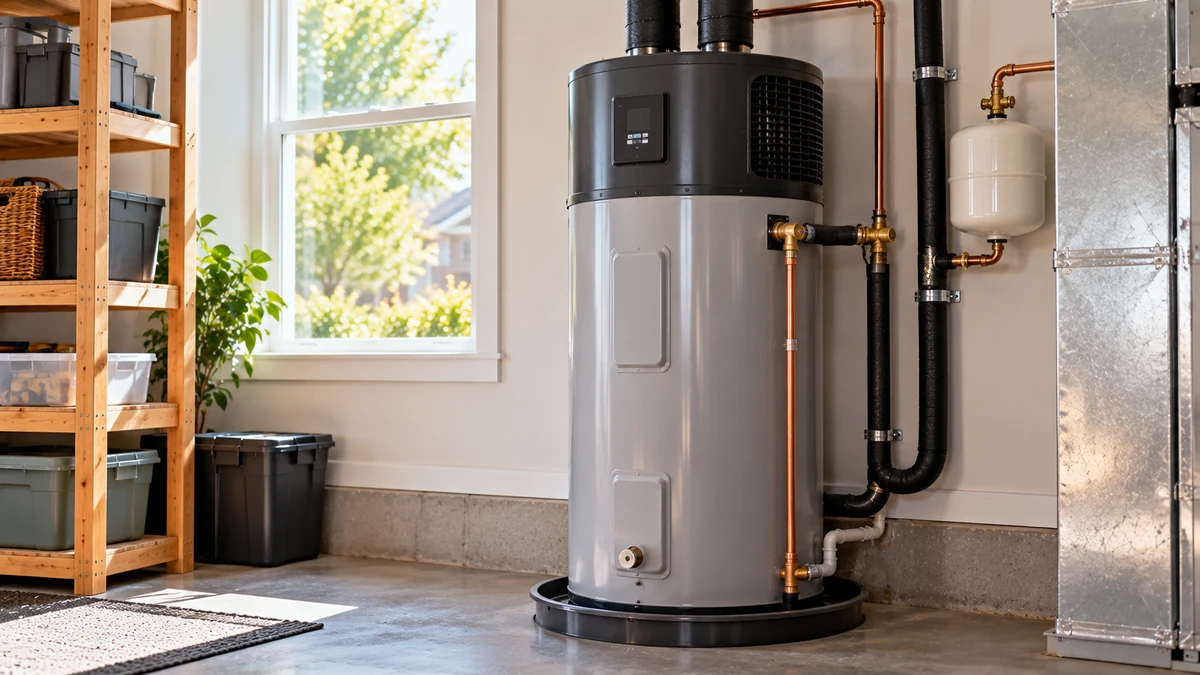
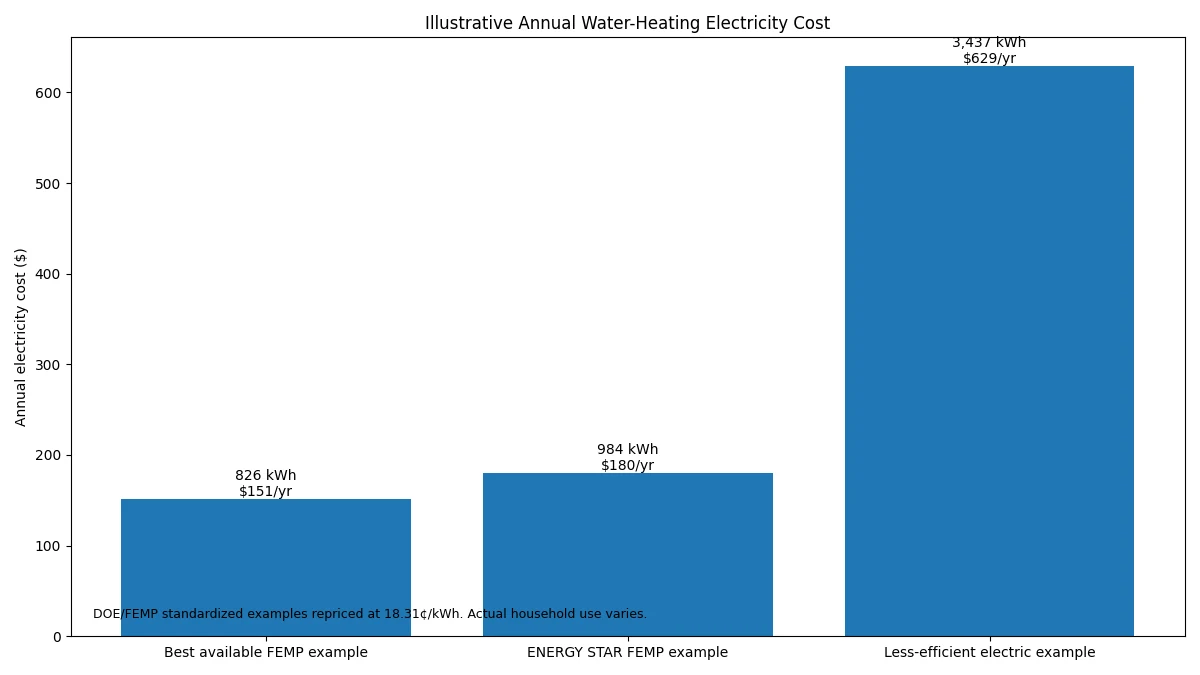
Heat pump water heater running cost USA is usually much lower than the cost of a standard electric-resistance tank because the unit moves heat into the water instead of creating all of the heat directly with resistance elements. DOE/FEMP’s standardized residential water-heater examples list 984 kWh/year for an ENERGY STAR heat pump water heater, 826 kWh/year for a best-available example, and 3,437 kWh/year for a less-efficient conventional electric storage example.
At the U.S. Energy Information Administration’s July 2026 residential average electricity price of 18.31¢/kWh, those standardized examples work out to about $180/year for the ENERGY STAR heat pump example, $151/year for the best-available example, and $629/year for the less-efficient electric-storage example.
Your real bill can differ because hot-water demand, tank size, ambient temperature, operating mode, incoming water temperature and backup resistance use all matter. Use the HomeBillLab U.S. Hot Water Running Cost Calculator with your own kWh or equipment assumptions.
Table of Contents
Heat pump water heater running cost USA: quick answer
DOE/FEMP’s current residential water-heater purchasing guidance provides a useful standardized benchmark. Its ENERGY STAR heat-pump-water-heater example uses 984 kWh/year, while its best-available example uses 826 kWh/year. The comparison is based on the DOE test method and a water-heating load of 20,075 gallons per year.
| DOE/FEMP example | Annual electricity | Cost at 18.31¢/kWh | Monthly equivalent |
|---|---|---|---|
| Best available HPWH | 826 kWh/year | $151.24/year | $12.60/month |
| ENERGY STAR HPWH | 984 kWh/year | $180.17/year | $15.01/month |
| Less-efficient electric storage | 3,437 kWh/year | $629.31/year | $52.44/month |
How much does a heat pump water heater cost per day and month?
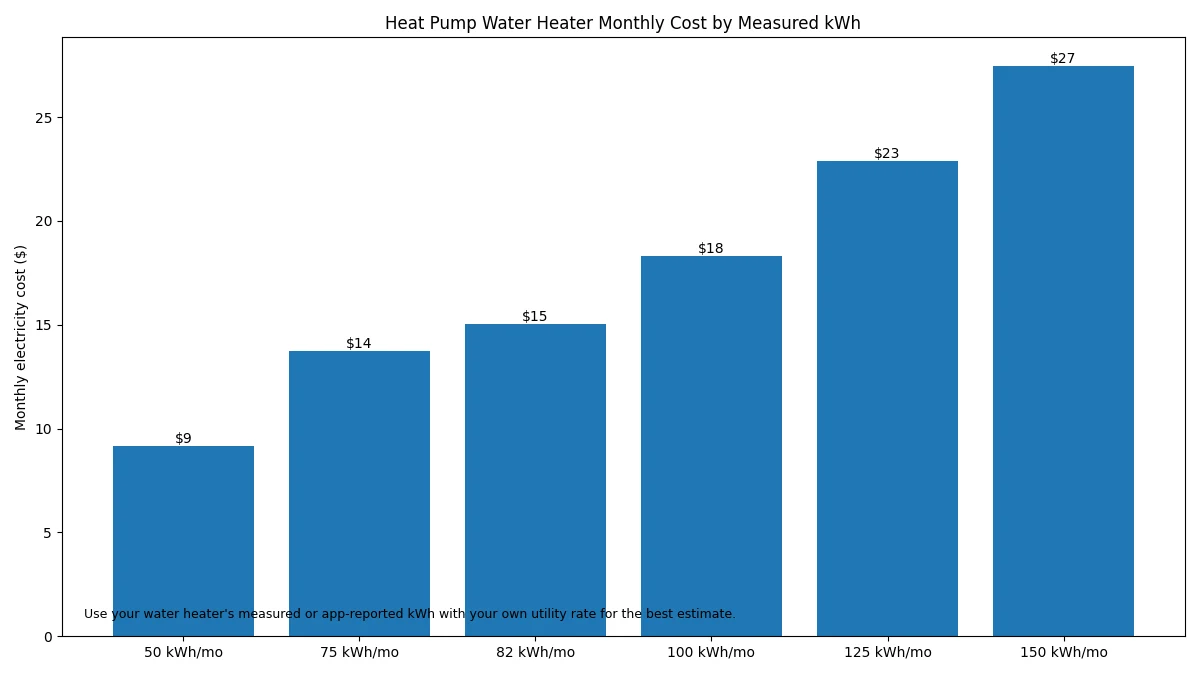
If a heat pump water heater uses 984 kWh/year, the simple annual average is about 2.70 kWh/day. At 18.31¢/kWh, that equals about $0.49/day, $15.01/month, or $180.17/year.
Do not expect every month to be identical. Winter incoming-water temperatures can be lower, household hot-water use can change, and some heat pump water heaters use more backup resistance heat during high-demand periods.
The best monthly formula is simply measured kWh × your electricity price. For example, 100 kWh in a month costs about $18.31 at 18.31¢/kWh.
Why heat pump water heaters use less electricity
ENERGY STAR’s heat pump water heater explanation describes the basic idea: a heat pump water heater moves heat from the surrounding air into the tank rather than generating all of the heat directly. It works more like a refrigerator in reverse.
That is why one kWh of electrical input can move more than one kWh-equivalent of heat into the water. The compressor, fan and controls still use electricity, and many hybrid models also include conventional electric resistance elements for high-demand or backup operation.
UEF: the main efficiency number to compare
Uniform Energy Factor, or UEF, is the current standardized water-heater efficiency metric. Higher is better. ENERGY STAR’s current residential water-heater criteria require an integrated heat pump water heater to reach UEF ≥3.30. Integrated 120-volt/15-amp models and split-system heat pump water heaters have a current ENERGY STAR threshold of UEF ≥2.20.
UEF is useful for comparing models tested under the same draw pattern, but it is not a direct promise of your annual bill. Tank size, first-hour rating and how frequently backup resistance operates also matter.
Operating mode can change heat pump water heater running cost
Hybrid heat pump water heaters often have several modes. ENERGY STAR notes that an efficiency or economy mode maximizes heat-pump operation, while an electric/heater mode uses the resistance element and is the least energy-efficient setting. Auto or hybrid modes balance efficiency with faster hot-water recovery.
If a household frequently outruns the heat-pump recovery rate, the unit can call on resistance heat more often. That can push actual annual kWh above a simple heat-pump-only expectation.
Installation location can affect electricity use
ENERGY STAR’s current buying guidance recommends interior locations that stay roughly between 40°F and 90°F year-round and provide about 1,000 cubic feet of surrounding air space. Colder locations can reduce heat-pump efficiency and may increase backup resistance use.
The unit also cools and dehumidifies the surrounding space while it runs. A basement, utility room or garage can be a good location if the model’s installation requirements are met. Always follow the manufacturer-specific airflow and temperature limits.
Household size and hot-water use matter more than tank wattage
Annual hot-water demand is a major driver of cost. More showers, larger households, high-flow fixtures, frequent laundry and long hot-water draws increase the amount of energy the tank must deliver.
This is why the DOE/FEMP 984 kWh/year figure should be treated as a standardized comparison point rather than a universal household forecast. A low-use household can come in below it; a high-use household can be well above it.
How to estimate your real heat pump water heater cost
- Best: use kWh reported by the water heater, circuit monitor or compatible energy monitor.
- Second best: use annual kWh from the EnergyGuide label and multiply by your local electricity rate.
- For planning: use a standardized benchmark such as the DOE/FEMP 984 kWh/year ENERGY STAR example.
- For time-of-use tariffs: account for when the heater reheats water, not just total kWh.
The EIA’s July 2026 Electric Power Monthly summary reports a U.S. residential average price of 18.31¢/kWh. Your state or utility rate can be very different, so repricing annual kWh is important.
Heat pump vs standard electric water heater running cost
Using the DOE/FEMP standardized examples at the same 18.31¢/kWh electricity rate, 984 kWh/year costs about $180, while 3,437 kWh/year costs about $629. The difference is approximately $449/year in this specific standardized comparison.
For the dedicated side-by-side analysis, see Heat Pump Water Heater vs Electric Water Heater. For conventional electric-tank costs, see Electric Water Heater Running Cost USA. For current state and utility incentive programs, see Heat Pump Water Heater Rebates USA.
HomeBillLab’s approach to electricity prices, standardized efficiency data and running-cost examples is documented in the HomeBillLab Methodology. Browse the U.S. Hot Water hub for related guides.
Heat pump water heater running cost USA FAQ
How much does an ENERGY STAR heat pump water heater cost to run?
DOE/FEMP’s standardized ENERGY STAR example uses 984 kWh/year. At 18.31¢/kWh, that is about $180/year, or roughly $15/month. Actual household use varies.
Does a heat pump water heater run all the time?
No. It cycles to maintain tank temperature and recover after hot-water draws. Compressor, fan and backup resistance runtime depend on demand and control mode.
Why does my heat pump water heater use more electricity in winter?
Colder surrounding air and colder incoming water can increase the work required, and some systems may use more backup resistance heat during colder or high-demand periods.
Is UEF 3.3 good for a heat pump water heater?
Yes. UEF 3.30 is the current ENERGY STAR threshold for standard integrated heat pump water heaters. Some models exceed it.
Bottom line
For heat pump water heater running cost USA, annual kWh is the most useful number. DOE/FEMP’s standardized ENERGY STAR example uses 984 kWh/year, which costs about $180/year at the July 2026 national residential average of 18.31¢/kWh. Your actual cost will depend on hot-water use, operating mode, installation temperature and local electricity price. Use the U.S. Hot Water Running Cost Calculator with your own numbers.