
How much does a clothes dryer cost to run in Australia? The answer depends on the electricity used by each drying cycle, how many loads you dry and the usage rate on your electricity bill. Calculate one load first, then extend that result to your weekly or annual routine.
Quick answer: at an illustrative tariff of 32c/kWh, a cycle using 1.5kWh costs about $0.48. A 3kWh cycle costs $0.96, while a 5kWh cycle costs $1.60. These are transparent energy-use scenarios, not averages for heat-pump, condenser or vented dryers.
Enter the dryer’s cycle energy or a measured average into the Appliance Running Cost Calculator. Use the tariff from your own plan and test different weekly schedules rather than relying on one national price.
Clothes dryer running cost per load: examples
The table holds the tariff at 32c/kWh. Weekly and annual columns assume three drying loads per week, or 156 cycles per year.
| Energy per cycle | Cost per load | Cost for 3 loads | Cost for 156 loads |
|---|---|---|---|
| 1.5kWh | $0.48 | $1.44 | $74.88 |
| 3.0kWh | $0.96 | $2.88 | $149.76 |
| 5.0kWh | $1.60 | $4.80 | $249.60 |
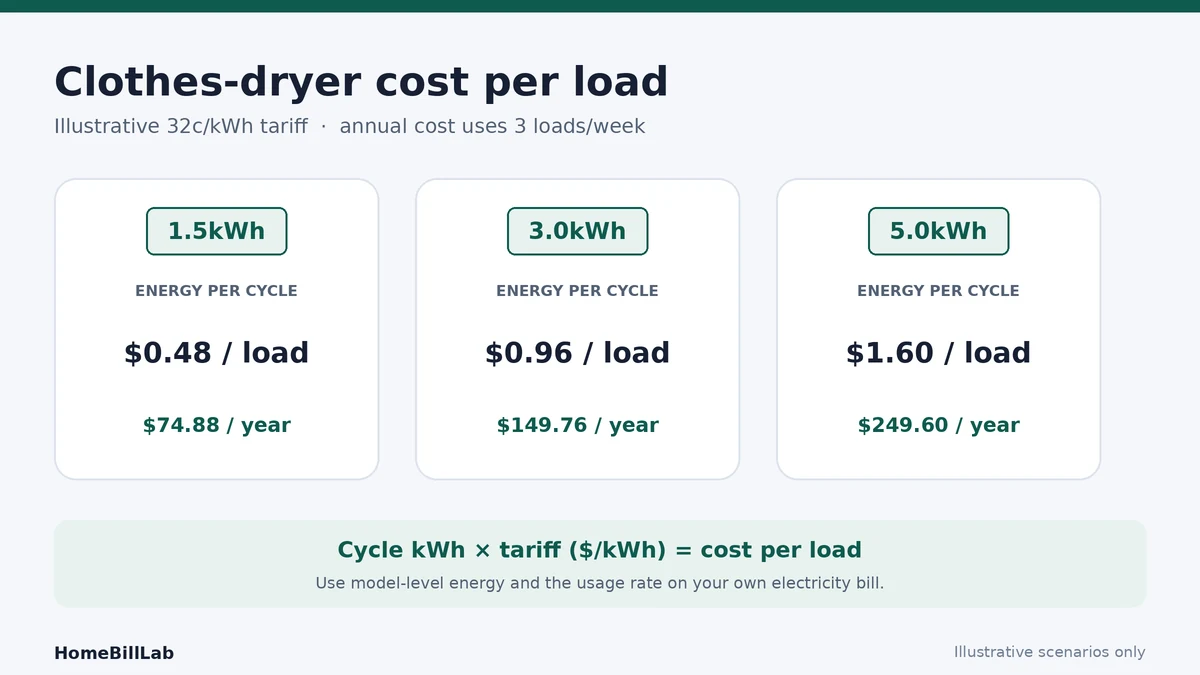
Do not assign the first row automatically to a heat-pump dryer or the last row to a vented dryer. Real models, capacities, programs and loads vary. Use model-level information when estimating clothes dryer running cost.
How to calculate clothes dryer running cost
The basic formula is:
Cost per load = cycle energy (kWh) × electricity tariff ($/kWh)
If a cycle uses 3kWh and the tariff is 32c/kWh, convert 32 cents to $0.32 and multiply: 3kWh × $0.32 = $0.96 per load. At four loads per week, that becomes $3.84 per week and about $199.68 across 52 weeks.
This calculation follows the transparent approach in the HomeBillLab Methodology. Keep cycle kWh, loads, tariff and time period visible so another person can reproduce the estimate.
How to use the Energy Rating Label correctly
The annual energy-consumption number on an Energy Rating Label is based on standardised testing. The official Energy Rating Label guide states that the clothes-dryer calculation assumes one full load per week. It also says the usage assumption appears on the label.
That detail matters. If the label says 208kWh per year under the one-load-per-week assumption, the implied standardised energy per load is:
- 208kWh ÷ 52 loads = 4kWh per labelled load.
- 4kWh × $0.32/kWh = $1.28 per load.
- Three similar loads per week: 4kWh × 156 = 624kWh per year.
- 624kWh × $0.32 = $199.68 per year.
This scaling is useful for planning, but it assumes your loads and selected program behave like the standardised test. Smaller loads, different fabrics, moisture levels and sensor-controlled stopping can change actual energy use.
Use the tariff from your own electricity bill
The Australian Energy Regulator explains that the variable electricity charge is shown in cents per kilowatt-hour. Its energy-bill guide also notes that one bill can contain different variable rates.
For a single-rate plan, use the general usage rate. For a time-of-use plan, use the peak, shoulder or off-peak rate that applies when the dryer is operating. Separate scenarios are clearer than a hidden blended rate.
Do not add the daily supply charge to clothes dryer running cost. That fixed account charge generally remains payable even if no drying cycle is run. The appliance comparison should focus on costs that change with its electricity consumption.
Cost per hour versus clothes dryer running cost per load
A cost-per-hour estimate can be useful when only input power and runtime are available, but it is not always the best way to compare dryers. Heating elements, compressors, fans and controls may not draw their maximum power for every minute of a cycle. A heat-pump dryer may also run longer while consuming less total electricity than a shorter conventional cycle.
If you know only rated input, calculate a clearly labelled scenario: input kW × cycle hours × tariff. Do not present that result as measured cycle energy unless the power figure represents a realistic operating average. When a trustworthy kWh-per-cycle or annual label figure is available, use that for clothes dryer running cost instead.
Cost per load also makes different cycle lengths easier to compare. A two-hour cycle using 2kWh costs less than a one-hour cycle using 3kWh at the same tariff, despite taking longer. Electricity bills charge for kWh, not simply the number of minutes the appliance is switched on.
Vented vs condenser vs heat-pump dryer costs
Dryer type influences how heat and moisture are handled, but the type name alone does not give a reliable dollar figure.
- Vented dryer: heats air and exhausts warm, moist air. Check installation and ventilation requirements carefully.
- Condenser dryer: condenses moisture into a container or drain rather than venting it outdoors. Model efficiency varies.
- Heat-pump dryer: recovers and reuses heat within the drying process. These models often have higher purchase prices but can use substantially less electricity than conventional dryers.
- Washer-dryer combination: use the energy information for the drying function and the selected cycle; washing and drying costs should not be confused.
The official Energy Rating dryer information says heat-pump dryers are much less expensive to operate and recommends auto-sensors that avoid over-drying. It also states that every additional dryer star cuts running cost by 15%. Apply that comparison to suitable models with similar capacity and features.
Use the Energy Rating Calculator for clothes dryers to compare registered models, customise uses per week and enter a relevant tariff. Its savings are indicative, so retain purchase price and real household use when assessing total cost.
What changes the energy used by one load?
- Water remaining after washing: wetter clothes require more drying work.
- Load size: a very small load may waste capacity, while overloading can restrict movement and extend drying.
- Fabric type: heavy towels retain a different amount of water from lightweight items.
- Program and temperature: cycle logic, target dryness and heat level influence consumption.
- Sensor performance: an automatic cycle can stop when the load reaches the selected dryness instead of running for a fixed extra period.
- Lint and airflow: a blocked filter or restricted airflow can affect operation and safety.
- Room and installation conditions: follow the manufacturer’s clearance, drainage and ventilation instructions for the dryer type.
- Maintenance: condenser units and heat-pump systems may have additional filters or components that require cleaning as directed.
Because these factors change from load to load, one cycle is not proof of a permanent clothes dryer running cost. A range based on light, normal and heavy loads is more honest than false precision.
Build low, middle and high annual scenarios
When future usage is uncertain, do not force one clothes dryer running cost into the budget. Build three scenarios using different cycle energy and load frequency. At the same illustrative 32c/kWh tariff:
- Low-use scenario: 1.5kWh × 1 load/week × 52 weeks = 78kWh, or $24.96 per year.
- Middle scenario: 3kWh × 3 loads/week × 52 weeks = 468kWh, or $149.76 per year.
- High-use scenario: 5kWh × 5 loads/week × 52 weeks = 1,300kWh, or $416.00 per year.
These scenarios deliberately combine different energy and frequency assumptions to show the possible range; they do not describe standard dryer types or Australian households. Replace both inputs with model and household information before making a purchase decision.
Seasonality can matter as well. A household may air-dry most loads during warm, dry periods and use the dryer more during wet weather. A yearly estimate based on the same number of loads every week can hide that pattern. Record expected loads by season if that produces a more realistic clothes dryer running cost.
Practical ways to reduce drying cost
- Use a high washer spin speed when suitable for the fabric so less water enters the dryer.
- Air-dry clothes when weather, space and household needs allow.
- Dry similar fabrics together so one item does not keep the whole load running.
- Use an automatic moisture-sensing program where available.
- Avoid running longer than needed or selecting an unnecessarily dry result.
- Clean the lint filter as directed and never operate the dryer with blocked airflow.
- Use a full but not overloaded drum, following the model’s capacity instructions.
- Compare off-peak and peak scenarios if your electricity plan uses time-of-use rates.
Australian Government tropical and sub-tropical household guidance recommends maximum washer spin before tumble drying, cleaning the lint filter after each load and considering medium heat, which takes longer but uses less energy. Follow garment labels and the dryer’s manual when choosing a program.
Should you pay more for an efficient dryer?
Compare purchase price and operating cost together. A household drying six loads every week has a different decision from one using a dryer only during occasional wet weather. Calculate each model with the same tariff, load frequency and comparison period.
For example, a difference of 2kWh per cycle equals $0.64 per load at 32c/kWh. At one load per week, that is $33.28 per year; at five loads per week, it is $166.40. These figures show why usage frequency affects payback, but they do not include purchase, repair or installation costs.
Australian Government appliance guidance recommends choosing efficient appliances that meet household needs and using the Energy Rating resources to compare models. Capacity and features should be matched first; efficiency is then compared among suitable choices.
Frequently asked questions
How much does a clothes dryer cost per load?
Multiply cycle energy in kWh by your tariff in dollars per kWh. At 32c/kWh, cycles using 1.5kWh, 3kWh and 5kWh cost about $0.48, $0.96 and $1.60 per load respectively.
How many dryer loads does the Energy Rating Label assume?
The current Australian Energy Rating guidance says the annual dryer calculation assumes one full load per week. Scale the label result cautiously if your household uses the dryer more or less often.
Are heat-pump dryers cheaper to run?
Official Energy Rating guidance says heat-pump dryers are much less expensive to operate. Compare actual annual kWh, capacity, features and purchase price for the specific models rather than relying only on the technology name.
Does a longer cycle always cost more?
Not necessarily. Cost depends on total kWh, not time alone. A lower-power heat-pump cycle may run longer while using less total electricity than a shorter high-power cycle.
Can solar make dryer use free?
On-site solar may reduce grid imports while the dryer runs, but “free” can ignore foregone feed-in credits and times when solar generation is insufficient. Compare self-consumed solar value, exports and grid electricity separately.
Bottom line
A useful clothes dryer running cost starts with kWh per cycle, actual loads per week and the tariff on your own bill. Use the Appliance Running Cost Calculator to compare low, middle and high scenarios. You can also compare this result with the fridge running-cost guide or browse the complete Appliances guide hub.
Reviewed: 22 August 2026. This guide provides transparent calculations and illustrative scenarios, not a quote or guarantee for a particular dryer, electricity plan or household.