Mini split running cost USA can range from only a few cents per hour at light load to several tenths of a dollar per hour when the system is working hard. The reason is simple: most modern mini-splits are variable-speed heat pumps. They do not draw one fixed amount of electricity every hour.
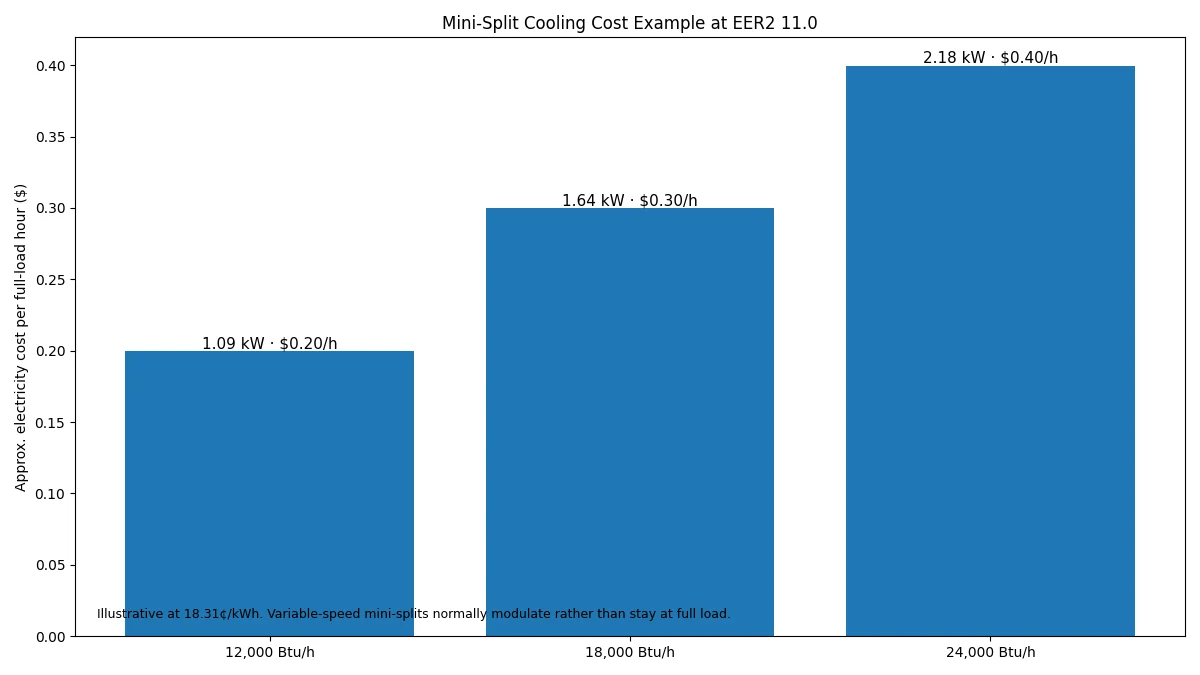
For a transparent 2026 reference, the U.S. Energy Information Administration reports a national residential electricity price of 18.31¢/kWh for July 2026. At that rate, a 12,000 Btu/h mini-split delivering cooling at an EER2 of 11.0 would require about 1.09 kW at the rating condition, or about $0.20 for one full-load hour. An 18,000 Btu/h example is about $0.30/hour and a 24,000 Btu/h example about $0.40/hour at the same EER2 and rate.
Those are full-load examples, not promises of continuous consumption. Inverter-driven mini-splits normally reduce compressor output once the room approaches the set temperature. For your own estimate, use the HomeBillLab U.S. Air Conditioner Running Cost Calculator with measured electrical input or the best model-specific power data you have.
Table of Contents
How much does a mini split cost to run per hour?
The most direct calculation is based on electrical input:
Hourly cost = electrical input in kW × electricity rate in $/kWh.
| Average electrical input | Hourly cost at 18.31¢/kWh | 8-hour cost if input stayed constant |
|---|---|---|
| 0.5 kW | $0.09 | $0.73 |
| 0.8 kW | $0.15 | $1.17 |
| 1.2 kW | $0.22 | $1.76 |
| 1.5 kW | $0.27 | $2.20 |
| 2.0 kW | $0.37 | $2.93 |
The eight-hour column is intentionally simple. A mini-split that runs for eight hours does not necessarily consume its maximum input for eight hours. If it averages 0.5 kW, eight hours is 4 kWh. If it averages 1.5 kW, the same eight hours is 12 kWh.
Cooling running-cost formula using EER2
If you know the system’s cooling capacity and EER2, you can estimate electrical input at the EER2 rating condition:
Electrical input (W) ≈ cooling capacity (Btu/h) ÷ EER2.
For example, 12,000 Btu/h ÷ EER2 11.0 is about 1,091 W, or 1.09 kW. At 18.31¢/kWh, that is about $0.20 for one hour at that power level. A 24,000 Btu/h unit at the same EER2 is about 2.18 kW and about $0.40/hour.
EER2 is a standardized rating, not a permanent operating wattage. Outdoor temperature, indoor temperature, humidity, fan operation and compressor modulation all change actual draw.
How SEER2 affects seasonal mini-split cooling cost
SEER2 is a seasonal cooling-efficiency metric. ENERGY STAR defines it as the total heat removed during the cooling season, in Btu, divided by total electrical energy used in watt-hours. Holding the cooling load constant, a higher SEER2 means less electricity is required.
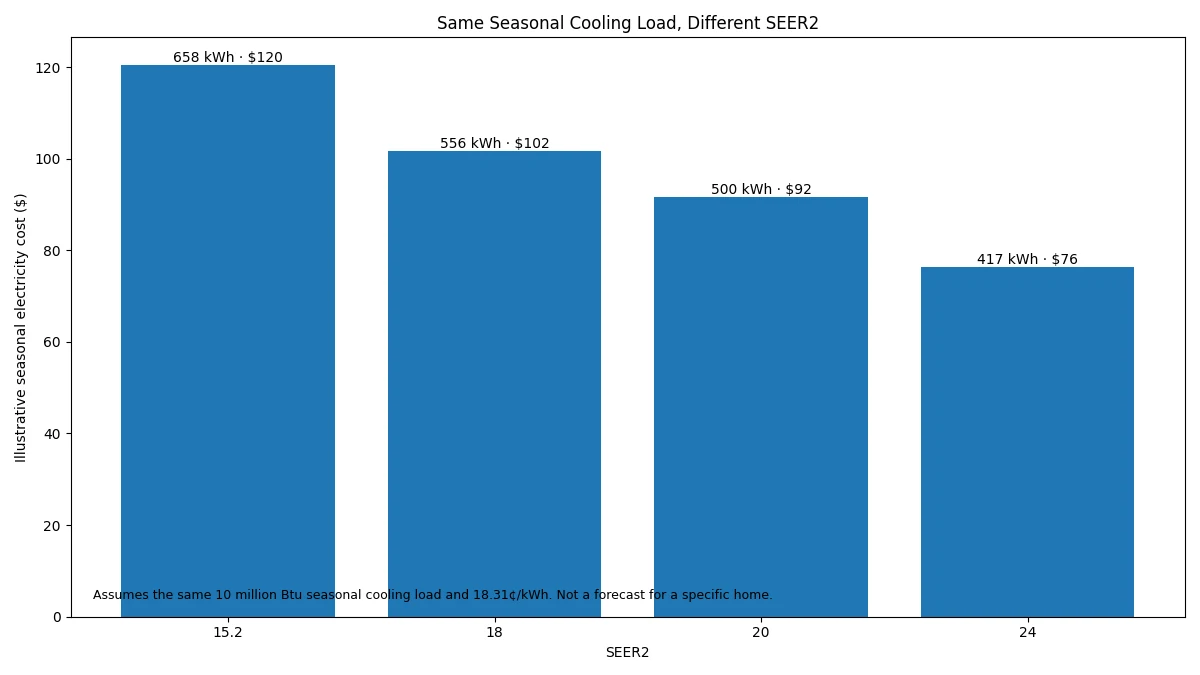
For an intentionally simple example, assume a home needs 10 million Btu of seasonal cooling. At SEER2 15.2, the calculation is about 658 kWh. At SEER2 20, it is about 500 kWh. At 18.31¢/kWh, that is roughly $120 versus $92 for the same assumed cooling load.
This does not predict your home’s annual bill. Climate, insulation, air leakage, solar gain, floor area, thermostat settings and occupancy determine the cooling load. The example isolates the effect of efficiency while keeping the load fixed.
Mini-split heating cost: use COP or HSPF2
When a mini-split operates as a heat pump, it transfers heat into the home. For one operating condition, COP is the clearest efficiency measure:
Electrical input = delivered heating output ÷ COP.
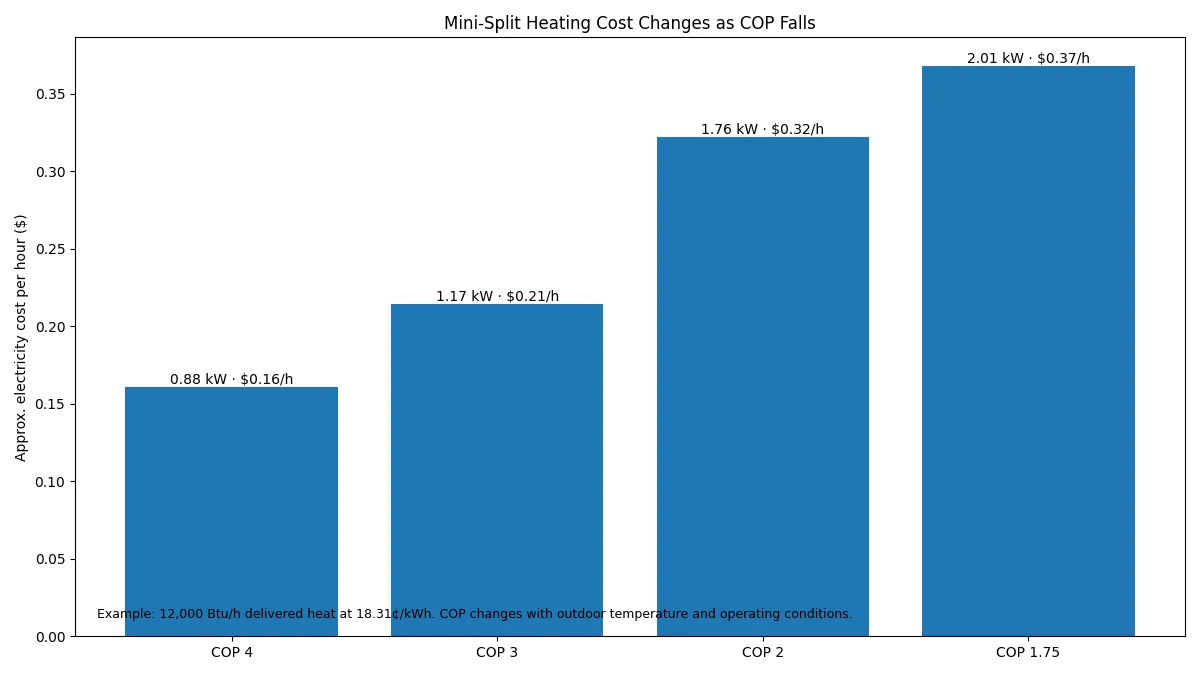
A 12,000 Btu/h heating output is about 3.52 kW of thermal output. At COP 3.0, electrical input is about 1.17 kW and the cost is about $0.21/hour at 18.31¢/kWh. At COP 2.0, input rises to about 1.76 kW and cost to about $0.32/hour.
Why mini-split heating cost rises in colder weather
Heat-pump performance changes with outdoor temperature. As outdoor air gets colder, the system may have to work harder to deliver the same amount of indoor heat. Available heating capacity and COP can both change.
ENERGY STAR’s current cold-climate criteria are useful context. A cold-climate heat pump must demonstrate a COP of at least 1.75 at 5°F and provide at least 70% of its 47°F heating capacity at 5°F under the specified test method. That is a certification threshold, not a statement that every mini-split has exactly COP 1.75 at 5°F.
For a dedicated comparison with resistance heat, see Heat Pump vs Electric Resistance Heating Cost USA.
ENERGY STAR 2026 mini-split efficiency benchmarks
Current ENERGY STAR heat-pump criteria list general split-system thresholds of at least 15.2 SEER2, 11.0 EER2 and 7.8 HSPF2. For cold-climate non-ducted split systems, the criteria include at least 15.2 SEER2 and 8.5 HSPF2, plus low-temperature performance requirements.
The terms matter because a mini-split can be used for cooling only or as a heat pump for both cooling and heating. SEER2 and EER2 describe cooling efficiency, while HSPF2 and COP describe heating performance.
Why variable-speed operation changes the math
Many mini-splits use inverter-driven variable-capacity compressors. Instead of cycling only between maximum power and off, they can reduce output when the room is close to setpoint. That often means long runtimes at low electrical input.
This is why multiplying maximum nameplate input by every hour the unit is switched on can badly overstate energy use. Runtime alone is not enough; average kW during that runtime is what determines kWh.
Measured kWh is best. If you cannot measure it, use manufacturer performance data for the exact matched indoor and outdoor units, or a transparent scenario based on EER2, SEER2 or COP.
What does “ductless” change?
The U.S. Department of Energy explains that air-source heat pumps are available in ductless form as mini-splits. In a ductless system, refrigerant lines connect the outdoor unit directly to one or more indoor units instead of sending conditioned air through a large central duct network.
DOE’s heat-pump overview emphasizes that heat pumps transfer heat rather than generate it directly and notes that ductless mini-split versions are available for homes without ducts.
Avoiding ducts can remove duct-distribution losses in the served zones, but “ductless” does not automatically guarantee low bills. Indoor-unit placement, sizing, room layout, door positions, insulation and thermostat behavior still matter.
Mini-split monthly running-cost examples
For a monthly estimate, use average electrical input during operation. The examples below use 18.31¢/kWh and 30 days:
| Average input | Hours/day | Monthly kWh | Approx. monthly cost |
|---|---|---|---|
| 0.5 kW | 6 | 90 | $16.48 |
| 0.8 kW | 8 | 192 | $35.16 |
| 1.2 kW | 8 | 288 | $52.73 |
| 1.5 kW | 10 | 450 | $82.40 |
| 2.0 kW | 10 | 600 | $109.86 |
The national electricity price is context only. The EIA July 2026 state price table shows large differences in residential electricity prices across the country. Replace 18.31¢ with the rate on your own bill whenever possible.
What changes your actual mini-split running cost?
- Outdoor temperature: extreme heat and cold raise the load.
- Indoor setpoint: a larger indoor-outdoor temperature difference generally requires more energy.
- System size: poor sizing can reduce comfort and real-world efficiency.
- SEER2, EER2 and HSPF2: these ratings affect energy required for a defined load.
- COP in cold weather: heating input changes with outdoor conditions.
- Insulation and air leakage: a better building envelope reduces heating and cooling demand.
- Number of zones: conditioning fewer rooms can reduce load, while running more indoor units raises total demand.
- Solar gain and internal heat: windows, cooking, appliances and occupants affect cooling load.
- Maintenance: dirty filters and obstructed coils can hurt airflow and performance.
- Electricity tariff: identical kWh can cost very different amounts across utilities.
For whole-home ducted cooling context, see Central Air Conditioner Running Cost USA. For a smaller room-cooling alternative, see Window Air Conditioner Running Cost USA. This article is intentionally focused on ductless mini-split heating and cooling cost rather than repeating those topics.
HomeBillLab’s source hierarchy, tariff handling and calculation approach are documented in the HomeBillLab Methodology.
Mini-split running cost FAQ
How much does a 12,000 Btu mini split cost to run per hour?
At EER2 11.0, 12,000 Btu/h corresponds to about 1.09 kW at the rating condition. At 18.31¢/kWh, that is about $0.20/hour at that power level. Real variable-speed consumption may be much lower after the room reaches setpoint.
Does a mini split use less electricity than central AC?
It can, particularly if it has higher equipment efficiency, avoids duct losses or conditions fewer zones, but there is no universal answer. A fair comparison needs the same cooling load, climate, operating schedule and tariff.
Is it cheaper to leave a mini split running all day?
Not automatically. Variable-speed systems can operate efficiently at low output, but total energy still depends on the building load and setpoint. A stable setting may avoid repeated recovery at high output, but the cheapest schedule varies by climate, house and tariff.
How many watts does a mini split use?
There is no single wattage. A mini-split can modulate over a wide range. Use measured input, manufacturer data or a rating-based calculation rather than the Btu capacity alone.
Can a mini split heat efficiently below freezing?
Some cold-climate models are designed to maintain useful capacity and efficiency at very low outdoor temperatures. Check the exact model’s published low-temperature capacity and COP rather than assuming all mini-splits perform the same.
Bottom line
For mini split running cost USA, the most useful number is average electrical input in kW, not advertised Btu capacity. At the July 2026 U.S. residential average of 18.31¢/kWh, 1 kW of average input costs about 18.3 cents per operating hour. Use EER2 or SEER2 for cooling scenarios, COP or HSPF2 for heating, and replace the national rate with your own tariff. Test your numbers in the U.S. Air Conditioner Running Cost Calculator and browse the U.S. Air Conditioning hub for related guides.