Gas furnace running cost USA depends on the furnace input rate, AFUE, how much heat the house needs, and the natural-gas price on your utility bill. There is no single winter cost that fits every U.S. home because climate, insulation, thermostat settings and gas tariffs vary widely.
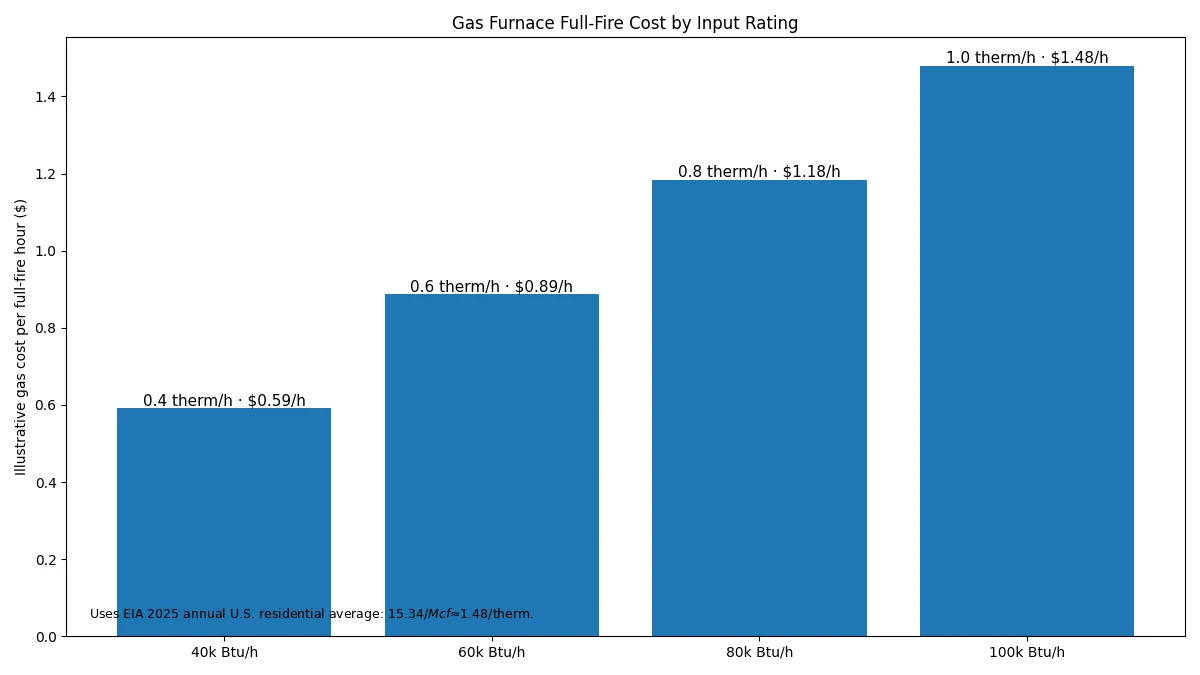
For a transparent national reference, the U.S. Energy Information Administration reports a 2025 annual average residential natural-gas price of $15.34 per thousand cubic feet (Mcf). EIA also reports that 1 Mcf of natural gas averaged about 10.37 therms in 2025, which converts the national annual price to about $1.48 per therm. At that illustrative rate, an 80,000 Btu/h furnace burning at full input uses about 0.8 therm per hour and costs roughly $1.18 for one full-fire hour.
That is not the same as saying an 80,000 Btu/h furnace costs $1.18 every clock hour all winter. Furnaces cycle or modulate as the thermostat calls for heat. For your own estimate, use the HomeBillLab U.S. Heating Running Cost Calculator with your actual gas rate, furnace efficiency and operating assumptions.
Table of Contents
Gas furnace running cost USA: how much per hour?
If you know the furnace’s input rating in Btu/h, the full-fire fuel calculation is straightforward. One therm equals 100,000 Btu. A 60,000 Btu/h input furnace therefore burns 0.6 therm per full-fire hour; an 80,000 Btu/h furnace burns 0.8 therm; and a 100,000 Btu/h furnace burns 1 therm.
| Furnace input rating | Gas at full fire | Illustrative cost at $1.48/therm |
|---|---|---|
| 40,000 Btu/h | 0.4 therm/hour | $0.59/hour |
| 60,000 Btu/h | 0.6 therm/hour | $0.89/hour |
| 80,000 Btu/h | 0.8 therm/hour | $1.18/hour |
| 100,000 Btu/h | 1.0 therm/hour | $1.48/hour |
These are fuel-cost examples at continuous full input. A furnace that fires for 20 minutes during a clock hour does not consume a full hour’s worth of gas. Two-stage and modulating furnaces can also operate below maximum input.
Which natural-gas price should you use?
The best rate is the one on your own bill. U.S. utilities may bill in therms, Ccf, Mcf or another local presentation, and the bill can include customer charges that do not scale directly with furnace use.
EIA’s official annual U.S. residential natural-gas price series reports $15.34/Mcf for 2025, the latest complete annual value. Using EIA’s 2025 average heat content of 10.37 therms per Mcf, that is about $1.48/therm.
EIA’s monthly residential natural-gas price table is more current and reports $26.45/Mcf for July 2026, but a summer national delivered-price average is not a good stand-in for every winter furnace bill. Residential gas use is much lower in summer, so fixed and semi-fixed utility revenues can be spread over fewer units of gas. Use your utility’s current winter rate whenever possible.
EIA’s natural-gas conversion guidance explains that 1,000 cubic feet equaled about 1.037 MMBtu or 10.37 therms using the 2025 U.S. average heat content. Local gas heat content can differ, so a utility-supplied conversion is better when available.
Gas furnace running cost USA formula
When the furnace input rating is listed in Btu/h:
Therms per full-fire hour = input Btu/h ÷ 100,000.
Gas cost per full-fire hour = therms/hour × gas price per therm.
If you are estimating a whole heating season from useful heat demand, AFUE enters the calculation:
Fuel input required = useful heating load ÷ AFUE.
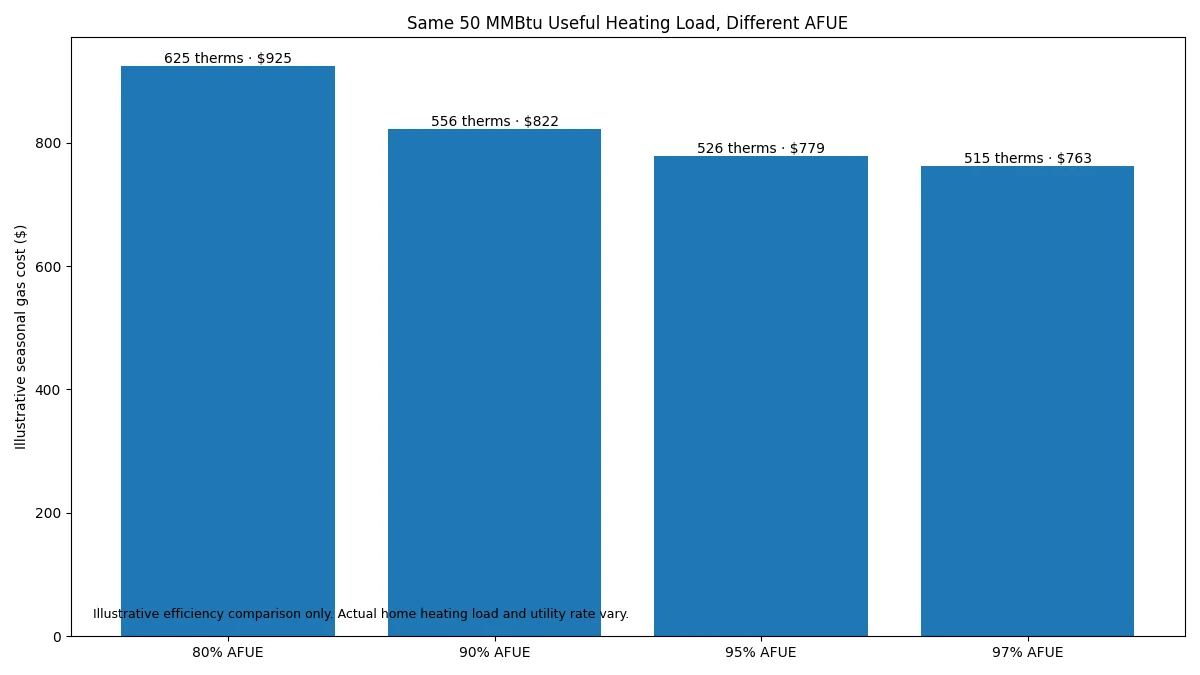
For example, supplying 50 MMBtu of useful heat requires about 62.5 MMBtu of fuel at 80% AFUE, but only about 52.6 MMBtu at 95% AFUE.
How AFUE changes furnace gas use
AFUE stands for Annual Fuel Utilization Efficiency. ENERGY STAR describes it as the percentage of incoming fuel energy converted to useful space heat over the heating season rather than being lost.
Holding the useful heating requirement at 50 MMBtu, an 80% AFUE furnace needs about 625 therms. A 90% furnace needs about 556 therms, a 95% furnace about 526 therms, and a 97% furnace about 515 therms. At the $1.48/therm illustrative national rate, that is roughly $925, $822, $779, and $763 respectively.
This comparison holds the useful heating load constant so you can see the efficiency effect. It does not mean every U.S. home needs 50 MMBtu of useful heat. A warm-climate home may need much less, while a large or poorly insulated cold-climate house may need more.
Gas furnace cost for a winter or heating season
A seasonal estimate is usually more useful than multiplying the furnace’s maximum Btu/h by every winter hour. Start with annual or winter gas consumption attributable to space heating, then multiply by your effective rate per therm.
| Illustrative furnace gas use | Cost at $1.48/therm |
|---|---|
| 300 therms | $444 |
| 400 therms | $592 |
| 500 therms | $740 |
| 600 therms | $888 |
| 800 therms | $1183 |
| 1,000 therms | $1479 |
If the home also uses natural gas for water heating, cooking or a dryer, the total gas bill is not the same as furnace consumption. One practical method is to compare winter gas use with the home’s mild-weather baseline, while allowing for seasonal changes in hot-water demand and other gas loads.
DOE/FEMP standardized furnace examples
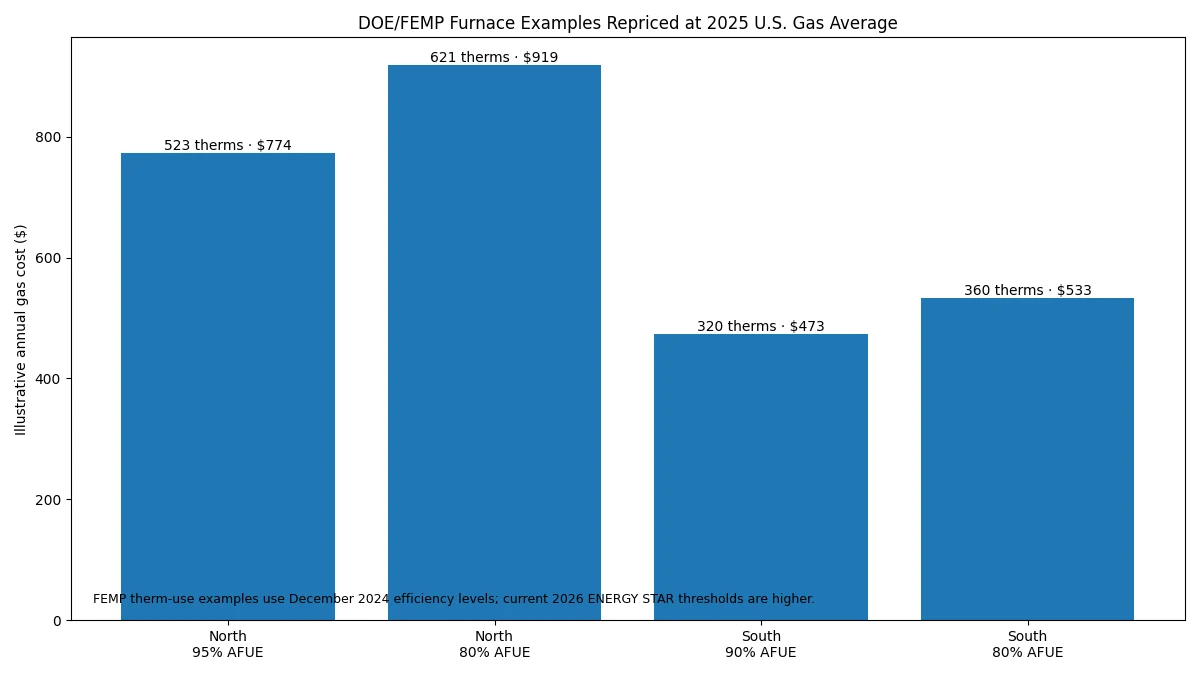
The U.S. Department of Energy’s Federal Energy Management Program publishes standardized residential furnace examples for northern and southern regions. In its northern example, a 70,000 Btu/h output furnace at 95% AFUE uses 523 therms/year, while the 80% AFUE comparison model uses 621 therms. In its southern example, the 90% model uses 320 therms and the 80% model 360 therms.
If those official therm-use examples are repriced at the EIA 2025 annual national residential rate of about $1.48/therm, they correspond to roughly $774 versus $919 in the northern example and $473 versus $533 in the southern example.
There is an important freshness note: FEMP says those model efficiency levels were based on the ENERGY STAR criteria current in December 2024. ENERGY STAR’s gas-furnace criteria changed in 2026, so use the FEMP table as a standardized energy-use illustration rather than as today’s certification threshold.
Current 2026 ENERGY STAR gas-furnace criteria
The current ENERGY STAR furnace criteria require at least 97% AFUE for U.S. North gas furnaces and 95% AFUE for U.S. South gas furnaces. ENERGY STAR’s certified-furnace dataset states that Version 5.0 requirements became effective on July 31, 2026.
Those regional thresholds reflect the fact that higher efficiency generally creates more fuel savings where heating loads are larger. AFUE is still only one part of real-world performance: duct leakage, sizing, blower operation, thermostat settings and building heat loss all change actual gas consumption.
Why full-fire cost is not your average hourly furnace cost
A furnace input label tells you fuel use while the burners are firing at that input. It does not tell you how many minutes the burners will fire in a clock hour. A mild winter hour might need only a short cycle; a design-cold hour may keep the furnace running much longer.
Two-stage and modulating furnaces complicate the picture further because they can operate at reduced firing rates. Daily or monthly gas-meter data is therefore usually more useful for bill forecasting than assuming 100% runtime from the nameplate.
A gas furnace also uses electricity
The burners use natural gas, but the furnace blower, inducer motor, ignition system and controls use electricity. The electricity portion is usually much smaller than the gas energy input, but it is not zero.
If you are comparing fuels, keep them separate: gas therms belong on the gas calculation and blower kWh on the electricity calculation. For electric alternatives, see Heat Pump Running Cost USA and Heat Pump vs Electric Resistance Heating Cost USA.
What changes your real gas-furnace winter bill?
- Climate: more heating degree days usually mean more furnace runtime.
- House heat loss: insulation, air leakage, windows and exposed surface area determine heating demand.
- AFUE: a higher AFUE requires less fuel for the same useful seasonal heat.
- Furnace sizing: oversized equipment can short-cycle and may reduce comfort.
- Duct losses: leaky or poorly insulated ducts increase the heat the furnace must produce.
- Thermostat setting: higher indoor temperature increases the indoor-outdoor temperature difference and heat loss.
- Gas rate: tariffs, delivery charges and fixed charges vary by utility.
- Other gas appliances: water heaters, dryers and cooking can make the total gas bill look like furnace use when it is not.
- Maintenance and airflow: filter and airflow problems can affect system operation.
If you are comparing whole-home gas heat with a portable electric option, see 1500 Watt Space Heater Cost to Run in the USA. A room heater and a whole-home furnace serve different loads, so compare the same useful heating requirement rather than only appliance hourly prices.
How to reduce gas-furnace running cost
Reducing the building’s heating load is often the most durable strategy. Air sealing, appropriate insulation and duct repairs can reduce how much heat the furnace has to supply. Routine filter changes and professional maintenance help keep airflow and combustion systems operating correctly.
When replacing equipment, compare the exact AFUE, sizing calculation, installation quality and venting requirements rather than buying by input Btu alone. A high-AFUE furnace cannot compensate for major duct leakage or an oversized system.
HomeBillLab’s treatment of fuel rates, standardized source data and illustrative assumptions is documented in the HomeBillLab Methodology.
Gas furnace running cost USA FAQ
How much does an 80,000 Btu gas furnace cost per hour?
An 80,000 Btu/h input furnace burns 0.8 therm per full-fire hour. At the illustrative EIA 2025 national residential rate of about $1.48/therm, that is about $1.18 per full-fire hour. Actual clock-hour cost is lower when the burner cycles off or operates at a reduced stage.
How much does a gas furnace cost for a winter?
It depends on seasonal therm use. At $1.48/therm, 400 therms cost about $592, 600 therms about $888, and 800 therms about $1183. Add fixed charges separately if they are not already captured by the rate you are using.
What does 95% AFUE mean?
In broad terms, 95% AFUE means about 95% of fuel energy becomes useful space heat over the standardized heating season, with the remainder lost. It is a seasonal rating, not a guarantee of 95% efficiency in every instant or installation.
Why can the national summer gas price per Mcf look high?
EIA’s residential delivered price is based on revenue and delivered gas volume. In low-volume summer months, some fixed or semi-fixed utility revenues can be spread over fewer Mcf, so the calculated price per Mcf can rise. Use your actual utility tariff for furnace forecasting.
Does a gas furnace use electricity?
Yes. A modern gas furnace normally needs electricity for the blower, ignition, inducer and controls. Most conventional systems will not provide normal heating during a power outage unless they have an appropriately designed backup-power arrangement.
Bottom line
For gas furnace running cost USA, start with the input Btu/h, your actual gas rate per therm and the furnace AFUE. Using the latest complete EIA annual national residential price, $15.34/Mcf in 2025 converts to about $1.48/therm. At that rate, an 80,000 Btu/h input furnace costs roughly $1.18 per full-fire hour, but real winter cost depends on runtime and seasonal heating demand. Use the U.S. Heating Running Cost Calculator for your own inputs and browse the U.S. Heating hub for related guides.