Heat pump running cost USA depends on three things more than anything else: how much heat your home needs, the heat pump’s seasonal efficiency, and the electricity price on your utility bill. There is no single national monthly cost that applies to every home, because a mild-climate house and a cold-climate house can have completely different heating loads.
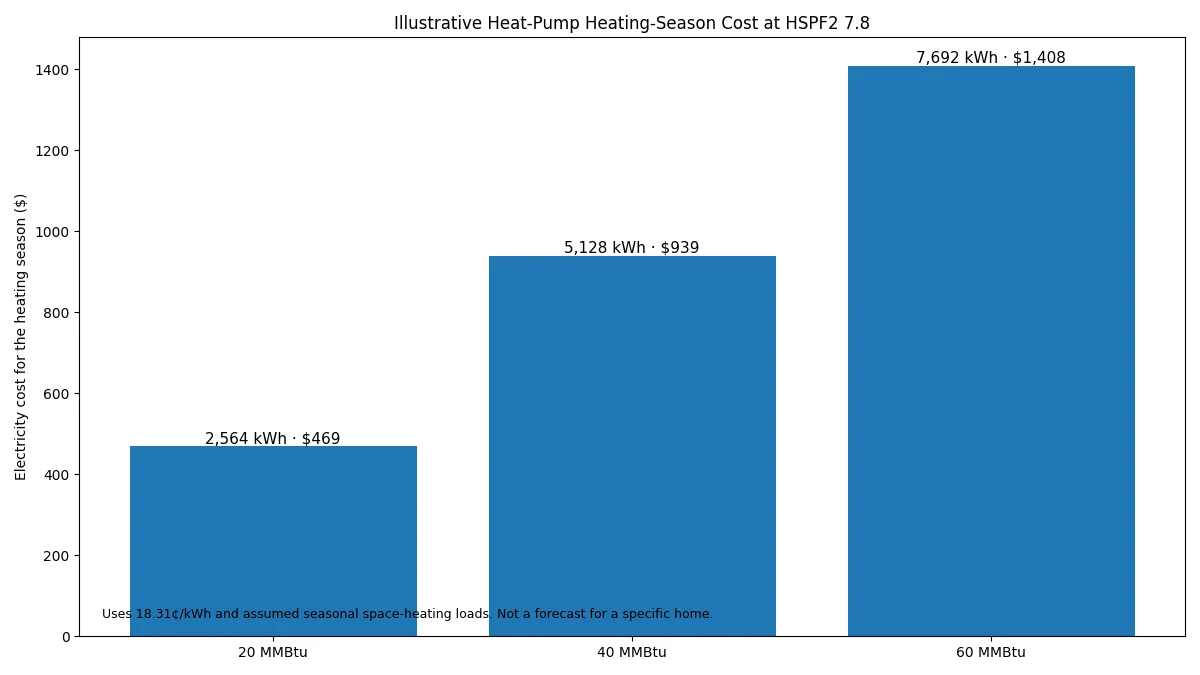
For a transparent 2026 reference, the U.S. Energy Information Administration reports an average residential electricity price of 18.31¢/kWh for July 2026. At that rate, an illustrative air-source heat pump with HSPF2 7.8 serving a 40 million Btu seasonal heating load would use about 5,128 kWh for space heating and cost roughly $939 for the heating season. Spread across five heating months, that is about $188 per month. The load and five-month season are examples, not U.S. averages.
For your own home, use the HomeBillLab U.S. Heating Running Cost Calculator with your local electricity rate and the best equipment data available. If you know your heat pump’s measured kWh from utility interval data or a dedicated energy monitor, measured consumption is better than any generic rule of thumb.
Table of Contents
Heat pump running cost USA: quick monthly and seasonal examples
The safest way to discuss heat pump running cost USA is with clearly stated heating-load scenarios instead of pretending there is one “average house.” The table below uses HSPF2 7.8, which is the current ENERGY STAR minimum for a general residential split-system heat pump, and the July 2026 national residential electricity price of 18.31¢/kWh.
| Illustrative seasonal heating load | Electricity at HSPF2 7.8 | Heating-season cost | Average over 5 months |
|---|---|---|---|
| 20 million Btu | 2,564 kWh | $469 | $94/month |
| 40 million Btu | 5,128 kWh | $939 | $188/month |
| 60 million Btu | 7,692 kWh | $1,408 | $282/month |
These are space-heating examples only. They exclude cooling, domestic hot water, appliances, lighting, fixed utility charges and taxes. A real heating season may last three months, seven months or longer depending on climate. The monthly column simply divides the seasonal total by five to make the scale easier to understand.
The July 2026 price comes from the EIA Electric Power Monthly state electricity-price table. The national average is useful context, but your own utility rate should replace it in any personal estimate.
How to estimate heating-season cost from HSPF2
HSPF2 is expressed in Btu of seasonal heating delivered per watt-hour of electricity consumed. That gives a useful planning formula:
Seasonal electricity (kWh) ≈ seasonal heating load (Btu) ÷ HSPF2 ÷ 1,000.
Then:
Seasonal cost = seasonal kWh × electricity rate ($/kWh).
Example: 40,000,000 Btu ÷ 7.8 ÷ 1,000 = about 5,128 kWh. At $0.1831/kWh, the electricity cost is about $939. This calculation assumes the seasonal load and HSPF2 are appropriate inputs. It does not predict how much heat your particular building needs.
What HSPF2 means for a 2026 heat pump
Current ENERGY STAR heat-pump criteria list a minimum HSPF2 of 7.8 for general residential split systems. For cold-climate split systems, the current criteria are at least 8.1 HSPF2 for ducted models and 8.5 HSPF2 for non-ducted models, along with defined low-temperature performance requirements.
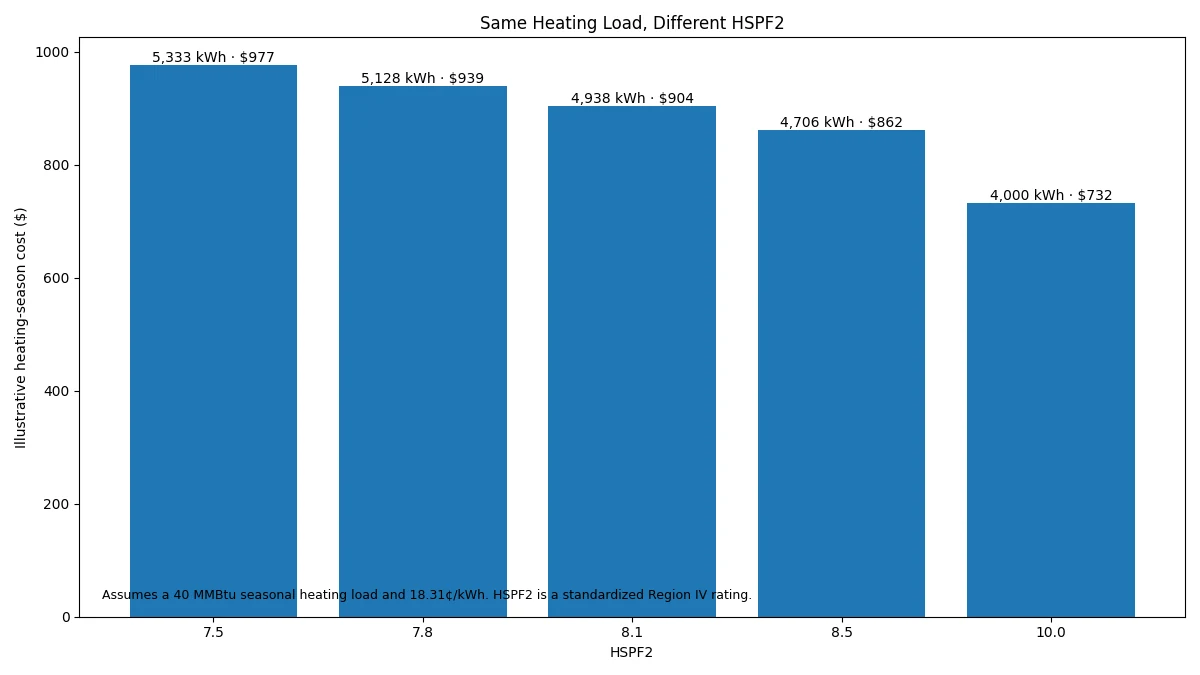
Holding the building’s seasonal heating load constant, a higher HSPF2 means fewer kWh. With the same 40 million Btu example at 18.31¢/kWh, HSPF2 7.8 costs about $939, HSPF2 8.5 about $862, and HSPF2 10 about $732. That comparison isolates equipment efficiency; it does not account for different sizing, controls, ductwork or climate.
HSPF2 is a standardized seasonal rating based on Region IV test conditions. It is useful for comparing equipment, but it is not a climate-specific prediction for every U.S. location.
How much does a heat pump cost to run per hour?
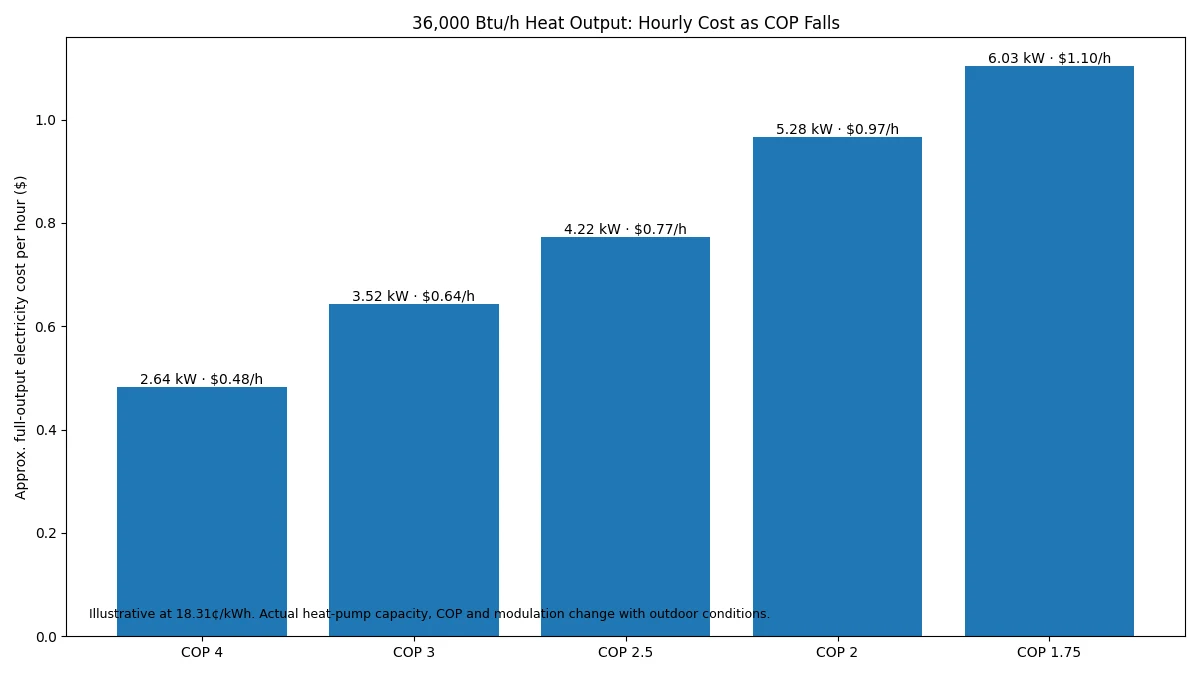
For a single operating condition, COP is more useful than HSPF2. ENERGY STAR defines COP as the ratio of heating delivered to electrical energy consumed. If a system is delivering 36,000 Btu/h, that is about 10.55 kW of thermal output.
At COP 3.0, the electrical input is about 3.52 kW, which costs roughly $0.64/hour at 18.31¢/kWh. At COP 2.0, input rises to about 5.28 kW and the hourly cost to about $0.97. At COP 1.75, the example reaches about 6.03 kW and $1.10/hour.
This is full-output math. Modern variable-capacity heat pumps often modulate below maximum output for long periods, so actual hourly kWh can be much lower once the home is near setpoint.
Why heat-pump running cost rises in colder weather
An air-source heat pump extracts heat from outdoor air. As outdoor temperature falls, the house usually loses heat faster while the heat pump may deliver less capacity or operate at a lower COP. That combination can raise electricity consumption sharply during cold weather.
ENERGY STAR’s cold-climate designation requires qualifying heat pumps to demonstrate a COP of at least 1.75 at 5°F and at least 70% of their 47°F heating capacity at 5°F under the specified test procedure. Those are certification thresholds, not a promise that every cold-climate model performs exactly the same way.
The U.S. Department of Energy’s Heat Pump Systems guidance explains that modern air-source heat pumps are used across U.S. climates and that cold-climate designs have expanded their usefulness in regions with subfreezing weather.
Auxiliary electric heat can change the bill quickly
Many ducted heat-pump systems include electric resistance elements for supplemental or emergency heat. Resistance heat has a COP of about 1 at the point of use: roughly 1 kWh of electricity becomes 1 kWh-equivalent of heat. A heat pump operating at COP 3 transfers roughly three times as much heat per unit of electrical input.
DOE/FEMP’s residential air-source heat-pump purchasing guidance specifically warns that resistance backup elements can reduce efficiency and recommends minimizing unnecessary use. Large thermostat setbacks followed by rapid recovery can trigger auxiliary heat on some systems.
If your winter electricity use suddenly jumps, check whether the thermostat is displaying AUX HEAT or EMERGENCY HEAT, whether the outdoor unit is operating normally, and whether severe cold has changed the system’s balance point. A service issue should be handled by a qualified HVAC technician.
Monthly heat-pump heating cost examples
Monthly cost can be estimated directly from measured kWh. The formula is simply:
Monthly heating cost = heat-pump heating kWh × electricity rate.
| Heat-pump electricity in one month | Cost at 18.31¢/kWh |
|---|---|
| 500 kWh | $91.55 |
| 750 kWh | $137.33 |
| 1,000 kWh | $183.10 |
| 1,250 kWh | $228.88 |
| 1,500 kWh | $274.65 |
| 2,000 kWh | $366.20 |
If your utility portal provides hourly or daily data, compare mild and cold days. That makes it easier to see whether consumption is tracking weather, whether backup heat is appearing, or whether another large electric load is responsible.
What DOE/FEMP model examples tell us about annual energy use
DOE/FEMP also publishes standardized annual heating-and-cooling examples for 36,000 Btu/h residential air-source heat pumps. In its current guidance, an ENERGY STAR example at SEER2 15.2 and HSPF2 7.8 uses 11,660 kWh/year in the hot-humid/Southeast scenario, 10,743 kWh/year in the hot-dry/Southwest scenario, and 10,990 kWh/year in the northern-state scenario.
Those figures include both heating and cooling under FEMP’s standardized assumptions, so they should not be copied as a household’s heating-only number. Their main value is showing that climate assumptions change annual use even when the nominal equipment efficiency is the same.
The same FEMP table compares a less-efficient HSPF2 7.5 / SEER2 14.3 model with the ENERGY STAR example and a much more efficient HSPF2 11 / SEER2 24 model. That supports the basic principle used throughout this guide: equipment efficiency matters, but climate and building load matter too.
What changes your actual heat pump running cost?
- Climate and weather: colder outdoor temperatures increase heat loss and can reduce heat-pump COP.
- House heat loss: insulation, air sealing, windows and exposed surface area determine how much heat the building needs.
- HSPF2 and low-temperature performance: more efficient equipment needs fewer kWh for the same standardized heating load.
- Equipment sizing: incorrect sizing can hurt comfort and seasonal performance.
- Duct losses: leaky or poorly insulated ducts increase required output.
- Thermostat strategy: aggressive recovery can activate resistance backup heat on some systems.
- Defrost cycles: air-source heat pumps periodically defrost the outdoor coil in cold, humid conditions.
- Backup heat: resistance strips can add substantial kWh during cold periods.
- Maintenance: dirty filters, airflow problems and refrigerant issues can reduce performance.
- Electricity price: identical kWh can have very different dollar costs across U.S. states and utilities.
For the efficiency comparison with straight electric resistance heating, see Heat Pump vs Electric Resistance Heating Cost USA. For ductless heat-pump operation, see Mini Split Running Cost USA. For cooling-season context, see Central Air Conditioner Running Cost USA.
How to reduce heat-pump running cost
Start with the building load. Air sealing, insulation improvements and duct repairs can reduce the amount of heat the system must deliver. Then make sure filters are clean, supply and return airflow is unobstructed, and the outdoor unit is clear of debris and snow.
Use thermostat settings appropriate for heat pumps. Avoid forcing emergency heat unless it is actually needed, and be cautious with large setbacks if your system responds by energizing resistance backup heat. Variable-speed systems are often designed to maintain temperature with long, low-output cycles.
For a replacement system, compare the exact matched-system HSPF2 and cold-weather performance rather than relying only on tonnage or brand name. HomeBillLab’s assumptions, rate treatment and source hierarchy are documented in the HomeBillLab Methodology.
Heat pump running cost FAQ
How much does a heat pump cost to run per month?
There is no single U.S. monthly figure. At 18.31¢/kWh, 1,000 kWh of heat-pump electricity costs $183.10 and 1,500 kWh costs $274.65. Your heating kWh depends on climate, house heat loss, equipment efficiency and backup-heat use.
How much does a heat pump cost for a full heating season?
Using HSPF2 7.8 and 18.31¢/kWh, a 20 MMBtu seasonal heating-load example is about $469, a 40 MMBtu example about $939, and a 60 MMBtu example about $1,408. These are load scenarios, not national household averages.
Is HSPF2 the same as COP?
No. HSPF2 is a seasonal heating-efficiency rating under a standardized test procedure. COP describes efficiency at a particular operating condition. COP changes with temperature and system output.
Why did my heat-pump electricity use jump during a cold snap?
The home needs more heat in colder weather, heat-pump COP can fall, defrost cycles can increase, and auxiliary resistance heat may operate. Those effects can occur at the same time.
Is emergency heat more expensive?
On systems where emergency heat is electric resistance, it normally uses much more electricity to deliver the same heat than the heat-pump compressor operating at a COP well above 1. Emergency heat is intended for situations where the normal heat-pump system cannot provide heating correctly.
What is a good HSPF2 rating?
ENERGY STAR’s current general split-system threshold is HSPF2 7.8, while cold-climate split-system requirements are higher. A higher rating means better standardized seasonal heating efficiency, but low-temperature capacity and COP also matter in cold climates.
Bottom line
The best way to estimate heat pump running cost USA is to combine your home’s heating load or measured heat-pump kWh with the exact electricity rate on your bill. At the July 2026 U.S. residential average of 18.31¢/kWh, a 40 MMBtu heating-season example at HSPF2 7.8 costs about $939. The actual result can be far lower or higher because climate, insulation, ductwork, low-temperature performance and auxiliary heat all matter. Use the U.S. Heating Running Cost Calculator for your own scenario and browse the U.S. Heating hub for related guides.