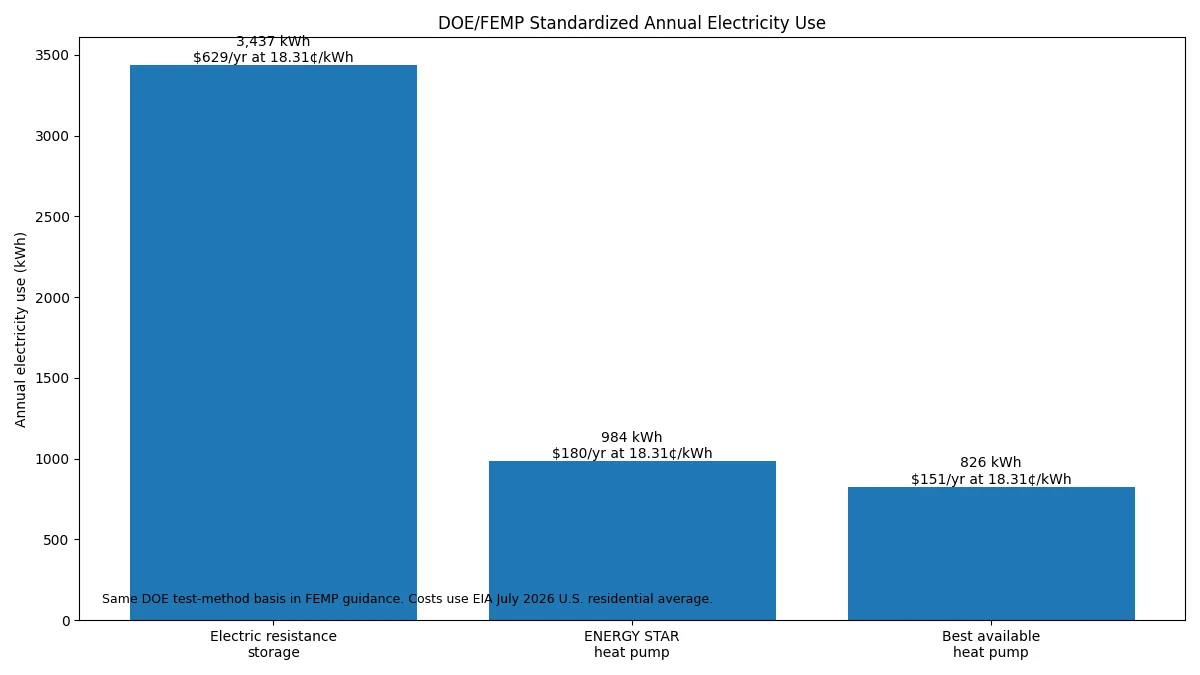
Heat pump water heater vs electric water heater running cost is one of the clearest efficiency comparisons in home energy. Under the same U.S. Department of Energy test-method basis used in current FEMP guidance, a conventional electric storage benchmark is listed at 3,437 kWh/year, while an ENERGY STAR heat pump water heater example is listed at 984 kWh/year. That is 2,453 kWh/year less electricity, or about 71% lower electricity use in the standardized comparison.
At the U.S. Energy Information Administration’s July 2026 residential average electricity price of 18.31¢/kWh, those figures translate to about $629/year for the conventional electric-resistance example and $180/year for the ENERGY STAR heat-pump example. The illustrative difference is about $449/year. Your actual result can be smaller or larger because hot-water demand, electricity price, operating mode, ambient temperature and the exact models all matter.
If you already know your own annual kWh from an EnergyGuide label or measured data, use that instead of a generic benchmark. The HomeBillLab U.S. Hot Water Running Cost Calculator can compare your own electricity rate and usage assumptions directly.
Table of Contents
Heat pump water heater vs electric water heater: quick comparison
| DOE/FEMP standardized example | Annual electricity | Cost at 18.31¢/kWh | Monthly equivalent |
|---|---|---|---|
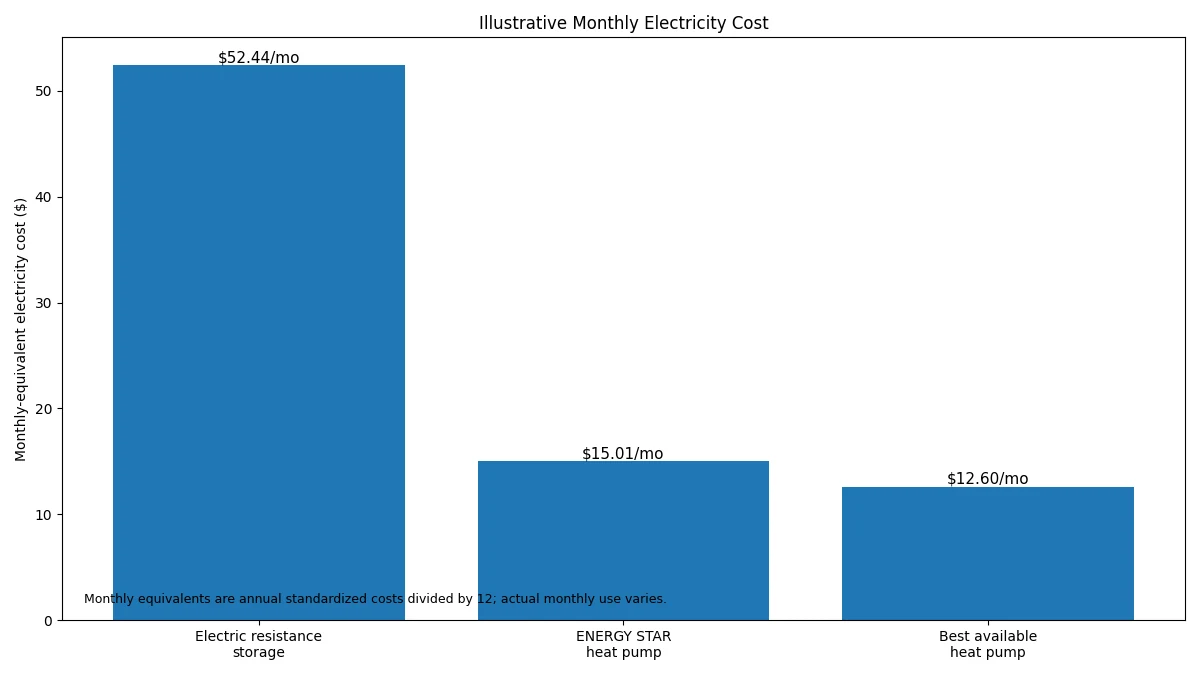
| Conventional electric resistance storage | 3,437 kWh | $629.31/year | $52.44/month |
| ENERGY STAR heat pump water heater | 984 kWh | $180.17/year | $15.01/month |
| Best-available heat-pump example in FEMP table | 826 kWh | $151.24/year | $12.60/month |
The comparison is useful because the products are evaluated using the same DOE test framework in the FEMP table. It is not a promise that every electric tank will use 3,437 kWh or every heat pump water heater 984 kWh. A smaller household with low hot-water demand may use much less electricity with either technology.
The same caution applies to the dollar values. The national 18.31¢/kWh figure is a 2026 reference point, not a substitute for your utility tariff.
How do the two water heaters use electricity differently?
A conventional electric-resistance water heater creates heat directly with resistance elements inside the tank. A heat pump water heater uses a refrigeration cycle to move heat from surrounding air into the water. Most residential HPWHs are hybrid appliances: they use the heat pump when possible and include resistance elements for backup or high-demand operation.
The U.S. Department of Energy’s heat pump water heater overview explains that HPWHs move heat rather than generating it directly. That is the basic reason they can use substantially less electricity for the same standardized hot-water service.
Because the heat pump takes heat from room air, it can also cool and dehumidify the installation space while operating. That can be useful in a warm basement or utility room, but it can be less desirable in a small or cold space.
DOE/FEMP standardized energy-use comparison
The current DOE/FEMP residential water-heater purchasing guidance lists a less-efficient electric storage water heater of 55 gallons or less at 3,437 kWh/year and UEF 0.95. In the same table, the ENERGY STAR heat-pump example uses 984 kWh/year, while the best-available heat-pump model shown uses 826 kWh/year.
FEMP says its energy-use comparison follows the DOE test method and assumes the water heater produces 20,075 gallons of hot water per year. That standardized draw is about 55 gallons per day. It is a test-comparison framework rather than a prediction of what your household must use.
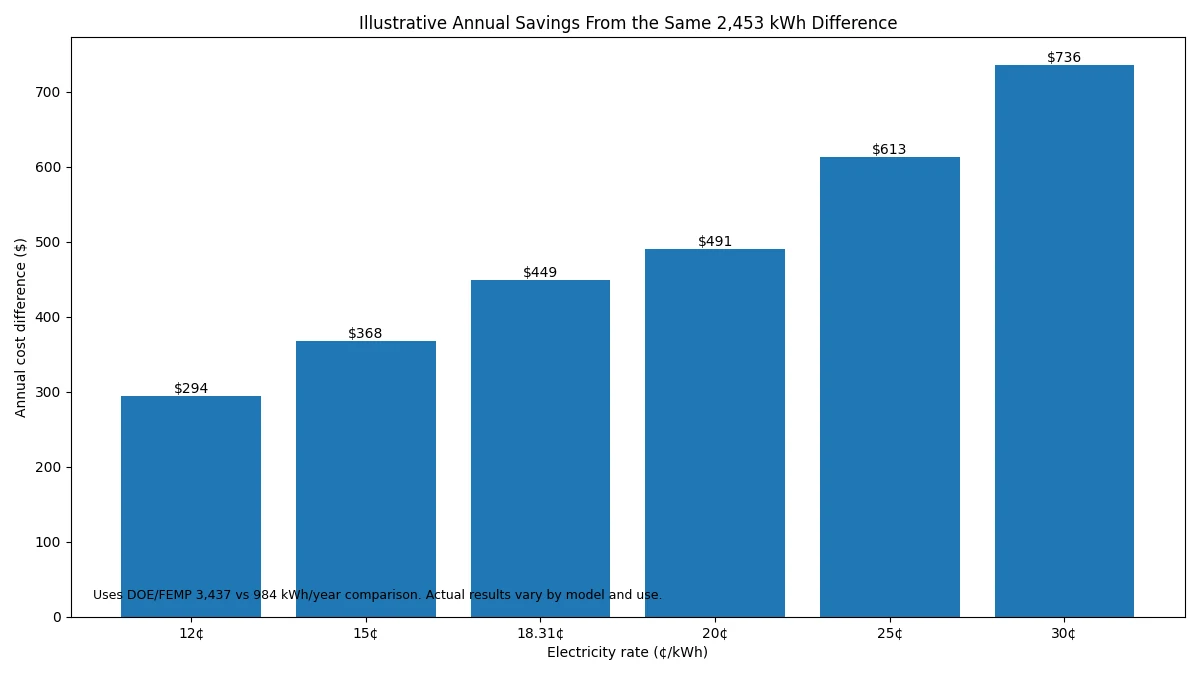
The difference between 3,437 and 984 kWh is 2,453 kWh/year. At 18.31¢/kWh, that electricity difference is worth about $449.14 per year.
How your electricity rate changes the savings
The kWh gap stays the same when you simply change the tariff, but the dollar value changes:
| Electricity rate | Illustrative annual operating-cost difference |
|---|---|
| 12¢/kWh | $294.36 |
| 15¢/kWh | $367.95 |
| 18.31¢/kWh | $449.14 |
| 20¢/kWh | $490.60 |
| 25¢/kWh | $613.25 |
| 30¢/kWh | $735.90 |
EIA’s July 2026 residential electricity-price table reports a U.S. average of 18.31¢/kWh and shows substantial state-to-state variation. Replace the national figure with the rate from your bill when estimating your own running cost.
If you need help separating the electricity rate from the total bill, see Electricity Cost per kWh USA.
UEF: the efficiency number behind the comparison
Uniform Energy Factor, or UEF, is the current federal efficiency metric for residential water heaters. A higher UEF means more hot-water service per unit of energy under the DOE test procedure.
Current ENERGY STAR residential water-heater criteria require UEF of at least 3.30 for integrated heat pump water heaters in the main certified category. ENERGY STAR also lists a minimum UEF of 2.20 for its 120-volt/15-amp integrated category and for split-system HPWHs.
That is a large efficiency difference from the UEF 0.95 conventional electric-resistance benchmark used in FEMP’s comparison. When shopping, compare models within the appropriate product and draw-pattern category rather than treating one UEF number as a complete description of capacity and performance.
Installation conditions can change heat-pump water heater performance
A heat pump water heater depends on the air around it. ENERGY STAR says HPWHs should generally be installed in interior spaces that remain between 40°F and 90°F year-round and provide about 1,000 cubic feet of surrounding air space.
ENERGY STAR’s heat pump water heater guidance also notes that colder spaces and lower incoming water temperatures can cause some models to switch temporarily to backup standard electric-water-heating mode. That raises electricity use during those periods.
Other practical differences include condensate drainage, filter maintenance, unit height and operating sound. A replacement is easiest when the location has enough air volume, suitable temperature, electrical capacity and a practical condensate path.
Backup resistance heat can narrow the advantage temporarily
Most integrated HPWHs include electric-resistance backup so they can recover faster when hot-water demand is high. In efficiency mode, the heat pump does most of the work and electricity use is lowest. In hybrid or high-demand modes, the resistance elements can operate more often.
DOE/FEMP notes that heat-pump-only operation can have longer recovery times and lower first-hour delivery than modes that allow resistance backup. Tank size, first-hour rating, household hot-water pattern and control mode therefore matter alongside the headline UEF.
A household that repeatedly exhausts the tank and triggers resistance backup may not achieve the same percentage reduction as the standardized annual example. A household with moderate, spread-out hot-water demand and a warm installation space may stay in heat-pump operation more of the time.
How to compare two actual water-heater models
The best comparison is model-specific. The Federal Trade Commission’s EnergyGuide guidance explains that appliance labels show standardized operating-cost and energy information, while actual cost depends on local energy prices and how the appliance is used.
- Compare annual kWh. Reprice both models at your own electricity rate.
- Check UEF. Higher is more efficient within an appropriate comparable category.
- Check first-hour rating. Make sure the unit can meet peak household hot-water demand.
- Check operating modes. Understand when resistance backup can run.
- Check installation requirements. Air volume, temperature, condensate and electrical service can affect feasibility.
- Separate purchase price from running cost. Lower annual energy cost does not by itself determine payback.
For the conventional-electric side of the comparison, see Electric Water Heater Running Cost USA. For the dedicated HPWH guide, see Heat Pump Water Heater Running Cost USA.
What changes with the federal water-heater standards in 2029?
DOE finalized updated residential water-heater efficiency standards in 2024, with compliance beginning in 2029. DOE says the amended standards for common-size electric storage water heaters reflect the efficiency level of entry-level heat-pump storage technology.
DOE’s final standards announcement estimated that replacing common-size traditional electric-resistance storage water heaters with heat-pump models meeting the new standards would save consumers about $1,800 on utility bills on average over the appliance life. That is a national rulemaking estimate, not a guaranteed household payback.
For a 2026 buyer, the practical point is that conventional electric resistance tanks are still common and relevant to today’s replacement decisions, while federal efficiency requirements for many new common-size electric storage products are scheduled to shift significantly in 2029.
Which type makes more sense for your home?
A heat pump water heater has the stronger running-cost case when the installation location is suitable, electricity prices are meaningful, hot-water demand fits the available tank and recovery performance, and you expect to keep the unit long enough to benefit from lower annual kWh.
A conventional electric-resistance tank is mechanically simpler and may be easier to install in a tight or cold location, but it generally uses much more electricity for the same standardized hot-water service. The dollar difference becomes larger where electricity prices or hot-water demand are higher.
Do not decide from operating cost alone. Compare purchase price, installation work, space, electrical service, condensate drainage, noise, hot-water capacity, warranty and current local incentives. HomeBillLab’s source hierarchy and calculation approach are documented in the HomeBillLab Methodology.
Heat pump water heater vs electric water heater FAQ
How much cheaper is a heat pump water heater to run?
In DOE/FEMP’s standardized comparison, 984 kWh/year for the ENERGY STAR HPWH versus 3,437 kWh/year for the conventional electric storage example is about 71% less electricity. At 18.31¢/kWh, the illustrative annual operating-cost difference is about $449.
Does a heat pump water heater always use 984 kWh per year?
No. That is a standardized FEMP example. Actual use depends on hot-water volume, incoming-water temperature, ambient-air temperature, tank size, mode and how often resistance backup operates.
Does a heat pump water heater work in a cold garage?
Performance can suffer in cold spaces. ENERGY STAR generally recommends installation locations that stay between 40°F and 90°F and provide adequate surrounding air. Check the exact model’s operating-temperature requirements.
Can a heat pump water heater run out of hot water?
Any storage tank can be depleted if demand exceeds stored volume and recovery rate. HPWHs often include hybrid or resistance-backup modes to recover faster, but using those modes more often increases electricity use.
Is a heat pump water heater better in every home?
No. Operating efficiency is much higher, but installation space, ambient temperature, condensate, electrical service, purchase cost, sound and hot-water demand all need to fit the home.
Bottom line
For heat pump water heater vs electric water heater running cost, the official DOE/FEMP standardized comparison strongly favors the heat-pump example: 984 kWh/year versus 3,437 kWh/year for the conventional electric-storage benchmark. At the July 2026 U.S. residential average electricity price, that is about $180 versus $629 per year. The real decision still depends on your model, tariff, hot-water demand and installation conditions. Use the U.S. Hot Water Running Cost Calculator for your scenario and browse the U.S. Hot Water hub for related guides.