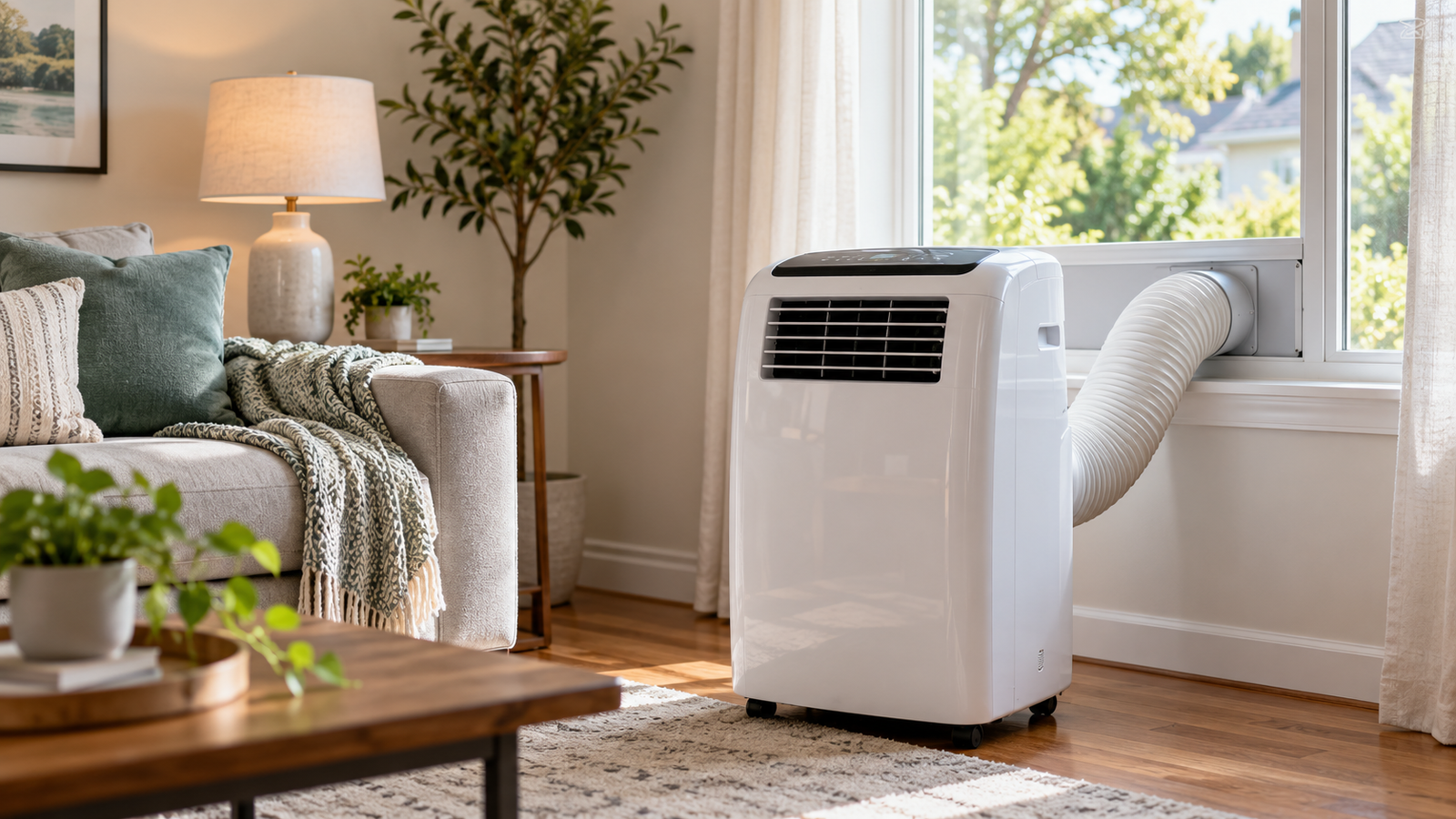
Portable air conditioner running cost USA depends on the unit’s actual electrical input, how many hours it runs, and the electricity price on your utility bill. A useful 2026 national reference is the U.S. Energy Information Administration’s July residential average of 18.31¢/kWh. At that price, a portable AC averaging 1.0 kW while operating costs about 18 cents per hour; a 1.5 kW average draw costs about 27 cents per hour.
Monthly cost changes quickly with runtime. A unit averaging 1.1 kW for 8 hours per day uses about 264 kWh in a 30-day month, which is roughly $48 at 18.31¢/kWh. But a portable AC does not necessarily draw the same wattage every minute. Thermostat cycling, compressor speed, room temperature, humidity and outdoor conditions all change real consumption.
For your own numbers, use the HomeBillLab U.S. Air Conditioner Running Cost Calculator with measured watts or kWh when available. If you are shopping for a unit, the yellow EnergyGuide label is usually a better starting point than a marketing BTU claim.
Table of contents
- Portable AC cost per hour
- Portable AC monthly cost
- Running-cost formula
- SACC vs advertised BTU
- What CEER means
- How to use the EnergyGuide label
- Current federal efficiency standards
- Single-hose vs dual-hose operation
- What changes real-world electricity use
- How to reduce running cost
- Portable AC vs other cooling options
- FAQ
Portable air conditioner running cost USA: cost per hour
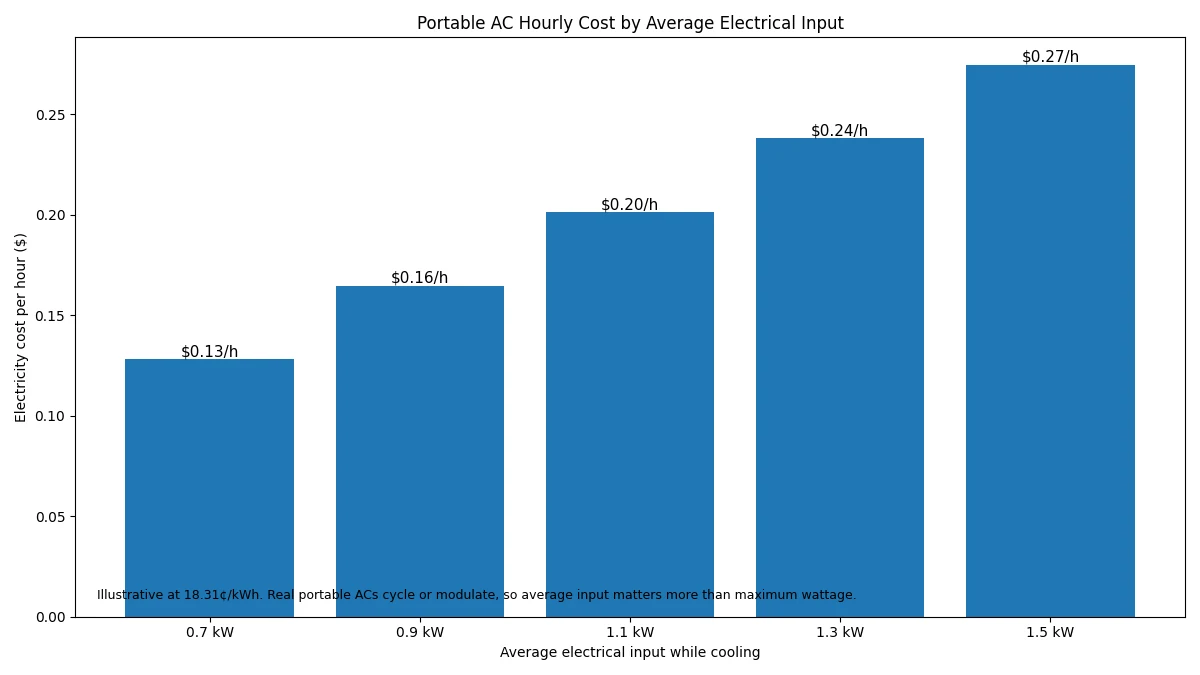
The cleanest hourly calculation starts with average electrical input:
Hourly cost = average input in kW × electricity rate in $/kWh.
| Average electrical input | Cost per hour at 18.31¢/kWh | 8 operating hours |
|---|---|---|
| 0.7 kW | $0.13 | $1.03 |
| 0.9 kW | $0.16 | $1.32 |
| 1.1 kW | $0.20 | $1.61 |
| 1.3 kW | $0.24 | $1.90 |
| 1.5 kW | $0.27 | $2.20 |
These examples assume the listed power draw continues for the whole hour. A thermostat-controlled portable AC may cycle off after the room cools, while a variable-speed model may reduce compressor output instead of stopping completely. That means average kW over time is more useful than maximum nameplate wattage for bill estimates.
How much does a portable air conditioner cost per month?
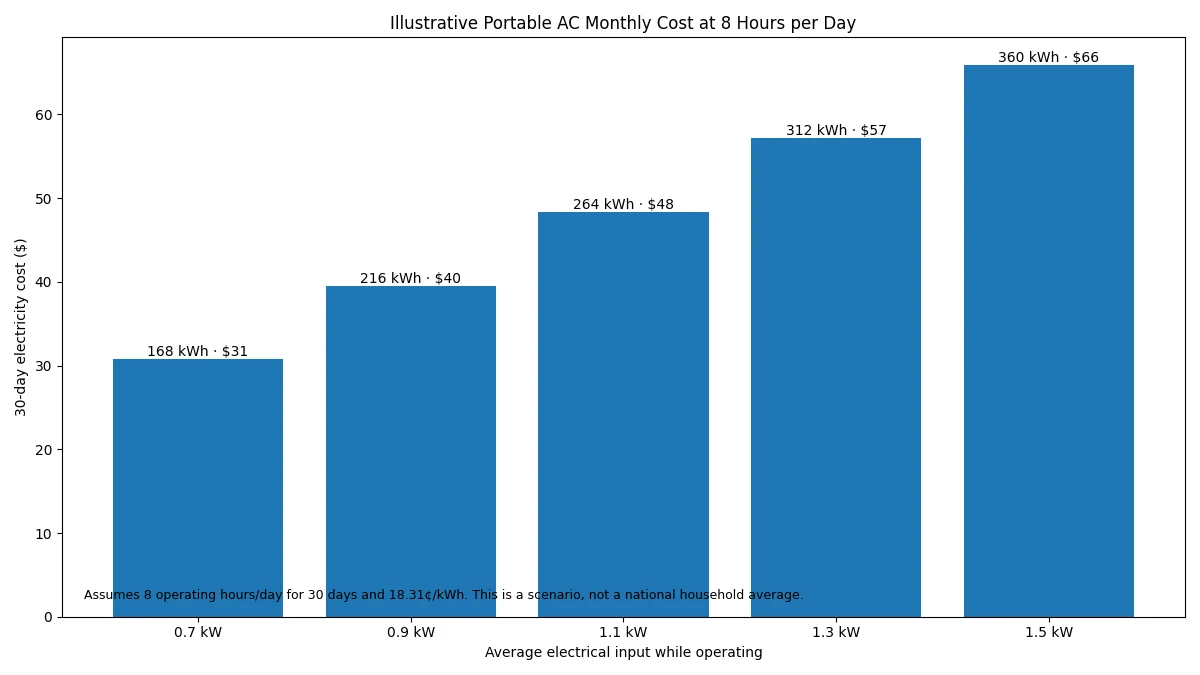
Monthly cost depends on both average input and daily runtime. The following scenarios assume 8 hours per day for 30 days and the July 2026 national residential price of 18.31¢/kWh:
| Average input | Monthly electricity | Illustrative monthly cost |
|---|---|---|
| 0.7 kW | 168 kWh | $30.76 |
| 0.9 kW | 216 kWh | $39.55 |
| 1.1 kW | 264 kWh | $48.34 |
| 1.3 kW | 312 kWh | $57.13 |
| 1.5 kW | 360 kWh | $65.92 |
At 4 hours per day, the energy portion is roughly half these amounts. At 12 hours per day, it is roughly 50% higher. Real utility bills can also include fixed charges, taxes or time-of-use prices that are not captured by a simple kWh × rate calculation.
Portable AC running-cost formula
If the unit shows watts:
kW = watts ÷ 1,000.
Daily cost = kW × operating hours × electricity rate.
Monthly cost = daily cost × days used.
Example: a portable AC averaging 1,200 W for 6 hours per day uses 7.2 kWh/day. At 18.31¢/kWh, that is about $1.32/day or about $39.55 over 30 days.
If you have a plug-in energy meter or compatible smart plug that can safely handle the AC load, measured kWh is even better. Divide total kWh by the measured hours to find average electrical input during your test period.
SACC vs advertised BTU: use the right cooling capacity
Portable air conditioners use a federal metric called Seasonally Adjusted Cooling Capacity, or SACC. DOE’s current portable air conditioner standards page says manufacturers must use the federal test method in 10 CFR Part 430 Appendix CC to determine SACC and efficiency for current products.
SACC matters because portable AC performance is affected by factors that a simple laboratory cooling-capacity number can miss, especially heat transfer through the exhaust hose and the way room air can be exhausted or replaced. When comparing modern U.S. portable ACs, use the DOE-rated SACC shown for the product rather than comparing only a larger legacy or marketing BTU number.
Cooling capacity is not electrical input. A unit rated at 8,000 Btu/h SACC does not use 8,000 watts. Btu/h measures cooling delivered; watts measure electrical power consumed.
What does CEER mean on a portable air conditioner?
DOE uses Combined Energy Efficiency Ratio, or CEER, for portable air conditioners. CEER is expressed in Btu per watt-hour and incorporates the federal test procedure’s treatment of cooling performance and other energy use. Higher CEER means better efficiency for a comparable cooling duty.
The current federal standard is capacity-dependent rather than one single CEER number for every size. DOE’s 2020 final rule for portable air conditioners established the minimum-efficiency equation, and compliance with those standards began on January 10, 2025.
For a shopper in 2026, the practical lesson is simpler than the regulatory formula: compare SACC and CEER between products that can cool the same room. A higher-capacity unit may draw more power in absolute terms even when it is efficient, while an undersized unit may run for much longer.
Use the EnergyGuide label to compare real models
The Federal Trade Commission requires EnergyGuide labeling for portable air conditioners. FTC’s portable AC labeling rule update requires labels on units manufactured after October 1, 2022, and the FTC now provides a specific portable-air-conditioner EnergyGuide template.
FTC consumer guidance on using the EnergyGuide label says the estimated operating cost is only an estimate based on standardized use and a national average energy price. Your actual cost depends on your local price and how you operate the appliance.
When comparing two portable ACs, check the label’s model-specific energy information, then reprice the expected kWh at your own electricity rate. That is more useful than comparing only purchase price or the largest BTU number on the box.
Current 2026 federal portable AC efficiency standards
DOE says the current portable-air-conditioner energy conservation standards were established in the January 10, 2020 final rule, with compliance required beginning January 10, 2025. That means portable ACs newly manufactured for the U.S. market in 2026 are subject to the current federal standard and test procedure.
Do not confuse portable ACs with ENERGY STAR room air conditioners. DOE/FEMP’s room air conditioner purchasing guidance explicitly excludes portable air conditioners from that room-AC ENERGY STAR acquisition category. For a portable AC, focus on its EnergyGuide information, SACC, CEER and your own operating conditions.
Single-hose vs dual-hose portable air conditioners
A single-hose portable AC sends warm exhaust air outside through one duct. That can create negative pressure in the room, causing warmer outside or adjacent-space air to enter through leaks. A dual-hose design separates condenser intake and exhaust airflow more effectively, which can reduce some of that penalty.
However, hose count alone is not enough to predict running cost. Compare the tested SACC and CEER of the actual models. A well-performing product with the right capacity for the room is more important than making a buying decision from one design feature.
What changes real portable air conditioner electricity use?
- Room heat gain: sun, windows, roof exposure, cooking and electronics add cooling load.
- Outdoor temperature and humidity: hotter and more humid weather usually increases runtime.
- Room size and layout: an undersized unit may run continuously without reaching setpoint.
- SACC and CEER: tested capacity and efficiency affect how much electricity is needed for useful cooling.
- Thermostat setting: a lower setpoint usually increases compressor runtime.
- Air leakage: gaps around the window kit or building envelope can bring warm air back indoors.
- Exhaust hose: long, hot or poorly positioned hose runs can add heat back to the room.
- Filter and coil condition: restricted airflow can hurt performance.
- Drainage mode: humidity and condensate handling can affect operation.
- Electricity tariff: the same kWh costs more in higher-rate areas or during expensive TOU periods.
The EIA’s July 2026 Electric Power Monthly summary reports the U.S. residential average electricity price at 18.31¢/kWh, up from 17.45¢/kWh in July 2025. Use that only as national context; your local tariff remains the correct number for your calculation.
How to reduce portable AC running cost
Seal the window kit carefully so hot outdoor air does not leak around the exhaust panel. Keep the hose as short and straight as the manufacturer allows, shade direct sun where practical, close doors to unused spaces, and clean the filter on schedule.
Avoid choosing a dramatically oversized or undersized model. Use the manufacturer’s sizing guidance and compare SACC rather than only a legacy BTU figure. If the room stays hot despite continuous runtime, reducing heat gain with blinds, curtains or air sealing can be more effective than simply lowering the thermostat.
If your utility uses time-of-use pricing, cooling during a peak window may cost more per kWh. See Time-of-Use Electricity Rates USA for how peak and off-peak periods affect energy charges.
Portable AC vs window AC, mini-split and central air
A portable AC is attractive when you need temporary or movable cooling and cannot install a window unit or permanent system. But portability comes with trade-offs, including the exhaust hose, floor space and often lower effective cooling efficiency than other room-cooling options.
For a direct room-unit alternative, see Window Air Conditioner Running Cost USA. For a permanent ductless heat-pump option, see Mini Split Running Cost USA. For whole-home cooling, see Central Air Conditioner Running Cost USA.
HomeBillLab’s approach to electricity rates, source dates and calculation assumptions is documented in the HomeBillLab Methodology.
Portable air conditioner running cost USA FAQ
How much does a 1,000-watt portable AC cost per hour?
At 18.31¢/kWh, a constant 1.0 kW draw costs about 18.3 cents per hour. If the compressor cycles or modulates, the average hourly cost can be lower.
How much does a portable AC cost to run 8 hours a day?
A unit averaging 1.1 kW for 8 hours uses 8.8 kWh/day. At 18.31¢/kWh, that is about $1.61/day or roughly $48 over 30 days.
Does a portable AC use its rated watts all the time?
No. Compressor cycling, variable-speed operation and fan-only periods can change instantaneous draw. Measure kWh over time for the best household estimate.
What is SACC on a portable air conditioner?
SACC is Seasonally Adjusted Cooling Capacity, the DOE-rated cooling-capacity metric for portable ACs under the federal test procedure. It is expressed in Btu/h and is useful for comparing the effective cooling capacity of current models.
Do portable air conditioners have EnergyGuide labels?
Yes. FTC rules require EnergyGuide labels for portable ACs manufactured after October 1, 2022. The label helps compare standardized energy information among models.
Bottom line
For portable air conditioner running cost USA, the most useful inputs are average electrical power, runtime and your own cents-per-kWh rate. At the July 2026 U.S. residential average of 18.31¢/kWh, each 1.0 kW of average input costs about 18 cents per hour. A 1.1 kW unit averaging 8 operating hours per day is about $48 per 30-day month at that rate. Use the U.S. Air Conditioner Running Cost Calculator for your own scenario and browse the U.S. Air Conditioning hub for related guides.