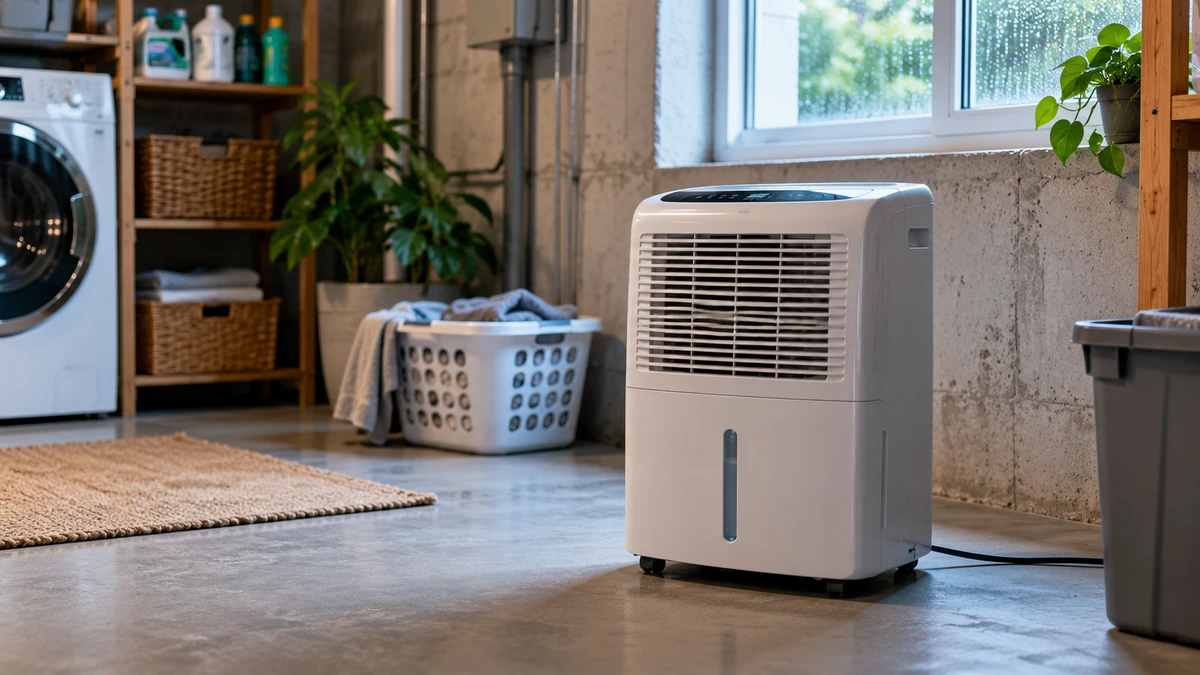
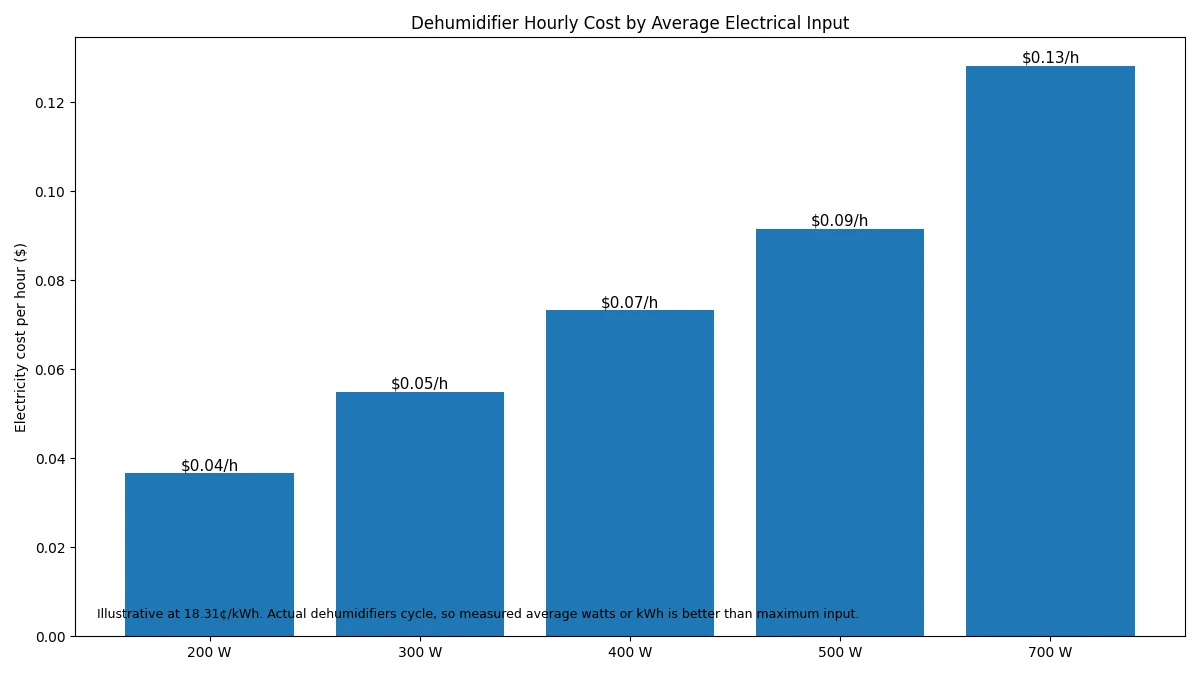
Dehumidifier running cost USA depends on electrical input, runtime, humidity level, room conditions and your electricity rate. Using the U.S. Energy Information Administration’s July 2026 residential average of 18.31¢/kWh, a dehumidifier averaging 300 watts while operating costs about 5.5 cents per hour. A 500-watt average draw is about 9.2 cents per hour, while 700 watts is about 12.8 cents per hour.
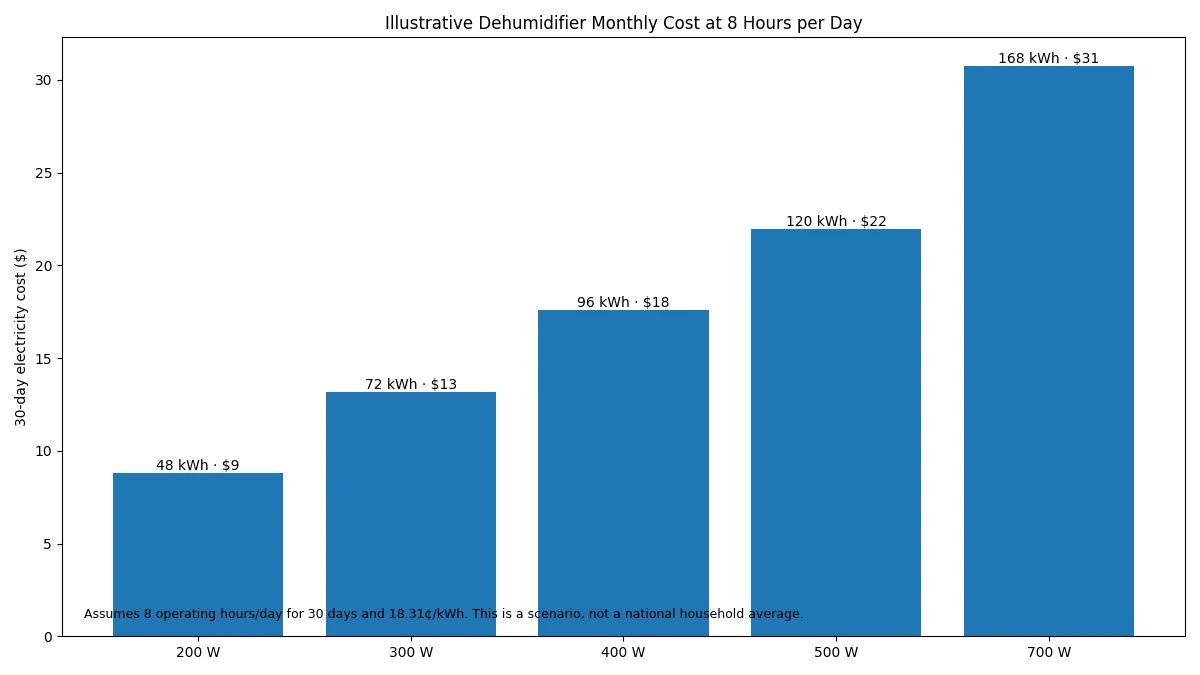
Monthly cost depends much more on how long the compressor actually runs than on the number printed on the box. A 500-watt dehumidifier averaging 8 operating hours per day uses about 120 kWh in 30 days, or roughly $22/month at 18.31¢/kWh. If it runs nearly continuously in a very damp basement, the cost can be much higher.
For your own numbers, use the HomeBillLab U.S. Appliance Running Cost Calculator with measured watts or kWh whenever possible. Dehumidifiers cycle on and off as humidity changes, so a plug-in energy meter can give a more realistic result than multiplying maximum rated watts by every hour of the day.
Table of Contents
Dehumidifier running cost USA: cost per hour
The basic hourly calculation is:
Hourly cost = average electrical input in kW × electricity rate in $/kWh.
| Average electrical input | Cost per hour at 18.31¢/kWh | 8 operating hours |
|---|---|---|
| 200 W | $0.04 | $0.29 |
| 300 W | $0.05 | $0.44 |
| 400 W | $0.07 | $0.59 |
| 500 W | $0.09 | $0.73 |
| 700 W | $0.13 | $1.03 |
These are illustrative power levels, not standard wattages for every dehumidifier size. The correct number is the unit’s measured average input while operating or total kWh over a representative day.
How much does a dehumidifier cost per month?
The table below assumes 8 operating hours per day for 30 days:
| Average input | Monthly electricity | Illustrative cost at 18.31¢/kWh |
|---|---|---|
| 200 W | 48 kWh | $8.79 |
| 300 W | 72 kWh | $13.18 |
| 400 W | 96 kWh | $17.58 |
| 500 W | 120 kWh | $21.97 |
| 700 W | 168 kWh | $30.76 |
If the same 500-watt average draw occurs for 16 hours per day instead of 8, the energy use doubles to 240 kWh/month and the illustrative cost rises to about $44. In a damp basement after flooding or during a humid season, runtime can temporarily be much higher than normal.
The national electricity-price reference used in this guide comes from the U.S. EIA Electric Power Monthly July 2026 summary, which reports an average residential price of 18.31¢/kWh.
Dehumidifier electricity-use formula
If power is shown in watts:
kW = watts ÷ 1,000.
Daily electricity = kW × operating hours.
Running cost = kWh × electricity price.
Example: 450 W is 0.45 kW. If the compressor and fan average 10 operating hours in a day, that is 4.5 kWh. At 18.31¢/kWh, the energy cost is about $0.82 for that day.
When a dehumidifier cycles, “operating hours” should mean the equivalent hours at the average measured draw, not simply the number of hours the unit was switched on.
Pints per day does not tell you running cost by itself
Dehumidifier capacity is commonly stated in pints per day. ENERGY STAR explains that product capacity is the amount of water a dehumidifier can remove in 24 hours under specified test conditions. A larger capacity does not automatically mean a larger electric bill because efficiency and actual runtime also matter.
ENERGY STAR’s dehumidifier testing and capacity guidance explains that DOE ratings focus on two separate concepts: moisture-removal capacity and energy efficiency. That is why comparing only “35-pint” or “50-pint” labels is incomplete.
A larger, more efficient unit that reaches the humidity setpoint quickly can sometimes use less energy than an undersized unit that runs almost continuously. Correct sizing therefore affects both comfort and electricity use.
What is Integrated Energy Factor (IEF)?
ENERGY STAR defines Integrated Energy Factor as liters of water removed per kilowatt-hour, or L/kWh. A higher IEF means the dehumidifier removes more moisture for each unit of electricity.
IEF is useful for comparing products because it combines moisture removal with energy use under the federal test method. It also includes energy consumed during relevant off-cycle, inactive or off modes rather than looking only at compressor-on efficiency.
Do not convert a rated IEF directly into your exact monthly bill unless you also know how many liters of water your home actually needs removed under comparable conditions. Real basements, bedrooms and crawlspaces do not remain at the laboratory test condition every day.
Current 2026 ENERGY STAR dehumidifier criteria
ENERGY STAR Version 6.0 has been effective since October 1, 2025. Current ENERGY STAR dehumidifier efficiency criteria require the following minimum IEF values for portable dehumidifiers:
| Portable dehumidifier capacity | Minimum ENERGY STAR IEF |
|---|---|
| 25.00 pints/day or less | 1.70 L/kWh |
| 25.01–50 pints/day | 2.01 L/kWh |
| 50 pints/day or more | 3.30 L/kWh |
ENERGY STAR also has separate whole-home dehumidifier criteria based on product case volume. Its current dehumidifier buying guidance says certified units use more efficient coils, compressors and fans and use about 20% less energy than similarly sized conventional models.
The current ENERGY STAR certified-product dataset was updated September 30, 2026, so shoppers can compare certified models using current Version 6.0 data rather than older efficiency criteria.
Why humidity level changes dehumidifier electricity use
A dehumidifier’s compressor runs more when the space is humid and less when the target humidity has been reached. A basement at 70% relative humidity after a wet spell may keep a unit running for long periods. The same unit may cycle only occasionally once the room stabilizes near the chosen setpoint.
Water intrusion, damp foundations, open windows, clothes drying, showers and outdoor humidity can all add moisture. If the moisture source is not corrected, the dehumidifier may be forced to remove the same incoming moisture continuously.
ENERGY STAR recommends choosing capacity based on both room size and how damp the space is. That is more useful than selecting the smallest machine and assuming it must be cheaper to operate.
Portable basement dehumidifier vs whole-home dehumidifier
A portable dehumidifier normally treats one room or a limited open area. A whole-home model is installed with ductwork to treat one or more larger spaces and is usually integrated with the home’s air-distribution system.
ENERGY STAR notes that whole-home dehumidifiers can make sense in humid climates and well-sealed homes with central air conditioning when indoor humidity stays above roughly 55% throughout the house. Installation quality and duct sealing are important because the system has to move and dry much more air than a portable unit.
For a single damp basement, a correctly sized portable unit may be the simpler solution. For persistent whole-house humidity, a contractor should evaluate moisture sources, HVAC operation, ventilation and envelope issues before treating dehumidification as the only fix.
Why maximum rated watts can overstate real energy use
A dehumidifier contains a compressor and fan, so power changes as the unit cycles. Maximum or nameplate watts may describe a high operating condition rather than the average draw over an entire day.
That is why a plug-in energy meter can be valuable. If a unit uses 3.6 kWh over a 24-hour period, your actual average power over the full day was 150 watts, even if the compressor drew several hundred watts while running.
The U.S. Department of Energy’s consumer dehumidifier standards page confirms that current compliance testing uses the federal Appendix X1 procedure and IEF as the energy-efficiency metric. DOE’s page also notes ongoing rulemaking activity, which is another reason to use current product data instead of old efficiency tables.
How to reduce dehumidifier running cost
- Fix moisture sources. Repair leaks, improve drainage and avoid leaving windows open during humid weather.
- Use a realistic humidity setpoint. An unnecessarily low setting can make the compressor run longer.
- Choose the right capacity. Undersized equipment can run nearly continuously without controlling humidity.
- Keep filters and air inlets clean. Restricted airflow reduces performance.
- Allow proper clearance. Follow manufacturer instructions so intake and exhaust airflow are not blocked.
- Use continuous drainage where appropriate. A full bucket may stop the machine and allow humidity to rise again.
- Compare IEF. A higher-efficiency model removes more moisture per kWh under the test procedure.
- Measure before guessing. A kWh meter can reveal whether the real cost is much lower or higher than a wattage-based estimate.
For another humidity-related appliance, see Portable Air Conditioner Running Cost USA. If you need to understand the rate used in the calculations, see Electricity Cost per kWh USA. For a continuously cycling household appliance comparison, see Refrigerator Running Cost USA.
HomeBillLab’s treatment of power, runtime, electricity rates and changing source data is documented in the HomeBillLab Methodology.
Dehumidifier running cost USA FAQ
How much does a 500-watt dehumidifier cost per hour?
At 18.31¢/kWh, a constant 500-watt or 0.5 kW draw costs about 9.2 cents per hour. If the compressor cycles off, the average cost across the full day will be lower.
How much electricity does a dehumidifier use per month?
A unit averaging 500 watts for 8 operating hours per day uses about 120 kWh in 30 days. At 18.31¢/kWh, that is about $22. A wetter room or longer runtime can raise the total substantially.
Is a larger dehumidifier always more expensive to run?
No. A larger unit may draw more power while running but can remove moisture faster and cycle off sooner. Capacity, IEF, room conditions and runtime all matter.
What is a good IEF for a dehumidifier?
Higher IEF is better. Current ENERGY STAR Version 6.0 minimums range from 1.70 L/kWh for portable units up to 25 pints/day to 3.30 L/kWh for units rated 50 pints/day or more.
Should I run a basement dehumidifier 24 hours a day?
It can be left available to control humidity if the manufacturer allows continuous operation, but the compressor should normally cycle once the setpoint is reached. If it runs continuously for long periods after the space should have dried, check sizing, setpoint and moisture sources.
Bottom line
For dehumidifier running cost USA, average watts and actual runtime matter more than the capacity number alone. At the July 2026 U.S. residential average of 18.31¢/kWh, a dehumidifier averaging 500 watts costs about 9 cents per operating hour and roughly $22 per month at 8 hours per day. Use your own electricity tariff and measured kWh whenever possible. Test your scenario with the U.S. Appliance Running Cost Calculator and browse the U.S. Appliances hub for related guides.