Gas vs electric water heater running cost depends on local fuel prices, equipment efficiency, hot-water demand and whether the home already has natural-gas service. Using the latest complete same-year national averages from the U.S. Energy Information Administration — 17.30¢/kWh for residential electricity in 2025 and $15.34 per thousand cubic feet (Mcf) for residential natural gas in 2025 — natural gas can have a substantial fuel-cost advantage over a conventional electric-resistance storage water heater.
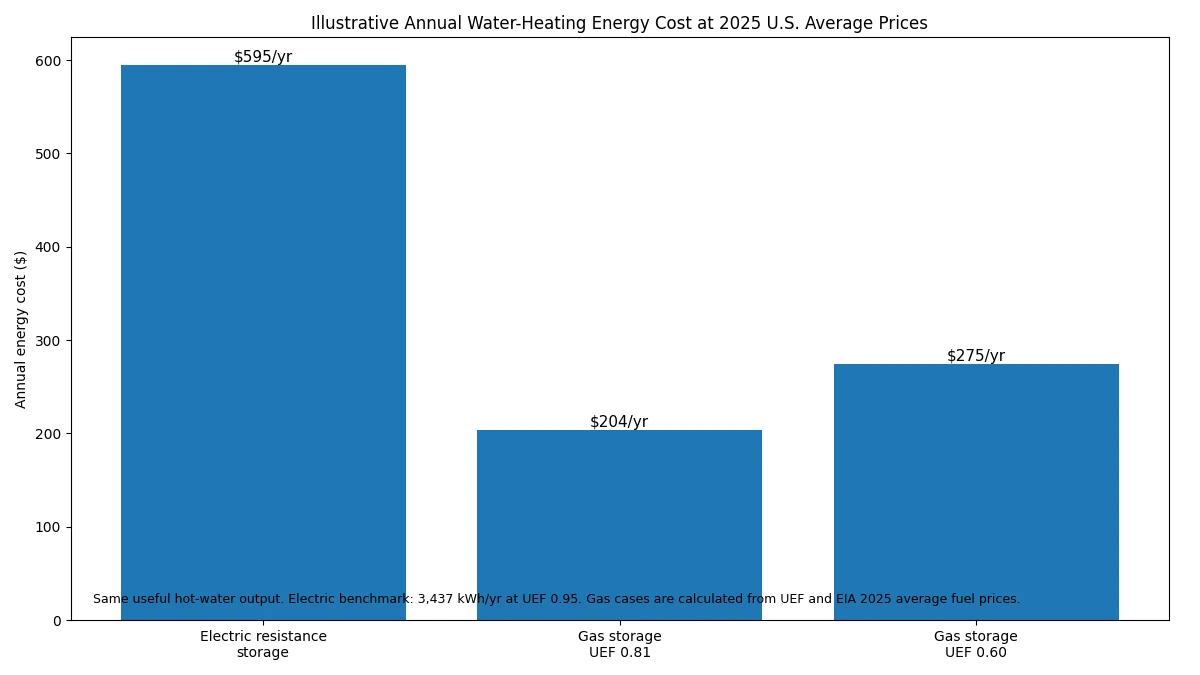
For a transparent apples-to-apples example, start with DOE/FEMP’s conventional electric-storage benchmark of 3,437 kWh/year at UEF 0.95. That benchmark delivers about the same useful annual hot-water energy as roughly 138 therms/year in a gas storage water heater at the current ENERGY STAR minimum UEF of 0.81. At the 2025 national average fuel prices, the illustrative energy cost is about $595/year for electric resistance versus about $204/year for the high-efficiency gas example.
That does not mean gas is always cheaper for every home. A gas-only customer can face fixed monthly gas service charges, installation and venting costs can be significant, and local gas prices vary. Electric resistance is simple to install and may be preferable where gas service is unavailable or expensive. Use the HomeBillLab U.S. Hot Water Running Cost Calculator with your own tariff for the household-specific answer.
Table of Contents
Gas vs electric water heater: which costs less to run?
At 2025 U.S. national-average residential fuel prices, a conventional natural-gas storage water heater generally has a lower energy-only running cost than a conventional electric-resistance storage water heater when both deliver the same useful hot water. The size of that advantage depends heavily on gas-water-heater efficiency.
| Illustrative technology | Efficiency basis | Annual input energy for same useful output | 2025 national-average energy cost |
|---|---|---|---|
| Electric resistance storage | UEF 0.95 benchmark | 3,437 kWh | $595/year |
| Gas storage — high efficiency | UEF 0.81 | 138 therms | $204/year |
| Gas storage — lower-efficiency illustration | UEF 0.60 | 186 therms | $275/year |
The 0.60 gas example is a sensitivity case, not a statement that every standard gas water heater has exactly UEF 0.60. The point is to show that gas efficiency materially changes therm consumption even when the hot-water load is held constant.
Where the national comparison numbers come from
The U.S. Energy Information Administration reports a 2025 annual average residential electricity price of 17.30¢/kWh in its electricity price overview. The same annual period is useful because EIA’s residential natural-gas price series reports $15.34/Mcf for 2025.
EIA’s natural-gas conversion guidance says that 1,000 cubic feet of natural gas equaled about 1.037 MMBtu in 2025, or approximately 10.37 therms per Mcf. That converts the 2025 national residential gas price to about $1.48/therm.
For the electric side, DOE/FEMP’s residential water-heater guidance uses a less-efficient electric storage benchmark of 3,437 kWh/year at UEF 0.95 under the DOE test method. FEMP says the comparison assumes production of 20,075 gallons of hot water per year.
How to compare gas and electric water heaters fairly
Do not compare a therm price directly with a kWh price. One therm contains about 29.3 kWh of energy, and the two appliances convert that input energy to useful hot water at different efficiencies.
A useful framework is:
Useful hot-water energy = input energy × UEF.
For the DOE/FEMP electric benchmark, 3,437 kWh × 0.95 UEF equals about 3,265 kWh of useful annual hot-water service under the simplified comparison. That useful output is equivalent to about 111.4 therms of delivered heat.
A gas unit at UEF 0.81 therefore needs about 111.4 ÷ 0.81 = 138 therms/year. A gas unit at UEF 0.60 needs about 186 therms/year for the same useful output.
Conventional electric-resistance water-heater running cost
A conventional electric storage water heater is simple: resistance elements convert electricity directly to heat. The element itself is nearly 100% efficient at turning electricity into heat, but tank standby losses reduce whole-water-heater efficiency, which is why the DOE/FEMP benchmark is UEF 0.95 rather than 1.00.
At the 2025 U.S. annual residential electricity average of 17.30¢/kWh, the 3,437 kWh benchmark costs about $594.60/year, or roughly $49.55/month. Your own cost should use your utility rate rather than the national average.
For the dedicated conventional-electric guide, see Electric Water Heater Running Cost USA.
Gas storage water-heater running cost
Gas storage units lose more energy through combustion and venting than an electric-resistance tank loses in electrical conversion. That is why gas UEF values are lower. However, natural gas can still produce a lower dollar operating cost when the price per unit of useful heat is substantially lower.
Current ENERGY STAR residential water-heater criteria require gas storage units from more than 20 gallons through 55 gallons to reach at least UEF 0.81 for the medium draw pattern or 0.86 for the high draw pattern. Larger certified gas storage models must reach at least UEF 0.86.
Using UEF 0.81 in the same-load comparison gives about 138 therms/year. At the 2025 national residential gas average of $1.48/therm, that is roughly $204/year for fuel.
What gas price makes the two options equal?
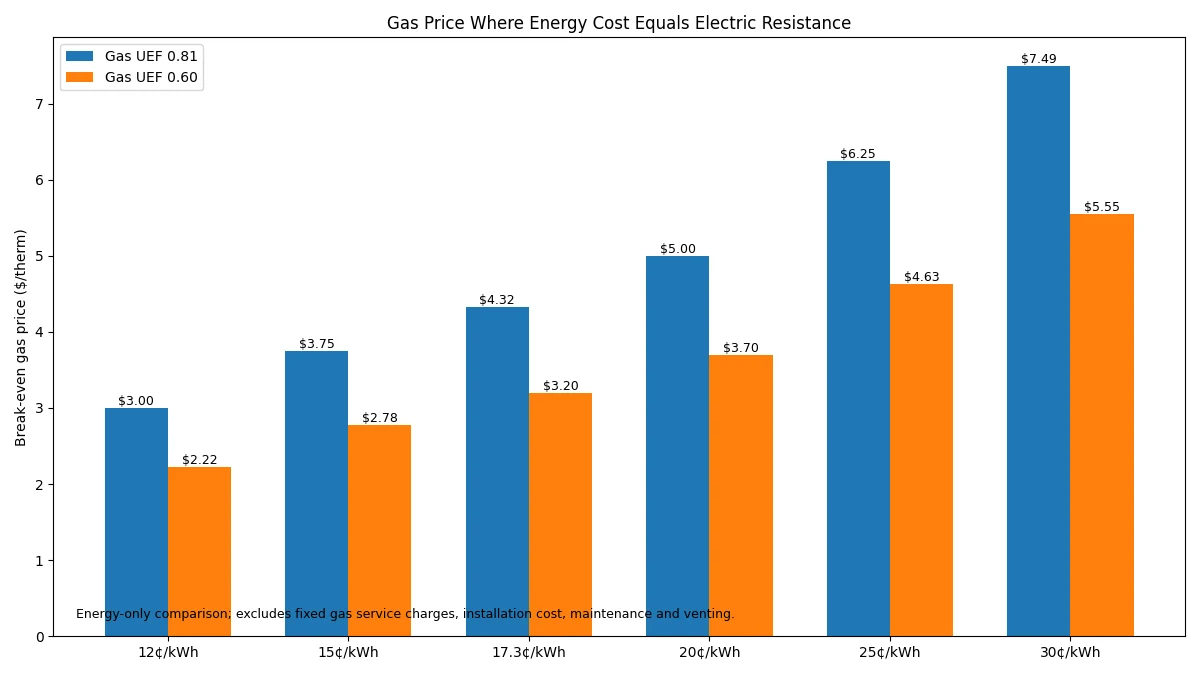
A break-even fuel price is useful because local gas rates vary. At 17.30¢/kWh electricity and the UEF assumptions above, gas at UEF 0.81 reaches the same energy-only annual cost as electric resistance at roughly $4.32/therm. A lower-efficiency UEF 0.60 gas unit reaches break-even around $3.20/therm.
The 2025 national residential gas average was about $1.48/therm, well below either break-even example. But some households can face much higher effective gas costs once fixed service charges are included, especially if water heating is the home’s only gas load.
Fixed gas service charges can change the answer
Energy-only math does not capture the whole household bill. Natural-gas utilities commonly include a monthly customer charge or minimum bill that remains even when therm use is low.
If the home already uses gas for a furnace, cooking or a dryer, the water heater shares that existing gas account and the fixed charge may not be incremental. If you would open a gas account only to operate the water heater, the annual fixed charge should be added to the gas option before comparing it with electric resistance.
For example, a hypothetical $20/month gas customer charge adds $240/year. If that account exists only for water heating, it can erase much of the fuel-cost advantage in some locations. Always compare the incremental cost of keeping or adding gas service, not just therm price.
UEF matters more than the fuel label alone
Uniform Energy Factor is the federal metric used to compare water-heater efficiency. ENERGY STAR defines UEF as the useful energy delivered by the water heater divided by the energy supplied to it under the DOE test method. Higher is better.
A high-efficiency gas storage model at UEF 0.81 or 0.86 can use materially fewer therms than an older or less efficient gas tank. Likewise, a heat pump water heater can have a UEF above 3, dramatically reducing electricity use compared with electric resistance.
That is why the best comparison is not simply “gas vs electricity.” It is fuel price × actual model energy use, ideally using annual kWh or therms from the yellow EnergyGuide label.
Installation cost can outweigh a few years of fuel savings
A like-for-like electric tank replacement can be relatively straightforward when the home already has the correct electrical circuit. A gas tank needs a gas connection, combustion air and compliant venting unless it is a different sealed-combustion design.
Changing fuels can therefore cost far more than replacing an existing heater with the same fuel. New gas piping, vent modifications, chimney work, electrical upgrades, permits and condensate handling for high-efficiency equipment can all affect installed price.
The Federal Trade Commission’s EnergyGuide guidance recommends using model energy-use information to compare operating cost, while remembering that actual cost depends on local energy prices and household use. EnergyGuide does not replace an installation quote.
Gas and electric tanks can feel different in daily use
Gas storage water heaters often have higher burner input than the heating-element input of a typical electric resistance tank, which can provide faster recovery after heavy hot-water use. But recovery depends on tank size, burner or element power, incoming-water temperature and thermostat settings.
When comparing models, check the First Hour Rating (FHR) rather than assuming one fuel always delivers more hot water. ENERGY STAR’s current gas-storage criteria require an FHR of at least 51 gallons per hour, while heat-pump water-heater criteria use a different minimum.
What about a heat pump water heater?
A heat pump water heater is electrically powered but should not be grouped with conventional electric resistance when comparing running cost. It moves heat from the surrounding air into the water and can use far less electricity.
DOE/FEMP’s current standardized table lists an ENERGY STAR heat-pump example at 984 kWh/year, compared with 3,437 kWh/year for the conventional electric storage benchmark. At 17.30¢/kWh, 984 kWh is about $170/year — actually below the high-efficiency gas example in the national-average scenario.
That is why a homeowner choosing among all technologies should include heat-pump water heaters rather than treating the decision as only gas versus resistance electric. See Heat Pump Water Heater Running Cost USA and Heat Pump Water Heater vs Electric Water Heater.
2026 buying context and the 2029 federal standards
DOE’s current consumer water-heater standards page says amended standards for several consumer water-heater classes were finalized in 2024, became effective July 5, 2024, and require compliance beginning May 6, 2029.
Those 2029 requirements do not force a homeowner to replace a working 2026 water heater. They apply to products manufactured under the future compliance standard. Today’s comparison should therefore use the model you can actually buy and its current EnergyGuide data.
Which one is cheaper for your home?
- If you already have gas service and inexpensive gas: a gas storage water heater can have a large energy-cost advantage over electric resistance.
- If gas service would exist only for the water heater: add the annual customer charge before calling gas cheaper.
- If electricity is inexpensive or you have solar: electric operating economics can improve substantially.
- If you are open to heat-pump technology: compare HPWH running cost separately; it can beat both conventional options in many rate scenarios.
- If replacement requires major fuel-switching work: installation cost may dominate the first several years of energy savings.
HomeBillLab’s fuel-price handling, unit conversions and source hierarchy are documented in the HomeBillLab Methodology. Browse the U.S. Hot Water hub for related guides.
Gas vs electric water heater FAQ
Is a gas water heater cheaper to run than an electric water heater?
At 2025 U.S. national-average residential fuel prices, the energy-only comparison favors gas storage over conventional electric resistance in the scenarios shown here. Your local rates, gas fixed charges and exact model efficiencies can change the result.
How much does an electric water heater cost per year?
DOE/FEMP’s conventional electric storage benchmark uses 3,437 kWh/year. At the 2025 U.S. residential average of 17.30¢/kWh, that is about $595/year.
How much gas does a gas water heater use per year?
There is no single number for every household. In this same-use illustration, a UEF 0.81 gas storage heater needs about 138 therms/year, while a UEF 0.60 example needs about 186 therms/year.
Is gas still cheaper if I pay a monthly gas customer charge?
It depends. If the gas account already exists for heating or cooking, the water heater may add only incremental therm consumption. If the water heater is the only gas appliance, the annual fixed service charge should be added to the gas option.
Is a heat pump water heater cheaper than gas?
It can be. In DOE/FEMP’s standardized example, an ENERGY STAR HPWH uses 984 kWh/year. At the 2025 national residential electricity price, that is about $170/year, which is below the high-efficiency gas-storage example calculated here. Local rates and installation conditions still determine the household result.
Bottom line
For gas vs electric water heater running cost, national 2025 energy prices favor natural gas over conventional electric resistance in a same-hot-water-load comparison. Using a UEF 0.81 gas storage example gives roughly $204/year in gas versus about $595/year for DOE/FEMP’s conventional electric storage benchmark. But fixed gas charges, installation cost, local tariffs and model efficiency can change the decision. Use the U.S. Hot Water Running Cost Calculator with your own numbers before choosing.