
Heat pump water heater rebates USA are still available in 2026, but the incentive landscape changed significantly after the federal 25C tax credit ended for property placed in service after December 31, 2025. The biggest remaining opportunities now come from state-administered Home Energy Rebates, utility programs, regional efficiency programs and local offers.
The key point is that there is no single nationwide 2026 rebate that every homeowner can claim automatically. Availability depends on your state or territory, income, existing water-heater fuel, utility service area, product efficiency, project timing and whether program funds are still open. Some programs are active; others are waitlisted or fully reserved.
Before buying a unit, check the current program status and reserve the rebate first if required. Then compare the remaining project cost with expected operating savings using the HomeBillLab U.S. Hot Water Running Cost Calculator.
Table of Contents
Heat pump water heater rebates USA: what is available in 2026?
There are four main places to look for a heat pump water heater incentive in 2026:
- State-administered HEEHR programs: the federal program design allows up to $1,750 for a qualifying heat pump water heater, subject to income, state implementation, current DOE rules and available funding.
- HOMES rebates: whole-home efficiency projects can receive rebates based on modeled energy savings and household income.
- Utility or regional efficiency programs: electric and gas utilities, statewide efficiency administrators and regional programs may offer separate rebates.
- Local or municipal programs: some cities, community-choice providers or local agencies offer additional incentives.
EPA’s current ENERGY STAR Rebate Finder lists hundreds of heat pump water heater offers nationwide, but the exact result depends on ZIP code and service territory. Treat the finder as a starting point and verify the offer on the program administrator’s own website before purchasing.
Did the federal heat pump water heater tax credit end in 2026?
Yes. The federal Energy Efficient Home Improvement Credit under Internal Revenue Code Section 25C is not available for qualifying property placed in service after December 31, 2025.
The IRS’s current energy-credit termination FAQ states that Section 25C is not allowed for property placed in service after December 31, 2025. That means a heat pump water heater installed in 2026 does not qualify for the former 25C homeowner credit.
This distinction matters because many older rebate articles still show the former federal tax credit of 30% up to $2,000. That information can still be relevant to a 2025 tax return for qualifying property placed in service in 2025, but it is not a 2026 purchase incentive.
HEEHR can provide up to $1,750 for a heat pump water heater
The federal Home Energy Rebates program includes the High-Efficiency Electric Home Rebates program, or HEEHR. DOE’s Home Upgrades guidance lists an ENERGY STAR electric heat pump water heater as potentially eligible for a HEEHR rebate of up to $1,750.
The program is administered by states, territories and Tribes rather than through a single national homeowner application. DOE’s current Home Energy Rebates page says rebates are available in select states and directs households to their state or territory energy office for current program status and eligibility.
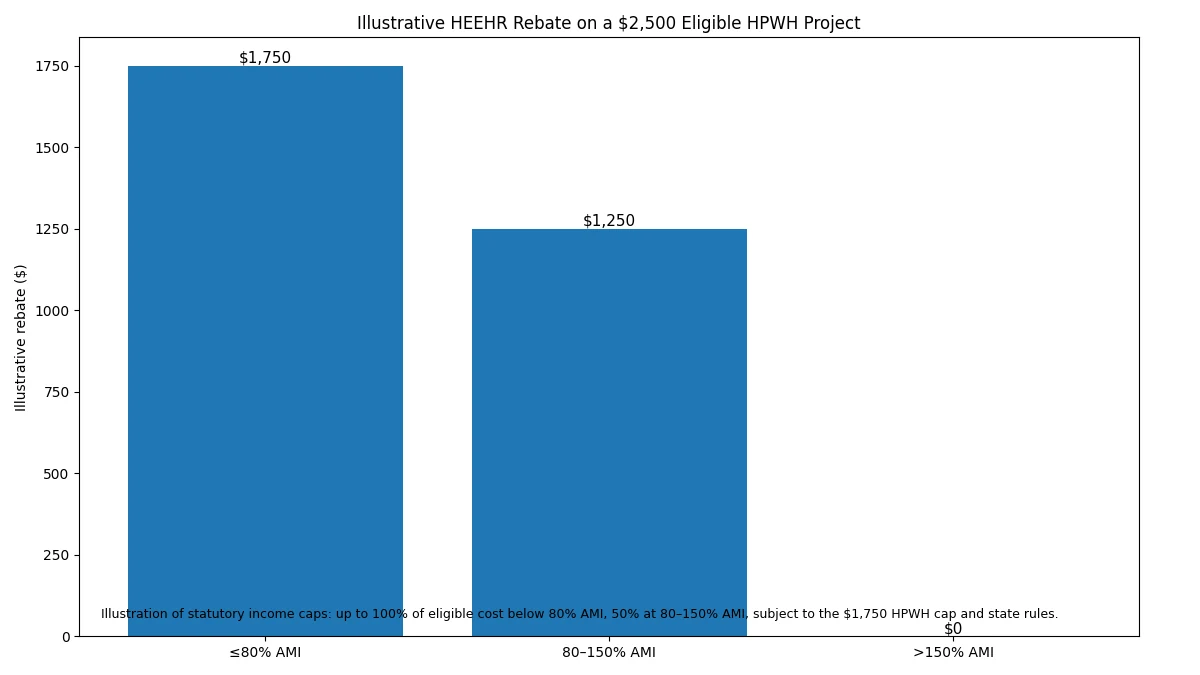
Under the underlying HEEHR income structure, households at or below 80% of area median income can be eligible for up to 100% of qualified project cost, while households from 80% to 150% of area median income are generally limited to 50% of qualified cost, subject to the product cap and the state’s implementation. Households above 150% AMI are not eligible for HEEHR.
Important 2026 change: HEEHR no longer broadly supports fuel-switching projects
DOE changed HEEHR program guidance in May 2026. The current HEEHR Program Notice 26-2 removes the prior program allowance for fuel-switching and says rebates for HVAC and appliances should now upgrade existing electric equipment to more efficient electric equipment. New-construction electric equipment remains allowable under the notice.
For heat pump water heaters, this means you should not assume that replacing a gas, propane or oil water heater with an HPWH will qualify for the federal-state HEEHR rebate in 2026. A state program that has implemented the new DOE guidance may restrict new reservations to electric-to-electric upgrades.
The same notice says programs that were already launched were required to adapt within three months unless DOE approved an exception, while already approved reservations made under earlier rules could still be completed. This is another reason to check the current state program page rather than relying on an older eligibility list.
HOMES rebates can include water heaters as part of a whole-home project
The second federal-state pathway is the Home Owner Managing Energy Savings, or HOMES, program. DOE says HOMES rebates can support whole-home energy upgrades that produce at least 20% modeled savings, and eligible project measures can include water heaters along with insulation, air sealing, HVAC, duct sealing and other improvements.
DOE’s current Home Energy Rebates page says households can save up to $8,000 on qualifying whole-home upgrades, with higher rebates possible for households below 80% of area median income. The exact project rules are controlled by the state or territory program.
HOMES is not simply a $1,750 appliance coupon. The project has to meet the applicable whole-home energy-savings pathway, so it may make more sense when a heat pump water heater is part of a larger retrofit.
State programs can be active, waitlisted or fully reserved
State availability changes quickly because programs have finite budgets. California provides a useful 2026 example of why homeowners must check status before buying.
TECH Clean California’s current single-family incentive page says HEEHRA/HEEHR single-family rebates were fully reserved statewide as of February 24, 2026, and the program stopped accepting new income-verification applications. Some submitted projects were moved to waitlists, and a waitlisted project is eligible only if the heat pump is installed after the reservation is approved.
This does not mean California has no heat pump incentives at all. TECH directs users to statewide incentive-finder resources and also operates separate targeted or multifamily pathways. The lesson is that the status of one funding bucket cannot be generalized to an entire state.
Utility and regional programs can continue even after the federal tax credit ended
Utility rebates are often the simplest 2026 incentive because they can be tied directly to the customer’s electric account, retailer, distributor or contractor. These offers are not nationally standardized and can change during the year.
EPA’s ENERGY STAR Rebate Finder is useful because it filters participating utility and program offers by ZIP code and product category. Still, always click through to the program administrator because equipment requirements, install dates and application deadlines can differ.
Current 2026 heat pump water heater rebate examples
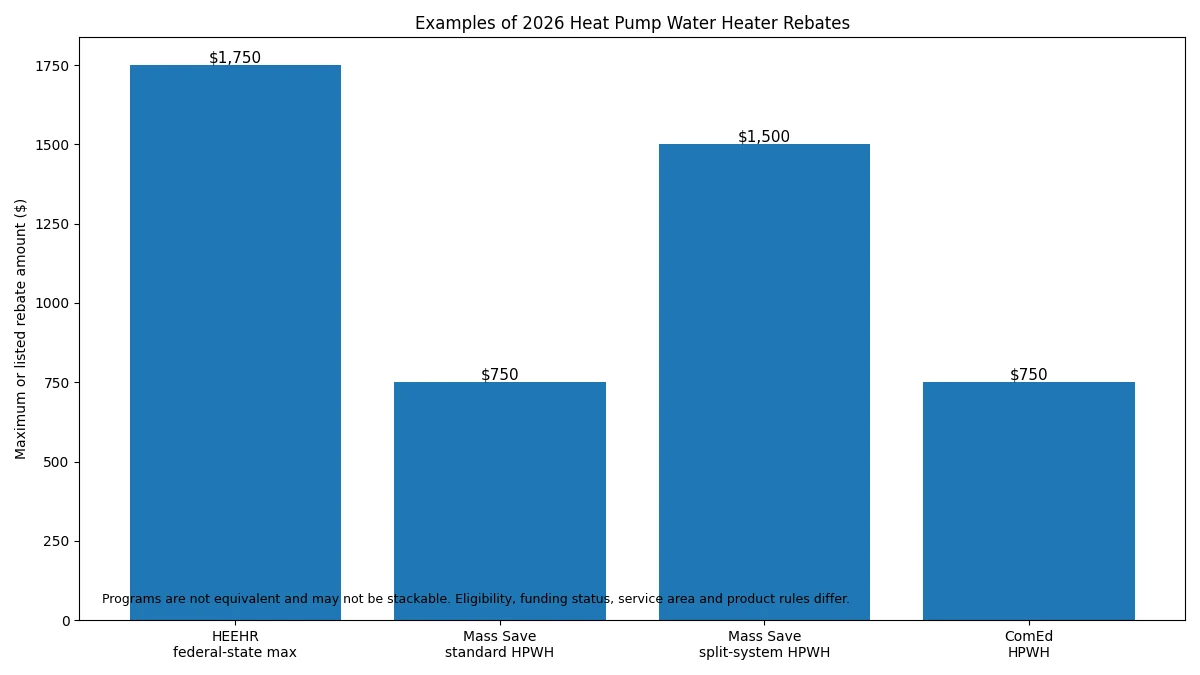
The following examples show how different 2026 programs can look. They are not a national price list and should not be assumed to stack with one another.
| Program | 2026 example | Important condition |
|---|---|---|
| Federal-state HEEHR | Up to $1,750 for an eligible HPWH | State implementation, income, current 2026 DOE rules and funding availability apply |
| Mass Save | $750 for qualifying HPWH; $1,500 for qualifying split-system HPWH | Participating Massachusetts sponsor territory; 2026 install and product requirements |
| ComEd | $750 HPWH rebate | ENERGY STAR Rebate Finder lists offer valid July 1–December 31, 2026; service-area restrictions apply |
| TECH Clean California single-family HEEHRA | Fully reserved statewide as of February 24, 2026 | Waitlist and targeted-program rules may apply |
Mass Save’s current 2026 heat pump water heater page lists a $750 rebate for qualifying ENERGY STAR units and $1,500 for qualifying split-system HPWHs. The offer is limited to eligible customers in participating sponsor territories and has 2026 installation and submission deadlines.
For northern Illinois, ENERGY STAR’s current incentive database lists a $750 ComEd heat pump water heater rebate valid from July 1 through December 31, 2026, via online application or mail-in process, subject to the utility’s restrictions.
Can you stack a heat pump water heater rebate with another incentive?
Sometimes, but never assume that every listed incentive can be added together. Program rules differ.
DOE’s 2026 HEEHR notice encourages states and territories to combine HEEHR funding with other programs where permitted, but it also states that a HEEHR rebate may not be combined with another federal grant or rebate for the same qualified electrification project. Utility and state non-federal incentives can have their own anti-stacking rules.
Mass Save, for example, states that its 2026 HPWH rebate may not be combined with another utility or energy-efficiency service-provider offer for the same equipment. That kind of program-specific restriction is why a simple “add every rebate together” calculation can be wrong.
The former 25C tax credit is not part of a new 2026 project stack because it ended for property placed in service after December 31, 2025.
How to find heat pump water heater rebates in your ZIP code
- Start with ENERGY STAR Rebate Finder. Enter your ZIP code and filter for Heat Pump Water Heaters.
- Check your state energy office. Look for HEEHR and HOMES program status, income rules and reservation requirements.
- Check your electric utility. Search its rebates or energy-efficiency section using your exact account service territory.
- Check regional efficiency administrators. Programs such as Mass Save can operate across several utilities under one statewide framework.
- Check municipal and community-choice programs. Local programs can exist outside the main state or utility rebate.
- Verify funding before purchase. A program page that says “fully reserved” or “waitlist” is not the same as an open rebate.
Because these offers can change faster than appliance efficiency standards, HomeBillLab treats rebate availability as time-sensitive data. The ENERGY STAR Heat Pump Water Heater Rebate Finder is one of the best nationwide starting points for current local offers.
What to verify before buying the water heater
- Funding status: open, waitlisted, fully reserved or closed.
- Reservation rule: some programs require approval before purchase or installation.
- Existing fuel: especially important under the revised 2026 HEEHR electric-to-electric rule.
- Income eligibility: HEEHR uses area-median-income thresholds.
- Product qualification: many programs require ENERGY STAR certification and a minimum UEF.
- Installation date: offers often have a defined 2026 installation window.
- Contractor rule: some programs require a participating contractor or distributor.
- Application deadline: the install can occur before year-end while paperwork is due later.
- Stacking restrictions: check every program before counting multiple incentives.
- Final installed cost: include electrical work, condensate drainage, permits and labor.
After incentives, compare the remaining project cost with operating savings. See Heat Pump Water Heater Running Cost USA for annual electricity-use examples, Heat Pump Water Heater vs Electric Water Heater for the resistance-electric comparison, and Electric Water Heater Running Cost USA for the conventional electric benchmark.
HomeBillLab’s source hierarchy, freshness rules and treatment of time-sensitive incentives are documented in the HomeBillLab Methodology. Browse the U.S. Hot Water hub for related guides.
Heat pump water heater rebates USA FAQ
Is there still a $2,000 federal heat pump water heater tax credit in 2026?
No for a new 2026 installation. IRS guidance says the Section 25C Energy Efficient Home Improvement Credit is not allowed for property placed in service after December 31, 2025.
Can I get a $1,750 rebate for a heat pump water heater in 2026?
Potentially, through a state-administered HEEHR program. The federal program maximum for an eligible HPWH is up to $1,750, but actual eligibility depends on state availability, income, product rules, existing equipment and current 2026 DOE guidance.
Can HEEHR pay for replacing a gas water heater with a heat pump water heater?
Do not assume so in 2026. DOE Program Notice 26-2 removed the general HEEHR allowance for fuel-switching and directs new rebates toward upgrades from existing electric equipment to more efficient electric equipment, with new-construction electric equipment also allowed.
Are utility rebates still available after the federal tax credit expired?
Yes in many service territories. For example, Mass Save lists 2026 HPWH rebates and ENERGY STAR lists a 2026 ComEd HPWH rebate. Availability depends on service area, equipment and funding.
Should I buy the water heater before applying for the rebate?
Only if the specific program allows it. Some incentives are instant point-of-sale discounts, some are post-install rebates, and others require a reservation before installation. Read the current program rules first.
Where is the best place to search for local HPWH rebates?
Start with the ENERGY STAR Rebate Finder, then verify the result with your utility, state energy office or program administrator. Funding status can change quickly.
Bottom line
Heat pump water heater rebates USA did not disappear in 2026, but the path changed. The former federal homeowner tax credit ended after 2025. The main 2026 opportunities are now state-administered HEEHR and HOMES programs plus utility, regional and local rebates. HEEHR can provide up to $1,750 for an eligible HPWH, but the 2026 DOE rules, income limits, existing-equipment requirements and state funding status all matter. Check the rebate before you buy, reserve funds if required, and calculate the remaining project cost with the U.S. Hot Water Running Cost Calculator.