Heat pump vs gas furnace running cost depends on two things more than anything else: your local electricity-to-gas price ratio and how efficiently the heat pump operates in your winter climate. At the latest complete same-year U.S. averages for 2025 — 17.30¢/kWh for residential electricity and $15.34/Mcf for residential natural gas — a heat pump needs a fairly strong seasonal COP to beat a high-efficiency gas furnace on energy-only heating cost.
Using EIA’s 2025 gas heat-content conversion, $15.34/Mcf is about $1.48/therm. At those national fuel prices, a 95% AFUE gas furnace costs about $15.57 per useful MMBtu of heat. A heat pump costs about $16.90/MMBtu at COP 3.0 and $14.49/MMBtu at COP 3.5. The break-even COP against the 95% furnace is roughly 3.26.
That national comparison is a benchmark, not a verdict for every home. Electricity and gas prices vary sharply by state and utility, heat-pump COP falls as outdoor temperature drops, fixed gas customer charges can matter, and a heat pump can replace both a furnace and an air conditioner. Use the HomeBillLab U.S. Heating Running Cost Calculator with your own tariffs and equipment data.
Table of Contents
Heat pump vs gas furnace: which costs less to run?
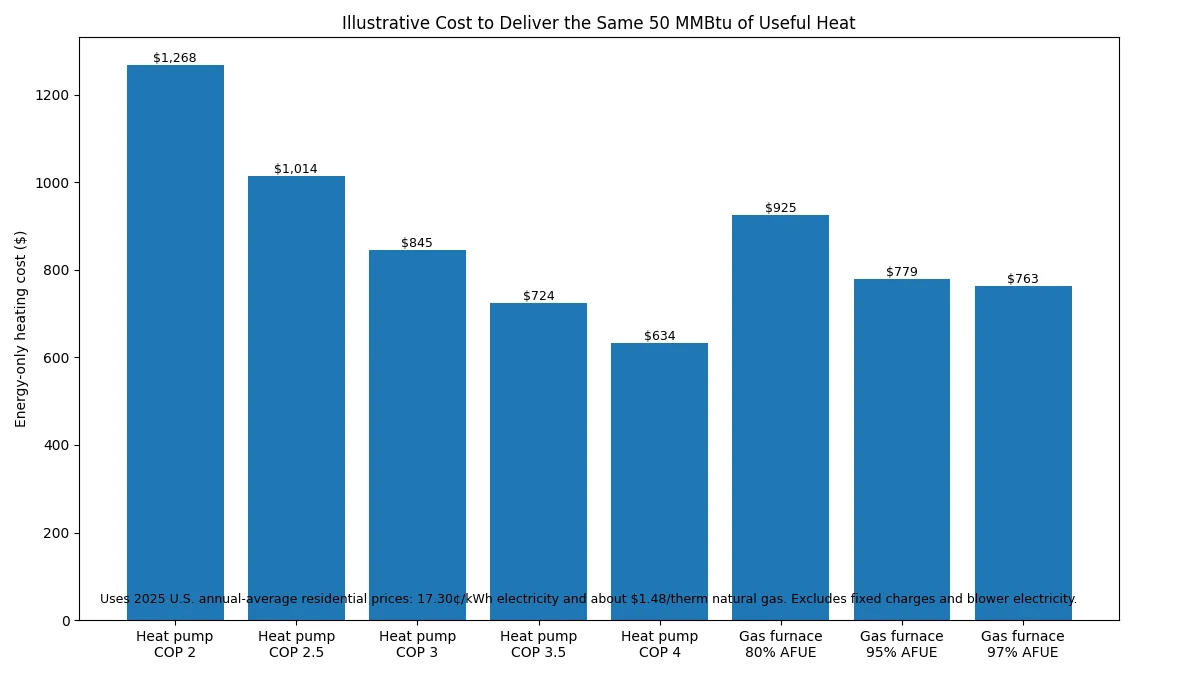
At the 2025 U.S. national-average fuel prices used here, the answer changes with heat-pump COP. A high-efficiency gas furnace at 95% AFUE is cheaper than a heat pump averaging COP 3.0, but a heat pump averaging COP 3.5 is cheaper on energy-only useful heat cost.
| Heating option | Efficiency assumption | Energy cost per useful MMBtu | 50 MMBtu useful heat |
|---|---|---|---|
| Heat pump | COP 2.0 | $25.35 | $1,268 |
| Heat pump | COP 2.5 | $20.28 | $1,014 |
| Heat pump | COP 3.0 | $16.90 | $845 |
| Heat pump | COP 3.5 | $14.49 | $724 |
| Heat pump | COP 4.0 | $12.68 | $634 |
| Gas furnace | 80% AFUE | $18.49 | $925 |
| Gas furnace | 95% AFUE | $15.57 | $779 |
| Gas furnace | 97% AFUE | $15.25 | $763 |
The 50 MMBtu column is an illustrative useful-heating load so the technologies can be compared on the same output. Your house may need far less or far more heat over a winter.
How to compare electricity and natural gas fairly
Do not compare cents per kWh with dollars per therm directly. Those are different energy units, and the equipment efficiencies are also different.
One MMBtu of heat equals about 293.1 kWh of energy or 10 therms. A heat pump with COP 3.0 delivers three units of heat for each unit of electrical energy it consumes. A 95% AFUE gas furnace delivers about 95% of the fuel’s heating value as useful space heat under the standardized seasonal metric.
The simplified energy-only formulas are:
Heat pump cost per useful MMBtu = electricity price × 293.1 ÷ COP.
Gas furnace cost per useful MMBtu = gas price per therm × 10 ÷ AFUE.
Latest complete same-year U.S. fuel-price benchmark
For a fair national comparison, this guide uses complete-year 2025 prices for both fuels. EIA’s electricity price overview reports a 2025 residential annual average of 17.30¢/kWh.
EIA’s annual residential natural-gas price table reports $15.34/Mcf for 2025. EIA’s natural-gas conversion FAQ states that 1 Mcf averaged about 10.37 therms in 2025, which converts the national annual residential price to about $1.48/therm.
State and utility prices can differ dramatically from those national numbers. Use the benchmark only to understand the mechanics; replace both rates with the ones on your own bills for a household decision.
Heat-pump COP is the key running-cost variable
Coefficient of Performance, or COP, is the ratio of heat delivered to electricity consumed at a specific operating condition. ENERGY STAR’s current heat-pump criteria define COP that way and require split-system products to meet at least 7.8 HSPF2 and 15.2 SEER2.
COP is not constant through the winter. A heat pump may operate at a high COP during mild weather and a much lower COP when it is very cold outside. That is why the table above shows several COP values instead of pretending one number fits the whole country.
At 17.30¢/kWh, every useful MMBtu costs about $25.35 at COP 2.0, $20.28 at COP 2.5, $16.90 at COP 3.0, $14.49 at COP 3.5 and $12.68 at COP 4.0.
Gas-furnace AFUE determines therm use
Annual Fuel Utilization Efficiency, or AFUE, is the percentage of the fuel’s heat that becomes useful space heat instead of being lost. ENERGY STAR’s current furnace criteria require at least 97% AFUE in the U.S. North and 95% AFUE in the U.S. South for certified gas furnaces.
At the 2025 national gas price of about $1.48/therm, a 95% furnace needs about 10.53 therms to deliver one useful MMBtu, for an energy-only cost of about $15.57. A 97% model is slightly lower at $15.25.
An older or less efficient furnace changes the comparison. At 80% AFUE, the same useful MMBtu costs about $18.49 at the national gas benchmark.
What COP does a heat pump need to beat a gas furnace?
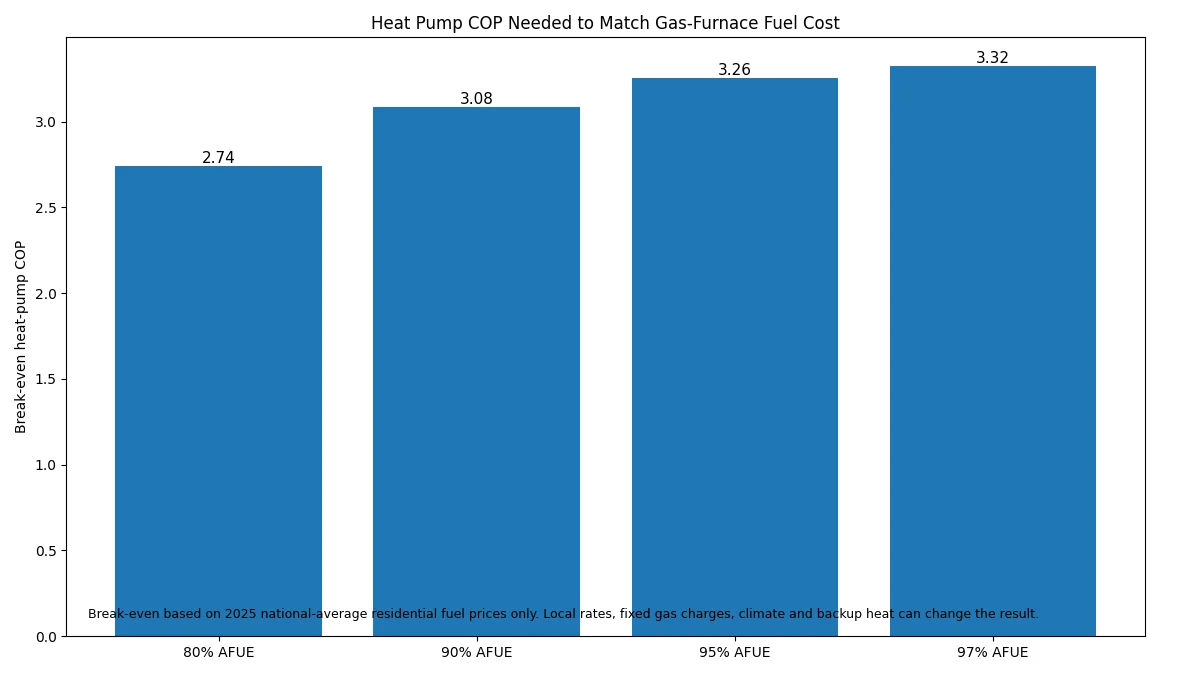
At the national 2025 fuel prices used here, the break-even heat-pump COP is approximately:
| Gas furnace AFUE | Heat-pump break-even COP |
|---|---|
| 80% | 2.74 |
| 90% | 3.08 |
| 95% | 3.26 |
| 97% | 3.32 |
If your heat pump’s effective seasonal COP is above the break-even number, its energy-only heating cost is lower. If it is below the break-even number, the gas furnace is cheaper on fuel alone.
This is why the same heat pump vs gas furnace comparison can produce different results in California, New England, the Midwest and the Mountain West. Both fuel prices and winter operating conditions vary.
Cold weather can change heat-pump economics quickly
DOE’s Heat Pump Systems guidance says modern air-source heat pumps are now a legitimate heating option in colder regions, but outdoor temperature still affects capacity and efficiency.
ENERGY STAR’s current cold-climate criteria require a qualifying split-system heat pump to demonstrate COP of at least 1.75 at 5°F and at least 70% of its 47°F heating capacity at 5°F. That is a low-temperature certification threshold, not a claim that every cold-climate heat pump runs at COP 1.75 all winter.
A system can spend much of the season at milder temperatures and higher COP, then operate less efficiently during cold snaps. Backup resistance heat can also raise electricity use if it runs frequently. For cold climates, look at the exact model’s low-temperature performance and design temperature instead of relying only on headline HSPF2.
Fixed gas charges and furnace electricity can shift the result
The comparison above is energy-only. A gas bill can include a monthly customer charge that stays even when therm use is low. If the gas account exists only for the furnace, that fixed annual cost should be included when comparing a future all-electric heat pump.
A gas furnace also uses electricity for the blower, inducer motor, ignition and controls. That electrical use is normally much smaller than the gas energy input, but it is not zero. A precise household comparison should include both fuels.
On the other hand, some electricity tariffs have high winter rates or demand charges that can make heat-pump operation more expensive. Use the full tariff, not just an advertised base energy rate.
A heat pump also replaces the air conditioner
A gas furnace provides heating only. Most homes with central gas heat also need a separate central air conditioner for cooling. An air-source heat pump provides both heating and cooling with the same refrigeration system.
That means the replacement decision is bigger than winter fuel cost. If an aging furnace and aging AC would both need replacement, one heat-pump system may avoid buying a separate new cooling-only condenser. Conversely, a newer furnace paired with a good existing AC changes the economics.
For the dedicated heat-pump operating-cost guide, see Heat Pump Running Cost USA. For furnace-only costs, see Gas Furnace Running Cost USA.
Ducts, sizing and installation quality matter on both systems
A high-efficiency furnace or heat pump can underperform if the duct system leaks, the equipment is oversized, airflow is incorrect or controls are poorly configured. Both systems deliver heat through the same building envelope, so insulation and air sealing also change how many useful MMBtu the home needs.
Weatherization can therefore improve the economics of either technology. DOE specifically recommends weatherizing older homes when replacing gas heating with a heat pump so the new system can deliver better comfort and operating savings.
For another efficiency comparison, see Heat Pump vs Electric Resistance Heating Cost USA.
Which system fits which home?
- Heat pump can make sense when: electricity is relatively inexpensive, winters are moderate or the selected model maintains strong cold-weather performance, gas fixed charges are high, or the AC also needs replacement.
- Gas furnace can make sense when: gas is inexpensive, winters are very cold, the home already has a good gas account and furnace infrastructure, and electricity is relatively expensive.
- Dual-fuel can make sense when: a heat pump handles milder weather and a gas furnace takes over below an economic or comfort balance point.
- For any option: correct load calculation, duct condition and installation quality matter as much as the nameplate efficiency.
HomeBillLab’s handling of fuel-price conversions, COP, AFUE and same-use comparisons is documented in the HomeBillLab Methodology. Browse the U.S. Heating hub for related guides.
Heat pump vs gas furnace FAQ
Is a heat pump cheaper to run than a gas furnace?
Sometimes. At 2025 national-average fuel prices, a heat pump needs about COP 3.26 to match the energy-only heating cost of a 95% AFUE gas furnace. Local rates and winter temperatures can move that break-even point substantially.
What COP is good for a heat pump?
Higher COP is better, but COP changes with outdoor temperature and operating point. A mild-weather COP above 3 can be common for efficient equipment, while very cold weather can reduce COP materially. Use the exact model’s performance data.
Does a 97% AFUE furnace save much versus 95% AFUE?
For the same useful heat load, the fuel-input difference is modest: a 97% furnace needs about 2.1% less gas than a 95% furnace. Installation cost, venting and blower efficiency may matter more than the small AFUE difference alone.
What happens when the heat pump needs backup resistance heat?
Resistance backup has an effective COP near 1, so frequent auxiliary-heat operation can raise electricity cost sharply. Proper sizing, thermostat settings and a cold-climate model can reduce unnecessary backup use.
Should I compare only winter utility bills?
No. A heat pump also provides cooling, while a gas furnace does not. For a replacement decision, compare annual heating and cooling costs plus equipment and installation costs.
Bottom line
For heat pump vs gas furnace running cost, there is no universal winner. At 2025 U.S. average residential fuel prices, a heat pump needs roughly COP 3.26 to match a 95% AFUE gas furnace on useful-heat energy cost. Mild-climate operation above that COP can favor the heat pump; cold-weather operation below it can favor gas. Local utility rates, gas fixed charges, backup heat and the need for air conditioning can all change the whole-home result. Use the U.S. Heating Running Cost Calculator with your own numbers.