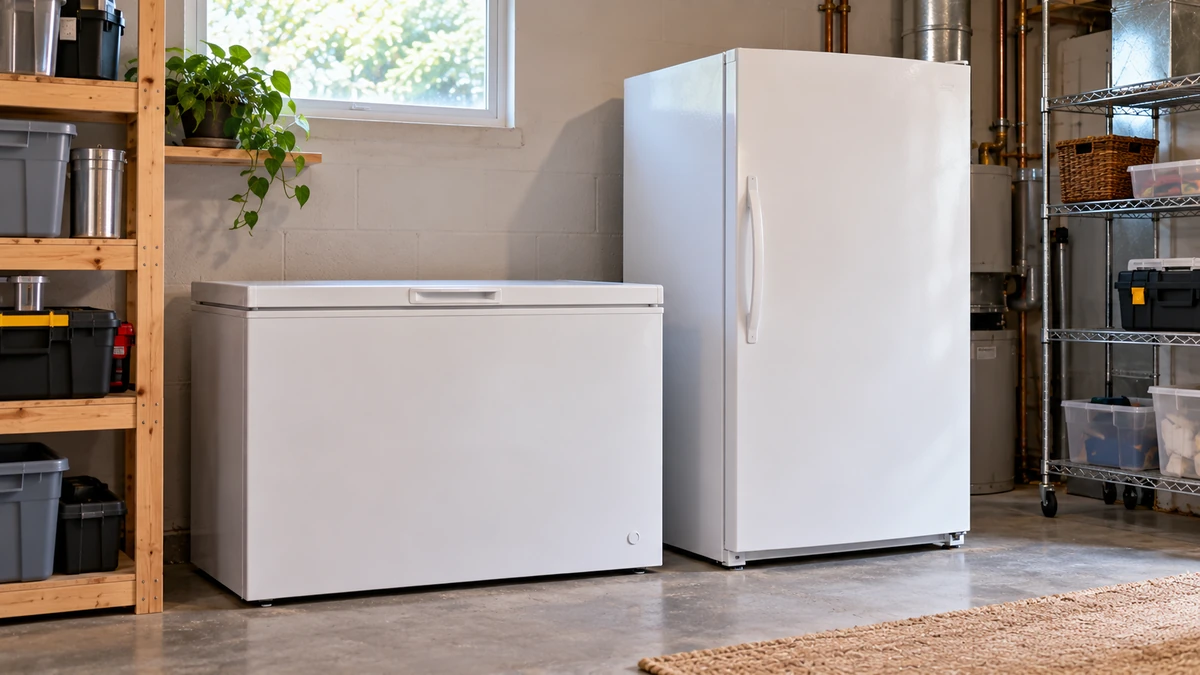
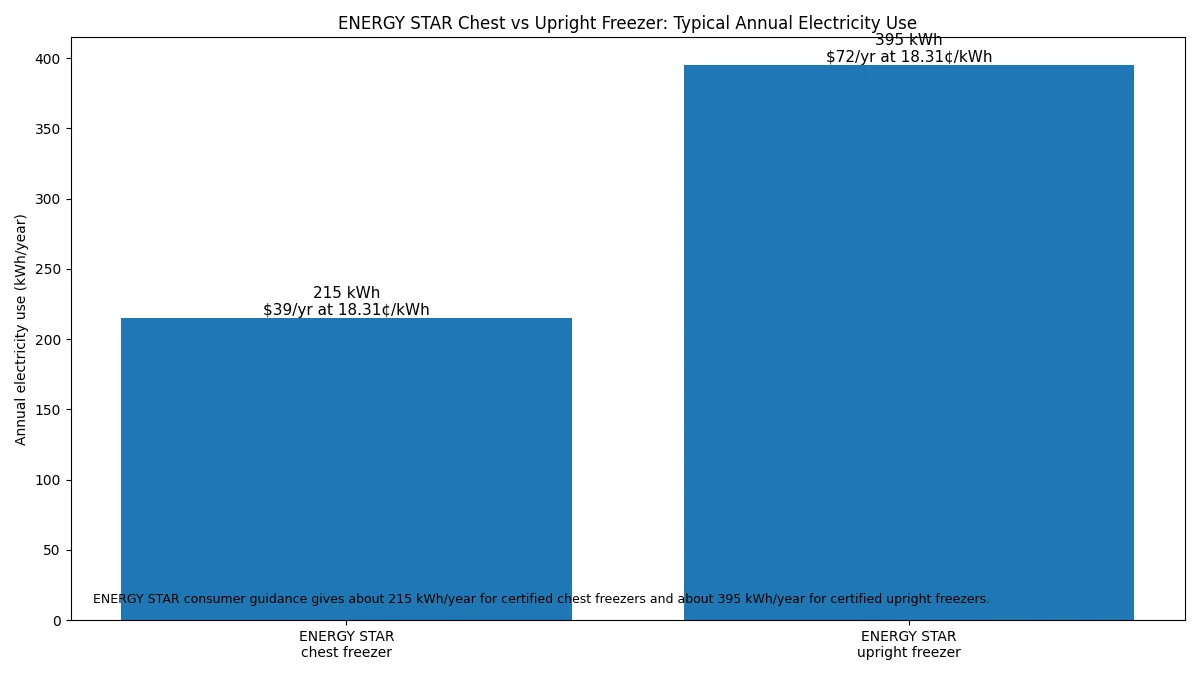
Freezer running cost USA depends mainly on the model’s annual electricity use in kWh and your local electricity price. ENERGY STAR says an ENERGY STAR certified chest freezer uses about 215 kWh/year, while an ENERGY STAR certified upright freezer uses about 395 kWh/year. At the U.S. Energy Information Administration’s July 2026 residential average of 18.31¢/kWh, that works out to roughly $39/year for the chest-freezer example and $72/year for the upright example.
The difference is about 180 kWh/year, or roughly $33/year at that national electricity price. That does not mean every chest freezer costs less than every upright freezer. Size, defrost type, insulation, garage temperature, age, door seals and actual model efficiency can all change the result.
The most accurate shopping method is to use the model’s yellow EnergyGuide annual kWh figure and reprice it using your own utility rate. You can also use the HomeBillLab U.S. Appliance Running Cost Calculator to convert annual kWh, watts or measured usage into operating cost.
Table of Contents
Freezer running cost USA: chest vs upright
For ENERGY STAR certified models, the program’s current consumer guidance gives a useful national reference:
| ENERGY STAR freezer type | Approx. annual electricity | Cost at 18.31¢/kWh | Monthly equivalent |
|---|---|---|---|
| Chest freezer | 215 kWh/year | $39.37/year | $3.28/month |
| Upright freezer | 395 kWh/year | $72.32/year | $6.03/month |
ENERGY STAR’s current freezer buying guidance says chest freezers are usually more energy efficient because the lid opens from the top and less cold air escapes. It also says ENERGY STAR certified freezers are at least 10% more energy efficient than the minimum federal standard.
How to calculate a freezer’s annual electricity cost
When annual energy use is already known, the calculation is simple:
Annual cost = annual kWh × electricity price per kWh.
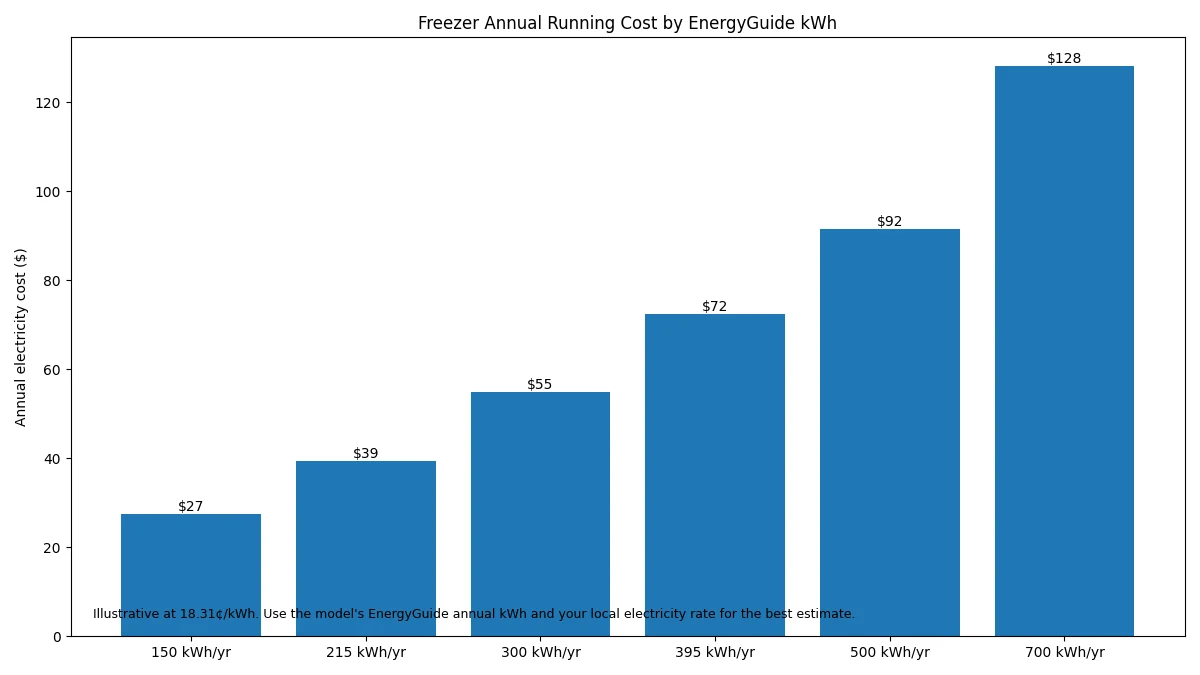
At 18.31¢/kWh, the following annual EnergyGuide values would cost approximately:
| Annual electricity use | Cost at 18.31¢/kWh |
|---|---|
| 150 kWh/year | $27.47/year |
| 215 kWh/year | $39.37/year |
| 300 kWh/year | $54.93/year |
| 395 kWh/year | $72.32/year |
| 500 kWh/year | $91.55/year |
| 700 kWh/year | $128.17/year |
The EIA’s July 2026 Electric Power Monthly summary reports the national residential average electricity price of 18.31¢/kWh used in these examples. Your own utility price may be substantially lower or higher.
Use the yellow EnergyGuide label instead of guessing from watts
A freezer compressor cycles on and off, so the rated watts on a nameplate are not a good estimate of annual electricity use by themselves. The yellow EnergyGuide label is usually much more useful because it shows standardized annual energy consumption for that specific model.
The Federal Trade Commission’s EnergyGuide consumer guidance confirms that freezers are among the appliances required to carry the label. The label lets buyers compare energy use with similar appliances and gives an estimated operating cost.
FTC also warns that the estimated operating cost is only an estimate based on typical use and a national average energy price. Your actual cost depends on how you use the freezer and your local electricity price. For HomeBillLab calculations, the annual kWh number is therefore more reusable than the printed annual dollar estimate.
Why chest freezers often cost less to run than upright freezers
Cold air is denser than warm air and tends to stay low. When you open the top lid of a chest freezer, less cold air spills out compared with opening the full-height front door of an upright freezer. ENERGY STAR specifically identifies this as one reason chest freezers are usually more energy efficient.
Chest freezers also often have simpler interior layouts and may use manual defrost, which can reduce energy use further. The trade-off is convenience: upright freezers are easier to organize because shelves and front access make food easier to see and reach.
That means the lower-energy design is not automatically the best purchase for every household. If poor organization causes food to be forgotten or the lid to remain open while you search, some of the energy advantage may be less valuable in practice.
Manual defrost vs automatic defrost
ENERGY STAR’s freezer guidance says manual-defrost freezers use about half the energy of automatic-defrost models, although they require periodic manual defrosting to maintain that advantage. ENERGY STAR recommends not allowing frost to build beyond about one-quarter inch.
Automatic defrost is more convenient because the freezer periodically warms parts of the system to prevent frost buildup. That convenience uses additional electricity. When comparing two similarly sized freezers, check defrost type as well as annual kWh.
A heavily frosted manual-defrost freezer can also lose efficiency, so its theoretical advantage depends on proper maintenance.
Bigger freezers usually use more electricity
ENERGY STAR notes that larger freezers generally consume more energy. A 20-cubic-foot freezer should not be compared directly with a compact 7-cubic-foot model just because both are uprights or both are chest freezers.
When shopping, compare annual kWh between models of similar usable volume and configuration. A larger freezer can still be efficient for its size, but it may use more total electricity simply because it maintains a larger cold space.
EPA’s current refrigerator and freezer criteria confirm that federal efficiency limits depend on configuration, adjusted volume, defrost type and features. ENERGY STAR freezers of 7.75 cubic feet or more must use at least 10% less measured energy than the applicable federal minimum.
Garage temperature can change freezer electricity use
A freezer has to move heat from inside the cabinet to the surrounding room. When the surrounding space is very hot, the compressor can run longer and work against a larger temperature difference. Very cold ambient temperatures can also create operating problems for some models that are not designed for those conditions.
ENERGY STAR recommends keeping freezers indoors unless you live in a mild climate because extreme temperatures are hard on the compressor and can reduce appliance life. If the freezer will be installed in a garage, check the manufacturer’s approved ambient-temperature range.
Also leave the ventilation clearances specified by the manufacturer. Trapped condenser heat makes the compressor work harder.
An old freezer can cost much more than a new efficient model
Age alone does not determine energy use, but old compressors, worn door gaskets, damaged insulation and older efficiency standards can all increase consumption. The easiest way to know is to measure kWh with a plug-in meter if the freezer is compatible with one and the meter is rated safely for the load.
ENERGY STAR says replacing an old freezer with an ENERGY STAR model can save about $300 over the appliance’s 12-year lifetime under its program assumptions. Your dollar savings depend on the old freezer’s actual kWh and your electricity price.
For another continuously cycling cold appliance, see Refrigerator Running Cost USA.
Current freezer efficiency standards and the 2029–2030 change
The U.S. Department of Energy’s current Refrigeration Products page says consumer refrigerators and freezers are subject to federal energy-conservation standards and DOE test procedures.
DOE finalized amended refrigeration-product standards in 2024. The rule became effective May 16, 2024, but compliance with the new standards is required in 2029 or 2030 depending on product class. That means a freezer sold in 2026 is still evaluated under the current applicable standards; the future compliance dates do not require homeowners to replace existing freezers.
For 2026 shopping, the most practical efficiency comparison remains the specific model’s EnergyGuide annual kWh plus ENERGY STAR certification where available.
How to reduce freezer running cost
- Set the freezer to 0°F. ENERGY STAR recommends this temperature for normal operation.
- Check door or lid seals. Warm-air leakage increases compressor runtime.
- Keep the door closed. Limit the time spent searching for food.
- Defrost manual models. Do not let frost become excessive.
- Leave ventilation space. Keep condenser airflow clear.
- Avoid extreme ambient temperatures. Follow the manufacturer’s installation range.
- Buy the right size. An unnecessarily large freezer creates more cold volume to maintain.
- Compare annual kWh before buying. EnergyGuide makes model-to-model comparison much easier.
If you need to reprice a freezer for your own utility rate, see Electricity Cost per kWh USA. For another appliance where room conditions affect running cost, see Dehumidifier Running Cost USA.
HomeBillLab’s treatment of electricity rates, model energy-use data and illustrative operating-cost calculations is documented in the HomeBillLab Methodology. Browse the U.S. Appliances hub for related guides.
Freezer running cost USA FAQ
How much does a chest freezer cost to run per year?
ENERGY STAR says a certified chest freezer uses about 215 kWh/year. At 18.31¢/kWh, that is about $39/year. Actual models vary, so check the EnergyGuide label.
How much does an upright freezer cost to run per year?
ENERGY STAR gives about 395 kWh/year as a current certified upright-freezer reference. At 18.31¢/kWh, that is roughly $72/year.
Why do chest freezers usually use less electricity?
The top-opening design lets less cold air spill out when the lid is opened. Chest models also commonly use manual defrost, which can reduce energy use compared with automatic defrost.
Does an upright freezer always cost more?
No. Model size, efficiency, defrost system and age matter. A small efficient upright can use less energy than a large or old chest freezer. Compare annual kWh for the exact models.
Does a freezer use the same electricity every month?
No. Ambient temperature, door openings, food loading, frost and compressor cycling change monthly consumption. Annual EnergyGuide kWh is designed as a standardized comparison value rather than a prediction of every month.
Bottom line
For freezer running cost USA, annual kWh is the number that matters most. ENERGY STAR’s current consumer guidance gives about 215 kWh/year for a certified chest freezer and 395 kWh/year for a certified upright freezer. At the July 2026 U.S. residential average of 18.31¢/kWh, that is approximately $39 versus $72 per year. Use the model’s EnergyGuide annual kWh and your own utility rate for the best estimate, then test it with the U.S. Appliance Running Cost Calculator.