
Fixed vs variable electricity rates USA comparisons are mainly about how the electricity-supply price behaves during a contract. A fixed-rate product is designed to keep the supplier price stable for a stated term, while a variable-rate product can change from one billing cycle to another under the supplier’s rules.
The important catch is that this choice is not available in the same way everywhere. In restructured or retail-choice markets, some customers can choose an alternate electricity supplier; in vertically integrated markets, the serving utility generally supplies the electricity as well as delivering it. The U.S. Energy Information Administration explains the distinction in its customer-choice FAQ.
If you are comparing plans, start with the contract structure, then check the actual cents-per-kWh price, delivery charges, usage assumptions, renewal terms and any cancellation fee. For a household bill estimate, use the HomeBillLab U.S. Electricity Bill Calculator with your own rate details.
Table of Contents
What is the difference between fixed and variable electricity rates?
A fixed-rate electricity plan generally sets the supplier’s electricity price for a contract term. In Texas retail-electricity rules, a fixed product must have a term of at least three months and its recurring price is intended to remain the same during the term, although specified items such as transmission and distribution utility charges, grid administrative fees, or law-driven costs can still change. See the Public Utility Commission of Texas customer-protection rule.
A variable-rate electricity plan allows the supplier’s price to change. Texas rules define a residential variable-price product as month-to-month and require the supplier to disclose the current price and a price history for residential customers. The exact rules depend on the state and market, so the contract and regulator guidance for your location control.
Massachusetts gives another useful consumer example: its Department of Public Utilities says competitive suppliers may offer fixed and variable rates; a fixed rate stays the same for the contract period, while a variable rate typically changes month to month according to market conditions and the agreement. See Massachusetts electric-supply guidance.
Where can U.S. customers choose an electricity supplier?
Supplier choice depends on where you live and which utility serves the property. EIA says some electric-utility customers in restructured states can select an alternate electricity supplier, while the local distribution utility still delivers the electricity to the meter. Texas is a special case in much of the ERCOT market, where many customers are required to choose a retail electricity provider.
The U.S. Department of Energy also distinguishes vertically integrated markets from retail-choice markets. In a vertically integrated market, the serving utility is responsible for generation, transmission and distribution. In a retail-choice market, eligible customers may choose the supplier for the commodity portion of the bill. DOE’s overview is available in its electricity-procurement market guide.
Before comparing fixed vs variable electricity rates USA offers, confirm that competitive supply is actually available to your address. Your state utility regulator or distribution utility is usually the best place to verify eligibility.
Fixed vs variable electricity rates: side-by-side comparison
| Feature | Fixed-rate plan | Variable-rate plan |
|---|---|---|
| Supply price | Designed to remain stable for the contract term, subject to allowed pass-through changes | Can change between billing cycles under the plan terms |
| Contract length | Usually a defined term | Often month-to-month |
| Budget predictability | Higher for the supply-rate component | Lower because the supply rate can move |
| Benefit if market prices fall | You may remain on the contracted rate until renewal | Your rate may fall, depending on the supplier’s pricing method |
| Risk if market prices rise | The contracted supply price is generally more insulated during the term | Your rate may rise |
| Early cancellation | May involve a termination fee | Often more flexible, but check the terms |
| Renewal | Can renew to a different fixed or variable product | Price can continue changing under the new/current terms |
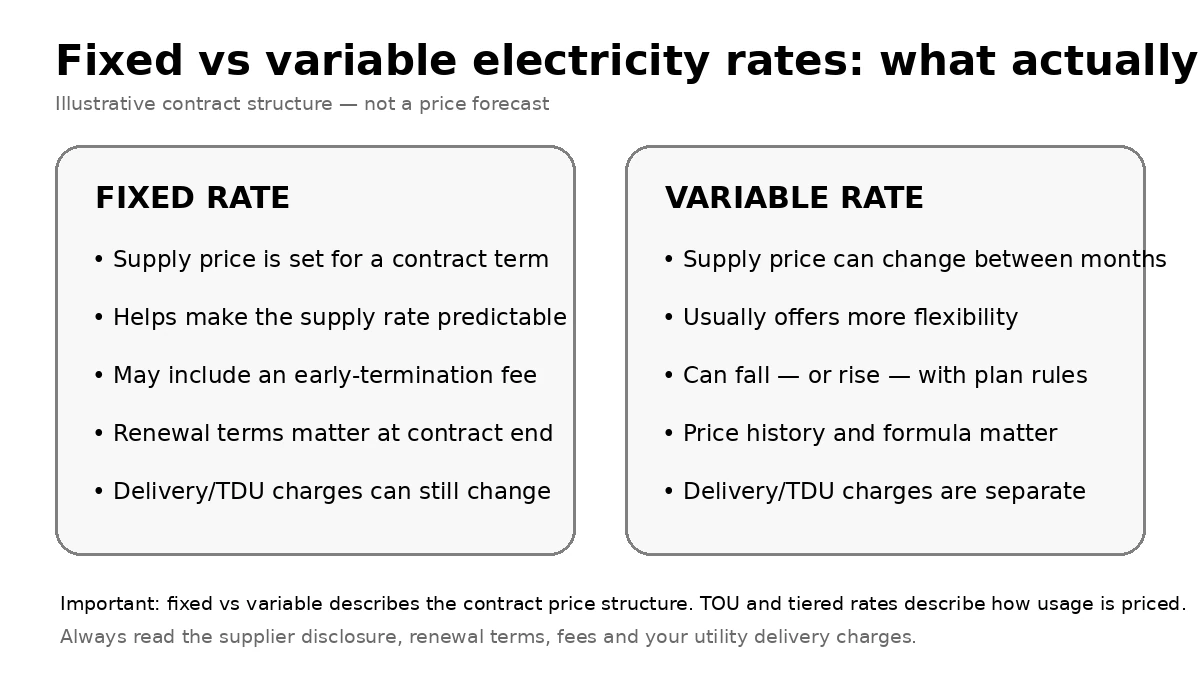
The PUCT’s current consumer fact sheet, Types of Electric Plans, makes the practical distinction clearly: fixed plans keep the provider’s price stable during the contract except for defined pass-through changes, while variable plans have no fixed contract period and can move from month to month. It also notes that indexed and time-of-use products are separate plan features that can sit alongside these structures.
How does a fixed-rate electricity plan work?
With a fixed-rate plan, the supplier commits to a pricing structure for a defined term. That can make the supply portion of the bill easier to budget because you are not expecting the supplier’s cents-per-kWh price to reset every month.
- Contract term: commonly several months or longer, depending on the state and supplier.
- Supply-rate stability: the contracted supplier price is designed to remain stable during the term.
- Possible pass-through changes: regulated delivery or transmission charges, taxes, fees or other items allowed by the contract or law may still move.
- Exit cost: some plans charge an early-termination fee.
- Renewal risk: the new rate after the term can be materially different from the old rate.
That means “fixed” does not necessarily mean the entire monthly bill is fixed. Usage still changes, and delivery charges or other bill components can change independently. Our electricity supply vs delivery charges guide explains that split.
How does a variable-rate electricity plan work?
A variable-rate plan gives the supplier room to change the supply price between billing periods under the plan terms. That can offer flexibility, but it also makes the next month’s supply price less predictable.
Variable does not automatically mean “market index.” Some products use a supplier-determined variable price, while an indexed product follows a disclosed formula tied to a public index. Texas consumer rules treat variable and indexed products separately. Always check whether the agreement explains how the price changes or merely states that it can change.
Massachusetts consumer guidance warns that competitive-supply variable rates may change after an introductory period and recommends asking how the rate changes, how long the contract lasts, whether there is an introductory price, and whether the contract automatically renews.
Fixed vs variable is not the same as time-of-use or tiered pricing
This distinction prevents a lot of confusion. Fixed vs variable describes how the supplier’s contract price changes over time. Time-of-use pricing changes the price according to when electricity is used. Tiered pricing changes the applicable rate as usage moves through defined blocks or baseline thresholds.
- A plan can be fixed-rate and still have different on-peak and off-peak prices.
- A plan can have tiered usage charges without being a competitive-supplier variable product.
- A variable-rate plan can change monthly even if the household uses electricity at the same time of day.
For the other structures, see our time-of-use electricity rates USA guide and tiered electricity rates USA guide.
Illustrative fixed vs variable bill examples
Suppose a household uses 1,000 kWh in a month and we look only at the electricity-supply component. These are hypothetical rates for explaining the math, not market quotes.
| Scenario | Supply rate | 1,000 kWh supply cost |
|---|---|---|
| Fixed plan | 14.0¢/kWh | $140 |
| Variable plan — lower month | 12.5¢/kWh | $125 |
| Variable plan — higher month | 18.0¢/kWh | $180 |
The arithmetic is simple: kWh × supply rate. The decision is harder because the future variable price is not known in advance, while a fixed contract can come with term commitments or cancellation fees. Delivery charges, fixed customer charges, taxes and credits must then be added to estimate the final bill.
If you first need the household’s effective rate, use our electricity cost per kWh USA guide.
What should you check before choosing a fixed or variable plan?
- Current supply price: compare cents per kWh on the same basis.
- Contract term: note the start date, end date and renewal rules.
- Variable-price method: ask exactly how and when the price can change.
- Price history: where available, review previous monthly prices rather than only the current offer.
- Early-termination fee: understand the cost of leaving before the term ends.
- Introductory rate: check when any teaser price expires.
- Delivery charges: confirm which utility charges are outside the supplier’s advertised energy price.
- Usage assumptions: compare the plan at your likely kWh use, not only at one advertised example level.
- Auto-renewal: find out whether the plan rolls to a new fixed rate, a variable rate or another default product.
Read the plan disclosure and terms of service rather than relying on a headline price. Texas requires an Electricity Facts Label that identifies whether a product is fixed or variable and shows average pricing information under specified usage assumptions.
What happens when a fixed electricity contract expires?
The answer depends on the contract and state rules. A fixed contract can renew to another fixed product, move to a variable product, or default to another supplier offer. This is one of the highest-value details to check before signing.
For example, Texas law requires multiple expiration notices for residential fixed-rate products and requires disclosure of early-termination charges. If the customer does not choose another product, the default renewal product must be month-to-month and cancellable without a fee under the applicable Texas rule framework. Your state may work differently, so treat this as an example rather than a national rule.
Frequently asked questions
Is a fixed electricity rate always cheaper than a variable rate?
No. A fixed rate trades some price flexibility for greater predictability in the supplier-rate component. A variable rate may be lower in some months and higher in others. The outcome depends on the actual prices during the period, your usage, fees and contract terms.
Can my bill change even if I have a fixed electricity rate?
Yes. Your electricity use can change, and delivery charges, taxes, regulated fees or other allowed pass-through items can also change. “Fixed” usually refers to the supplier pricing structure, not a fixed total monthly bill.
Are variable electricity rates the same as wholesale-indexed rates?
No. A variable product can change according to a supplier’s method, while an indexed product follows a disclosed pricing formula tied to an index. Regulators can treat these as distinct product types.
Can a fixed-rate plan also be a time-of-use plan?
Yes. The contract may fix the schedule of on-peak and off-peak prices for a term while still charging different rates depending on when electricity is used.
How do I know whether electricity supplier choice is available to me?
Check with your state utility regulator or local distribution utility. Retail choice varies by state, utility type and service territory.
Bottom line
When comparing fixed vs variable electricity rates USA offers, focus on the contract mechanics before trying to pick a winner. Fixed plans can make the supply rate more predictable; variable plans can move from month to month and may offer more flexibility. Neither structure guarantees the lower total cost.
Compare the full supply terms, delivery charges, cancellation rules, renewal language and your own expected usage. Browse more U.S. rate and billing guides in the HomeBillLab U.S. Electricity hub. For how HomeBillLab builds transparent examples and keeps source periods visible, see our methodology.