
Tiered electricity rates USA plans charge different prices for different blocks of electricity use during a billing period. Instead of one flat cents-per-kWh price for every unit, the first block of kWh may be cheaper and later blocks may cost more. That is why two households on the same utility can have different effective prices per kWh even when they are on the same basic rate plan.
The exact thresholds and prices are local, not national. Some utilities use a simple two-tier structure tied to a baseline allowance, while others use three or four usage blocks. Other households may be on a flat rate, a time-of-use plan, or another tariff entirely. The safest way to understand your bill is to identify the official rate schedule and then calculate each block separately.
HomeBillLab’s U.S. Electricity Bill Calculator can still help with bill estimates, but tiered tariffs need an extra step because the calculator does not automatically model every utility’s block thresholds. This guide shows how to do that step and how to convert a tiered bill into a useful blended rate.
Table of Contents
What are tiered electricity rates?
A tiered rate divides electricity consumption into usage blocks. Each block has its own per-kWh price. In an inclining or progressive tier design, later blocks cost more per kWh than earlier blocks. The idea is simple: lower household use is billed at the lower block price, while higher use moves additional kWh into more expensive tiers.
The U.S. Energy Information Administration explains in its electricity price overview that retail electricity prices vary by locality because of factors such as generation resources, fuel costs, transmission and distribution systems, weather and regulation. That makes national and state averages useful context, but they still cannot tell you the tier thresholds or exact tariff that applies to your own account.
Tiered pricing is also different from a simple electricity cost per kWh benchmark. A benchmark is one average number. A tiered tariff is a set of rules that determines which kWh are billed at which price.
Why does your electricity price change when you use more?
On a progressive tier plan, the utility intentionally charges the first block of usage at a lower rate and later usage at a higher rate. The threshold may be a fixed monthly number of kWh, or it may be based on a daily or seasonal baseline allowance that changes with climate, billing-period length or heating type.
California provides a clear example of the baseline approach. The California Public Utilities Commission’s electric-rates guidance says the baseline quantity is intended to cover a significant portion of reasonable household energy needs and must be priced lower per kWh than electricity used above the baseline. Baseline quantities can vary by climate zone and season.
Other utilities use fixed monthly usage bands. In that design, the first 300 kWh might be Tier 1, the next several hundred kWh Tier 2, and so on. The exact structure is utility-specific, so the phrase “tiered rate” describes the pricing method rather than one national set of thresholds.
How are tiered electricity charges calculated?
Most progressive block tariffs charge each portion of usage at the rate assigned to that block. Reaching a higher tier does not normally mean every kWh from the start of the month is retroactively charged at the highest rate. Always confirm your tariff, but the usual calculation is block by block.
Suppose an illustrative plan uses these three blocks:
| Usage block | Illustrative rate | Usage in a 1,000 kWh month | Charge |
|---|---|---|---|
| Tier 1: first 400 kWh | 15¢/kWh | 400 kWh | $60 |
| Tier 2: next 400 kWh | 20¢/kWh | 400 kWh | $80 |
| Tier 3: usage above 800 kWh | 30¢/kWh | 200 kWh | $60 |
| Total | — | 1,000 kWh | $200 |
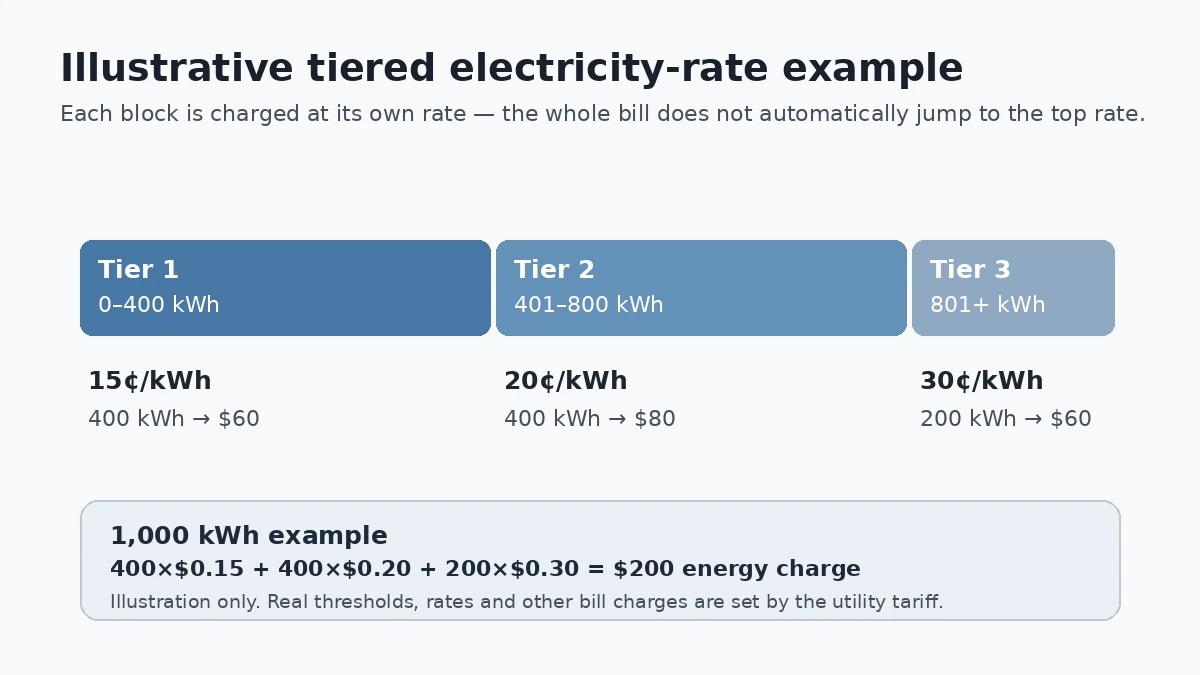
The energy charge is therefore $200, not $300. Multiplying all 1,000 kWh by the top 30¢ rate would overstate the cost in this example. The blended energy rate is $200 ÷ 1,000 kWh = 20¢/kWh.
That blended rate is useful for comparing one billing period with another, but it is not the same as the marginal price of the next kWh. If the household is already in Tier 3, the next additional kWh may cost 30¢ in the example even though the month’s blended energy rate is 20¢.
Baseline allowances vs fixed kWh thresholds
Not every tier plan uses fixed numbers such as 0–400 kWh. Some California tariffs use a baseline allowance. The allowance can depend on the customer’s climate zone, season, number of billing days and whether the home uses electric heat.
Southern California Edison’s current Tiered Rate Plan starts each billing period at Tier 1 and moves usage above the applicable baseline allocation into Tier 2. SCE’s page also shows that the daily baseline allocation changes by region and between summer and winter.
PG&E describes the same basic mechanism in its Tiered Rate Plan: electricity within the Baseline Allowance is Tier 1, while electricity above the allowance is Tier 2. The allowance varies with location, heating source and season.
That means two customers using the same number of kWh can have different tier allocations if their applicable baseline quantities differ. It is another reason not to copy another household’s threshold without checking your own tariff.
Current U.S. examples of tiered residential rates
Tier designs vary widely. These tiered electricity rates USA examples show two different structures that were published by the utilities in October 2026. They are examples of rate design, not national prices and not quotes for your address.
| Utility example | How the tiers work | Published energy-rate example |
|---|---|---|
| Southern California Edison Schedule D | Two tiers tied to the customer’s baseline allocation | Tier 1: 30¢/kWh; Tier 2: 39¢/kWh on the utility page effective Oct. 1, 2026 |
| Austin Energy — inside City of Austin | Four fixed monthly energy-charge blocks | 0–300 kWh: 4.872¢; 301–900: 5.395¢; 901–2,000: 7.901¢; above 2,000: 11.428¢ |
Austin Energy’s residential rate page is especially useful for seeing how a tiered energy charge fits inside a larger bill. The utility lists a customer charge, power-supply adjustment, community-benefit charges and regulatory charge in addition to the tiered energy charge. So the tier rate is only one component of the final bill.
Rates can change after regulatory or governing-body approval. Use these numbers only as dated examples, then verify the current tariff before making a household decision.
Tiered vs flat vs time-of-use electricity rates
| Rate design | What changes the price? | Main household lever |
|---|---|---|
| Flat / single usage rate | Usually the same usage price for each kWh during the billing period | Reduce total kWh |
| Tiered / block rate | Total usage moves additional kWh into higher or different blocks | Reduce total kWh, especially before crossing higher tiers |
| Time-of-use rate | The clock, day or season determines the applicable rate period | Shift flexible use to cheaper hours |
Tiered pricing answers the question how much have I used? Time-of-use pricing answers when did I use it? Some tariffs can combine both ideas. For a detailed explanation of hourly pricing periods, see Time-of-Use Electricity Rates USA.
If your bill shows separate generation, supply or delivery items, those are a different dimension again. A household can have a tiered energy charge plus fixed service charges, riders or separate delivery components. Our guide to reading an electric bill in the USA explains how those line items fit together.
Why your effective cost per kWh can differ from the tier rate
A bill can show a Tier 1 rate of one amount and still have an all-in effective cost per kWh that is higher. Fixed customer charges, delivery charges, fuel or power-supply adjustments, taxes, credits and other riders may sit outside the tiered energy charge.
To calculate an all-in effective bill rate, divide the total dollar amount you want to analyze by the total kWh for the same period. To calculate only the blended tiered energy rate, divide the sum of the tier energy charges by total kWh. Keep those two calculations separate so you know what the number represents.
How to find the tiers on your electricity bill
- Find the official rate-plan name. Look for a schedule code, tariff name or rate plan in the bill or online account.
- Find the threshold rule. It may be a fixed kWh block or a baseline allowance.
- Check the season and billing days. A baseline allowance can change with season and the length of the billing period.
- Separate the energy charge from other components. Fixed charges and adjustments may not follow the same tiers.
- Calculate each block separately. Multiply the kWh in each tier by that tier’s rate, then add the results.
- Verify the current tariff. Utility rates and eligibility rules can change.
If the bill is difficult to decode, start with the tariff or rate-plan page from the utility rather than an old forum post or a neighbor’s bill. Utility-specific rules determine what actually applies to your account.
How to estimate a tiered bill with the HomeBillLab calculator
The current HomeBillLab U.S. Electricity Bill Calculator supports a single/blended rate and time-of-use inputs, not every utility’s tier logic. For a tiered plan, calculate the tiered energy charge first, then divide that charge by total kWh to get a blended energy rate for the period.
Using the 1,000 kWh illustration above, the tiered energy charge is $200, so the blended energy rate is 20¢/kWh. You could enter 1,000 kWh and 20¢/kWh in the calculator, then add any separate delivery rate, fixed customer charge and known adjustments. That reproduces the same tiered energy total for that usage level.
Do not reuse that blended 20¢ rate for a very different usage level. Because the tier mix changes as consumption changes, the blended rate can also change. For a new scenario, recalculate the blocks first.
Tiered electricity rates USA FAQ
Why does my electricity plan show different rates depending on how much I use?
You are probably looking at a tiered or block rate. The utility divides usage into blocks, and each block has its own cents-per-kWh price. Higher usage may move additional kWh into a more expensive tier.
If I reach Tier 2, is all my electricity charged at Tier 2?
Usually no. Progressive block tariffs normally charge Tier 1 usage at the Tier 1 rate and only the usage in Tier 2 at the Tier 2 rate. However, the official tariff controls, so verify your utility’s rules.
Are tiered rates the same as time-of-use rates?
No. Tiered rates change with the amount of electricity used. Time-of-use rates change according to when electricity is used. Some tariffs can combine multiple pricing features.
Does every U.S. utility use tiered rates?
No. Residential rate designs vary by state, utility and customer class. A household may have a tiered rate, flat rate, time-of-use plan or another structure.
What is a baseline allowance?
A baseline allowance is a quantity of electricity assigned to the lower-priced tier under some tariffs. In California, it can vary by climate zone, season and other account characteristics.
Bottom line
Tiered electricity rates USA are not one national rate schedule. They are a pricing method in which the cents-per-kWh charge depends on how much electricity falls into each usage block. To estimate a bill correctly, identify the tariff, determine the threshold for each tier, multiply each block separately and then add any other bill components.
Use the U.S. Electricity hub for related rate and bill guides, and see the HomeBillLab Methodology for how we handle tariff inputs, benchmarks and calculator assumptions.