
Regulated vs deregulated electricity markets USA is really a question about who supplies your electricity, who owns the local wires, and whether you can shop for the supply portion of your bill. In a traditional vertically integrated market, the serving utility generally controls or procures generation and also handles transmission or distribution service for customers in its territory. In a restructured or retail-choice market, eligible customers may be allowed to choose a competitive electricity supplier while the local utility continues to deliver power to the meter.
The word deregulated can be misleading. Competitive electricity markets are still regulated. State utility commissions, consumer-protection rules, transmission operators and federal reliability requirements still apply. For this guide, “deregulated” is used in the common consumer sense and is paired with the more precise terms restructured and retail choice.
The practical question is simple: can you choose the company that sells you electricity supply? The U.S. Energy Information Administration says some customers in restructured states can choose an alternate supplier, while the distribution utility still delivers the electricity and charges for that delivery service. See the EIA customer-choice FAQ.
Table of Contents
Regulated vs deregulated electricity markets: what is the difference?
The U.S. electricity industry does not use one market structure nationwide. The U.S. Environmental Protection Agency explains that electricity markets differ by state and can be traditionally regulated, restructured at the wholesale level, open to retail choice, or some combination of these features. Its power market structure overview is useful because it separates wholesale restructuring from the consumer question of retail choice.
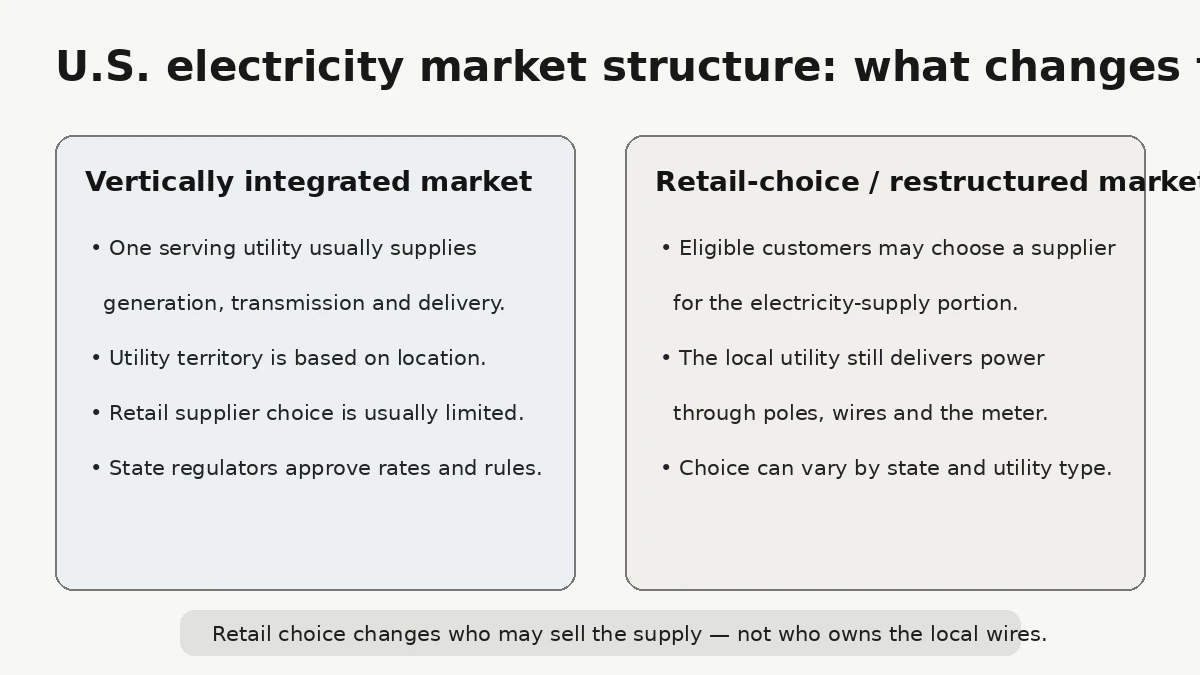
In a vertically integrated market, the serving utility is generally responsible for providing the bundled electricity service used by the customer. The U.S. Department of Energy describes these markets as ones where the utility is responsible for generation, transmission and distribution, with the utility serving a location determined by geography. See DOE’s electricity procurement market guide.
In a retail-choice market, an eligible customer may choose the company that supplies or markets the commodity electricity. The local distribution utility normally remains responsible for the poles, wires, outage response and delivery to the meter. That is why switching suppliers usually does not change who restores power after a local outage.
What changes on your electric bill in a retail-choice market?
The biggest change is usually the supply portion of the bill. A competitive supplier may set or offer the energy price, while the local utility continues to charge for distribution and other regulated delivery services. Depending on the state and billing arrangement, the supplier charge may appear on the utility bill or on a separate bill.
This is why comparing an advertised supplier price with your total utility bill can be misleading. Delivery charges, customer charges, taxes and riders may still apply even if you switch suppliers. Our guide to electricity supply vs delivery charges explains the split in more detail.
Before comparing offers, calculate your own effective electricity cost and monthly usage. The HomeBillLab U.S. Electricity Bill Calculator lets you test kWh use and rates, while our how to read an electric bill guide helps identify the relevant bill components.
Where is retail electricity choice available?
Retail choice is not simply “on” or “off” for every resident of a state. EIA notes that retail choice is generally associated with customers served by investor-owned utilities, although some municipal utilities, cooperatives and government-operated utilities may have different arrangements. Customers should contact their distribution utility or state utility regulator to confirm whether retail choice applies to their specific service territory.
DOE’s current federal procurement guidance lists states with complete or partial retail electric choice, but the list should not be treated as a guarantee that every residential customer in those states can shop. Eligibility can depend on customer class, utility territory and state-specific rules. EPA likewise notes that some states are only partially restructured and that municipally owned utilities may not offer retail choice even inside otherwise competitive states.
For that reason, this guide does not publish a simplistic “deregulated states” map as if all customers in each state face the same rules. The more reliable process is to verify the address with the state regulator or serving utility.
Why is Texas often used as the retail-choice example?
Texas has one of the best-known competitive residential electricity markets. The Public Utility Commission of Texas operates the Power to Choose shopping resource for consumers in areas open to retail competition. In a 2025 consumer reminder, the PUCT said customers in competitive areas can compare electricity plans and providers and should review pricing, usage assumptions, Electricity Facts Labels and contract terms. See the PUCT Power to Choose consumer notice.
Texas also shows why “deregulated” does not mean “unregulated.” Retail electric providers compete for customers, but the Public Utility Commission still enforces consumer protections and the transmission and distribution utilities remain regulated. Other states use different structures, so Texas should be treated as an example rather than a national template.
Does a deregulated electricity market automatically mean lower prices?
No. Market structure alone does not determine the household price of electricity. Fuel costs, generation mix, transmission constraints, utility investment, taxes, weather, contract terms, state policy and customer usage all matter. Retail choice can give customers more products to compare, but it does not guarantee that every competitive offer will beat the default or regulated service.
EPA notes that competitive markets can give consumers access to different suppliers and product types, including renewable options, but it also warns that products may be difficult to compare. Its competitive green power product guidance is a useful example of how supplier choice can expand product variety without making every offer automatically cheaper.
If you want to compare actual price levels instead of market structures, use our electricity cost per kWh USA guide. Market structure explains the rules of the shopping environment; it does not replace a rate comparison.
What types of electricity plans can customers compare?
Where competitive retail supply is available, the supplier may offer different contract and pricing structures. These can include fixed-rate, variable-rate, indexed or renewable-supply products. Time-of-use and tiered structures describe other ways electricity can be priced and should not be confused with the question of whether the market itself offers retail choice.
- Fixed vs variable: describes whether the supplier price is designed to stay stable for a term or may change between billing periods. See our fixed vs variable electricity rates USA guide.
- Time-of-use: changes the price according to when electricity is used. See time-of-use electricity rates USA.
- Tiered pricing: can change the per-kWh price when usage crosses defined blocks. See tiered electricity rates USA.
The market structure determines whether you can shop among suppliers. The plan structure determines how a particular offer charges you. Keeping those two questions separate makes electricity-plan comparisons much easier.
How do you check whether you can choose your electricity supplier?
- Find your distribution utility: use a recent electric bill or your service address.
- Check your state utility regulator: look for retail choice, customer choice or competitive supply information.
- Confirm your utility territory: a state may have retail choice while a municipal utility or cooperative does not participate.
- Check your customer class: rules can differ for residential, commercial and industrial customers.
- Compare supply and delivery separately: a low supply offer does not remove regulated delivery charges.
- Read the contract: check rate structure, fees, renewal rules and early-termination terms.
EIA specifically recommends contacting the distribution utility or the state utility regulatory commission to determine whether retail choice is available. That is safer than relying on a generic national list that may not reflect your exact utility territory.
Frequently asked questions
What is a regulated electricity market?
In a traditional regulated or vertically integrated market, the serving utility generally provides bundled electricity service in a defined territory and operates under state regulatory oversight. Customers usually do not choose a separate competitive supplier for the commodity electricity.
What is a deregulated electricity market?
In consumer usage, “deregulated” usually means a restructured market where eligible customers can choose a competitive electricity supplier. The market is still regulated: consumer protections, delivery utilities, grid operators and other rules remain in place.
If I switch electricity suppliers, who handles an outage?
The local distribution utility normally remains responsible for poles, wires, meter service and outage restoration. Choosing another supplier generally changes the supply relationship, not the physical distribution network serving the home.
Can everyone in a retail-choice state choose a supplier?
No. Eligibility can vary by utility territory, utility ownership and customer class. Municipal utilities and cooperatives may follow different rules, and some states are only partially restructured.
Is retail choice the same as time-of-use pricing?
No. Retail choice describes whether a customer can choose an electricity supplier. Time-of-use pricing describes how the price changes by time of day. A customer can encounter time-of-use pricing in either a competitive or a traditional utility setting.
Bottom line
When comparing regulated vs deregulated electricity markets USA, focus on the practical customer question: who sells the electricity supply, who delivers it, and whether your address is eligible for retail choice. A competitive market can expand supplier and plan options, but it does not eliminate regulation and it does not guarantee a lower total bill.
Verify your own service territory with the local utility or state regulator, then compare the supply price, delivery charges, contract terms and usage assumptions. Browse more billing and rate guides in the HomeBillLab U.S. Electricity hub. For the assumptions and review process behind HomeBillLab guides, see our methodology.