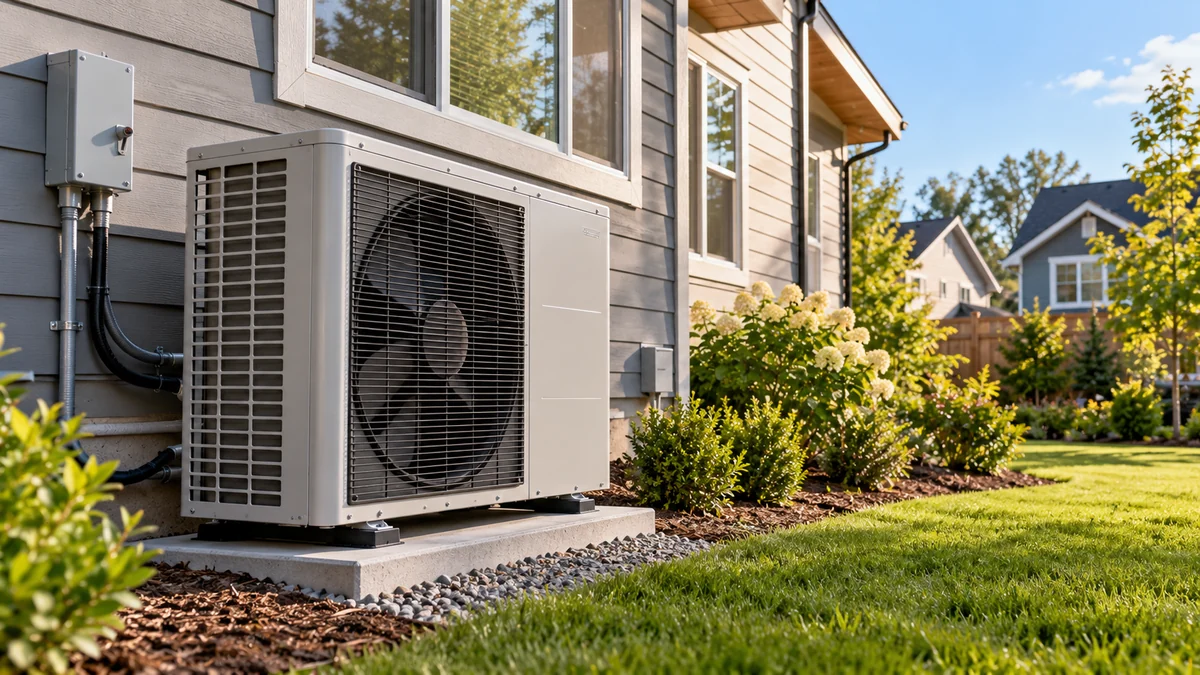
Heat pump rebates USA options in 2026 look different from they did in 2025. The federal Energy Efficient Home Improvement Credit under Internal Revenue Code Section 25C is no longer available for property placed in service after December 31, 2025. However, federal Home Energy Rebates administered through states, territories and Tribes are still available in selected locations, and many utilities, states and local programs continue to offer their own incentives.
The largest federal rebate pathway for an ENERGY STAR-certified heat pump used for space heating and cooling is the Home Electrification and Appliances Rebate program, often called HEAR or HEEHR. Under the federal framework, an eligible household may receive up to $8,000 toward a qualifying heat pump, but the actual amount depends on household income, project cost, the program rules adopted in your state or territory and whether the local program has launched. DOE says Home Energy Rebates are currently available in select states, not automatically nationwide. Check the DOE Home Energy Rebates program page before assuming a rebate is available where you live.
Table of Contents
Heat pump rebates USA in 2026: quick answer
| Incentive path | Potential help with a heat-pump project | Main limitation in 2026 |
|---|---|---|
| HEAR / Home Electrification and Appliances Rebate | Up to $8,000 for an eligible ENERGY STAR heat pump for space heating and cooling | Income-limited, state-administered, and not available everywhere yet |
| HOMES / Home Efficiency Rebates | Whole-home retrofit rebates can reach up to $8,000 for qualifying low-income projects that meet required energy-savings thresholds | Project must meet modeled or measured whole-home savings rules; state implementation varies |
| Federal Section 25C tax credit | $0 for equipment placed in service in 2026 | IRS says the credit is not allowed for property placed in service after Dec. 31, 2025 |
| State, utility and local incentives | Varies by location and utility | Amounts, equipment rules and application windows change frequently |
The table is a screening guide, not a promise of eligibility. A household can be in a state with an active program and still fail an income, equipment, contractor, timing or project-type requirement. ENERGY STAR provides a location-based Home Improvement Savings finder for state, utility and local incentives.
The old federal heat-pump tax credit ended after 2025
This is the most important 2026 change. The IRS states that Section 25C, the Energy Efficient Home Improvement Credit, is not allowed for property placed in service after December 31, 2025. The same IRS guidance explains that the termination date was accelerated by Public Law 119-21, enacted July 4, 2025. See the IRS energy-credit modification FAQ.
That means a homeowner installing a qualifying air-source heat pump in 2026 should not budget around the former 30% federal 25C credit of up to $2,000. Some older web pages and search results still describe that credit because it applied to qualifying installations through 2025. For a 2026 project, use current IRS guidance for federal tax treatment and treat rebates as a separate question.
HEAR can provide up to $8,000 for a qualifying heat pump
The Home Electrification and Appliances Rebate program is designed for low- and moderate-income households. ENERGY STAR’s current HEAR program summary lists an ENERGY STAR-certified electric heat pump for space heating and cooling as eligible for a maximum rebate of $8,000 under the federal framework.
Income matters:
- Households below 80% of area median income (AMI) may receive up to 100% of eligible project cost, subject to the program maximums.
- Households from 80% to 150% of AMI may receive no more than 50% of eligible project cost, again subject to program maximums.
- Households above 150% of AMI are not eligible for the HEAR income-based appliance rebate under the federal framework.
Those are federal program boundaries. States may restrict eligibility further, may phase programs in over time and are not required to offer every eligible technology to every household type. Confirm the live rules for your address before ordering equipment or signing a non-refundable contract.
A heat-pump project may involve other HEAR-eligible upgrades
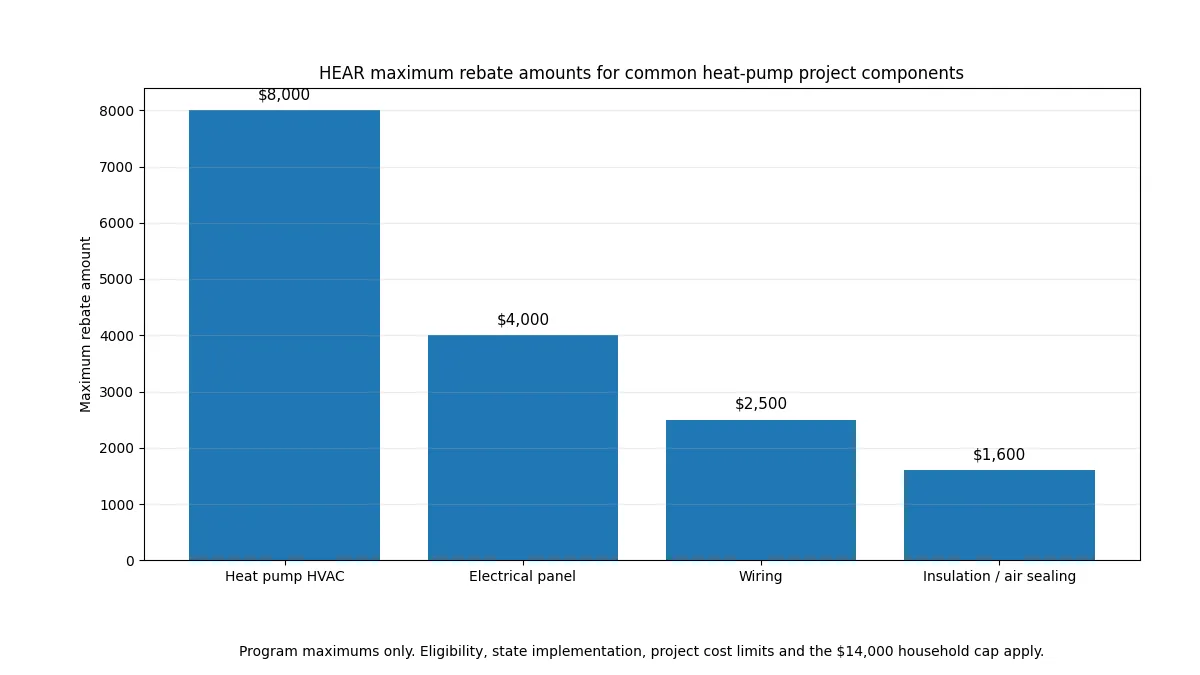
A heat pump sometimes requires more than the outdoor and indoor HVAC equipment. Under the HEAR framework, related project components can have separate maximum rebate amounts, including up to $4,000 for an electric load service center, up to $2,500 for eligible electric wiring, and up to $1,600 for insulation, air sealing and ventilation. The household maximum across HEAR measures is $14,000.
Do not simply add every maximum together and assume that is your rebate. Project cost limits, income percentages, state rules, equipment eligibility and the overall household cap still apply. The chart above shows federal program ceilings, not a guaranteed payment.
HOMES is a different whole-home rebate pathway
The Home Efficiency Rebates program, commonly called HOMES, is based on verified whole-home energy savings rather than a single appliance purchase. The current ENERGY STAR HOMES program summary shows that modeled projects achieving at least 20% but less than 35% savings can qualify for up to $2,000 for a standard-income single-family household, while projects achieving at least 35% modeled savings can qualify for up to $4,000. Maximums are higher for low-income households, reaching up to $8,000 for qualifying projects.
A heat pump can be part of a HOMES project when the overall retrofit meets the program’s energy-savings and equipment requirements. That may make HOMES relevant when the project combines HVAC replacement with insulation, air sealing, duct work or other efficiency measures.
Can you combine HEAR and HOMES?
You cannot receive two federal Home Energy Rebates for the same single upgrade. DOE’s current program-integration guidance explains that federal grants and rebates cannot be double-counted for the same upgrade. A household may participate in more than one program when separate funding is assigned to distinct, separable upgrades and all program rules are met.
Non-federal incentives are different. State, utility, local or philanthropic funding may sometimes be combined with a Home Energy Rebate for remaining project costs, provided the combined upfront funding does not exceed project cost and the state program allows the combination. Always verify stacking rules with the program administrator before assuming two incentives can be used together.
How 2026 program updates affect heat-pump projects
DOE continues to modify implementation details while states operate their programs. For example, Home Energy Rebates Program Notice 26-2, issued in 2026, expanded flexibility under the HEAR framework. Among other changes, it allows an existing fossil-fuel HVAC system to remain in the home when a heat pump is installed even when the new heat pump will not become the primary heating and cooling source, subject to the administering program’s rules.
This is one reason a static national list can become outdated. The safe process is to verify your state or territorial program close to the date you plan to buy or install the equipment.
Utility and state heat-pump rebates still matter
Separate from the federal Home Energy Rebates, utilities and state energy programs may offer equipment rebates, contractor discounts, financing or special rates. These programs can be highly local: two homes in the same state but served by different electric utilities may see different incentives.
Use the ENERGY STAR Home Improvement Savings finder with your ZIP code, then verify the incentive on the utility or state program’s own website before purchasing. Check the qualifying model list, required efficiency rating, installer requirements, pre-approval rules, installation deadline and whether the incentive is available only for replacing a particular fuel or equipment type.
Do the running-cost math before chasing the rebate
A rebate reduces upfront cost; it does not automatically make every heat pump the lowest-cost heating option for every home. Your operating result still depends on electricity price, climate, heat-pump efficiency, backup heat, building heat loss and the fuel price of the system being replaced.
Use the HomeBillLab U.S. Heating Running Cost Calculator with your own rates. The Heat Pump Running Cost USA guide explains HSPF2, COP and seasonal kWh, while the Heat Pump vs Gas Furnace running-cost comparison shows how electricity price, gas price and COP change the result.
A practical 2026 rebate checklist
- Check program status for your location. Start with DOE’s Home Energy Rebates page and your state or territory energy office.
- Check household income rules. HEAR eligibility depends on area median income, not a single national income cutoff.
- Confirm the exact heat-pump model qualifies. Do not rely on a sales description alone.
- Check contractor or pre-approval requirements. Some programs require an approved contractor or application before installation.
- Price the whole project. Include electrical service, wiring, duct work, permits, controls and envelope upgrades if required.
- Confirm stacking rules in writing. Separate federal and non-federal incentives may have different combination rules.
- Compare net upfront cost and operating cost. A large rebate can improve project economics, but long-term energy cost still depends on your home and tariffs.
- Keep invoices and eligibility documentation. Rebate administrators may require proof of purchase, installation, household income, equipment certification and contractor details.
Heat pump rebate FAQ
Is there a federal heat-pump tax credit in 2026?
Not under Section 25C for property placed in service in 2026. IRS guidance states that the Energy Efficient Home Improvement Credit is not allowed for property placed in service after December 31, 2025.
Can I still get up to $8,000 for a heat pump?
Potentially, through an active HEAR program if your household and project meet the applicable income, equipment, cost and state-program requirements. The federal framework allows up to $8,000 for an eligible ENERGY STAR heat pump for space heating and cooling; it is not an automatic nationwide payment.
What income qualifies for the federal HEAR heat-pump rebate?
The federal framework targets households below 150% of area median income. Households below 80% AMI can potentially receive a higher percentage of eligible project cost than households between 80% and 150% AMI. States may apply additional restrictions.
Can renters qualify for a heat-pump rebate?
The HEAR framework can include homeowners and renters, but the upgrade must meet program rules and the property owner may need to participate because HVAC installation affects the building. Check the local program before committing to a project.
Can a utility rebate be added to a federal Home Energy Rebate?
Sometimes. DOE allows certain non-federal funding to help cover remaining project costs, but the total upfront funding cannot exceed the project cost and your administering program may impose additional restrictions. Confirm the stacking rule before installation.
Should I wait for my state’s program before installing a heat pump?
If receiving the Home Energy Rebate is important to the project budget, verify program launch and eligibility before starting work. DOE says rebates are available in select states, and local rules determine timing, applications and eligible equipment. A project completed before a local program’s required approval point may not qualify.
For HomeBillLab’s source hierarchy, assumptions and review approach, see our methodology. Browse more equipment and fuel comparisons in the U.S. Heating hub, and use the U.S. electricity cost per kWh guide when estimating the operating side of a heat-pump decision.