
A baseboard heater installation cost USA estimate is usually much more variable than the heater’s sticker price. The metal heater itself can be inexpensive, but the finished project may also require a wall thermostat, new 120- or 240-volt wiring, a dedicated circuit, breaker space, permits, removal of old equipment, wall repair, or even an electrical-panel upgrade.
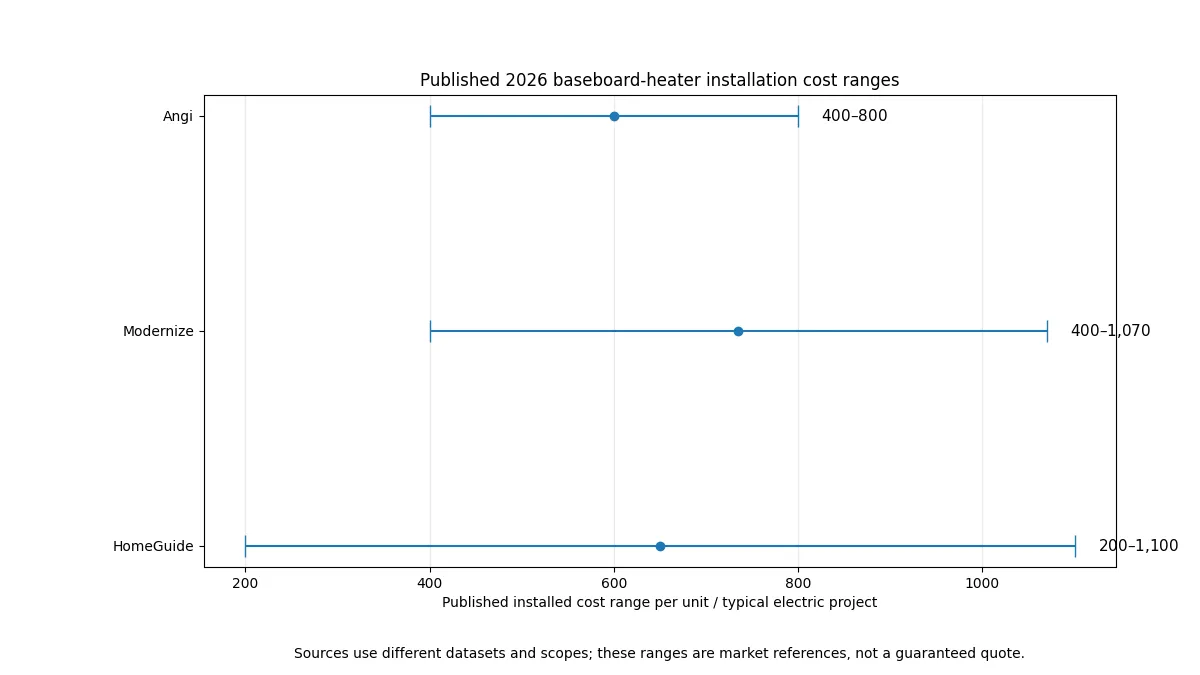
Current 2026 market estimates overlap around a few hundred dollars to roughly $1,100 per installed electric baseboard unit for many straightforward projects, although complex electrical work can push the total higher. HomeGuide lists about $200–$1,100 per electric baseboard heater installed; Modernize reports a typical installed baseboard-heater range of about $400–$1,070 per unit; and Angi’s 2026 guide lists a professional electric-baseboard scenario of roughly $400–$800. These sources use different datasets and scopes, so treat them as budgeting references rather than a national fixed price.
If you are deciding whether low upfront cost is worth the long-term energy use, keep installation cost separate from operating cost. Use the HomeBillLab U.S. Heating Running Cost Calculator for your electricity rate and heater wattage, and see our Electric Baseboard Heating Cost USA guide for hourly, monthly and winter running-cost examples.
Table of Contents
How much does it cost to install an electric baseboard heater?
| 2026 source | Published cost reference | Scope |
|---|---|---|
| HomeGuide | $200–$1,100 | Electric baseboard heater, per unit installed |
| Modernize | $400–$1,070 | Baseboard heater/radiator, typical installed range per unit |
| Angi | $400–$800 | Professional electric-baseboard installation scenario |
The ranges above are useful because they show the broad market overlap, but the quote for one room can fall outside them. A replacement using existing suitable wiring can be much simpler than adding a new heater where no circuit exists. A whole-home retrofit can also involve several breakers, long cable runs, service-capacity questions and many individual thermostats.
What is included in a baseboard-heater installation quote?
A complete quote should separate the heater from the work needed to make it operate safely and correctly. Depending on the project, that can include:
- the electric baseboard heater itself;
- a compatible line-voltage or other approved thermostat;
- new wiring and a suitable breaker;
- electrical boxes, conduit or cable protection where required;
- mounting hardware and wall preparation;
- removal and disposal of an old heater;
- permit and inspection fees where required;
- drywall, trim or paint repair after electrical work; and
- electrical-panel or service upgrades if the existing system cannot support the added load.
Angi’s current 2026 baseboard-heater installation cost guide notes that permits, old-unit removal, wall work and panel upgrades can materially change the project price. HomeGuide’s baseboard-heater cost guide similarly highlights electrician labor, thermostats, permits and circuit work as important cost factors.
New installation vs replacement: a major cost difference
Replacing an existing electric baseboard heater can be relatively straightforward when the old circuit, breaker, conductor size, thermostat and installation location are suitable for the new equipment. The installer still has to verify that the electrical system matches the new heater’s nameplate requirements; a similar-looking heater is not automatically an electrical drop-in replacement.
A first-time installation is usually more involved. Many permanently installed baseboard heaters are hardwired, and many larger models operate on 240 volts. New cable may need to be routed from the electrical panel to the room, and a new circuit or breaker position may be required. Finished walls, long wire runs and difficult access can increase labor.
How much can one-room installation cost?
For an early budget, a straightforward one-room electric-baseboard project is reasonable to think about in the broad hundreds of dollars, not just the heater’s retail price. HomeGuide reports electric units themselves can be inexpensive compared with the installed total, while Modernize’s 2026 baseboard-heater cost guide reports that equipment is only part of the installed price.
The room’s heat loss determines how much heating capacity is actually needed. Do not choose a heater only from a generic watts-per-square-foot rule. Window area, insulation, air leakage, outdoor design temperature, room exposure and ceiling height all change the heating load. Oversizing can create poor comfort and short cycling; undersizing can leave the room cold during design conditions.
What about a whole house?
Whole-home cost is not simply one heater multiplied by the number of rooms. Large rooms may need more than one unit, while small rooms may need less capacity. Electrical-distribution work can also become the dominant cost.
As a market reference, HomeGuide estimates roughly $5,400–$7,800 for 18 to 26 installed baseboard units in its whole-home example, with smaller and larger homes falling outside that range. That is one source’s modeled project pattern, not a universal U.S. price. A house that requires a panel or service upgrade, extensive wall opening or unusually long cable runs can cost more.
Before committing to a whole-home resistance-heating retrofit, compare the upfront price with alternatives. The Home Heating Cost USA guide compares operating costs across common fuels and heat pumps, while our Heat Pump Rebates USA 2026 guide explains current federal, state and utility incentive pathways.
Can the electrical panel handle the added heaters?
This question can change the economics of the project. Several baseboard heaters can represent a large connected electrical load even when thermostats prevent every zone from operating continuously. A qualified electrician should verify service capacity, panel space, circuit sizing, conductor sizing and required controls for the specific heaters and local code.
Do not assume that an unused breaker slot means the home automatically has enough capacity. Service size, existing loads and load-calculation rules matter. Conversely, do not assume a panel upgrade is always necessary just because multiple heaters are being added; the answer depends on the actual home and electrical design.
Electric baseboard vs hydronic baseboard: do not mix the estimates
Electric baseboard heaters create heat directly from electricity at the room. Hydronic baseboard systems use hot water or another heat-transfer fluid and may depend on a boiler, piping, pumps and controls. Their installation scope can therefore be very different.
HomeGuide reports higher typical installed costs for hydronic baseboard units than basic electric units, and Angi also separates electric and hydronic project pricing. If you already have a boiler and hydronic piping, extending that system is a different project from installing new electric resistance heaters. This article focuses primarily on permanently installed electric baseboards.
Low installation cost does not mean low operating cost
Electric baseboards are resistance heaters. The U.S. Department of Energy’s Heat Pump Systems guidance says modern heat pumps can reduce electricity use for heating by up to 75% compared with electric resistance systems such as baseboard heaters, depending on equipment and conditions.
Using the latest EIA national residential benchmark of 18.16¢/kWh for August 2026, a 1,500-watt heater costs about $0.27 per full-power hour. Eight equivalent full-power hours per day would use 360 kWh in 30 days and cost about $65.38 for that one heater. The national rate comes from the EIA’s August 2026 Electricity Monthly Update; your utility rate can be much lower or higher.
That does not mean a thermostat-controlled heater draws full power for eight clock hours every day. It means the energy cost should be compared using equivalent full-power runtime or measured kWh. For a whole house with several zones, add the electricity used by all heaters.
When can electric baseboards still make financial sense?
Electric baseboards can still be a practical choice when the installation is small, ductwork would be disproportionately expensive, the room is used only occasionally, the building has a very low heating load, or the homeowner values independent zoning and simple equipment. A single cold bedroom or addition is a different decision from choosing resistance heat for an entire house in a long, cold winter.
For a whole-home replacement, compare at least two numbers: net installation cost and expected annual energy cost. A heat pump may cost more to install but use much less electricity for the same delivered heat. Baseboards may be cheap to install but expensive to operate where electricity prices and heating demand are high.
Questions to ask before accepting a quote
- Is this a replacement on existing wiring or a completely new circuit?
- What heater wattage and voltage are included, and how was the room heating load determined?
- Is the thermostat included and compatible with the heater?
- Are permits and inspections included in the quote?
- Does the panel have enough service capacity and breaker space?
- Is wall repair, painting and old-heater disposal included?
- What happens to the price if additional circuit or panel work is required?
- What labor and equipment warranties are included?
Baseboard heater installation cost FAQ
How much does it cost to install one electric baseboard heater?
Current 2026 consumer cost guides commonly place straightforward installed electric-baseboard projects in the hundreds of dollars per unit, with published ranges extending to roughly $1,100 or more depending on the source and scope. New circuits, panel work, permits and difficult access can push the final quote higher.
Is replacing an old baseboard heater cheaper than adding a new one?
Often, yes, if the existing wiring, breaker, thermostat and location are suitable for the replacement. The installer still needs to verify compatibility. Adding a heater where no circuit exists usually involves more electrical labor.
Do electric baseboard heaters need a dedicated circuit?
Many permanently installed baseboard heaters are hardwired and may require dedicated branch-circuit capacity, especially higher-wattage 240-volt models. Requirements depend on the specific equipment, circuit design and local electrical code, so the installer should verify the design rather than assume.
How much does whole-home electric baseboard installation cost?
There is no reliable single national number because the heater count, room loads and electrical work vary widely. HomeGuide’s current example puts 18 to 26 installed units at roughly $5,400–$7,800, but a home needing panel upgrades or extensive new wiring can exceed that range.
Are electric baseboards cheaper to install than a heat pump?
For a simple single-room project, baseboards are usually much cheaper upfront than installing a heat-pump system. For whole-home heating, compare total project cost after rebates with long-term energy use. DOE says modern heat pumps can use substantially less electricity than electric resistance heating.
For HomeBillLab’s assumptions and source hierarchy, see our methodology. Browse more heating guides in the U.S. Heating hub.