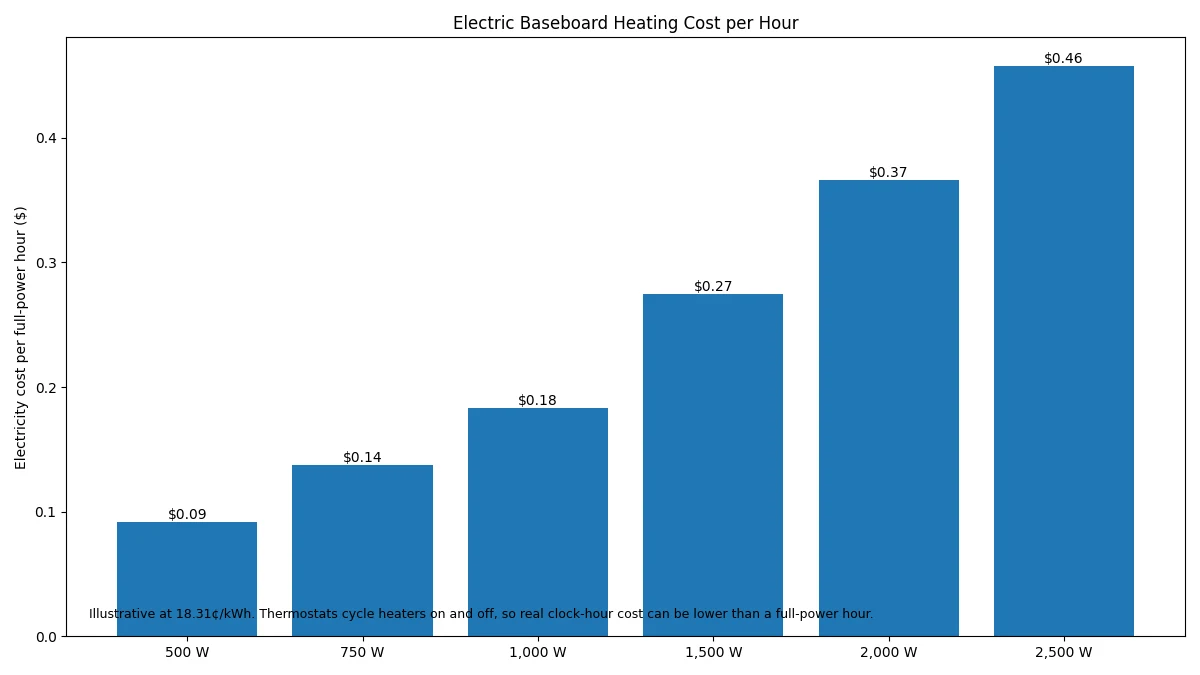
Electric baseboard heating cost USA is easy to estimate once you know the heater wattage, how long it is actually energized, and your electricity price. At the U.S. Energy Information Administration’s July 2026 residential average of 18.31¢/kWh, a 1,500-watt baseboard heater costs about 27¢ for each full-power hour. A 2,500-watt unit costs about 46¢ per full-power hour.
The important phrase is full-power hour. A thermostat-controlled baseboard heater does not necessarily draw its rated wattage every minute. If a 1,500-watt heater is switched on for eight clock hours but the thermostat energizes it only half the time, the equivalent full-power runtime is four hours, not eight.
For your own room or whole-home estimate, use the HomeBillLab U.S. Heating Running Cost Calculator with the heater’s wattage, estimated duty cycle and your actual utility rate.
Table of Contents
Electric baseboard heating cost USA: cost per hour
The basic cost is simply rated kilowatts multiplied by your electricity price:
Cost per full-power hour = heater watts ÷ 1,000 × electricity price per kWh.
| Heater rating | Electricity per full-power hour | Cost at 18.31¢/kWh |
|---|---|---|
| 500 W | 0.50 kWh | $0.09 |
| 750 W | 0.75 kWh | $0.14 |
| 1,000 W | 1.00 kWh | $0.18 |
| 1,500 W | 1.50 kWh | $0.27 |
| 2,000 W | 2.00 kWh | $0.37 |
| 2,500 W | 2.50 kWh | $0.46 |
These wattages are calculation examples, not a claim that every baseboard heater is sold in each size. Use the nameplate or circuit information for the actual heater you are estimating.
How much does electric baseboard heat cost per month?
For a simple monthly scenario, assume the heater averages eight equivalent full-power hours per day for 30 days:
| Heater rating | Monthly electricity | Monthly cost at 18.31¢/kWh |
|---|---|---|
| 500 W | 120 kWh | $21.97 |
| 750 W | 180 kWh | $32.96 |
| 1,000 W | 240 kWh | $43.94 |
| 1,500 W | 360 kWh | $65.92 |
| 2,000 W | 480 kWh | $87.89 |
| 2,500 W | 600 kWh | $109.86 |
A 1,500-watt baseboard at eight equivalent full-power hours per day uses 360 kWh/month. At 18.31¢/kWh, that is about $65.92/month. If the thermostat duty cycle averages only four equivalent full-power hours per day, the energy portion is about half that amount.
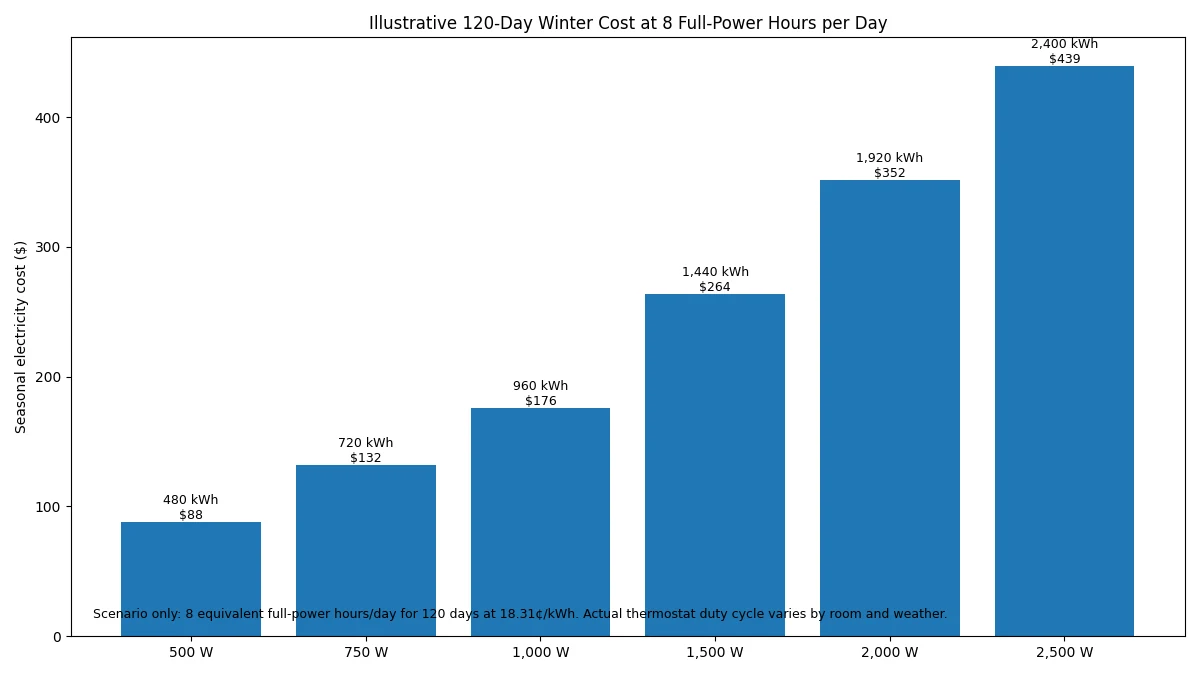
Electric baseboard heating cost for a 120-day winter
Using the same eight-equivalent-full-power-hours assumption over a 120-day heating season gives:
| Heater rating | 120-day electricity | Illustrative winter cost |
|---|---|---|
| 500 W | 480 kWh | $87.89 |
| 1,000 W | 960 kWh | $175.78 |
| 1,500 W | 1440 kWh | $263.66 |
| 2,000 W | 1920 kWh | $351.55 |
| 2,500 W | 2400 kWh | $439.44 |
This is a scenario, not a national seasonal average. A well-insulated bedroom in a mild climate may need far fewer full-power hours. A poorly insulated room in a cold climate can need much more.
Electric baseboard heating cost formula
Use these three steps:
- Convert watts to kilowatts: watts ÷ 1,000.
- Calculate electricity use: kW × equivalent full-power hours.
- Calculate cost: kWh × electricity price.
Example: a 2,000-watt baseboard is 2.0 kW. If it is energized for five equivalent full-power hours in a day, it uses 10 kWh. At 18.31¢/kWh, the electricity cost is about $1.83/day.
If your utility uses time-of-use pricing, use the price that applies during the hours when the heater runs. Electric space heating can be concentrated in morning and evening periods, which may overlap expensive peak windows on some tariffs.
Why thermostat cycling matters more than clock hours
Electric baseboard heat is usually controlled by a line-voltage or compatible wall thermostat. When the room reaches setpoint, the thermostat reduces or stops power to the heater. The unit can therefore be available for 12 hours but energized for only part of that time.
This creates a duty cycle. If a 1,500-watt heater is energized 40% of a 10-hour period, the equivalent full-power runtime is four hours and electricity use is 6 kWh, not 15 kWh.
The duty cycle changes with outdoor temperature, insulation, window area, air leakage, thermostat setting, internal heat gains and the size of the heater relative to the room’s heat loss.
Whole-home baseboard heating is the sum of every zone
One of the useful features of electric baseboards is room-by-room zoning. A bedroom, living room and bathroom can each have separate thermostatic control. The whole-home bill, however, is the combined kWh of every heater.
Suppose four rooms each have a 1,500-watt baseboard. The connected heating load is 6 kW. If the four zones collectively average eight equivalent full-power hours per day, the house uses 48 kWh/day for baseboard heat. At 18.31¢/kWh, that is about $8.79/day, $263.66 over 30 days, or about $1,054.66 over a 120-day season.
That does not mean all four heaters must run together. Zoning can reduce usage when unused rooms are kept cooler, but warm rooms also lose heat into cooler adjacent spaces. Savings depend on the actual building layout and temperature differences.
Your local electricity price can change the answer dramatically
The national rate used in this guide comes from the EIA’s July 2026 Electric Power Monthly summary, which reports a U.S. residential average of 18.31¢/kWh. EIA also reports a 2026 year-to-date residential average of 18.19¢/kWh through July.
State prices vary widely. The same 1,000 kWh of heating electricity costs $120 at 12¢/kWh, $183 at 18.31¢/kWh, $250 at 25¢/kWh and $300 at 30¢/kWh. Baseboard economics are therefore much more favorable in a low-rate utility territory than in a high-rate one.
For current state-level price context, EIA’s state year-to-date electricity-price table shows large regional differences in 2026. Use your actual bill whenever possible.
Electric baseboard vs heat pump running cost
Baseboard heating is electric resistance heating: every kWh you buy is used directly to create room heat. A heat pump works differently. It moves heat from outside to inside and can deliver multiple units of heat for each unit of electricity consumed.
DOE’s current Heat Pump Systems guidance says today’s heat pumps can reduce electricity use for heating by up to 75% compared with electric resistance systems such as furnaces and baseboard heaters. Actual savings depend on climate, model performance, backup heat and installation.
For a direct same-heat comparison, see Heat Pump vs Electric Resistance Heating Cost USA. For heat-pump-only examples, see Heat Pump Running Cost USA.
How to reduce electric baseboard heating cost
- Lower unused-zone temperatures. Zoning only saves energy when it actually reduces heat loss.
- Seal air leaks. Drafts around windows, doors and penetrations increase the heating load.
- Improve insulation where practical. Lower heat loss reduces heater duty cycle.
- Do not block the baseboard. Furniture and heavy curtains can interfere with natural convection and thermostat response.
- Keep the unit clean. Dust and debris can restrict airflow through the fins.
- Use accurate thermostats. Poor control can cause overheating or unnecessary runtime.
- Track kWh in winter. Compare daily electricity use before and after changes rather than relying only on the total bill.
DOE’s current Home Upgrades guidance says space heating is typically the largest home energy use and highlights heat pumps as a major upgrade pathway for homes using electric resistance heating.
When can electric baseboard heating still make sense?
High operating cost does not mean baseboard heat is always the wrong choice. It can be practical for a small, well-insulated room, an infrequently used space, a mild climate, an addition where extending ducts is difficult, or a property where the low installation cost matters more than seasonal energy use.
For whole-home heating in a cold climate, the operating-cost penalty becomes more important because many heaters can run for long periods at once. In that situation, compare a heat pump retrofit, weatherization, or another central system before replacing old baseboards with identical resistance equipment.
If natural gas is available, another comparison is Gas Furnace Running Cost USA. The right choice depends on fuel rates, equipment cost, climate and the existing building.
HomeBillLab’s treatment of electricity prices, heater wattage, runtime and illustrative seasonal calculations is documented in the HomeBillLab Methodology. Browse the U.S. Heating hub for related guides.
Electric baseboard heating cost USA FAQ
How much does a 1,500-watt baseboard heater cost per hour?
At 18.31¢/kWh, a 1.5 kW baseboard costs about $0.27 per full-power hour. If the thermostat cycles the heater off part of the time, the average clock-hour cost is lower.
How much does a 2,000-watt baseboard cost per month?
At eight equivalent full-power hours per day for 30 days, a 2,000-watt heater uses 480 kWh and costs about $87.89 at 18.31¢/kWh.
Does a baseboard heater use full power all day?
Usually not. A thermostat cycles the heater according to room temperature. Actual kWh depends on the percentage of time the element is energized.
Is baseboard heat more expensive than a heat pump?
Usually on electricity use for the same heat delivered. DOE says modern heat pumps can use up to 75% less electricity for heating than electric resistance systems such as baseboards. Local climate and heat-pump performance still matter.
Can zoning make baseboard heat cheaper?
It can if you genuinely maintain lower temperatures in unused rooms and reduce the home’s total heat loss. The savings are not equal to the number of zones turned down because heat moves between rooms.
Bottom line
For electric baseboard heating cost USA, wattage and equivalent full-power runtime determine kWh. At the July 2026 national residential average of 18.31¢/kWh, a 1,500-watt heater costs about $0.27 per full-power hour, about $66 over 30 days at eight full-power hours per day, and about $264 over a 120-day winter under the same runtime assumption. Use the U.S. Heating Running Cost Calculator with your own wattage, duty cycle and utility rate.