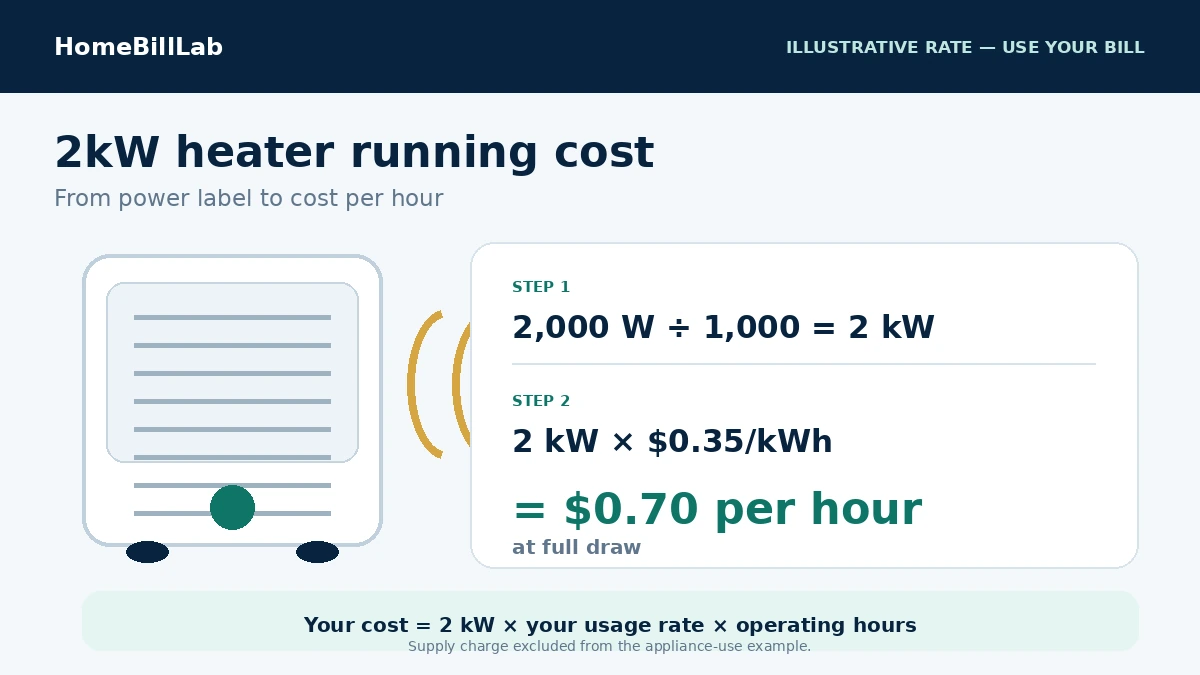
How much does a 2kW heater cost to run Australia? Multiply 2 kW by the usage rate on your electricity bill. At an illustrative rate of $0.35 per kWh, a 2kW heater costs $0.70 per hour at full draw. Five hours costs $3.50, and five hours a day for 90 days costs $315 if the heater draws its full 2 kW for every counted hour.
Your result can differ because Australian tariffs vary and a thermostat may cycle the heating element off after the room approaches its set temperature. The daily supply charge is excluded from these appliance-use examples because it is normally payable whether the heater runs or not.
Enter the power, hours and rate from your bill into the Home Heating Running Cost Calculator before relying on any example below.
What does 2kW mean on a heater?
A 2kW heater has a maximum electrical input of 2 kilowatts, which is the same as 2,000 watts:
2,000 W ÷ 1,000 = 2 kW
Power and energy are related but not identical. Kilowatts describe the rate of power draw. Kilowatt-hours describe energy used over time. If a 2kW heater operates continuously for one hour, it uses 2 kWh in that hour at full draw. For half an hour at full draw it uses 1 kWh.
The South Australian Government’s appliance running-cost guide uses the same method: convert watts to kilowatts, find the tariff on the bill, then multiply power by the tariff and operating time. It also notes that thermostatically controlled appliances may not run at full power continuously.
How much does a 2kW heater cost to run Australia per hour?
The hourly formula is:
Cost per hour = 2 kW × electricity usage rate ($/kWh)
At 35 cents per kWh, convert cents to dollars and calculate 2 × $0.35 = $0.70 per hour at full draw. The following rate table is illustrative only; it is not a national tariff.
| Electricity usage rate | 2kW heater cost per hour at full draw |
|---|---|
| 25c/kWh | $0.50 |
| 30c/kWh | $0.60 |
| 35c/kWh | $0.70 |
| 40c/kWh | $0.80 |
| 50c/kWh | $1.00 |
On a time-of-use plan, the same heater can have different hourly costs in peak and off-peak periods. Use the exact rate applying when the heater runs. Energy Made Easy explains that a bill generally separates the fixed supply charge from the usage charge measured in cents per kWh.
Cost for 1, 3, 5 and 8 hours
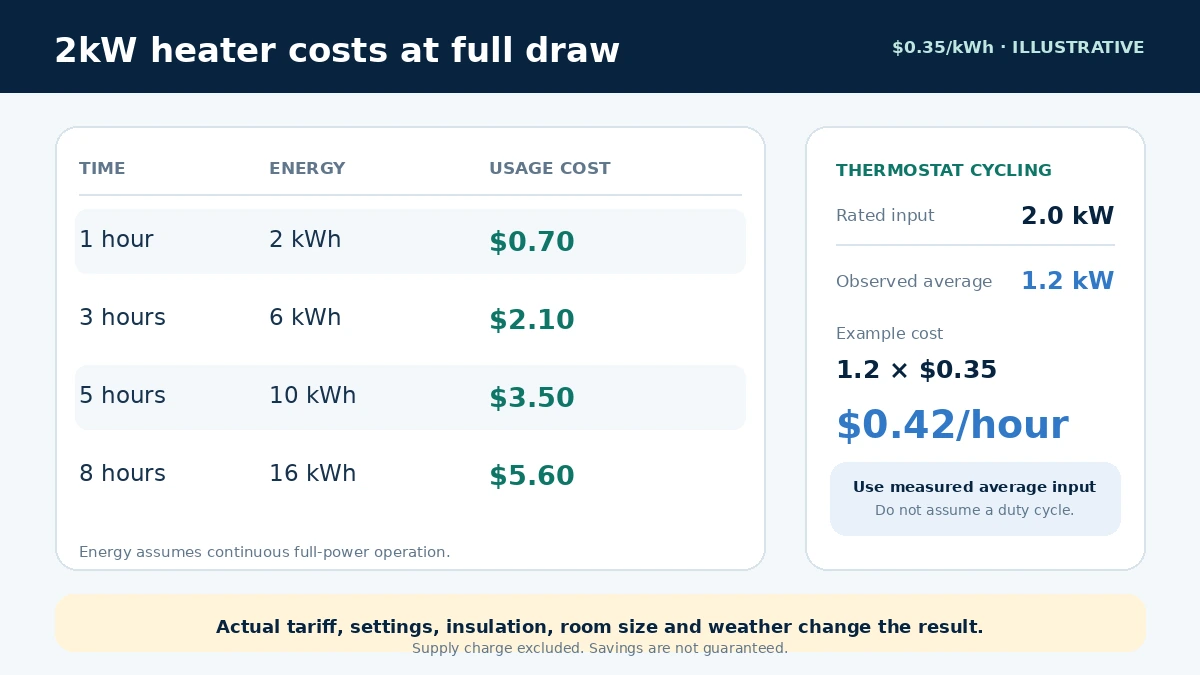
For this how much does a 2kW heater cost to run Australia example, the tariff is $0.35/kWh and the heater is assumed to stay at full draw for every counted hour.
| Operating time | Energy at full draw | Usage cost at $0.35/kWh |
|---|---|---|
| 1 hour | 2 kWh at full draw | $0.70 |
| 3 hours | 6 kWh | $2.10 |
| 5 hours | 10 kWh | $3.50 |
| 8 hours | 16 kWh | $5.60 |
Daily, monthly and winter scenarios
An accurate how much does a 2kW heater cost to run Australia estimate should scale actual hours without assuming year-round use. Multiply the hourly cost by the operating hours and days:
- Five hours in one day: $0.70 × 5 = $3.50.
- Five hours daily for 30 days: $3.50 × 30 = $105.
- Five hours daily for 90 winter days: $3.50 × 90 = $315.
- Eight hours in one night: $0.70 × 8 = $5.60.
Every result assumes continuous full-power operation. If the heater is used only five days a week, count those days instead. If different tariff periods apply, split the hours by period rather than multiplying everything by one rate. Supply charges remain outside this appliance-use estimate, but should be included when comparing complete electricity plans.
Why a heater may not draw 2kW continuously
A heater can draw close to its rated input while the element is on, then reduce or stop that draw when a thermostat reaches the setpoint. Lower power settings may also activate fewer elements. The average electricity used across an hour therefore depends on duty cycle, room temperature, insulation, draughts, heater controls and the selected setting.
For example, if monitoring shows an average input of 1.2 kW across an hour, the estimate at $0.35/kWh is 1.2 × $0.35 = $0.42 for that hour. Do not assume a 60% duty cycle without measurement; it is only an example of how to use an observed average.
The full-power calculation is still valuable as a conservative ceiling for the chosen hours. For a practical how much does a 2kW heater cost to run Australia estimate, use a suitable energy monitor or reliable interval data where practical, follow the appliance instructions, and enter the measured average into the calculator.
Fan, oil-column, panel and convection heaters
Portable resistance heaters turn electrical input into heat at the point of use. A 2kW fan heater, oil-column heater, panel heater or convection heater does not become dramatically cheaper merely because its shape is different. At the same average electrical input and tariff, the energy cost is similar.
The practical differences are how quickly and where the heat is delivered:
- Fan heater: moves warmed air quickly and can suit short use in a small occupied room.
- Oil-column heater: combines convective and radiant heat, warms more slowly and often includes a thermostat and timer.
- Convection or panel heater: warms circulating room air; results are affected by ceiling height, ventilation and insulation.
- Radiant heater: directs warmth towards people and objects, which can feel immediate without first warming all room air.
The Australian Government’s YourHome heating guide describes these delivery differences and advises choosing a system that suits the room, climate and use pattern. Compare the rated and average input rather than assuming that one resistance-heater style always produces substantially more heat per kWh.
Room conditions can change the running time
A heater in a small, closed and insulated room may reach its thermostat setting sooner than the same heater in a large, draughty room. Ceiling height, open doors, window coverings, outdoor temperature and the thermostat setting all affect runtime. The Australian Government’s winter energy guide highlights heat loss through the building envelope, while our guide to R-value and insulation explains thermal resistance.
Use heating only in occupied areas when practical, close obvious draught paths without blocking required ventilation, and use a reasonable thermostat setting. These steps can reduce runtime, but the saving is household-specific and should not be promised in advance.
Is reverse-cycle heating cheaper?
A reverse-cycle air conditioner is a heat pump: it moves heat rather than creating it only through electrical resistance. The Australian Government’s heating and cooling guide explains that one unit of electrical energy can deliver multiple units of heating under suitable conditions.
That does not mean a capacity label is the same as electrical input. Compare input power, delivered heat, efficiency, room coverage and cycling in the dedicated electric heater vs reverse-cycle air conditioner guide.
Use a portable heater safely
Running cost is not the only consideration. Follow the manufacturer’s clearances and instructions, keep the appliance stable and unobstructed, and stop using a heater with a damaged cord, plug or body. Energy Safe Victoria’s home electricity guidance says not to repair faulty electrical appliances yourself and not to use portable heaters in bathroom areas.
Do not overload power points or power boards. Fire and Rescue NSW provides current power-board safety advice. Keep combustible materials away from the heater, maintain working smoke alarms and switch the heater off when it is not required.
Frequently asked questions
How much electricity does a 2kW heater use in one hour?
It uses 2 kWh in one hour at full draw. If a thermostat switches the heating element off for part of the hour, measured energy use can be lower.
How much does a 2kW heater cost per hour?
Multiply 2 by your electricity rate in dollars per kWh. At an illustrative $0.35/kWh, the answer is $0.70 per hour at full draw.
Does a thermostat reduce heater running cost?
It can reduce average consumption when it cycles the element off after the room approaches the setpoint. The actual duty cycle depends on the heater, setpoint and room conditions.
Are oil heaters cheaper to run than fan heaters?
Not automatically. At the same average electrical input and tariff, their energy cost is similar. Warm-up speed, heat delivery, thermostat behaviour and how long each unit is used can change the real result.
Is a 2kW heater cheaper than reverse-cycle air conditioning?
Reverse-cycle systems can deliver more heat per kWh because they move heat, but the comparison must use actual electrical input, delivered heat and conditions. Do not compare a heating-capacity number directly with a 2kW electrical-input label.
Bottom line
For how much does a 2kW heater cost to run Australia, the auditable answer is 2 × your $/kWh rate for each hour at full draw. At the illustrative 35c/kWh rate, that is 70c per hour, $3.50 for five hours and $315 for five hours daily across 90 days. Thermostat cycling can lower the average, so use measured input when available.
Review the HomeBillLab running-cost methodology, calculate your own scenario with the Home Heating Running Cost Calculator, and explore more heating guides.
Reviewed: 31 August 2026. Medium-freshness guide; review the illustrative tariff quarterly and when an official source or calculator method changes.