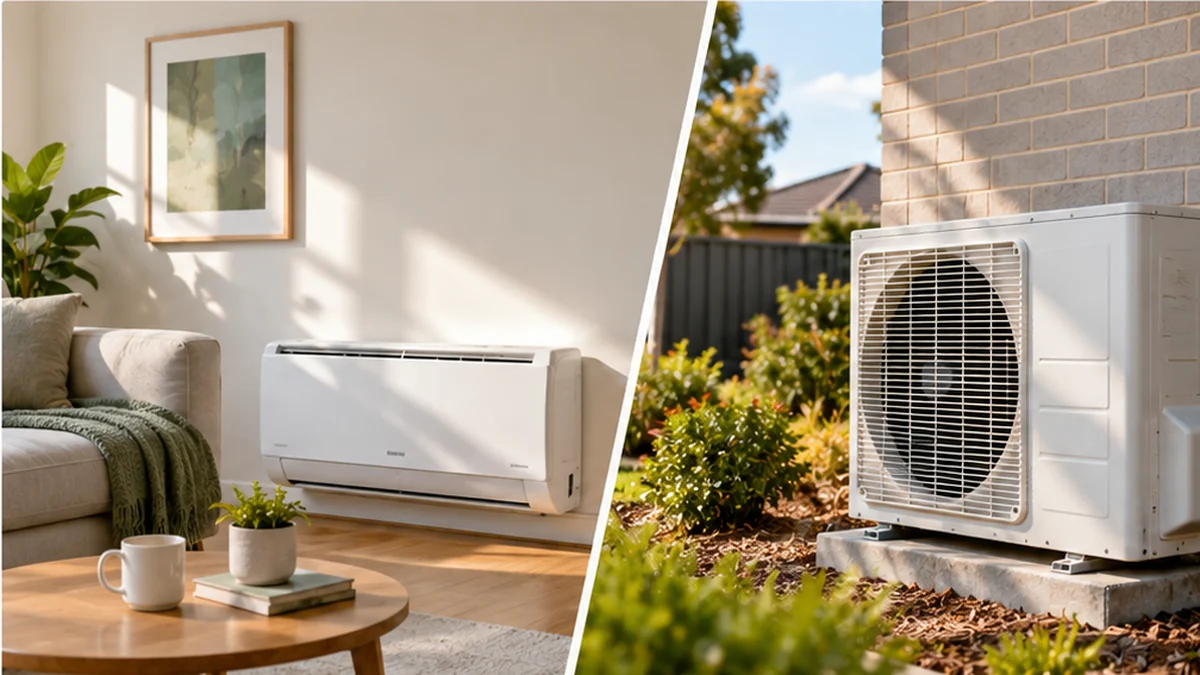
Reverse cycle heating running cost Australia estimates should start with the electricity the system actually uses, not the heating-capacity number printed in the model name. A reverse-cycle air conditioner is a heat pump: in heating mode it moves heat from outside air into the home, so one kilowatt-hour of electricity can deliver several kilowatt-hours of heat under suitable conditions. The Australian Government says reverse-cycle air conditioners on the market can achieve roughly 300% to 600% heating or cooling efficiency because they transfer heat rather than generating all of it directly.
There is no single national dollar-per-hour figure that fits every Australian home. Running cost changes with the unit’s electrical input, outdoor temperature, thermostat setting, room size, insulation, inverter operation and your electricity tariff. The most useful approach is to use your own bill rate and either a realistic average electrical input or the heating-energy figure from the model’s Zoned Energy Rating Label.
You can test both types of scenario in the HomeBillLab Heating Running Cost Calculator. For the assumptions used across our tools, see the HomeBillLab calculation methodology.
Table of Contents
How reverse-cycle heating uses electricity
A resistance heater turns electrical energy into heat at the point of use. A reverse-cycle system works differently. It uses a compressor, fans and a refrigerant circuit to collect heat from outside air and move it indoors. That is why its heating output can be much larger than its electrical input.
The Australian Government’s heating and cooling guidance describes reverse-cycle air conditioning as an electrical heat-pump system and notes that current products can deliver about three to six units of heating or cooling for each unit of electricity used. In practice, the ratio changes with model, outdoor conditions, indoor setpoint and operating load.
This distinction matters when you read a specification. A unit advertised as having 5kW of heating capacity is not automatically drawing 5kW from the power point. Heating capacity is useful output. Electrical input is the number used for a simple cost-per-hour calculation. If you only have output capacity, you need an efficiency assumption such as coefficient of performance (COP), and that assumption should be treated as a scenario rather than a fixed real-world value.
Two practical ways to calculate reverse-cycle heating cost
Method 1: use electrical input and operating time
The direct relationship is:
Electricity used (kWh) = average electrical input (kW) × operating time (hours)
Running cost = electricity used (kWh) × electricity tariff ($/kWh)
Suppose a reverse-cycle unit averages 1.2kW of electrical input over a five-hour heating period. It would use 6kWh. At an illustrative usage rate of $0.35/kWh, that scenario costs $2.10 for the five hours. The $0.35 rate is not an Australian average; substitute the variable usage rate that actually applies to your home.
The South Australian Government’s appliance running-cost method uses the same basic relationship: input power × time × electricity rate, while warning that thermostatic appliances such as air conditioners do not necessarily run at full power continuously.
Method 2: estimate from heating output and COP
If you are comparing delivered heat rather than a measured electrical input, you can build a simplified COP scenario:
Electrical input (kW) ≈ heating output required (kW) ÷ COP
For example, delivering 4kW of heat at an illustrative COP of 4 would require about 1kW of electrical input at that operating point. Five hours at that input is 5kWh, or $1.75 at the same illustrative $0.35/kWh tariff. If the effective COP fell to 3 under different conditions, the same 4kW heat-output scenario would require about 1.33kW of electrical input before allowing for cycling and other real-world effects.
COP is useful for understanding the physics, but it is not one permanent number for an inverter system. For household budgeting, a model’s climate-based seasonal data or measured electricity use can be more representative than assuming one COP for every winter hour.
What changes the real running cost?
Two homes with the same nominal air-conditioner size can record very different heating costs. The main reasons are the heating load of the building and how the system responds to that load.
- Outdoor temperature: colder outdoor air changes the heat pump’s operating conditions, capacity and efficiency. This is one reason climate-specific performance data matters.
- Thermostat setting: a warmer winter setpoint increases the temperature difference the system has to maintain. The Australian Government’s winter energy-saving guidance recommends 18°C to 20°C for heating and says each additional degree can add around 5% to 10% to energy costs.
- Room size and zoning: heating one occupied room is a different job from heating several open rooms or most of a house.
- Insulation, glazing and draughts: a home that loses heat quickly requires more ongoing input. YourHome’s heating and cooling guide stresses climate, building design, insulation and correct system sizing.
- Inverter operation: modern systems can reduce compressor speed as the room approaches setpoint. Nameplate or maximum input should not automatically be multiplied by every hour of use.
- Filters and airflow: dirty filters and restricted airflow can make operation less effective. Routine cleaning and appropriate servicing help the system operate as intended.
- Electricity plan: a time-of-use tariff can make the same kWh cost different amounts depending on when heating occurs.
Use the Zoned Energy Rating Label for a climate-based estimate
For eligible non-ducted air conditioners, the Zoned Energy Rating Label is one of the best starting points for comparing heating performance. The Energy Rating heating and cooling guidance explains that the label reports climate-zone performance for hot, average and cold zones rather than treating Australia as one climate.
The label separates heating capacity from estimated annual heating energy use. The annual heating figure is in kWh and can be multiplied by your own electricity usage rate for a simple seasonal-cost scenario. The official guide to the Zoned Energy Rating Label also explains that the star rating is designed for comparing similar-sized models in the relevant climate zone.
Do not read a climate-zone annual kWh number as a promise of what your bill will be. It is produced under standardised assumptions so products can be compared consistently. Your home, hours of use, setpoint and weather can differ. The official Energy Rating Calculator heating information also emphasises correct sizing and recommends winter thermostat settings around 18°C to 20°C.
Reverse cycle versus a portable electric heater
For sustained space heating, a reverse-cycle system can use much less electricity to deliver the same amount of heat than a resistance heater because the heat pump moves heat rather than converting purchased electricity directly into heat. That does not mean the reverse-cycle option is always the cheapest decision overall: installation cost, whether a suitable unit is already installed, how briefly the room is heated and the size of the heated area also matter.
For a like-for-like technology comparison, see Electric Heater vs Reverse-Cycle Air Conditioner: Running Costs. If you only want to price a fixed 2,000W resistance heater, use our separate 2kW heater running-cost guide. Keeping these questions separate avoids pretending that a 2kW electrical-input heater and a reverse-cycle unit with 2kW of heating output are equivalent.
How to reduce reverse-cycle heating costs
The most reliable savings usually come from reducing unnecessary heating demand rather than chasing one magic setting. The Australian Government and YourHome guidance support several practical steps:
- Use a moderate winter thermostat setting, with 18°C to 20°C as the government guidance range.
- Heat occupied rooms rather than automatically conditioning unused spaces.
- Close external doors and windows while heating, and address obvious draughts.
- Use curtains or blinds to reduce evening heat loss and admit useful winter sun during the day.
- Keep filters and indoor/outdoor airflow paths clean and unobstructed.
- Use timers or scheduling so the system is not maintaining temperature for long unoccupied periods.
- Compare time-of-use periods with your actual heating schedule if your electricity plan has different rates by time.
If you are purchasing a new unit, sizing matters before star rating. A very large unit is not automatically more efficient for a small room, and an undersized unit may struggle to meet the load. Compare models of suitable capacity using the relevant climate-zone heating stars and annual kWh.
Why someone else’s dollar-per-hour figure may not fit your home
Published running-cost examples can be useful for context, but they often bundle together assumptions about floor area, tariff, system type and climate. The South Australian Government’s heating guide, for example, publishes dated scenarios for different heater types and spaces. Those figures are useful within their stated assumptions; they should not be copied into another state, year or household as a universal rate.
For your own estimate, record the rooms heated, thermostat setting, hours used and the electricity rate that applies. If you have a suitable energy monitor or reliable model data, compare the expected kWh with the pattern you observe over several similar days. Avoid working on switchboards or fixed wiring yourself.
FAQ about Reverse Cycle Heating Running Cost Australia
How much does reverse-cycle heating cost per hour in Australia?
There is no single national hourly price. Multiply a realistic average electrical input in kW by the number of hours and your electricity rate in $/kWh. If the unit averages 1kW for an hour, the hourly energy use is 1kWh, so the dollar cost equals your applicable usage rate for that hour.
Is heating capacity the same as power consumption?
No. Heating capacity is useful heat delivered to the room. Electrical input is the electricity the system draws. A reverse-cycle heat pump can deliver several units of heat for each unit of electricity, so the two numbers should not be treated as interchangeable.
Is reverse-cycle heating cheaper than an electric heater?
For the same sustained heating requirement, reverse-cycle heating can require substantially less electricity than resistance heating. The final household decision also depends on installation, room size, runtime, controls and whether the reverse-cycle system is already available.
What temperature should I set reverse-cycle heating to?
Australian Government guidance recommends around 18°C to 20°C in winter. A higher setpoint generally increases energy use, so choose the lowest setting that keeps the occupied space comfortably warm.
Can I use the annual kWh on the Energy Rating Label to estimate cost?
Yes, as a standardised seasonal comparison. Multiply the annual heating kWh for the relevant climate zone by your electricity rate. Treat the result as a scenario, because your hours, thermostat, building and weather may differ from the label assumptions.
Calculate your own heating scenario
The best reverse cycle heating running cost Australia estimate is one built from inputs that match your home. Start with the Heating Running Cost Calculator, use your own electricity tariff, and choose either a realistic electrical-input scenario or a heating-output/COP scenario. Then compare different thermostat, runtime and room-use assumptions rather than treating one number as a guaranteed future bill.
For more context on equipment, tariffs and building factors, browse the HomeBillLab heating guides. HomeBillLab separates formulas from assumptions so you can see exactly which part of an estimate changes when your tariff, climate or usage pattern changes.