
The Cheaper Home Batteries Program 2026 provides an upfront discount for eligible solar-connected battery systems across Australia. For batteries installed and certified from 1 May to 31 December 2026, the applicable small-scale technology certificate (STC) factor is 6.8. The Australian Government describes the intended support as around 30%, but the dollar discount on a quote is not a guaranteed flat percentage.
Eligibility depends on the battery, usable and nominal capacity, solar connection, installer accreditation, installation date and other program rules. The retailer or installer generally applies the STC value as a point-of-sale discount after the owner assigns the right to create the certificates. Check the itemised quote and current official rules before signing.
Reviewed: 31 August 2026. This is a high-freshness guide. Program settings can change, so HomeBillLab reviews it monthly and after material government announcements.
Cheaper Home Batteries Program 2026 at a glance
| Question | Current position reviewed 31 August 2026 |
|---|---|
| Where is it available? | Nationally, subject to the Commonwealth eligibility rules and any local installation requirements. |
| How is support delivered? | Through STCs under the Small-scale Renewable Energy Scheme, usually applied by a retailer or installer as an upfront discount. |
| What battery sizes can qualify? | 5–100 kWh nominal capacity, with STCs limited to the first 50 kWh of new or added usable capacity. |
| Must the battery connect to solar? | Yes. It must be installed with eligible new or existing solar PV. A grid-charged battery without solar PV is not eligible. |
| Is VPP participation compulsory? | No. An on-grid system must be technically VPP-capable, but joining a virtual power plant is not required. |
| Who must install it? | The work must be undertaken by, or with on-site supervision from, a battery installer accredited by Solar Accreditation Australia, with licensed electrical work as required locally. |
The program began supporting eligible installations from 1 July 2025 through an expansion of the SRES. The current overview is maintained on the Department of Climate Change, Energy, the Environment and Water’s Cheaper Home Batteries Program page.
What changed on 1 May 2026?
Two important calculation changes started on 1 May 2026. First, the STC factor for installations from May to December 2026 became 6.8 certificates per eligible kWh before the size taper is applied. The factor is scheduled to decline every six months from January 2027 until the scheme ends in 2030. The factor applying to a system is determined by the installation date.
Second, support now tapers across usable-capacity bands:
- 0–14 kWh inclusive: 100% of the applicable STC factor.
- Above 14–28 kWh inclusive: 60% of the applicable factor for that capacity band.
- Above 28–50 kWh inclusive: 15% of the applicable factor for that capacity band.
- Above 50 kWh usable capacity: no additional battery STCs, although an eligible system may have up to 100 kWh nominal capacity.
The government’s battery STC guidance explains these bands and says partial certificate totals are rounded down. The broader program page publishes the scheduled factors and should be rechecked close to installation.
How the battery discount works
The Cheaper Home Batteries Program 2026 is not normally a cash payment made to the householder after installation. An eligible battery creates a right to STCs. In the common arrangement, the owner assigns that right to a registered agent and receives a financial incentive, generally shown as a discount in the quote. The Clean Energy Regulator’s solar battery guidance says owners can also choose to create and sell the STCs themselves, although that involves additional administration.
The approximate logic is:
Eligible STCs = usable capacity in each band × 2026 factor × band percentage, rounded down after calculation
Quoted incentive = eligible STCs × the certificate value offered in the contract
The first line is governed by program rules. The second depends on the commercial arrangement. Ask the supplier to show the number of STCs, the value allowed per certificate, any agent or administration charges, the total system price before support and the final price after support. Do not infer the discount only by comparing advertising claims.
Worked 2026 STC examples
These examples use the 6.8 factor applying from 1 May to 31 December 2026. They estimate certificate counts only, not the final dollar discount or eligibility.
| New usable capacity | Calculation | Illustrative STC count after rounding down |
|---|---|---|
| 10 kWh | 10 × 6.8 × 100% | 68 |
| 13.5 kWh | 13.5 × 6.8 × 100% = 91.8 | 91 |
| 20 kWh | (14 × 6.8) + (6 × 6.8 × 60%) = 119.68 | 119 |
| 35 kWh | (14 × 6.8) + (14 × 6.8 × 60%) + (7 × 6.8 × 15%) = 159.46 | 159 |
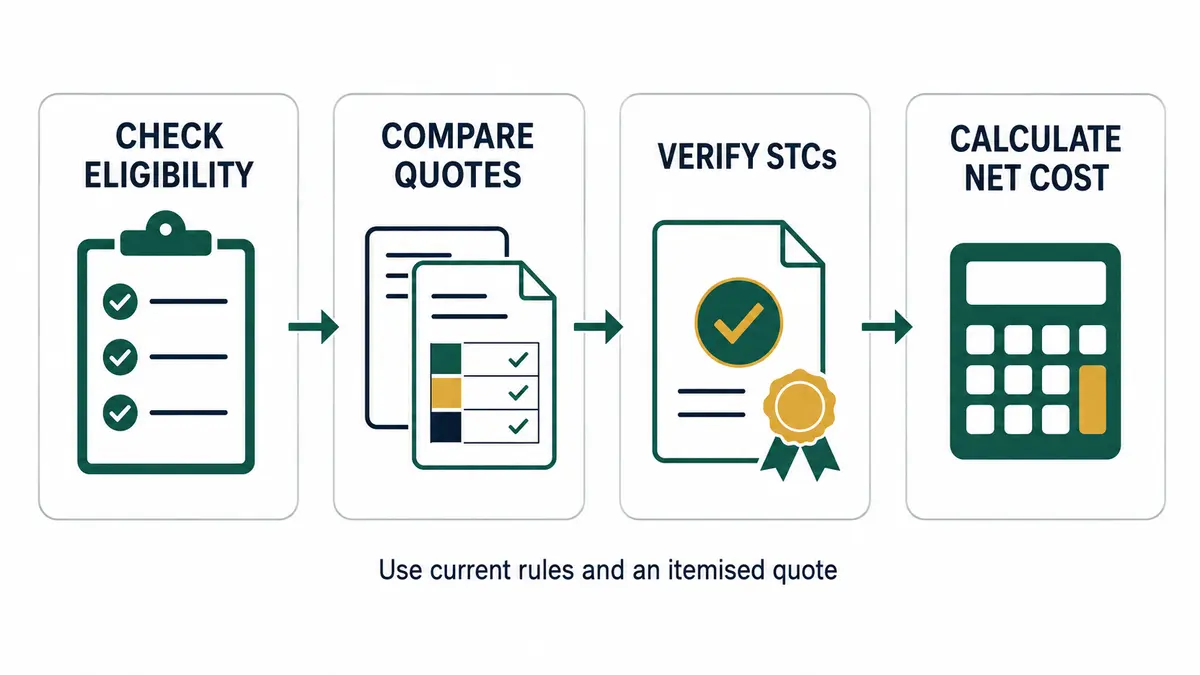
For a system-specific estimate, use the Australian Government’s REC Registry STC calculator. Its result is an approximate guide and may change as data or program settings are updated. Then enter the confirmed dollar support from an itemised quote into the Energy Rebate & Upgrade Cost Calculator to see the net installed cost. HomeBillLab does not use a hidden national rebate value.
Who and what may be eligible?
The Cheaper Home Batteries Program 2026 covers eligible batteries at residential and non-residential premises. The official eligibility information should be treated as the controlling consumer summary. Important requirements reviewed on 31 August 2026 include:
- Installation date: the battery must be considered installed on or after 1 July 2025. The relevant date is when the certificate of electrical compliance, or local equivalent, is issued.
- New equipment: the battery must meet SRES requirements for new equipment and must not have been previously installed or claimed.
- Capacity: nominal capacity must be at least 5 kWh and no more than 100 kWh. Only the first 50 kWh of new or added usable capacity attracts STCs.
- Solar connection: the battery must be installed with a new or existing solar PV system of no more than 100 kW. A battery that only stores grid electricity without solar PV is not eligible.
- Approved products: the battery and relevant inverter must meet the current approved-product requirements at the required point in the process.
- Accredited installation: a Solar Accreditation Australia accredited battery installer must undertake or supervise the installation on site. Licensed electrical work and state or territory requirements still apply.
- One supported system: generally, support is provided for one battery system at a single premises and only the first time a battery is installed, added to or replaced under the program.
- Permanent use: the equipment is intended for permanent use at the premises. Portable batteries and electric vehicles are not eligible.
This checklist cannot confirm a household’s entitlement. Product status, system design, existing equipment and certification details matter. Ask the retailer or installer to identify the exact rule supporting each claim of eligibility.
Existing solar, new solar and battery upgrades
You can install an eligible battery with an existing solar PV system, or install new or replacement solar and the battery together. An existing PV system must comply with relevant electrical safety rules. If the battery is connected through an existing hybrid inverter, that inverter must satisfy the current listing and VPP-capability requirements described by the Clean Energy Regulator.
Adding capacity to an existing battery may qualify only if the original battery system has not previously received program support. The added nominal capacity must be at least 5 kWh, and total nominal capacity after the upgrade cannot exceed 100 kWh. The final configuration of a stackable system must be listed as an approved configuration, compatible, installed and re-certified as required.
This first-supported-system rule makes sizing important. If you claim support for a smaller battery now, you should not assume that a later expansion will receive another discount. Ask for a design that reflects your current and expected electricity use, solar generation, inverter limits and backup goals.
VPP capability does not mean VPP participation
For an on-grid installation under the Cheaper Home Batteries Program 2026, the battery system and inverter must be technically capable of participating in a virtual power plant. That means the system can communicate and respond to authorised external signals. You do not have to join a VPP to receive support.
If you voluntarily consider a VPP, read the separate commercial terms. Check who can control charging and discharging, export payments, bill credits, minimum participation periods, exit fees, internet requirements, warranty effects and the reserve left for household backup. Potential VPP income is not guaranteed and should not be counted as certain battery savings.
Does a discount make a battery worth it?
A lower upfront price improves the economics, but it does not guarantee that the battery will pay for itself. Savings depend on how much energy the battery can regularly shift, charging source, round-trip efficiency, electricity tariff, feed-in tariff, degradation, maintenance, export limits and operating strategy.
Australian Government guidance on how batteries reduce electricity bills says batteries can increase solar self-consumption, use time-of-use price differences, reduce peak demand and participate in a VPP. It also cautions that a battery may not repay its cost within its lifetime for every household.
Use two separate calculations:
- Net installed cost: start with the complete installed quote, subtract the confirmed STC incentive and any other support that can legally be combined, and include necessary switchboard, inverter, metering or network work.
- Household-specific value: estimate usable battery throughput, avoided grid purchases, foregone solar exports, round-trip losses and tariff periods. Test conservative, central and optimistic scenarios.
The solar battery payback guide explains those inputs, while the Solar & Battery Savings Calculator lets you test your own rates and net installed cost.
How to compare battery quotes
When comparing offers under the Cheaper Home Batteries Program 2026, get multiple itemised quotes for comparable designs. The official guide to choosing a solar retailer and installer explains that approved sellers under the New Energy Tech Consumer Code commit to standards covering sales, quotes, contracts, installation, warranties and support.
- Battery and inverter make, model, nominal capacity, usable capacity and power output.
- Exact pre-incentive installed price and final payable price.
- Estimated STC count, value per certificate and any agent or administration amount.
- Evidence the proposed battery configuration is on the current Clean Energy Council approved batteries list.
- Installer’s Solar Accreditation Australia number and who will supervise on site.
- Switchboard, inverter, backup gateway, smart-meter, network-application and site-work inclusions.
- Backup capability: which circuits will operate, maximum backup power and whether additional hardware is included.
- Product, performance, workmanship and installation warranties, including capacity or throughput conditions.
- Written savings and payback assumptions, including tariffs, annual cycles, degradation and VPP income.
- Cooling-off rights, deposit terms, change-order process and responsibility for after-sales support.
Before signing, check the exact models again because approved-product lists can change. Australian Consumer Law also applies. The ACCC’s guidance on solar systems and home batteries explains that consumer guarantees cannot be excluded by contract and that suppliers may have to provide remedies when guarantees are not met.
Can you combine the federal discount with state support?
Sometimes, but do not assume that every program can be stacked. The Clean Energy Regulator advises consumers to check the rules because some state or territory programs may not allow a claim where SRES STCs are also claimed. Program availability and eligibility can change.
Start with the Australian Government’s rebates and loans guide and the HomeBillLab Australian home energy rebates finder. Then verify the current terms on the relevant state, territory or council website before entering a second incentive in any calculation.
Step-by-step checklist before you sign
- Collect recent electricity bills and, if available, interval data showing when you import and export electricity.
- Decide whether your priority is bill savings, backup, solar self-consumption, tariff shifting or a combination.
- Ask suppliers to size the battery against your solar generation and load profile, not only against a promotional discount.
- Verify the battery, inverter and final system configuration on current approved-product lists.
- Verify the installer’s current accreditation and the licensed electrician requirements in your state or territory.
- Compare itemised quotes using the same included hardware, backup scope, installation work and warranty conditions.
- Check the STC count and installation-period factor using the official REC Registry calculator.
- Read the assignment form before signing away the right to create STCs, and retain the quote, contract, compliance documents, warranties and serial numbers.
- Calculate both net cost and conservative annual savings. Do not treat advertised VPP revenue, tariff spreads or future electricity prices as certain.
- Confirm whether any state or local support can be combined with the federal STCs.
Frequently asked questions
Is the Cheaper Home Batteries Program 2026 a 30% cash rebate?
Not usually. It operates through STCs and the government describes the intended support as around 30%. A retailer or installer generally applies an upfront incentive after the owner assigns the STCs. The actual dollar amount depends on eligible usable capacity, the installation-period factor, tapering, rounding and the commercial STC value in the quote.
Can I get the discount without rooftop solar?
No for a grid-only charging system. The battery must be installed with eligible new or existing solar PV. Off-grid systems have additional requirements.
Can an existing solar home qualify?
Yes, subject to the existing PV system, inverter, battery, installer and installation meeting the current rules. The existing solar installation must comply with relevant electrical safety requirements.
Must I join a virtual power plant?
No. On-grid equipment must be VPP-capable, but participation is voluntary. Read any VPP contract separately before joining.
Can I claim again if I add more battery capacity later?
Do not assume so. Additional capacity can qualify only in limited circumstances, including where the original battery has not previously received program support. The official guidance states that support is generally available only the first time a battery system is installed, added to or replaced at a premises.
Bottom line
The Cheaper Home Batteries Program 2026 can materially reduce the upfront price of an eligible solar-connected battery, but “around 30%” is a program objective, not a universal quote guarantee. For installations from May to December 2026, start with the 6.8 STC factor, apply the capacity taper and rounding rules, and confirm the exact incentive in writing.
Use the HomeBillLab Methodology to keep assumptions visible, calculate confirmed support with the Energy Rebate & Upgrade Cost Calculator, and browse the Rebates hub for related Australian guides.
Reviewed: 31 August 2026. High-freshness guide; review monthly and immediately after any DCCEEW, Clean Energy Regulator or SRES program announcement.