
Mini split vs central air running cost does not have one universal winner. If both systems have the same seasonal efficiency and serve the same cooling load, their rating-based electricity use can be very similar. The biggest differences usually come from duct losses, zoning, equipment efficiency, system sizing and how much of the home you actually cool.
For a 2026 electricity-price reference, the U.S. Energy Information Administration reports a national residential average of 18.31¢/kWh for July 2026. At that rate, a system using 1,200 kWh over a cooling season costs about $220 in electricity, whether the equipment is ductless or centrally ducted. The technology affects how many kWh you need; the tariff converts those kWh into dollars.
Use the HomeBillLab U.S. Air Conditioner Running Cost Calculator to compare your own equipment input, runtime and electricity rate. For a fair comparison, keep the cooling load the same unless you intentionally want to model mini-split zoning.
Table of Contents
Mini split vs central air: which costs less to run?
A ductless mini-split can cost less to run when it avoids duct-distribution losses, has a higher SEER2, or lets you cool only occupied zones instead of the whole house. Central air can be equally competitive when the ducts are already installed, well sealed and located inside conditioned space, and the central system has comparable efficiency.
The correct comparison is therefore not simply “mini-split versus central AC.” It is:
- the same cooling load,
- the actual SEER2 or seasonal kWh of each system,
- duct losses for the central system,
- the percentage of the home cooled by the mini-split, and
- the local electricity price.
DOE’s current Heat Pump Systems guidance describes ductless air-source heat pumps as an efficient and flexible option for homes without existing ducts and emphasizes their usefulness for zone heating and cooling. DOE also notes that inverter-driven systems can modulate capacity instead of cycling only between full power and off.
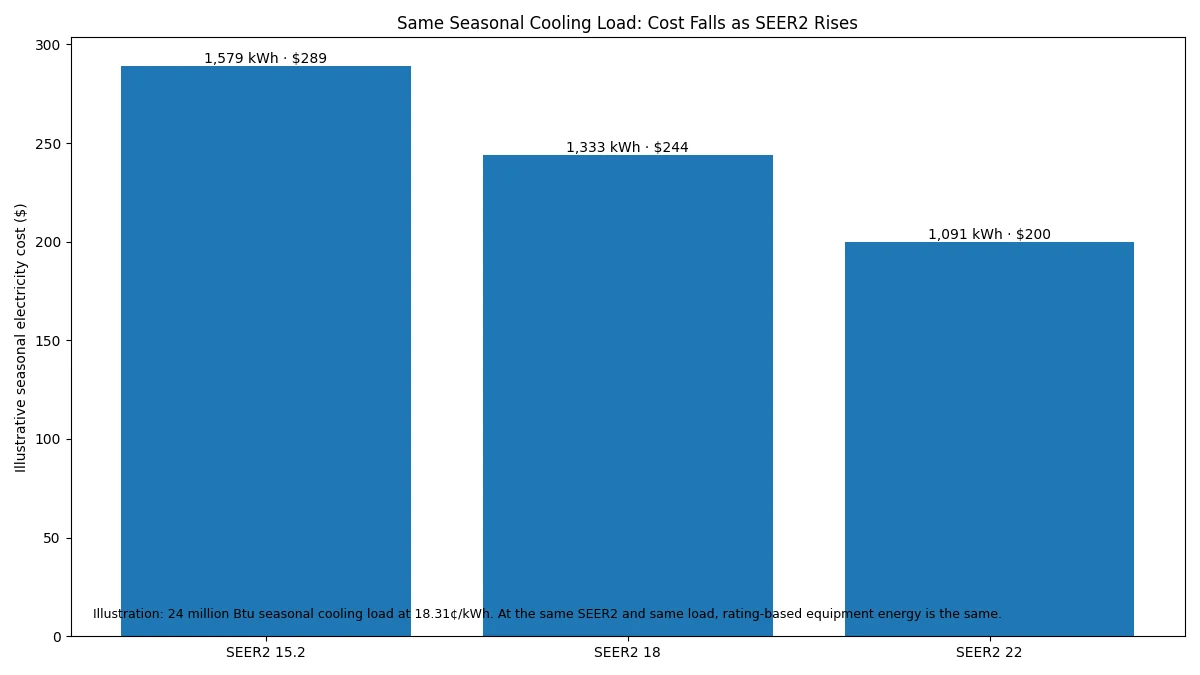
At the same SEER2 and same cooling load, the math starts equal
SEER2 is defined as the total seasonal cooling delivered, in Btu, divided by the total electrical energy consumed, in watt-hours. That means two systems with the same SEER2 serving the same standardized cooling load have the same basic rating-based seasonal electricity use before distribution and zoning effects are added.
For an illustrative 24 million Btu seasonal cooling load:
| SEER2 | Illustrative seasonal electricity | Cost at 18.31¢/kWh |
|---|---|---|
| 15.2 | 1,579 kWh | $289 |
| 18.0 | 1,333 kWh | $244 |
| 22.0 | 1,091 kWh | $200 |
These numbers do not say that a mini-split and central AC will actually consume the same kWh in a real house. They show why you should compare efficiency and delivered load first. A higher-efficiency central system can beat a lower-efficiency mini-split, and vice versa.
The current central-air threshold used here is also reflected in DOE/FEMP residential central air-conditioner guidance, which uses an ENERGY STAR level of 15.2 SEER2 for its current examples.
Current DOE/FEMP residential central air-conditioner guidance uses the ENERGY STAR level of at least 15.2 SEER2 for certified residential split-system central air conditioners. ENERGY STAR’s current heat-pump criteria also use a minimum of 15.2 SEER2 for qualifying split-system heat pumps, including ducted and non-ducted configurations.
How duct losses can raise central-air running cost
A conventional central system distributes cooled air through ducts. If those ducts leak or pass through a hot attic, crawlspace or garage, some cooling can be lost before it reaches the rooms.
DOE’s recent Energy Saver 101 home-cooling guide specifically lists avoiding ductwork energy loss as a mini-split advantage and advises central-air users to keep ducts properly sealed and connected. DOE’s central-air purchasing guidance also warns that leaky ducts and poor installation reduce realized efficiency.
Duct losses are not the same in every home. A short, tight duct system inside conditioned space can perform much better than old leaky ducts routed through a very hot attic. Do not apply one national duct-loss percentage to every house.
For an existing central system, duct sealing and insulation may be a cheaper way to reduce cooling cost than replacing the entire distribution system.
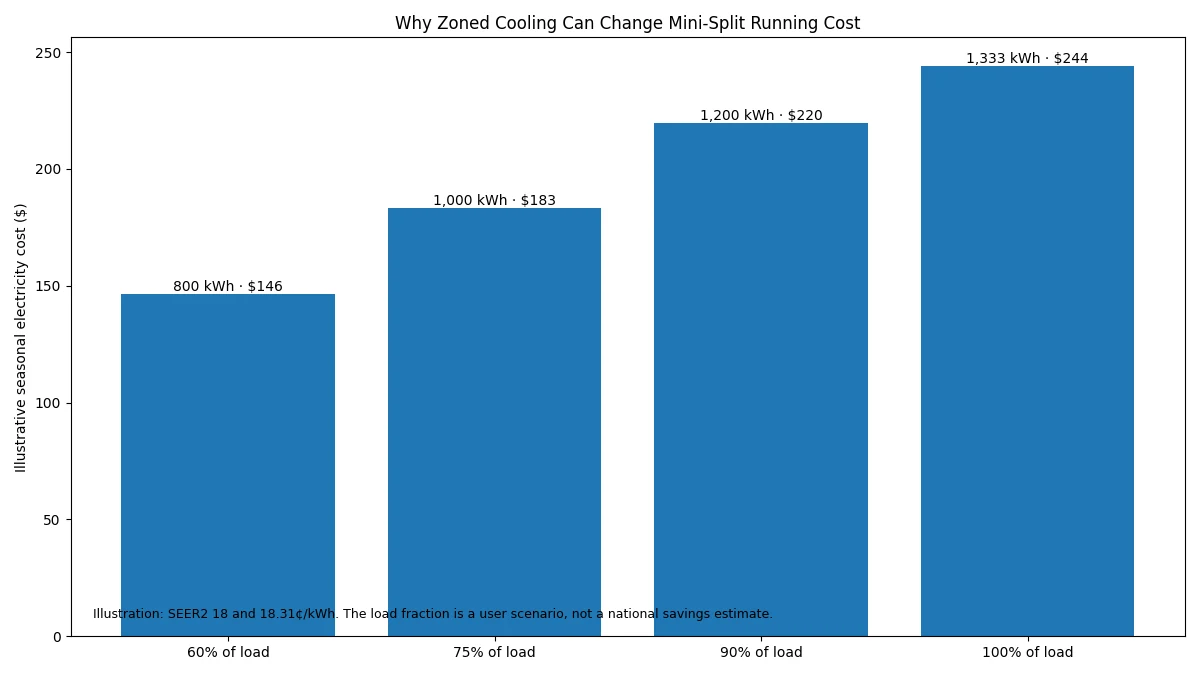
Mini-split zoning can reduce cost when you cool fewer rooms
One of the strongest mini-split advantages is the ability to condition individual zones. If you cool only a bedroom and living room instead of every room in the house, the equipment may serve a smaller total cooling load.
For example, assume SEER2 18 and a hypothetical whole-house cooling load of 24 million Btu. If a zoning strategy reduces the actively conditioned load to 60% of that amount, the rating-based electricity falls from about 1,333 kWh to about 800 kWh. At 18.31¢/kWh, the illustrative seasonal energy cost falls from about $244 to about $146.
That is a scenario, not a claim that mini-splits automatically save 40%. Savings only occur if the zones you leave unconditioned actually reduce the building’s total cooling requirement without creating comfort, humidity or air-distribution problems elsewhere.
Compare SEER2, EER2 and the exact matched system
SEER2 measures seasonal cooling efficiency, while EER2 describes efficiency at a specific cooling test condition. A high SEER2 system generally needs fewer kWh for the same standardized seasonal load, but EER2 can also be useful in very hot climates where peak-condition performance matters.
ENERGY STAR Version 6.2 requires certified residential split-system central air conditioners to reach at least 15.2 SEER2 and 12.0 EER2. For split-system heat pumps, the current ENERGY STAR threshold is 15.2 SEER2 and 11.0 EER2, with additional heating-efficiency requirements.
Mini-splits used for both heating and cooling are typically heat pumps, so compare them with the heat-pump criteria rather than assuming they use the same EER2 threshold as cooling-only central AC.
Central air has a whole-house distribution advantage
Central air is designed to distribute conditioned air throughout the home through supply and return ducts. When the duct system is properly designed and balanced, it can provide more uniform temperatures across bedrooms, hallways and closed rooms than a single wall-mounted mini-split head.
DOE’s home-cooling guidance says a central AC system provides even cooling throughout the home and can be cost-effective when ductwork already exists. That distribution advantage can matter in houses with many small rooms or where doors are frequently closed.
A mini-split can also provide whole-home comfort, but larger houses may need several indoor heads, concealed ducted mini-split units, or transfer strategies between rooms. More indoor units can reduce the simplicity and cost advantage of a single-zone installation.
Single-zone and multi-zone mini-splits do not have identical economics
A single-zone mini-split connects one indoor unit to one outdoor unit. A multi-zone system connects several indoor heads to one outdoor unit. Multi-zone systems are convenient, but the exact matched combination can have a different SEER2 and part-load performance than the brand’s most efficient single-zone model.
For a fair comparison, use the efficiency rating of the exact indoor/outdoor combination being quoted, not the highest SEER2 available anywhere in that product family.
The same rule applies to central air: the outdoor condenser, indoor coil and blower must be evaluated as a matched system. Installation quality can erase much of the laboratory efficiency advantage if refrigerant charge, airflow or duct design is wrong.
Existing ductwork can change the installation-cost decision
Running cost is only one part of the financial comparison. If a house already has good ductwork, replacing or adding a central AC can be relatively straightforward. If the home has no ducts, installing a complete duct system can be expensive and disruptive.
DOE’s Energy Saver 101 guide says ductless mini-splits avoid the need for ductwork and can be an affordable alternative to installing a ducted system. The same DOE guide also notes that in homes with existing ductwork, a mini-split installation can cost more than adding an air-conditioning unit to the existing system.
That means the lower-operating-cost option is not always the lower-lifetime-cost option. Get installed quotes for both systems and compare the upfront difference with realistic annual kWh savings.
Variable-speed operation can improve part-load comfort
Many modern mini-splits use inverter-driven variable-speed compressors. DOE explains that inverter systems can modulate capacity across a wide range instead of repeatedly cycling between full power and off. Many premium central systems also use variable-capacity compressors and variable-speed blowers.
Longer low-capacity operation can improve temperature stability and, when properly designed, humidity control. But oversized equipment can still short-cycle or fail to manage humidity well, regardless of whether it is ductless or ducted.
For hot-humid climates, compare latent performance, low-load operation and installation quality rather than assuming one equipment category automatically controls humidity better.
Installation quality can matter as much as the equipment label
DOE/FEMP’s central-air purchasing guidance warns that oversizing, improper refrigerant charge and leaky ducts can cause efficiency losses, comfort problems and shorter equipment life.
Mini-splits avoid duct leakage but still depend on correct refrigerant-line installation, condensate drainage, airflow, outdoor-unit placement and clean filters and coils. A poorly installed high-SEER2 system can perform worse than expected.
When comparing quotes, ask for the exact matched-system efficiency, load calculation, equipment size and commissioning steps — not only the brand name or tonnage.
Which system fits which home?
- Mini-split can make sense when: the home has no ducts, you want room-by-room zoning, only part of the home needs regular cooling, or the existing ducts are difficult to repair.
- Central air can make sense when: good ductwork already exists, you want even whole-house cooling, and the central system has competitive SEER2.
- For additions or converted spaces: a single-zone mini-split can avoid extending the main duct system.
- For many closed rooms: central duct distribution can simplify whole-house comfort.
- For energy cost: compare seasonal kWh, not just equipment type.
The latest EIA Electric Power Monthly summary reports a July 2026 U.S. residential average electricity price of 18.31¢/kWh. Use your actual utility rate whenever possible because the same efficiency difference is worth more in a high-rate state.
For standalone operating-cost details, see Mini Split Running Cost USA and Central Air Conditioner Running Cost USA. For another room-cooling alternative, see Window Air Conditioner Running Cost USA.
HomeBillLab’s treatment of electricity prices, efficiency ratings and illustrative load calculations is documented in the HomeBillLab Methodology. Browse the U.S. Air Conditioning hub for related guides.
Mini split vs central air FAQ
Is a mini-split always cheaper to run than central air?
No. A mini-split can save energy through higher efficiency, zoning and avoided duct losses, but a high-efficiency central system with tight ducts can use less electricity than a lower-efficiency mini-split serving the same load.
If both systems are SEER2 18, do they use the same electricity?
For the same standardized seasonal cooling load, SEER2 18 implies the same rating-based equipment energy. Real-world consumption can differ because of duct losses, zoning, controls, sizing and installation.
Does a mini-split save money by cooling only one room?
It can. If zoning genuinely reduces the amount of building space that must be conditioned, total cooling load and kWh can fall. The savings depend on room layout, heat transfer between zones and how the rest of the home is used.
Is central air better for a large house?
Central air can be easier for uniform cooling across many closed rooms when good ducts already exist. Multi-zone mini-splits can also serve large homes, but they may require several indoor units and careful design.
Which costs more to install?
It depends on the existing house. Mini-splits can avoid the high cost of adding ductwork to a ductless home. In a house with good existing ducts, central AC can be less expensive to add than multiple mini-split zones.
Bottom line
For mini split vs central air running cost, compare the same cooling load, the exact SEER2, duct condition and how much of the house you plan to cool. Mini-splits often gain an advantage from zoning and avoiding duct losses; central air can be highly competitive when efficient equipment uses tight, well-designed existing ducts. At 18.31¢/kWh, every 500 kWh difference in seasonal electricity use is worth about $92. Use the U.S. Air Conditioner Running Cost Calculator to compare your own scenarios.