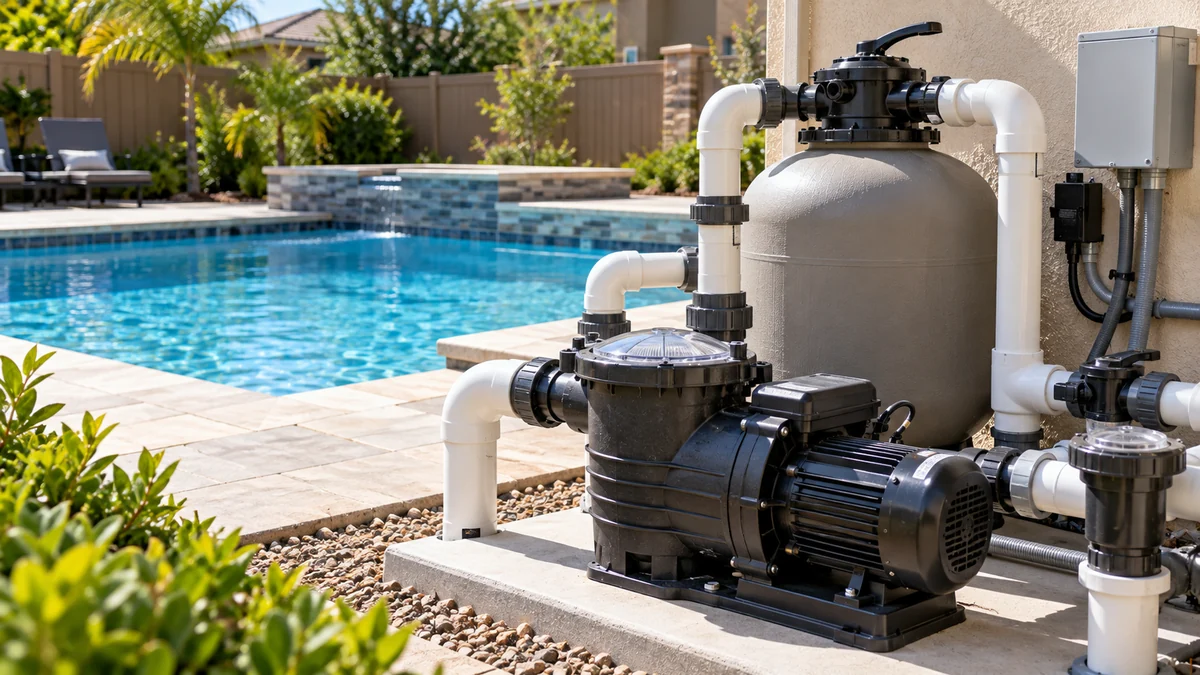
A pool pump running cost USA estimate should start with two things: the pump’s average electrical input while it is running and the number of hours it operates. Pool pumps can be one of the larger recurring electrical loads around a home with a swimming pool, but the cost varies widely because a single-speed pump running at full speed behaves very differently from a properly programmed variable-speed pump.
The latest U.S. Energy Information Administration data, released October 23, 2026, reports an average residential electricity price of 18.16¢ per kWh for August 2026. At that benchmark, a pump averaging 1.5 kW for eight hours per day would use 12 kWh per day and cost about $2.18 per day, $65.38 per 30-day month, or about $795 per year if operated on that same schedule every day. Your actual cost may be much lower or higher. Use your own rate and measured or documented pump input in the HomeBillLab U.S. Appliance Running Cost Calculator.
Table of Contents
How much electricity does a pool pump use?
The basic calculation is straightforward:
Daily electricity use (kWh) = average pump input (kW) × runtime (hours/day)
Daily electricity cost = daily kWh × electricity rate ($/kWh)
For the electricity-price examples in this guide, HomeBillLab uses the EIA’s August 2026 national residential average of 18.16¢/kWh. That is a benchmark, not a substitute for the price on your own utility bill. State, utility and rate-plan differences can be substantial.
| Average pump input | 8-hour daily use | Cost per day at 18.16¢/kWh | 30-day cost | 365-day example |
|---|---|---|---|---|
| 0.3 kW | 2.4 kWh | $0.44 | $13.08 | $159.08 |
| 0.5 kW | 4.0 kWh | $0.73 | $21.79 | $265.14 |
| 0.75 kW | 6.0 kWh | $1.09 | $32.69 | $397.70 |
| 1.0 kW | 8.0 kWh | $1.45 | $43.58 | $530.27 |
| 1.5 kW | 12.0 kWh | $2.18 | $65.38 | $795.41 |
| 2.0 kW | 16.0 kWh | $2.91 | $87.17 | $1,060.54 |
The table deliberately uses the same eight-hour runtime so you can see the effect of power draw. It does not mean every pool pump should run eight hours per day. Required circulation depends on the pool, equipment, sanitizer strategy, water conditions, plumbing, local rules and the tasks the pump is serving.

Single-speed pumps can draw much more power
A long-standing U.S. Department of Energy field guide on replacing single-speed pool pumps notes that a typical 1.5 to 2 horsepower single-speed pool pump can draw roughly 1,500 to 2,500 watts while operating at its fixed high speed. That range is useful as historical equipment context, but you should not assume your pump uses that exact amount. Modern pumps, motor designs, hydraulic systems and federal efficiency requirements have changed since that guide was published.
The better approach is to check your pump’s documentation, controller display, installer data or measured circuit energy. DOE’s current dedicated-purpose pool pump standards page confirms that covered pool pumps are subject to federal energy-conservation standards and a standardized test procedure. That means efficiency is now regulated and comparable in a more structured way than simply comparing horsepower.
Why variable-speed pumps can use less electricity
Filtration usually does not need the same high flow rate as tasks such as running certain cleaners, spa jets or water features. ENERGY STAR’s pool pump guidance explains that variable-speed and multi-speed pumps can match pump speed to the job instead of using one high speed for every task.
This matters because pump power does not fall in a simple one-for-one relationship with speed. DOE’s pool-pump measure guideline explains the pump affinity-law relationship: in an idealized comparison, cutting pump speed in half cuts flow to roughly half but can reduce hydraulic power dramatically. In real installations, plumbing resistance, motor efficiency, minimum flow requirements and longer runtime mean actual savings will differ from the theoretical relationship.
For a variable-speed pump, do not calculate the whole day using the highest programmed wattage. Break the schedule into operating blocks. For example, if the pump averages 300 W for six hours and 1,200 W for one hour, daily electricity use is:
(0.3 kW × 6 h) + (1.2 kW × 1 h) = 3.0 kWh/day
At 18.16¢/kWh, that example would cost about $0.54 per day or about $16.34 per 30-day month. The numbers are illustrative; the useful lesson is to calculate each speed period separately.
What does WEF mean on a pool pump?
Pool-pump efficiency is commonly expressed as Weighted Energy Factor (WEF), measured in thousands of gallons moved per kilowatt-hour (kgal/kWh). Higher WEF means the pump moves more water for each unit of electricity under the specified test conditions. DOE’s federal standards use WEF, and ENERGY STAR’s pool pump criteria also use WEF thresholds that vary by pump type and size.
WEF is useful for comparing eligible pumps, but it is not the same as watts. You generally cannot take a WEF number alone and turn it into a precise household monthly bill without also knowing the flow requirements, schedule and operating conditions. For bill planning, measured kWh or average kW by speed is more direct.
How long should a pool pump run each day?
There is no single national runtime that fits every pool. Runtime depends on pool volume, pump flow, filter condition, sanitizer system, bather load, debris, water temperature, plumbing and local health or building requirements. A variable-speed pump may intentionally operate longer at a much lower speed because the lower-speed schedule can use less electricity while still providing the needed filtration.
As one state-specific example, California’s current 2025 single-family pool and spa guidance requires programmable controls for off-peak operation and low-speed filtration defaults for applicable multi-speed equipment. Those California rules should not be treated as a nationwide runtime requirement, but they illustrate why modern pool systems are designed around scheduling and task-specific flow rather than simply running at maximum speed for a fixed number of hours.
Can running the pump off-peak reduce cost?
If your household is on a time-of-use electricity plan, moving flexible filtration hours away from expensive peak periods can reduce the dollar cost even when total kWh stays the same. The benefit depends on your utility’s actual rate windows and on whether the pool equipment can safely meet all circulation, heating, cleaning and sanitation requirements at the shifted times.
Use the schedule printed by your utility rather than assuming that nights are always cheaper. HomeBillLab explains the rate-plan logic in the U.S. time-of-use electricity rates guide.
Horsepower is not the same as electrical input
A 1.5 hp label does not mean the pump consumes exactly 1.5 kW. Horsepower describes mechanical output or motor/pump rating context, while electrical input includes motor efficiency and operating conditions. Service factor, pump curve, motor design, speed and system head can all affect the watts drawn from the electrical circuit.
If your documentation gives watts, use watts directly. Divide watts by 1,000 to convert to kilowatts. If your variable-speed controller reports watts at each programmed speed, that can be especially useful because it lets you calculate the actual schedule rather than guessing from horsepower.
Do not use a plug-in meter on a hardwired pool pump
Many pool pumps are hardwired, operate at 240 volts, or are installed in wet-location electrical systems. Do not improvise with a household plug-in energy meter or open electrical equipment to take measurements. If you do not have a safe built-in energy reading, use the manufacturer’s electrical data or have a qualified electrician or pool professional assess the circuit.
How to estimate your own monthly pool pump cost
Use this four-step method:
- Find the average watts or kW for each speed used in the daily schedule.
- Multiply each kW value by the hours spent at that speed.
- Add the blocks to get total daily kWh.
- Multiply daily kWh by your electricity rate, then by the number of operating days.
For example, a fixed-speed pump averaging 1.2 kW for seven hours per day uses 8.4 kWh per day. At 18.16¢/kWh, that is about $1.53 per day and $45.76 per 30-day month. If the pool is operated only part of the year, multiply by your actual seasonal operating days instead of using 365 days.
If you are checking whether the pump explains a change in your household bill, compare meter or interval-data consumption across similar periods. The HomeBillLab meter-reading bill guide shows how to turn changes in kWh into a bill estimate.
Should you replace an older single-speed pump?
Running cost is only one part of the decision. Compare the existing pump’s annual kWh, the expected kWh of the replacement, installed cost, remaining equipment life, warranty, available rebates and whether the new control schedule can meet the pool’s hydraulic needs. A variable-speed pump that is installed but programmed to run unnecessarily fast can give away part of its efficiency advantage.
Federal requirements are also evolving. DOE adopted standards for dedicated-purpose pool pump motors that include variable-speed control design requirements for certain small and standard-size motors. DOE’s April 2026 enforcement policy affects the timing of enforcement for some small-size motors manufactured during a future compliance window. For a homeowner buying equipment now, the practical takeaway is to compare current certified pump efficiency and controls rather than relying on old single-speed assumptions.
Pool pump running cost FAQ
How much does a pool pump cost to run per month?
It depends mainly on average kW, runtime and electricity price. At 18.16¢/kWh, a pump averaging 1.0 kW for eight hours per day costs about $43.58 per 30-day month; 1.5 kW on the same schedule costs about $65.38.
How many kWh does a pool pump use per day?
Multiply average kW by runtime. A 0.5 kW average for eight hours uses 4 kWh per day. A 1.5 kW average for eight hours uses 12 kWh per day. Variable-speed schedules should be calculated speed by speed.
Is a variable-speed pool pump always cheaper to run?
Variable-speed capability creates the opportunity to reduce energy use by matching speed to the task, but actual savings depend on the programmed speeds, runtime, plumbing and required flow. A poor schedule can reduce the advantage.
Should a pool pump run 24 hours a day?
Not as a universal rule. Some systems may use long low-speed schedules, while others need fewer hours. Set runtime around the pool’s actual filtration and equipment requirements rather than assuming that continuous operation is automatically necessary or automatically wasteful.
Does the pool heater count as pool pump electricity use?
No. The circulation pump and pool heater are separate loads, although heating can require the pump to operate at a particular flow rate. If you are estimating the total cost of heating a pool, calculate the heater and circulation pump separately and then combine them.
For the assumptions used across HomeBillLab running-cost guides, see our methodology. Browse more household equipment guides in the U.S. appliances hub, and use the U.S. electricity cost per kWh guide if you need help choosing the right electricity rate for your calculation.