
To calculate an electric bill from meter readings, start with the difference between the current meter reading and the previous reading. That difference is the number of kilowatt-hours (kWh) used during the billing period. You can then multiply those kWh by an applicable electricity rate to build an energy-use estimate.
The basic arithmetic is simple, but the final bill often is not. Many U.S. bills also include customer charges, delivery charges, taxes, credits, time-of-use prices, tiered rates or other tariff rules. So a meter-reading calculation is best treated as a transparent estimate that you can compare with the utility statement, not as a guarantee of the amount due.
If you already know your monthly kWh, HomeBillLab’s U.S. Electricity Bill Calculator can turn usage and a rate into a quick estimate. This guide focuses on the earlier step: turning the meter itself into a usable kWh figure.
Table of Contents
How do you calculate an electric bill from meter readings?
For a standard cumulative residential meter, the starting formula is:
Billing-period usage (kWh) = Current meter reading − Previous meter reading
Tucson Electric Power explains that its meters show a running total of kWh used since installation. To find the energy used since the previous billing period, TEP tells customers to subtract the previous reading from the current reading and then apply the meter multiplier shown on the bill. The utility notes that the multiplier is usually 1 for residential customers. See TEP’s meter-reading guidance.
If the residential multiplier is 1, the arithmetic is simply the reading difference. If your bill lists another multiplier, use the utility’s number rather than assuming 1.
Worked example: meter reading to estimated electricity cost
Suppose the previous reading was 12,840 kWh and the current reading is 13,615 kWh.
| Step | Example |
|---|---|
| Current reading | 13,615 kWh |
| Previous reading | 12,840 kWh |
| Usage | 13,615 − 12,840 = 775 kWh |
| Illustrative rate | 18.31¢/kWh |
| Energy-only estimate | 775 × $0.1831 = $141.90 |
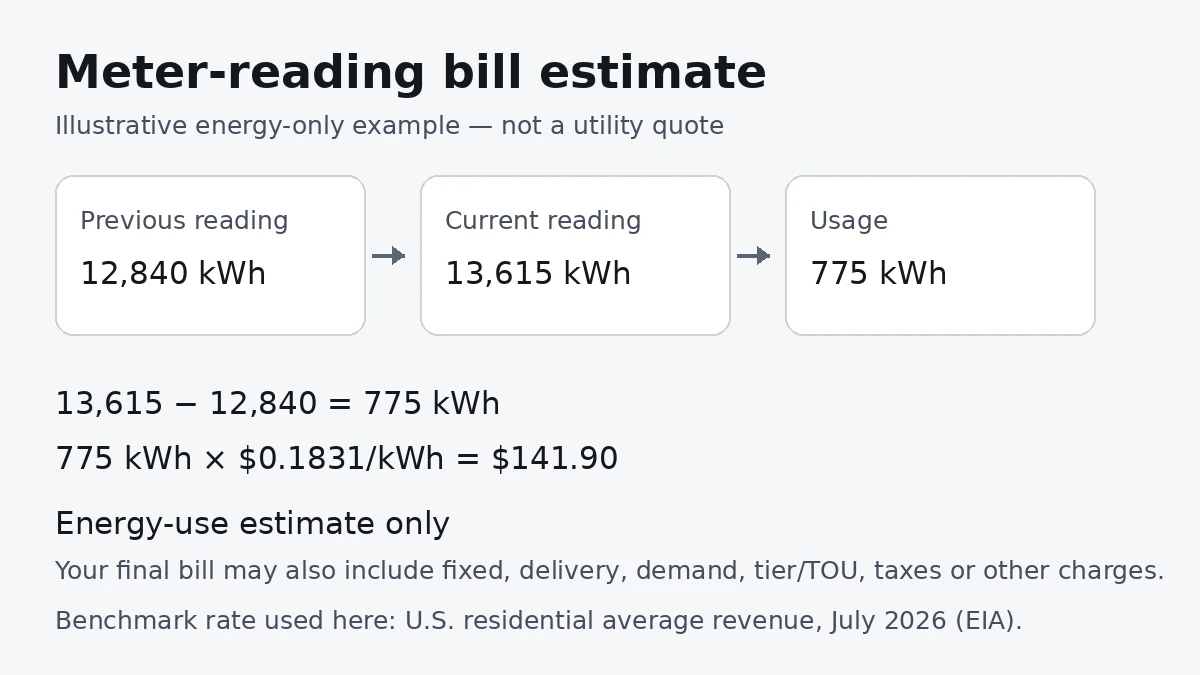
The 18.31¢/kWh figure in this example is the U.S. residential average revenue per kWh reported by the U.S. Energy Information Administration for July 2026. EIA describes average revenue per kWh as a useful proxy for retail prices, but your utility tariff can be materially different. See the EIA Electricity Monthly Update for the current national context.
For a local estimate, replace 18.31¢ with the rate or rates that actually apply to your account. If you are unsure what number to use, start with our guide to electricity cost per kWh in the USA, then confirm the utility tariff on your own bill.
How to read a digital or smart electric meter
Modern electric meters often cycle through several displays. The number you want for a simple cumulative-use calculation is the total kWh reading, not an instantaneous kW demand figure or a diagnostic screen.
Salt River Project’s meter guide shows that common digital meters can display total kWh as well as separate on-peak, off-peak or demand values depending on the plan and meter model. PG&E’s SmartMeter guidance likewise explains that the total kWh display is cumulative, while time-of-use customers may also see separate readings for rate periods.
Write down the reading at the start and end of the period you want to measure. For a bill-cycle comparison, use readings that line up as closely as possible with the utility’s billing dates. A one-day mismatch can matter if household use is high.
What is the meter multiplier?
Some bills include a meter multiplier. TEP’s residential guidance says the multiplier is usually 1 for residential customers, while commercial meters may use larger multipliers. The general calculation becomes:
Usage (kWh) = (Current reading − Previous reading) × Meter multiplier
Example: if the reading difference were 775 and the utility-listed multiplier were 2, billed usage for that meter register would be 1,550 kWh. Do not invent a multiplier; use the one shown by the utility for the meter or account.
Which electricity rate should you multiply by?
The safest rate is the one from your current approved tariff or bill. A single national average is useful for a rough benchmark, but it cannot reproduce local utility pricing.
If your plan is a simple single-rate tariff, the energy portion can often be estimated as:
Estimated energy charge = kWh used × dollars per kWh
If your bill shows 775 kWh at 16.5¢/kWh, the usage charge is 775 × $0.165 = $127.88 before any other charges. When the tariff has multiple price blocks or time periods, calculate each portion separately instead of forcing all kWh through one rate.
Why can the final electric bill differ from the meter estimate?
The meter tells you energy use. The bill applies a tariff to that use and can add other account-level charges. SRP’s residential bill guide shows current and prior meter readings, billing-period kWh, account charges, taxes and other line items as separate pieces of the statement. PG&E’s bill guide similarly notes that customers are billed based on monthly kWh but may also see fixed service fees, taxes, credits and rate-plan-specific charges.
- Customer or service charges: fixed amounts that do not necessarily change with kWh.
- Delivery or distribution charges: may be separate from the energy supply price.
- Taxes, assessments and local fees: depend on jurisdiction and utility.
- Credits: can reduce the amount due.
- Demand charges: some plans include charges linked to maximum kW demand, not only total kWh.
- Tiered or time-of-use rules: different kWh can be priced differently.
For a deeper breakdown of supply and wires-related line items, see electricity supply vs delivery charges. For the whole statement, use our U.S. electric bill guide.
How do time-of-use and tiered plans change the calculation?
A single cumulative meter difference gives total kWh, but it may not contain enough information to reproduce a complex tariff.
On a time-of-use electricity plan, the price depends on when electricity was consumed. SRP’s meter guidance shows that some meters keep separate on-peak and off-peak registers. If your utility bills by those periods, you need the relevant interval or register data rather than only one total number.
On a tiered electricity rate, different blocks of monthly usage can have different prices. Calculate each block at its assigned rate, then add the blocks together. Do not multiply all monthly kWh by the highest tier unless that is specifically how your tariff is written.
How to check your calculation against the utility bill
- Find the billing-period start and end dates.
- Find the utility’s prior and current meter readings, if shown.
- Subtract the prior reading from the current reading.
- Apply any meter multiplier listed on the account.
- Compare the resulting kWh with the bill’s stated usage.
- Identify the rate schedule or price plan.
- Calculate the usage-based energy charge using the correct rate structure.
- Add fixed, delivery, demand, tax and other items only if they apply.
SRP’s residential bill example confirms that the meter-information section can show total billing-period kWh together with current and prior readings. If your arithmetic does not match the utility’s stated usage, check the billing dates, meter multiplier, meter replacement history, net-metering rules or whether the plan uses interval data.
FAQ
Can I calculate my exact electricity bill from the meter alone?
Usually not. A meter can tell you kWh usage, but the final bill can also depend on fixed charges, delivery charges, taxes, credits, demand charges, tier thresholds or time-of-use periods.
How do I calculate kWh from two meter readings?
Subtract the earlier cumulative kWh reading from the later reading. Then apply the utility-listed meter multiplier, if one is required.
What if my meter is digital and cycles through several numbers?
Look for the display identified by the utility as total kWh. Other screens can show time, date, demand, diagnostic values or separate peak/off-peak registers.
Can I use the U.S. average electricity price?
Yes for a rough benchmark, but not for an exact household bill. EIA reported 18.31¢/kWh as the U.S. residential average revenue per kWh for July 2026; your local tariff may be much higher or lower.
Why is my calculated energy cost lower than the amount due?
Your estimate may include only kWh charges, while the bill can add fixed service, delivery, taxes, fees, prior balances or other tariff-specific items.
Bottom line
To calculate an electric bill from meter readings, subtract the previous cumulative kWh reading from the current reading, apply the utility’s meter multiplier if needed, and then price the resulting kWh using the correct tariff. For a simple single-rate plan, that can produce a useful energy-cost estimate. For tiered, time-of-use, demand or multi-component bills, treat the meter result as the usage input and then apply the additional billing rules separately.
HomeBillLab uses current public utility and government sources for examples and benchmarks. See our methodology and the U.S. Electricity hub for related guides and calculators.