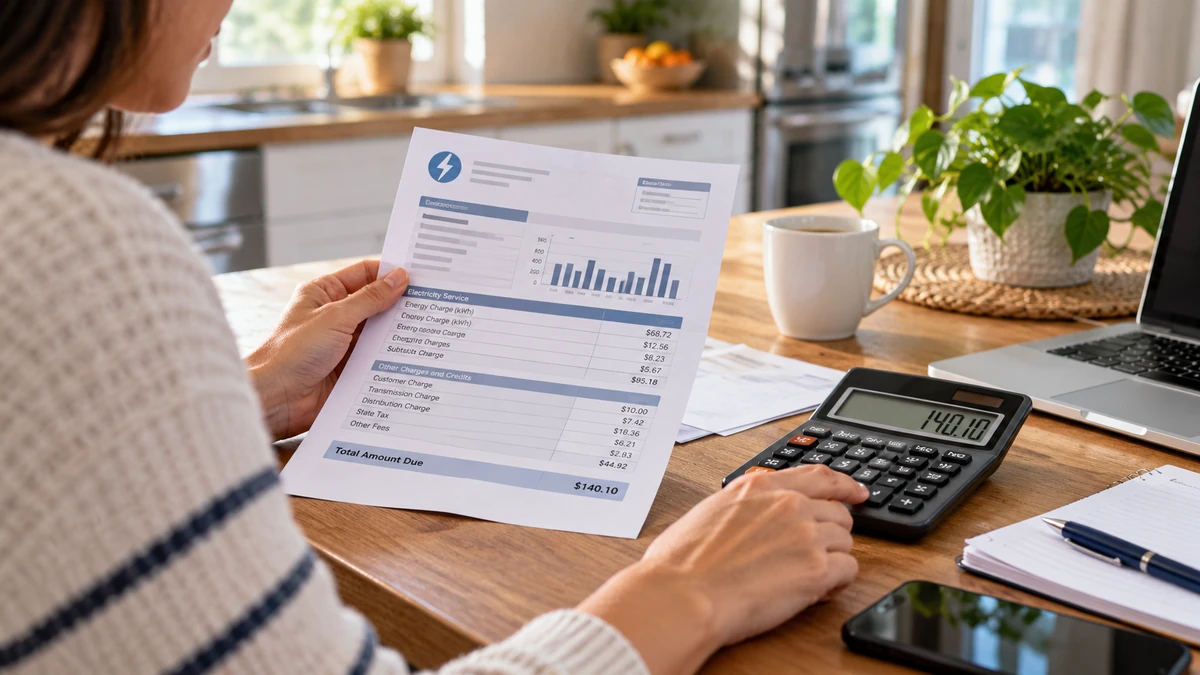
If you are learning how to read an electric bill, start with four numbers: the billing period, electricity use in kilowatt-hours (kWh), the rate or rates applied to that use, and the total amount due. Everything else on the bill explains how the utility, supplier, regulator and tax system turned those inputs into the final charge.
U.S. electric bills are not standardized nationally. One utility may show a single bundled energy charge, another may separate supply and delivery, and another may add riders, fuel adjustments, time-of-use periods or credits. The U.S. Energy Information Administration makes an important distinction: its published “average retail electricity price” includes generation, transmission, distribution, taxes and fees, while an individual utility rate is the set of prices applied to specific services on your bill.
Use the HomeBillLab U.S. Electricity Bill Calculator if you want to reconstruct a bill from kWh, energy prices, fixed charges and other inputs. This guide explains what each line usually means before you enter the numbers.
Table of Contents
How to read an electric bill: what to check first
Before looking at individual line items, find the basic account summary. Most residential bills show the service address, billing period, previous balance, payments or credits, new charges and total amount due. Also check whether the meter reading is actual or estimated if your utility reports that information.
The most useful energy numbers are usually:
- Billing days: the number of days covered by the statement.
- Current meter reading: the latest cumulative meter value or interval-meter total.
- Previous meter reading: the starting point for the period.
- Usage: electricity consumed during the billing period, in kWh.
- Rate plan: the tariff or retail plan that determines your charges.
- Total current charges: the new bill before any old balance or payment arrangement.
The U.S. Department of Energy’s utility-rate guidance says a utility bill can show the rate components, current monthly consumption and historical monthly use. That same logic applies to residential bill review even though the DOE page is written for larger sites.
1. Find your electricity use in kilowatt-hours (kWh)
A kilowatt-hour is a unit of energy. Using a 1,000-watt appliance for one hour consumes 1 kWh. Your bill’s kWh total is the amount of grid electricity recorded for the billing period after any utility-specific adjustments such as net metering or credits.
If the bill shows meter readings, the difference between the current and previous reading may correspond to billed kWh, sometimes after applying a meter multiplier. Smart-meter accounts may instead total interval data over the month.
Do not compare two monthly bills only by total dollars. First compare kWh per day because billing periods may contain different numbers of days:
Average daily use = billed kWh ÷ billing days.
For national household-use context, see How Much Electricity Does a House Use per Day & Month in the USA?.
2. Find the electricity rate in cents per kWh
The rate may be easy to spot — for example, 16.5¢/kWh — or it may be split across several lines. Some bills separate generation or supply from delivery. Others include fuel adjustments or riders that also change with kWh.
EIA’s retail electricity price FAQ explains that its published average retail price is calculated from retail revenue divided by electricity sales and includes generation, transmission, distribution, taxes and fees. EIA explicitly says this published average price is not the same thing as an individual utility rate.
That distinction matters when you compare your bill with an EIA state average. Your bill might show a 12¢ generation rate plus delivery charges and fees, while the EIA average price already reflects the broader delivered cost.
For a dedicated explanation of the price-per-kWh concept, see Electricity Cost per kWh USA.
3. Understand supply vs delivery charges
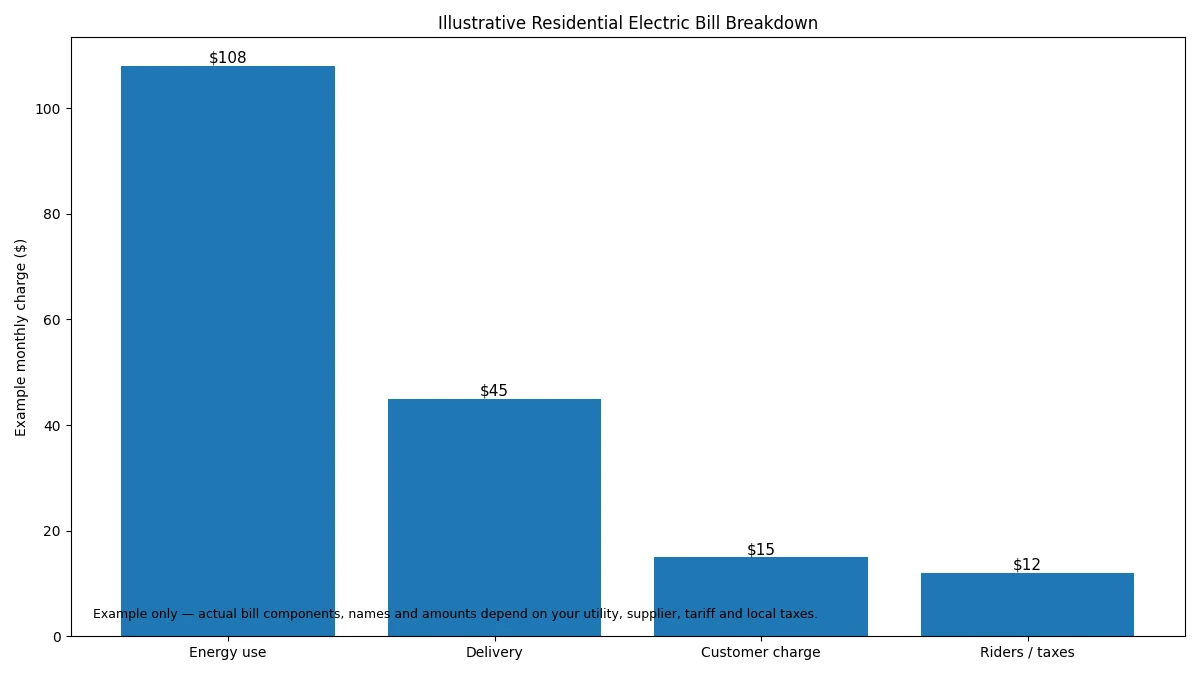
On some bills, electricity service is bundled: the same utility provides both the energy supply and the wires service. In other markets, the bill can be unbundled so that a competitive supplier provides the electricity while the local utility continues to deliver it.
DOE defines a bundled rate as one where supply and delivery are provided by the same provider. An unbundled rate separates electric supply from transmission and distribution, either on one consolidated bill or on separate bills.
Typical labels can include:
- Generation / supply / energy: the electricity commodity or retail supply portion.
- Transmission: high-voltage movement of electricity across the grid.
- Distribution / delivery: local wires, poles, substations and service to the home.
- Supplier charge: a competitive supplier’s energy charge in an electric-choice market.
Do not assume a lower supply price means the whole bill will fall by the same percentage. Delivery and fixed charges may remain unchanged.
4. Customer charges and other fixed monthly charges
A customer charge is a fixed amount that can appear every month even if electricity use is very low. It may cover metering, billing, account service or other fixed utility costs depending on the tariff.
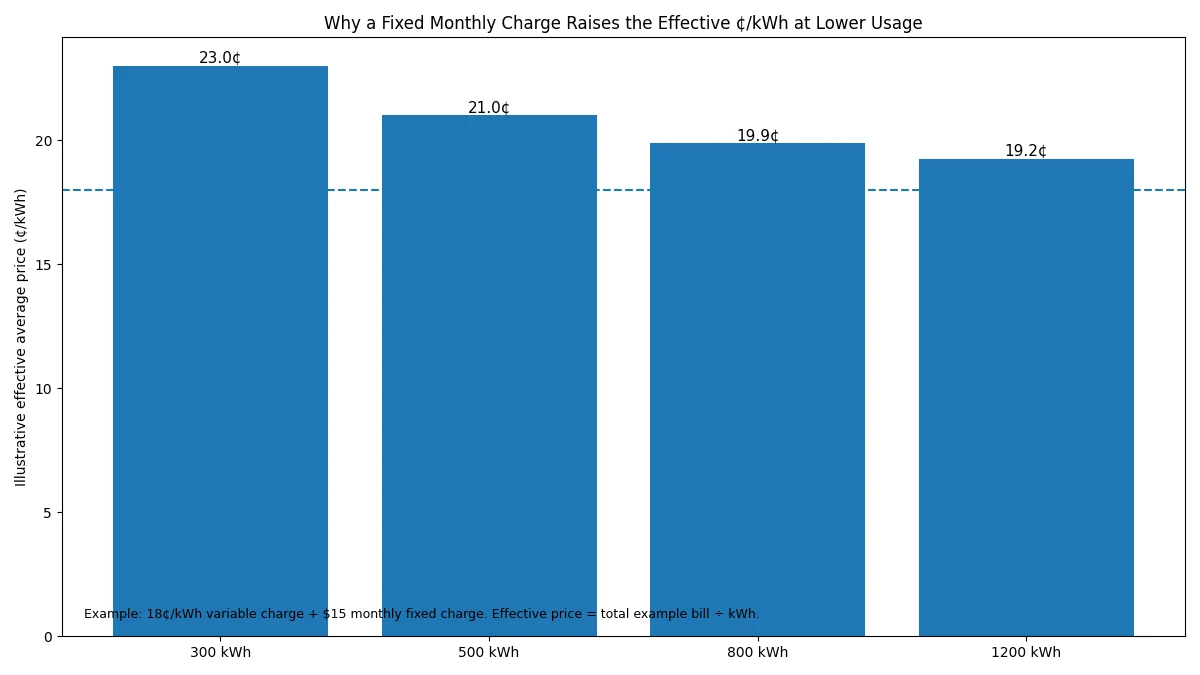
DOE’s rate guidance describes fixed charges as monthly costs determined by the rate schedule rather than by kWh consumption. Because they do not fall when you use fewer kWh, fixed charges have a larger effect on the effective cents per kWh of a low-usage household.
For example, a $15 fixed charge spread over 300 kWh adds 5¢/kWh to the effective average cost. Spread over 1,200 kWh, the same $15 adds only 1.25¢/kWh.
5. Riders, adjustments, taxes, fees and credits
This is often the most confusing part when learning how to read an electric bill. Utilities may use separate lines for fuel adjustments, renewable-energy programs, storm recovery, energy efficiency, securitization, public-benefit charges, franchise fees or state and local taxes.
Names vary by utility and state. The OpenEI U.S. Utility Rate Database, supported by the U.S. Department of Energy, shows how detailed a rate can become: individual records can contain fixed charges, energy tiers, adjustments and time-of-use schedules. Always confirm the current official tariff with the utility or regulator before relying on a database entry.
Credits can appear for net metering, distributed generation, low-income programs, demand-response participation, one-time adjustments or overpayments. If a credit is unfamiliar, check the bill legend or utility tariff rather than assuming it will repeat every month.
6. Time-of-use, seasonal and tiered rates
A flat-rate bill applies one energy price to every kWh in the relevant block. A time-of-use bill separates usage by time period, such as peak and off-peak. A tiered rate changes after usage crosses a defined kWh threshold. A seasonal rate can use different prices in summer and winter.
DOE notes that energy charges can vary by time of use and season. If your bill lists multiple kWh quantities, make sure each is multiplied by the correct rate period before adding the charges together.
For a full explanation, see Time-of-Use Electricity Rates USA.
7. What is a demand charge?
An energy charge is based on total kWh. A demand charge is based on the highest kW demand measured during a specified interval or period. DOE describes demand charges as charges based on maximum demand, typically the highest kW measured during the billing period.
Demand charges are common in commercial and larger-customer tariffs and are not a standard feature of every residential bill. However, some residential or specialty rate plans can include demand-based components. If your bill has a line in $/kW rather than ¢/kWh, check the tariff carefully.
8. Calculate your effective average electricity price
One useful check is to divide the current electricity charges by billed kWh:
Effective average price = current electric charges ÷ billed kWh.
If the bill is $180 for 900 kWh, the simple effective average is 20¢/kWh. This figure can include fixed charges, taxes and other bill components, so it may be higher than the energy-rate line you see on the statement.
This is conceptually similar to EIA’s national and state “average retail price” methodology: EIA divides retail revenue by retail kWh and therefore captures delivered costs including generation, transmission, distribution, taxes and fees.
Be careful with old balances. If your total amount due includes last month’s unpaid balance, late fees or a deposit, do not divide the full amount due by this month’s kWh. Use only the current electric-service charges if you want a meaningful effective rate.
9. Rebuild the bill to check whether the math makes sense
A simplified bill can often be checked with:
Usage charges + delivery charges + fixed charges + riders + taxes − credits = current bill.
For example, suppose a household uses 800 kWh. The bill shows $0.14/kWh for supply, $0.055/kWh for delivery, a $15 customer charge and $9 in taxes or riders:
| Example component | Calculation | Charge |
|---|---|---|
| Supply | 800 × $0.14 | $112.00 |
| Delivery | 800 × $0.055 | $44.00 |
| Customer charge | Fixed | $15.00 |
| Taxes / riders | Example | $9.00 |
| Total | $180.00 |
The effective average price in that example is 22.5¢/kWh, even though neither the supply nor delivery line individually shows 22.5¢.
10. Compare usage and price separately from month to month
A higher bill can come from more kWh, a higher rate, new fees, a longer billing period or a combination of all four. Compare them separately.
- Usage change: compare kWh/day, not only total kWh.
- Rate change: compare the current tariff lines with the previous bill.
- Fixed-charge change: check customer charges and minimum bills.
- Seasonal change: look for summer/winter prices or time-of-use periods.
- Credits: note whether a one-time credit made last month’s bill unusually low.
EIA reported that the average U.S. residential electric bill was about $144 per month in 2024, but averages hide large differences in electricity price and consumption between states. EIA explains that monthly bills reflect both the retail electricity price and how much grid electricity customers consume. See EIA’s state bill comparison for that national context, or read Average Electricity Bill in the USA for the dedicated HomeBillLab guide.
HomeBillLab’s treatment of electricity prices, bill data and rate assumptions is documented in the HomeBillLab Methodology.
How to read an electric bill FAQ
What is the most important number on an electric bill?
For energy analysis, start with billed kWh, billing days and current electric-service charges. The amount due can include previous balances or non-energy items that make it less useful for comparing electricity cost.
Why is my bill’s effective cost per kWh higher than the listed energy rate?
Because the final bill can include delivery charges, fixed customer charges, riders, taxes and other fees. Dividing the whole current electric-service bill by kWh spreads those charges across every unit of electricity.
What is the difference between supply and delivery?
Supply generally refers to the electricity commodity or generation portion. Delivery covers the utility network that moves electricity to your home, including transmission and distribution components. In some markets the supplier and delivery utility are different companies.
Why did my bill go up if my kWh went down?
The rate may have increased, the billing period may be longer, fixed charges or riders may have changed, or a previous credit may have disappeared. Compare kWh/day and each tariff line rather than only total dollars.
Should I compare my rate with the EIA average price?
Only as broad context. EIA’s average retail price includes delivered electricity costs, taxes and fees and is calculated from revenue divided by sales. It is not the same as one line-item rate on an individual utility bill.
Bottom line
Once you know how to read an electric bill, the statement becomes much easier to audit. Start with kWh and billing days, identify the energy price, separate supply from delivery where applicable, then add fixed charges, riders, taxes and credits. Finally, divide current electric-service charges by kWh to see your effective average cost. Use the U.S. Electricity Bill Calculator to reconstruct your own bill and browse the U.S. Electricity hub for related guides.