Australian home energy rebates are not one national list of guaranteed payments. Support can include bill concessions, grants, installation discounts, certificate-based incentives and low- or zero-interest finance. Availability depends on your state or territory, household circumstances, property, technology, program dates and sometimes the approved product or provider.
This maintained finder gives you the safest starting point: choose your jurisdiction, open the official government entry point, select the relevant bill-support or upgrade category, and confirm the rules before accepting a quote. The links were checked on 22 August 2026. Programs can change sooner than this page is reviewed.
Once you have a written quote and a confirmed support amount, use the Energy Rebate & Upgrade Cost Calculator to estimate the remaining cost. The calculator does not decide eligibility, search programs or preload a national rebate amount.
How to use this Australian rebates finder
- Start with your location. State and territory rules differ, and some national incentives are delivered through installers rather than paid directly.
- Choose your need. Look separately for electricity-bill help, solar, batteries, hot water, heating and cooling, insulation or appliance upgrades.
- Open the official page. Do not rely on an old search result, installer advertisement or a copied rebate table.
- Confirm your eligibility before committing. Check dates, address, ownership or tenancy status, income or concession-card rules, product standards, approved providers and quote timing.
- Calculate only confirmed support. Enter an amount or percentage only when the program or accredited provider has confirmed how it applies to your project.
That process matters because Australian home energy rebates can share similar names while operating differently. A household may qualify for a bill concession but not an upgrade grant, or qualify for a technology incentive only when an accredited provider installs an approved product.
Rebate, concession, grant, discount or loan?
The word “rebate” is often used loosely. When comparing Australian home energy rebates, identifying the support type prevents a loan from being mistaken for free money and prevents a certificate discount from being counted twice.
| Support type | What it usually means | What to confirm |
|---|---|---|
| Rebate | A contribution towards an eligible purchase, installation or bill. | Eligibility, cap, application timing and whether it is paid to you or applied by a provider. |
| Concession | Ongoing or recurring assistance, commonly for eligible concession-card holders or medical needs. | Card, account-holder, retailer and residence requirements. |
| Grant | Funding for a defined purpose, often with a limited application window or budget. | Opening and closing dates, assessment method and eligible expenditure. |
| Discount or certificate incentive | An upfront reduction commonly arranged through an accredited provider. | Approved activity, product, provider and whether the quote already includes it. |
| Low- or zero-interest loan | Finance that must be repaid, even when the interest rate is reduced to zero. | Loan term, repayments, fees, credit assessment and total amount repayable. |
Current national programs and entry points
For Australian home energy rebates, the Australian Government’s rebates and assistance finder is the broad national starting point. It can be filtered by location and category, but every listed scheme still has its own rules. Two national mechanisms are particularly relevant to home upgrades.
Small-scale Renewable Energy Scheme
Eligible small-scale renewable-energy systems and eligible solar or heat-pump hot-water systems may create small-scale technology certificates, or STCs. The benefit is commonly assigned to a supplier or installer in exchange for an upfront reduction. The number and market value of certificates can vary, so check whether the quoted price already includes the benefit. Start with the official Small-scale Renewable Energy Scheme information.
Cheaper Home Batteries Program
The federal Cheaper Home Batteries Program operates through the small-scale scheme for eligible battery installations. Program settings changed from 1 May 2026, so use the current DCCEEW program page and current eligibility information rather than a pre-May article or quote. Do not assume one advertised percentage will equal your final dollar benefit.
Important ended-program notice
The Australian Government’s Energy Bill Relief Fund ended on 31 December 2025. A bill may still show an earlier credit or adjustment, but households should not budget for a new national payment under that ended fund. State and territory concessions or other assistance can remain available independently.
Australian home energy rebates by state and territory
This table routes you to a current official entry point; it is not a promise that every named category is open to every household. “Current” means the official page was live on the reviewed date. Where an intake, budget or provider offer can vary, the status tells you to check before proceeding.
| Jurisdiction | Official program or entry point | Main category | Support type | Status · checked 22 Aug 2026 |
|---|---|---|---|---|
| Australia | Rebates and assistance | National and location-filtered assistance | Finder for multiple support types | Current; verify each linked program |
| NSW | Household energy-saving upgrades | Hot water, heating and cooling, batteries and eligible efficiency activities | Provider-delivered incentives; some separate finance programs | Current; products, providers and offers vary |
| Victoria | Solar Homes Program | Solar, hot water and eligible household or apartment pathways | Rebates and eligible loans | Current; eligibility settings changed in 2026 |
| Queensland | Home energy savings | Bill assistance, concessions and current household programs | Rebates, concessions and program-specific support | Current; open the relevant category |
| South Australia | Energy-saving rebates | Eligible efficiency and productivity activities | REPS provider incentives and separate concessions | Current; offers and contributions vary by provider |
| Western Australia | Household energy pricing and payment support; WA Residential Battery Scheme | Bill support and eligible home batteries | Payments, concessions, battery rebate and eligible loan | Current; check account and VPP conditions |
| Tasmania | Electricity and heating concessions | Eligible electricity, heating and medical assistance | Concessions | Current; Energy Saver Loan Scheme is closed |
| ACT | Rebates and incentives | Electrification, efficient products, solar and eligible household support | Rebates and eligible zero-interest finance | Current; funding and product pathways vary |
| Northern Territory | Home and Business Battery Scheme | Eligible battery systems and related equipment | Grant | Current page; confirm funding and application status |
What to check in each jurisdiction
New South Wales
NSW household upgrade incentives are commonly delivered through accredited providers under government schemes. The contribution can vary with the activity, equipment, location and provider. Obtain more than one quote where practical and ask whether the incentive has already been deducted. Separate programs can use loans rather than rebates, so read the finance terms.
Victoria
Solar Victoria is the primary route for Solar Homes support. Check the specific product page, household and property eligibility, approved product requirements, authorised retailer or installer rules and application sequence. Do not sign a contract on the assumption that a general Solar Homes headline guarantees approval.
Queensland
The Queensland home-energy page separates ongoing bill assistance from current upgrade initiatives. Some offers are designed for defined groups such as concession customers, renters or rental-property owners. Confirm the intended applicant, property type and application window rather than assuming a past Queensland battery or appliance offer is still open.
South Australia
South Australia’s Retailer Energy Productivity Scheme, or REPS, supports eligible activities through obliged retailers and activity providers. The available activity, customer contribution and provider offer can differ. A separate state energy-bill concession has different household eligibility. Treat the provider incentive and the concession as different forms of support.
Western Australia
WA households can use the state payment-support page to find the Energy Assistance Payment and related concessions. The WA Residential Battery Scheme is a separate upgrade pathway and can include a rebate and eligible no-interest finance. Battery rules can include retailer territory, system, installer and virtual power plant participation requirements.
Tasmania
Tasmania’s official concessions site lists ongoing electricity and heating support for eligible households. The former Energy Saver Loan Scheme page may still appear in search results, but the scheme is marked closed by ReCFIT. This is exactly why Australian home energy rebates need live status checks rather than copied lists.
Australian Capital Territory
The ACT Climate Choices portal brings together rebates and incentives, including program-specific support for eligible households and zero-interest finance for eligible products. A loan remains repayable. Check applicant, property, product, supplier and available-funding requirements for the exact pathway you intend to use.
Northern Territory
The NT Home and Business Battery Scheme is the main household-upgrade entry in this finder. Its official page controls funding availability, eligible systems, installer requirements and the order of application and installation. Check the current status before purchasing equipment or starting work.
How to confirm eligibility safely
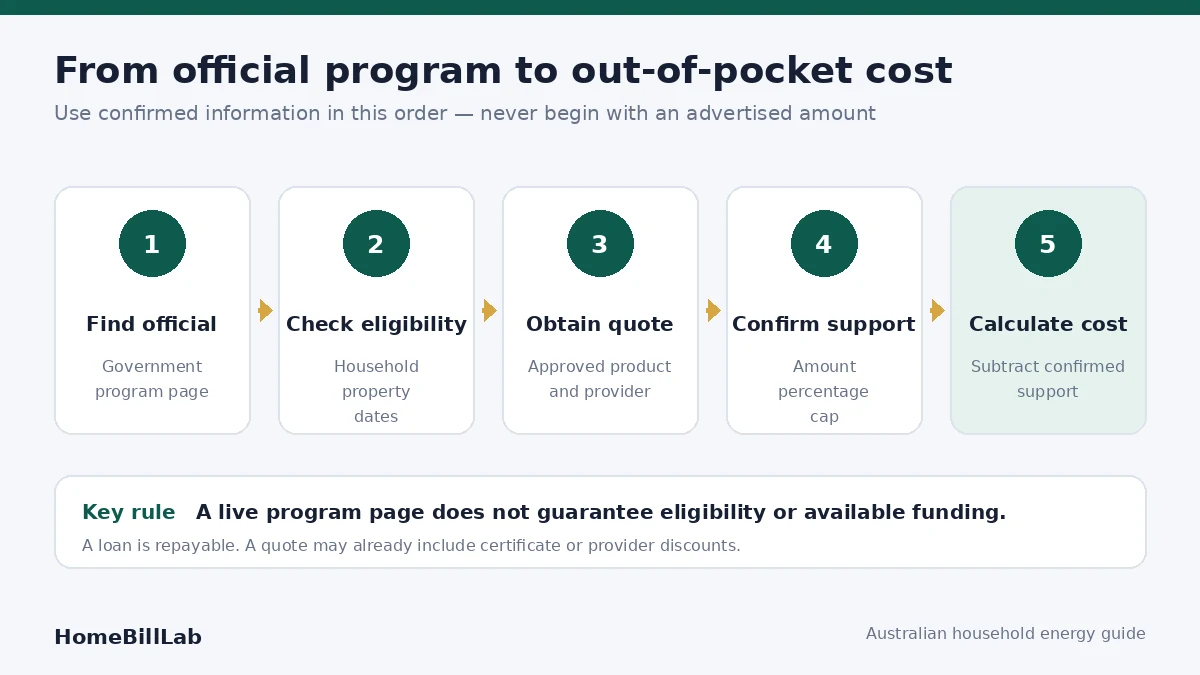
For Australian home energy rebates, “I saw the program online” is not the same as “my project is eligible”. Work through the following checks and save a copy of the official information that applied when you submitted the application.
- Address and jurisdiction: confirm the installation address is inside the program area and any retailer or network territory requirement.
- Applicant status: check whether the applicant must be an owner-occupier, landlord, tenant, body corporate, concession-card holder or member of another defined group.
- Property and account: check dwelling type, existing equipment, electricity-account name, meter or connection requirements.
- Technology: confirm the exact eligible activity, capacity range, efficiency standard, approved product list and replacement conditions.
- Provider: use any required accredited provider, authorised retailer, installer or lender.
- Dates and funding: verify that applications are open and funding remains available. A live information page does not always mean an intake is open.
- Sequence: check whether approval is required before signing, paying a deposit, installing or decommissioning existing equipment.
- Quote treatment: ask which discount, certificate or rebate is already included, which is claimed later and which must be repaid.
Calculate your out-of-pocket upgrade cost
After eligibility and the quote are confirmed, compare Australian home energy rebates with transparent arithmetic rather than an advertised “up to” amount. For a fixed contribution:
Out-of-pocket cost = installed cost − confirmed primary support − other confirmed discounts
For a percentage program, first apply the confirmed percentage to the eligible project cost, then respect any cap and exclusions. Total support cannot exceed the installed cost. A loan should not be subtracted as if it were a rebate: it changes the upfront payment and repayment schedule, not necessarily the total purchase cost.
Example: an eligible project is quoted at $6,800. The official pathway confirms a $1,200 contribution, and the quote separately identifies a $450 certificate-based discount. The estimated out-of-pocket cost is $6,800 − $1,200 − $450 = $5,150. This is illustrative, not a current program amount.
If you also have a reasonable annual bill-savings estimate, simple payback equals out-of-pocket cost divided by annual savings. It ignores finance costs, maintenance, degradation, tariff changes and the time value of money. Read the HomeBillLab methodology and test the confirmed numbers in the Energy Rebate & Upgrade Cost Calculator.
Avoid outdated offers and misleading claims
- Ignore an old amount without a current official page. Search snippets, news stories and installer pages can outlive funding rounds.
- Do not count one benefit twice. A quote may already include STCs or a state provider incentive.
- Separate approval from marketing. “Eligible product” does not automatically mean “eligible household” or “approved application”.
- Distinguish finance from support. A zero-interest loan reduces the immediate cash requirement but must still be repaid.
- Be careful with stacking. Federal and state support may sometimes be combined, but the current rules decide whether benefits can be used together.
- Do not treat payback as guaranteed. Real savings depend on tariffs, energy use, equipment performance, maintenance and household behaviour.
How this finder is maintained
Because Australian home energy rebates change quickly, this page is scheduled for monthly review and an immediate check after a major government announcement. Reviews verify the official URL, program status, support type, scope and material eligibility changes. The page intentionally avoids a permanent table of dollar amounts because caps and contributions can expire faster than the routing information.
The official administrator’s page always takes precedence over this summary. HomeBillLab does not accept applications, determine eligibility or represent a government program. If a link changes or a program closes between reviews, use the relevant government site’s search or assistance service.
Frequently asked questions
What Australian home energy rebates are available?
Available support can include electricity concessions, solar and battery incentives, hot-water or heating and cooling upgrade discounts, grants and low- or zero-interest finance. Start with the official national finder and your state or territory entry point, then filter by household and technology.
Are energy rebates the same in every state?
No. National mechanisms can operate across several jurisdictions, but state and territory programs have different categories, budgets, providers, eligibility rules and application processes.
Can federal and state incentives be combined?
Sometimes, but not automatically. Check the current rules for both programs and confirm how each benefit appears in the quote. Never add advertised headline amounts together without written confirmation.
How do I know whether a rebate is still open?
Open the official administrator’s page and look for current application status, dates, remaining funding and application instructions. A page appearing in Google does not prove that applications remain open.
Does HomeBillLab check whether I am eligible?
No. HomeBillLab routes readers to official sources and calculates scenarios from confirmed inputs. Only the program administrator or its authorised delivery partner can confirm an application.
Bottom line
The safest way to use Australian home energy rebates is to find the correct official program, confirm that your household and project meet the current rules, and make sure the quote shows how every incentive is applied. Only then should you calculate the remaining cost or payback.
Browse the Australian rebates and assistance hub, compare battery scenarios with the Solar & Battery Savings Calculator, or estimate hot-water energy use with the Hot Water Running Cost Calculator. Use confirmed official support only.