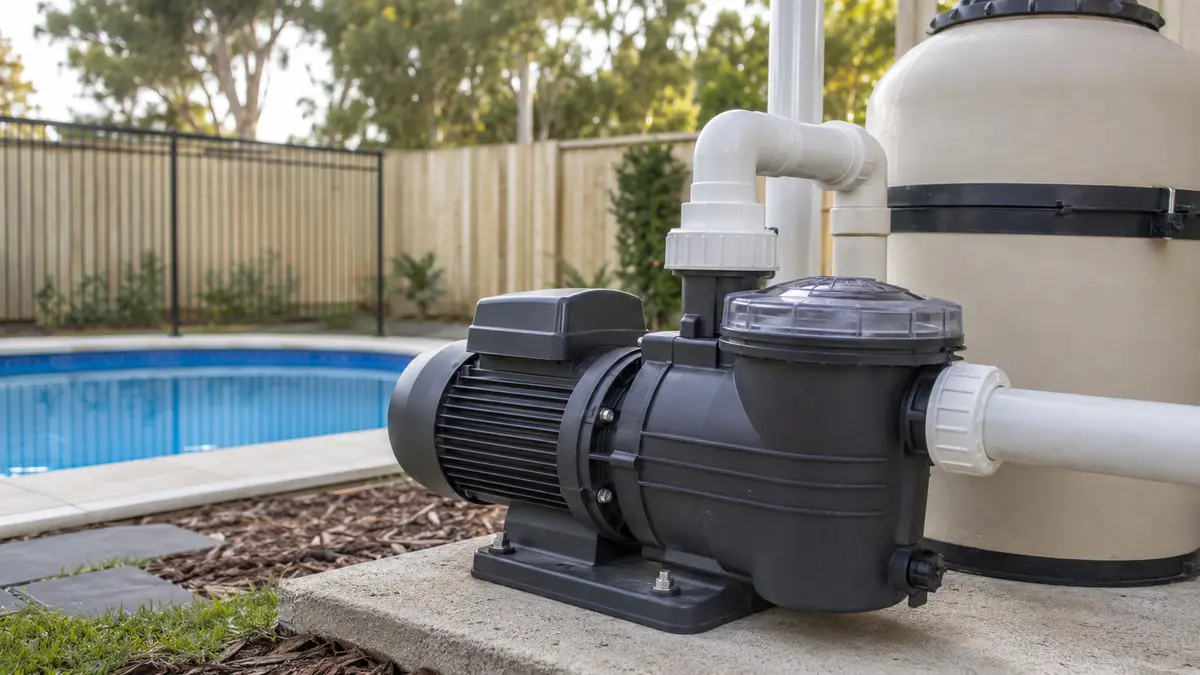
Pool pump running cost in Australia depends on the pump’s electrical input, how long it operates at each setting and the electricity rate you pay. For example, a pump drawing 1 kW for six hours uses 6 kWh. At an illustrative 30 c/kWh, that costs $1.80 for the day. This is a calculation example, not a recommended filtration schedule or an Australian average.
This guide covers the circulation pump that moves pool water through the filtration system. Pool heating is outside its scope. Use the Appliance Running Cost Calculator with your own inputs, then check the assumptions below before comparing pumps or changing a budget.
Pool pump electricity cost: quick examples
The table holds operating time at six hours and the usage rate at 30 c/kWh to show the effect of electrical input. These hypothetical inputs are not specifications for particular products.
| Electrical input | Energy per day | Cost per day | Cost for 30 identical days |
|---|---|---|---|
| 300 W (0.30 kW) | 1.80 kWh | $0.54 | $16.20 |
| 750 W (0.75 kW) | 4.50 kWh | $1.35 | $40.50 |
| 1,000 W (1.00 kW) | 6.00 kWh | $1.80 | $54.00 |
Equal hours do not mean equal water flow, filtration or suitability. A lower-power row is not automatically an adequate replacement for a higher-power pump. The table isolates the arithmetic; it does not establish equivalent pool care.
How to calculate pool pump running cost
The SA Government appliance running-cost guide uses electrical power, operating time and electricity price. Keep the units consistent:
- Input power in kW = watts ÷ 1,000.
- Electricity used in kWh = input kW × operating hours.
- Electricity cost = kWh × tariff in dollars per kWh.
For the 750 W example, 750 ÷ 1,000 = 0.75 kW. Multiplying by six hours gives 4.5 kWh; multiplying by $0.30 gives $1.35. Repeating that exact day 365 times would cost $492.75. A seasonal schedule needs separate totals instead of assuming every day matches summer.
Write the tariff as $0.30, not $30, when calculating manually. The calculator accepts cents per kWh, so enter 30 there. Its power-and-usage yearly estimate repeats a weekly pattern for 52 weeks; a manual 365-day projection can therefore differ slightly. Always state which period you used.
Use electrical input, not just horsepower
A pump’s marketed horsepower, motor output, maximum rating and electrical draw at a selected operating point are not interchangeable. Look for electrical input in the documentation, controller information or an existing suitable energy-monitoring report. If the meaning of a rating is unclear, ask the manufacturer or a qualified pool professional.
The Energy Rating pool-pump guide recommends matching the pump to the pool, filter and accessories, with professional advice where needed. Larger is not automatically better. Cost calculations should follow suitable equipment selection, not replace it.
A nameplate can provide a starting point, but maximum watts multiplied by every scheduled hour may overstate consumption when power varies. Conversely, a low-speed reading alone can understate a day that includes higher-speed operation. Record what the number represents alongside the number itself. Do not open electrical equipment or improvise a power-monitoring connection near a pool; use existing readings or arrange qualified assessment.
Single-speed versus variable-speed pump costs
A single-speed pump operates at one running speed. A variable-speed model can operate at different speeds for different duties. The Australian Government outdoor-living guide identifies efficient pump selection and appropriate operating speed as ways to reduce energy use while maintaining pool hygiene.
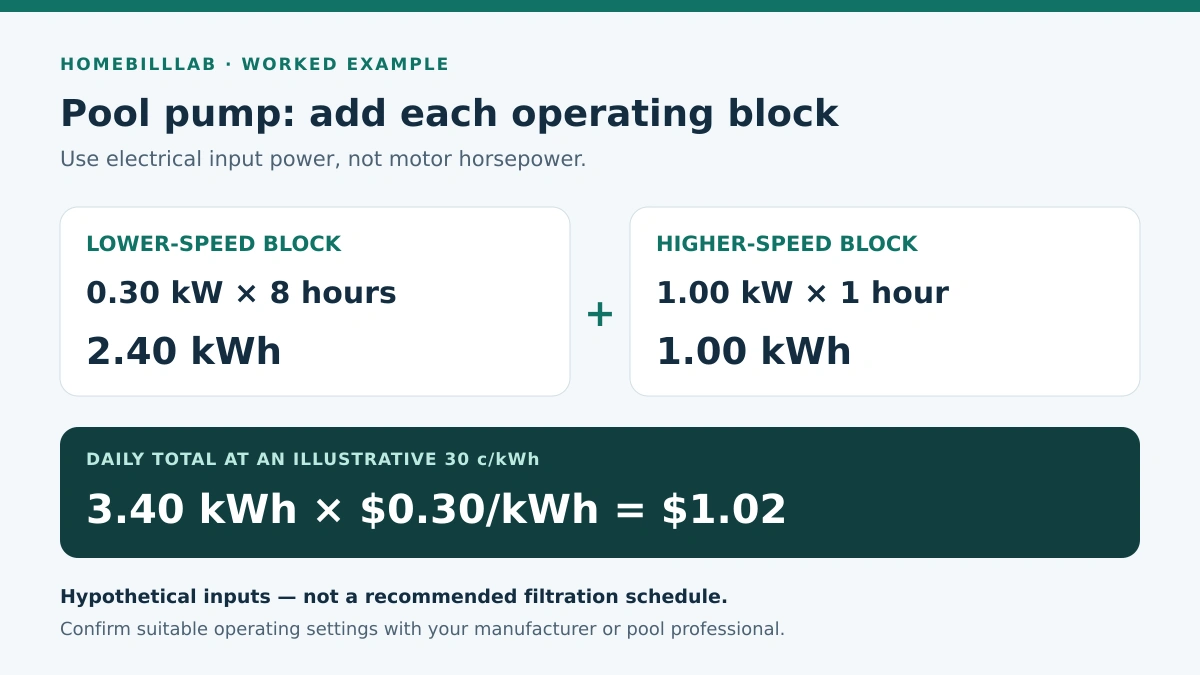
For a variable-speed pool pump, calculate each operating block separately. The following invented example demonstrates the method only; it does not recommend these speeds, powers or hours for your pool.
| Example operating block | Input power | Time | Energy |
|---|---|---|---|
| Lower-speed block | 0.30 kW | 8 hours | 2.40 kWh |
| Higher-speed block | 1.00 kW | 1 hour | 1.00 kWh |
| Total | Varies | 9 hours | 3.40 kWh |
At 30 c/kWh, the total is 3.40 × $0.30 = $1.02 per day, or $30.60 for 30 identical days. Using the higher input for all nine hours would produce a different and inappropriate estimate for this example.
Do not turn a speed reduction into the same percentage reduction in electricity, or apply a universal savings percentage to every replacement. A meaningful comparison needs suitable circulation, compatible equipment and the complete operating schedule. Ask for the assumptions behind projected annual kWh rather than relying on “up to” savings alone.
Enter a multi-speed example in the calculator
The existing appliance calculator handles one power-and-time scenario at a time. For the example above, calculate 300 W for eight hours, then calculate 1,000 W for one hour using the same tariff. Save each per-active-day result and add them: $0.72 + $0.30 = $1.02. Keep the days-per-week setting consistent if you also combine weekly estimates.
If a block crosses two tariff periods, split it again by price. This is an accounting exercise using an already suitable schedule, not a reason to reprogram equipment. Do not add the label-based annual estimate to these operating-block totals; that would count the same pump twice.
Using the Energy Rating Label
The official Energy Rating Label guidance explains that annual consumption comes from standardised testing. For pool pumps, its stated usage assumption is pumping 50,000 litres per day. That is a label-comparison assumption, not a universal pool volume or an instruction for how much water your pool must circulate.
If a hypothetical label shows 900 kWh/year, applying 30 c/kWh gives 900 × $0.30 = $270 per year. Do not multiply annual kWh by daily operating hours again: the annual figure already incorporates the label’s assumptions. Actual consumption can differ with installation and use.
Compare pumps with appropriate capacity and similar features, considering both stars and annual kWh. When requesting a quote, keep two columns: the standardised label result and the installer’s estimate for your particular setup. If they differ, ask which operating assumptions explain the gap. Neither number should be presented as a guaranteed future bill.
How many hours should a pool pump run?
There is no single daily-hour setting that this cost guide can safely prescribe for every pool. Pool size, equipment, conditions and water-treatment requirements matter. Energy Rating’s pool-pump efficiency advice stresses that filtration is important for safe swimming and that runtime depends on the pool and pump.
Use the operating schedule approved for your equipment and pool conditions as the calculation input. A qualified pool professional should assess changes, including minimum flow requirements for connected treatment equipment. Halving hours may halve electricity in a constant-power arithmetic example, but that does not demonstrate adequate filtration or sanitation.
If summer and winter schedules differ, cost them separately using the actual days in each period. For budgeting, a table with season, daily kWh, days and tariff is more transparent than a single annual number with an unstated schedule.
Off-peak electricity, solar and supply charges
Energy Made Easy’s electricity-charge guide distinguishes usage charges from the fixed supply charge. For pump-only running cost, use the relevant variable rate. Do not allocate the whole household supply charge to the pump when that charge would still apply without it.
With time-of-use pricing, split consumption across the applicable tariff periods. Hypothetically, 3.4 kWh costs $0.68 at 20 c/kWh or $1.36 at 40 c/kWh. The electricity quantity is unchanged; only its price differs. These are illustrative rates, not available offers. Check timing constraints, neighbours and applicable noise requirements before arranging a schedule change.
Daytime solar creates another comparison. Energy.gov.au’s solar financial-benefits guide explains how using your own generation reduces grid purchases. Where surplus solar would otherwise be exported for a credit, consuming it also forgoes that credit. Daytime pumping is therefore not automatically “free”.
Separate solar-supplied energy from grid imports, use the relevant import and export rates, and consider what else needs that surplus. Cloud cover and other household loads can change the result. The appliance calculator’s simple tariff calculation does not model this solar split. For tariff background, read single rate versus time-of-use electricity.
Check what your pool-cost estimate includes
The SA Government swimming-pool energy guide distinguishes several electricity-consuming components. A circulation-pump estimate does not automatically include a chlorinator, separate cleaning pump, lights or water features. Heating equipment is outside this article’s scope.
Before adding separate loads, check the boundary of any meter reading: a pool-equipment circuit may already include more than the circulation pump. Adding those devices again would double-count them. Likewise, a total household bill cannot isolate pump use when other consumption changes at the same time.
A useful worksheet records the pump model, source of the power or kWh figure, settings, operating hours, tariff and dates. Keep purchase price, installation, servicing and other pool expenses outside the electricity subtotal. If evaluating a replacement, compare equivalent service first and list upfront costs separately; a lower electricity estimate alone does not establish payback.
Compare energy and price separately
When reviewing existing monitoring records, first compare kWh over equivalent periods. Then apply the same tariff to both totals to isolate the energy difference. Finally, apply the actual tariffs if you want the bill difference. This prevents a cheaper electricity plan from being mistaken for a more efficient pump.
For example, suppose two comparable seven-day records show 35 kWh and 28 kWh. The difference is 7 kWh, worth $2.10 at an unchanged 30 c/kWh. That calculation describes those records only. It does not prove which change caused the difference or justify multiplying the saving across a year without considering seasonal operation. Keep notes about equipment servicing, approved schedule changes and which loads the records include.
Frequently asked questions
Does a pool pump use a lot of electricity?
It can be a substantial load when input power and daily hours are high. Work from kWh rather than a guessed share of the household bill. The examples above show why both power and operating time matter.
Is a variable-speed pool pump always cheaper to run?
Not by name alone. Compare complete energy consumption under suitable operating conditions and the tariff applying to that energy. A low-speed reading is only one part of a multi-speed day, and the required circulation still needs to be maintained.
Should I calculate from watts or annual kWh?
Use watts and hours when they represent the actual schedule. Use annual label kWh for a standardised comparison, or measured energy for a defined period when available. Keep these methods separate rather than mixing their assumptions.
Build an estimate you can check
The most useful pool pump running-cost estimate is traceable: identify the electrical input, account for each operating block and apply your own tariff. Start with the calculator linked above, then compare other loads in the Appliances hub. If you need help finding the right rate, use our guide to reading an electricity bill.
See the HomeBillLab Methodology for our approach to assumptions and estimates. This guide supports electricity-cost comparisons; it is not a pool-system design, water-treatment plan or guarantee of savings.
Reviewed: 4 September 2026. Review cadence: quarterly checks of example tariffs, sources and operating guidance; sooner after material changes. Next scheduled editorial review: December 2026.