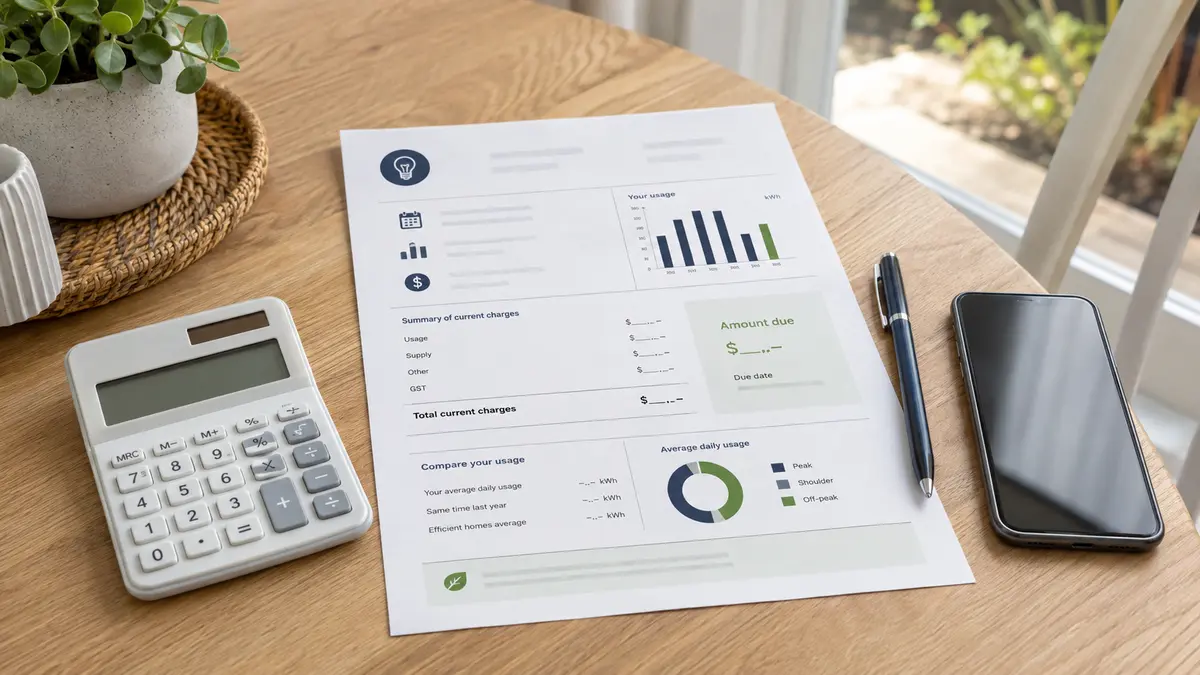
How to read an electricity bill: start with the billing period and total amount due, then check the electricity used in kilowatt-hours, each usage rate, the daily supply charge and whether the meter reading was actual or estimated. Finally, account for controlled loads, solar export credits, discounts, rebates, fees and any balance carried forward.
Quick answer: the amount due is not simply your kWh multiplied by one price. An Australian electricity bill can combine variable usage charges, a fixed daily supply charge and several adjustments. Time-of-use, controlled-load, demand and solar arrangements can add separate lines.
This guide explains how to read an electricity bill without assuming that every retailer uses the same layout. Keep your own bill beside you and enter its figures into the Electricity Bill Calculator Australia to reproduce the main energy subtotal.
The six checks to make on an electricity bill
Retailers arrange information differently, but the same practical checks usually reveal how the total was built.
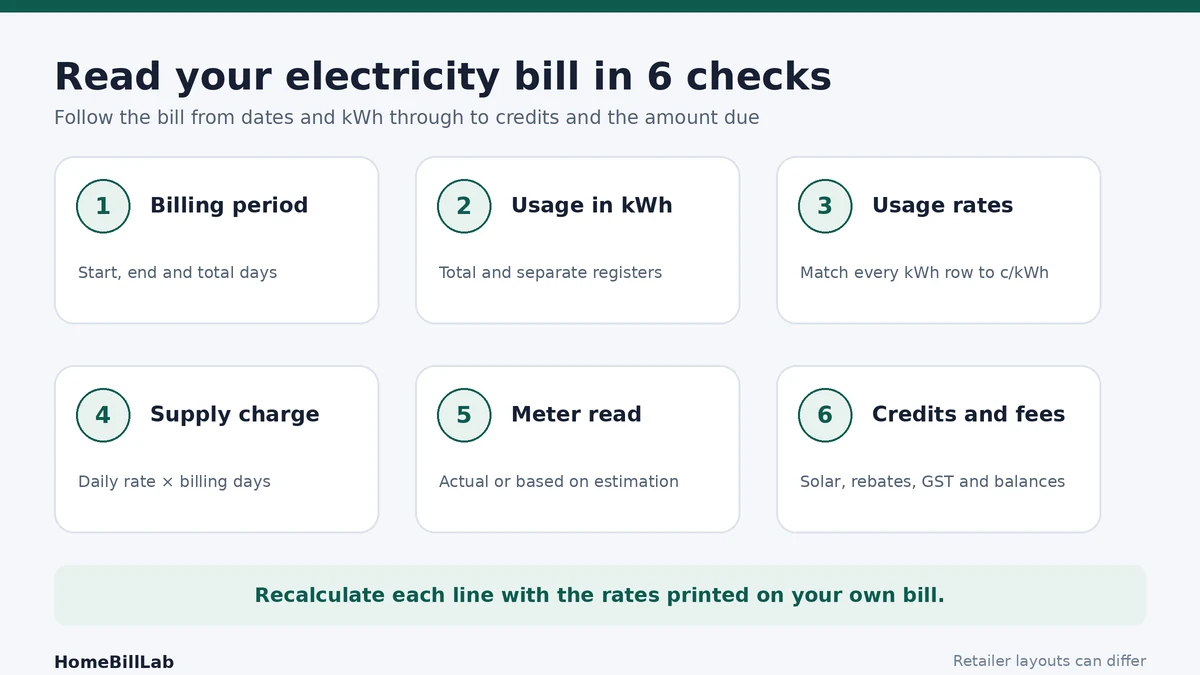
- Billing period: confirm the start date, end date and number of billed days.
- Electricity usage: find the total kWh and any separate peak, shoulder, off-peak or controlled-load usage.
- Usage rates: match every kWh amount to its rate in cents per kWh.
- Daily supply charge: check the cents-per-day rate and the number of days charged.
- Meter reading: identify whether the bill uses actual meter data or an estimate.
- Credits and adjustments: check solar exports, discounts, concessions, rebates, fees, GST and previous balances.
The Australian Energy Regulator’s energy-bill guide recommends checking the account details, meter number, billing period, readings, rates, supply charge, fees and credits. This is a useful order because it separates identity and timing errors from calculation errors.
How to read an electricity bill: start with the account summary
The first page normally shows the account holder, supply address, issue date, due date and amount due. Check whether the total includes a previous unpaid balance, a credit already on the account or a recent payment that has not yet appeared.
Next, count the billing days. A longer billing period can produce a higher total even if average daily use stayed similar. Comparing a 95-day bill with an 88-day bill only by total dollars can therefore be misleading. Compare kWh per day and cost per day as well.
The official Energy Made Easy bill guide says a bill shows the amount payable, billing dates, energy used, energy cost, extra fees, current-plan details and whether the usage was estimated. It may also include a message about a better offer from the current retailer where applicable.
NMI, meter number and meter readings
The National Metering Identifier, or NMI, identifies the electricity connection point. It is not the same as the physical meter number. The official Energy Made Easy glossary describes an NMI as a unique 10- or 11-digit number found on the electricity bill.
Compare the meter number shown on the bill with the number on the meter where it is safe and practical to do so. Homes with solar, controlled loads or a replaced meter may show more than one meter or register.
Then look for the reading type. An actual reading uses meter data for the billing period. An estimated bill must be clearly identified as based on an estimation under the applicable guidance. Energy Made Easy’s estimated-bill guidance explains that customers can request an adjusted bill using their own meter reading, subject to the retailer’s instructions and timing requirements.
An estimate is not automatically wrong, but it deserves attention when the total differs sharply from normal. Check the billed days, seasonal use, previous estimates and whether the next actual read may correct an earlier under- or over-estimate.
Understand kWh and the usage charge
A kilowatt-hour is a unit of electrical energy. On a simple single-rate bill, the usage calculation is:
Usage charge = electricity used (kWh) × usage rate ($/kWh)
If the bill shows 900kWh at 32c/kWh, convert 32 cents to $0.32: 900 × $0.32 = $288.00. Repeat the calculation for every usage line instead of multiplying the total kWh by only the first rate.
The official guide to gas and electricity charges explains that usage may also be called a consumption or variable charge. It can appear in multiple time periods or tariff blocks. A block tariff applies one rate to the first portion of use and another rate to the next portion, so each block must be calculated separately.
Check the daily supply charge
The daily supply charge is the fixed cost of having electricity supplied to the property. It is normally payable even when the home uses no electricity. The calculation is:
Supply charge = daily supply rate ($/day) × billing days
For a 90-day period at 105c/day, convert the rate to $1.05: 90 × $1.05 = $94.50. Do not compare electricity plans using only the usage rate. A lower c/kWh price can be offset by a higher daily supply charge, particularly for a low-use household.
Identify your tariff type
Knowing how to read an electricity bill also means recognising the tariff structure behind its rows. The official Energy Made Easy tariff guide distinguishes several common arrangements:
- Single rate: the same usage rate applies regardless of the time of day.
- Time of use: peak, shoulder and off-peak periods have different prices. The exact time windows come from the plan, not from one national schedule.
- Controlled load: a separate rate applies to a dedicated circuit, often for electric hot water, slab heating or another eligible appliance.
- Demand tariff: a charge is added according to how intensely electricity was drawn during a defined interval or period, usually measured in kW rather than kWh.
- Block tariff: different rates apply to successive portions of consumption.
If the bill has peak, shoulder and off-peak rows, multiply the kWh on each row by its own rate. Do not assume that “off-peak” always means the same hours across Australia. If there is a demand charge, read the plan document to identify the measurement interval, applicable days, demand window and billing method.
How to read an electricity bill with solar exports
A solar household bill normally separates electricity imported from the grid from electricity exported to it. Imports are charged at retail usage rates. Eligible exports receive a feed-in credit, often shown as exported kWh multiplied by a feed-in tariff.
The Australian Government’s guide to electricity pricing plans and tariffs explains that feed-in tariffs can use single, time-varying or block rates. Check both export volume and credit rate. A low bill does not by itself reveal total household consumption because rooftop solar may serve appliances before the meter records grid imports.
How to read an electricity bill by rebuilding the total
Suppose a 90-day bill contains the following illustrative figures:
| Bill line | Calculation | Amount |
|---|---|---|
| General usage | 900kWh × $0.32 | $288.00 |
| Controlled load | 150kWh × $0.20 | $30.00 |
| Daily supply | 90 days × $1.05 | $94.50 |
| Solar export credit | 250kWh × $0.05 | −$12.50 |
| Energy subtotal | $288 + $30 + $94.50 − $12.50 | $400.00 |
Reproducing the subtotal is one of the most useful steps when learning how to read an electricity bill. It separates the energy arithmetic from account adjustments. The HomeBillLab electricity bill calculator supports single-rate and time-of-use scenarios, daily supply charges, controlled load and solar export credit.
HomeBillLab uses the transparent calculation rules documented in its Methodology. Inputs and units remain visible, and no national-average tariff is inserted behind the result.
Check adjustments before comparing the final amount
- Previous balance: money carried from an earlier bill is not current-period energy use.
- Payments and credits: confirm recent payments and account credits have been applied.
- Discounts: check whether a benefit is guaranteed, conditional or expired.
- Rebates and concessions: verify that confirmed support appears as a credit where expected.
- Fees: late-payment, card-processing, special meter-reading or other contract fees can sit outside energy charges.
- GST: read whether displayed rates and subtotals include GST before trying to reproduce them.
- Rate changes: a bill spanning a price change may show the same tariff in two date ranges with different rates.
Do not call the bill incorrect merely because your energy subtotal differs from the amount due. First reconcile all adjustments and rounding. If an unexplained difference remains, contact the retailer using the account or reference number shown on the bill.
Use the consumption graph carefully
Many bills show average daily use, previous periods or a household benchmark. These can highlight a trend, but the comparison needs context. Weather, occupancy, billing days, electric heating or cooling, a new appliance, solar production and actual versus estimated readings can all change the pattern.
Compare average daily kWh before comparing total dollars. Then check whether the tariff or supply charge changed. A higher bill with unchanged kWh may be a price issue; higher kWh at unchanged rates points toward use, seasonality or meter-data questions.
A practical electricity-bill error checklist
- Does the supply address and NMI belong to the property?
- Does the meter number match the correct meter?
- Are the billing dates and number of days correct?
- Is the reading actual or based on an estimation?
- Do the current rates match the plan information and effective dates?
- Has each usage row been multiplied by the correct rate?
- Is the supply charge applied to the correct number of days?
- Are controlled-load and solar-export rows present where expected?
- Have payments, discounts, concessions and rebates been applied?
- Is the difference explained by GST, fees, rounding or a previous balance?
This checklist is useful for how to read an electricity bill, but it does not replace the retailer’s plan document or jurisdiction-specific consumer rules. Keep copies of the bill, plan summary and any meter evidence if you need the retailer to investigate.
Frequently asked questions
What is the difference between a usage charge and a supply charge?
The usage charge varies with electricity consumed and is usually expressed in c/kWh. The supply charge is normally a fixed daily amount for supplying the property, even if little or no electricity is used.
How do I know if my electricity bill is estimated?
Look near the meter-reading section for clear wording that the relevant usage is based on an estimation. If the estimate appears unsuitable, follow the retailer’s process for providing a customer meter reading before the stated deadline.
How to read an electricity bill with several rates?
You may have time-of-use periods, a controlled load, tariff blocks, a rate change during the billing period or a separate solar feed-in rate. Match each kWh line with its own price.
Is the NMI the same as the meter number?
No. The NMI identifies the electricity connection point, while the meter number identifies physical metering equipment. Both can appear on the bill.
Can I calculate the bill from the total kWh alone?
Only for a very simple estimate. A complete reconstruction also needs each usage rate, supply charge, billing days and any controlled load, solar credit, demand charge, discount, fee or account adjustment.
Bottom line
The safest way to learn how to read an electricity bill is to separate it into dates, kWh, rates, fixed charges and adjustments. Recalculate each row with the tariff printed on the bill, then compare the energy subtotal with the final amount due.
Use the Electricity Bill Calculator, browse the Australian electricity guide hub, or see how bill tariffs affect specific costs in the air-conditioner running-cost guide and clothes-dryer running-cost guide.
Reviewed: 22 August 2026. Bill layouts, tariff names, comparison notices and consumer rules can vary by retailer and Australian jurisdiction. This guide provides general calculation information, not legal advice or a retailer statement.