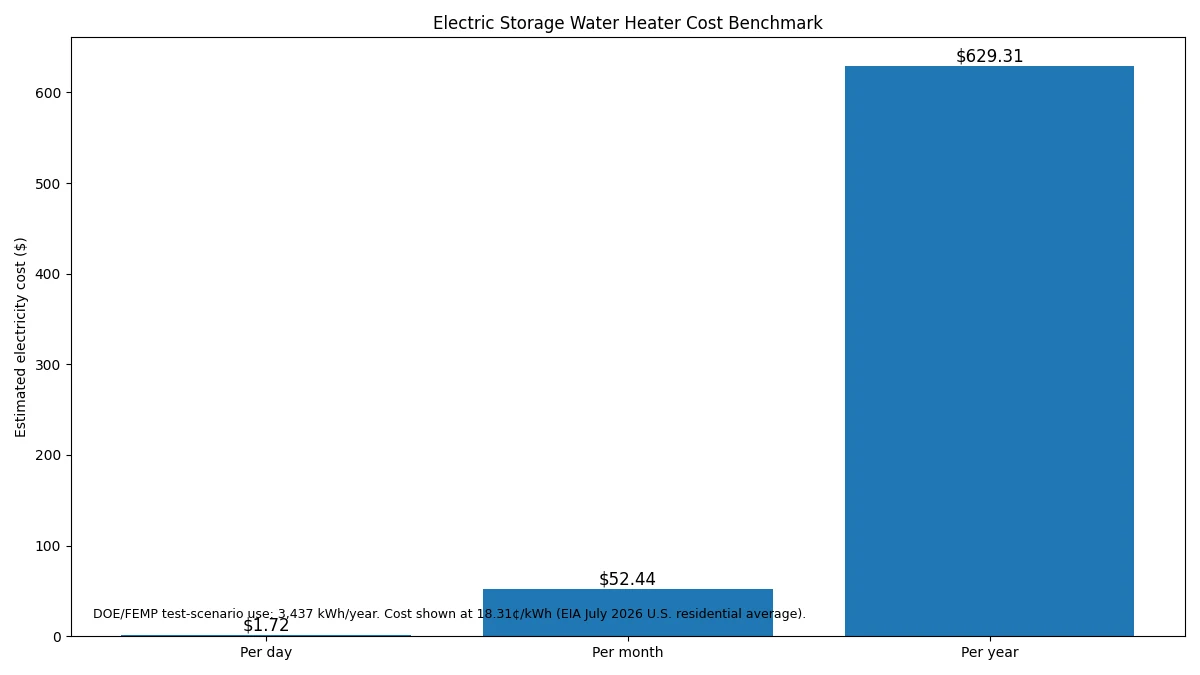
Electric water heater running cost USA depends mainly on how many kilowatt-hours the unit uses and the electricity rate on your bill. As a useful standardized benchmark, U.S. Department of Energy/FEMP guidance lists a less-efficient electric storage water heater of 55 gallons or less at 3,437 kWh per year under the DOE test procedure. At the July 2026 U.S. residential average electricity price of 18.31¢/kWh, that works out to about $629 per year, $52 per month, or $1.72 per day. Your actual cost can be much lower or higher.
The fastest way to estimate your own cost is to use the annual kWh on the yellow EnergyGuide label, a full year of measured electricity use, or the hot-water inputs in the HomeBillLab U.S. Hot Water Running Cost Calculator. Do not assume the national 18.31¢/kWh price is your tariff; the rate on your own utility bill is the better input.
Table of Contents
How much does an electric water heater cost to run?
For a concrete reference point, DOE’s Federal Energy Management Program uses 3,437 kWh/year for a less-efficient electric storage water heater of 55 gallons or less in its current residential water-heater purchasing guidance. Repricing that standardized energy use at the EIA’s July 2026 U.S. residential average of 18.31¢/kWh gives:
| Period | Energy use | Illustrative cost at 18.31¢/kWh |
|---|---|---|
| Per day | about 9.4 kWh | about $1.72 |
| Per month | about 286 kWh | about $52.44 |
| Per year | 3,437 kWh | about $629.31 |
These are not promised household costs. They are a transparent way to translate one official DOE test-scenario energy figure into 2026 dollars. Your model, hot-water demand, inlet-water temperature, thermostat setting, tank losses, household size and tariff can all change the result.
What the DOE 3,437 kWh benchmark actually means
The DOE/FEMP residential water-heater guidance compares a high-efficiency heat-pump water heater with a less-efficient electric storage model. For the less-efficient model, the table uses a Uniform Energy Factor of 0.95 and annual electricity use of 3,437 kWh. DOE explains that the energy-use calculation follows its federal test method and assumes the unit produces 20,075 gallons of hot water per year.
That is about 55 gallons of hot water per day in the standardized test scenario. It does not mean every family uses 55 gallons daily, and it should not be treated as a universal household forecast. Its value is that it provides a documented apples-to-apples reference. If your EnergyGuide label says 4,100 kWh/year, use 4,100. If your measured submeter data says 2,900 kWh/year, use 2,900.
Electric water heater running-cost formula
When you already know the water heater’s electricity use, the cost calculation is simple:
Running cost = electricity use in kWh × electricity rate in $/kWh.
For example, a water heater using 3,000 kWh/year on a 16¢/kWh tariff would cost about $480 per year for electricity. The same unit at 25¢/kWh would cost about $750 per year. Nothing about the water heater changed; only the tariff did.
If you know hot-water gallons, temperature rise and usage schedule rather than annual kWh, use the Hot Water Running Cost Calculator. It is better suited to scenario calculations because heating water is a thermal-energy problem, not just a nameplate-wattage problem.
For a specific model, start with the yellow EnergyGuide label
The Federal Trade Commission requires EnergyGuide information for water heaters. The label shows an estimated yearly operating cost and energy-use or efficiency information so shoppers can compare similar models. The FTC also makes an important point: the estimated operating cost is not necessarily what you will pay, because the label uses standardized assumptions and an energy price that may differ from your local tariff.
For a model-specific HomeBillLab estimate, the most useful number is usually the annual electricity consumption in kWh. Multiply that kWh figure by your actual electricity rate. If the label shows an estimated annual dollar cost but your rate is different from the label assumption, recalculate the cost rather than copying the dollar figure.
FTC consumer guidance on using the EnergyGuide label specifically includes water heaters and says actual cost depends on both appliance use and local energy prices.
How much electricity rates change electric water heater cost
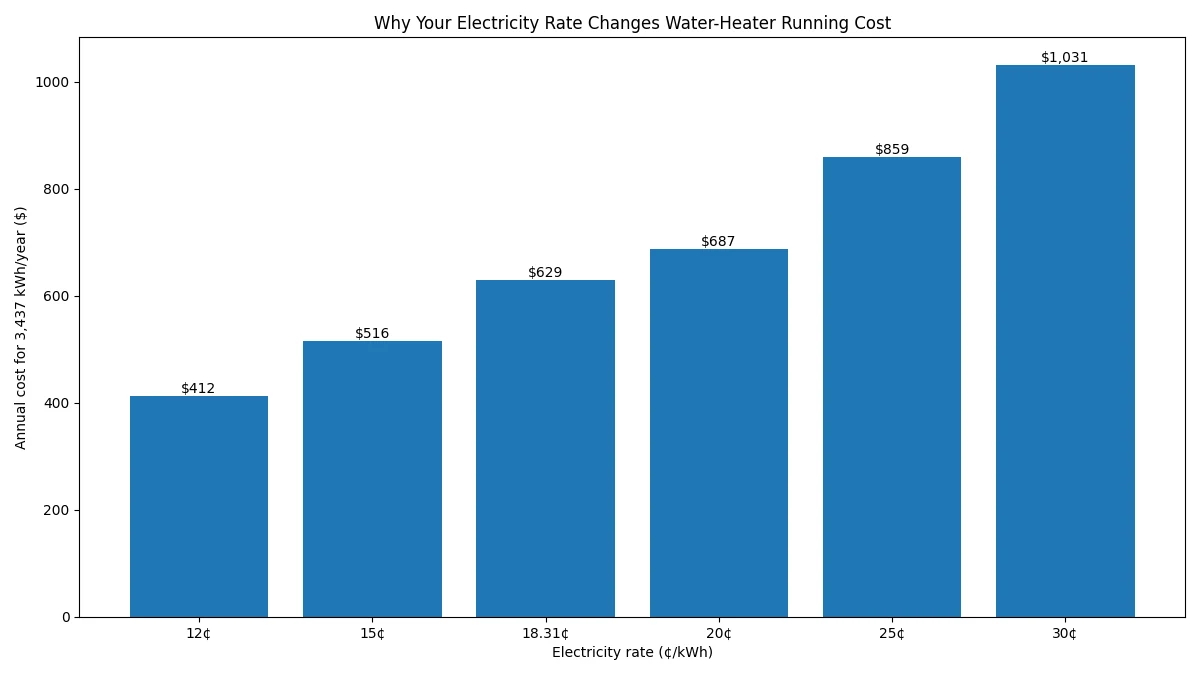
Using the same 3,437 kWh/year DOE test-scenario energy figure, tariff alone creates a wide cost range:
| Electricity rate | Annual cost | Monthly equivalent |
|---|---|---|
| 12¢/kWh | $412.44 | $34.37 |
| 15¢/kWh | $515.55 | $42.96 |
| 18.31¢/kWh | $629.31 | $52.44 |
| 20¢/kWh | $687.40 | $57.28 |
| 25¢/kWh | $859.25 | $71.60 |
| 30¢/kWh | $1,031.10 | $85.93 |
The EIA July 2026 state electricity-price table shows why your bill rate matters: residential electricity prices differ substantially by state and utility market. The national July average was 18.31¢/kWh, but that is context rather than a substitute for your own rate.
If you are unsure which rate to use, the Electricity Cost per kWh USA guide explains how to separate energy usage from the broader bill.
For how HomeBillLab handles changing tariffs, source dates and calculation assumptions, see the HomeBillLab Methodology. For broader state-by-state bill context, see Average Electricity Bill in the USA: State-by-State Guide.
Why element wattage × 24 hours usually gives the wrong answer
A conventional electric storage water heater might have one or more high-wattage resistance elements. That does not mean the elements draw full power all day. The thermostat cycles the elements on and off as hot water is used and as the tank replaces standby heat losses.
For example, treating a 4.5 kW element as if it ran continuously would imply 108 kWh/day and almost 39,420 kWh/year. That is not a realistic running-cost method for a thermostatically controlled storage water heater. Use measured kWh, EnergyGuide annual kWh, or a hot-water-demand calculation instead.
What changes electric water heater electricity use?
- Hot-water demand: more showers, baths, laundry and hot-water use require more energy.
- Incoming cold-water temperature: colder inlet water needs a larger temperature rise.
- Tank temperature: a higher setpoint increases the thermal energy required and can increase standby losses.
- Tank and pipe losses: heat continually escapes from stored hot water and distribution piping.
- Tank size and recovery pattern: size itself is not a direct annual-cost guarantee, but it affects stored volume and standby-loss behavior.
- Household schedule: clustered high-demand periods can change cycling and recovery behavior.
- Efficiency: electric resistance converts electricity to heat at the element, but storage losses reduce whole-system efficiency.
- Location: an unconditioned garage or cold utility space can increase tank and pipe heat losses compared with a warmer location.
DOE/FEMP’s water-use table illustrates how strongly demand matters. It defines draw levels of 10, 38, 55 and 84 gallons of hot water per day for very small, low, medium and high use. Those are test-comparison categories rather than household prescriptions, but they show why two identical water heaters can have very different annual bills.
Ways to reduce electric water heater running cost
Start with the variables that reduce the amount of hot water you have to heat or the amount of heat you lose. Shorter hot-water use, low-flow fixtures where appropriate, fixing hot-water leaks and insulating accessible hot-water pipes can reduce demand or distribution losses.
DOE/FEMP guidance says that for most residential applications, a 120°F water-heater setting is appropriate. Follow your manufacturer’s instructions and any local requirements; household safety and system design can affect the correct setting. The point for running cost is simple: unnecessarily high storage temperatures generally increase required heat input and heat loss.
If your utility offers time-of-use pricing, shifting some water heating to lower-cost hours can reduce dollars without changing total kWh. That depends on your tariff and whether the water heater has suitable controls; it should not be assumed for every home.
Conventional electric resistance vs heat-pump water heater
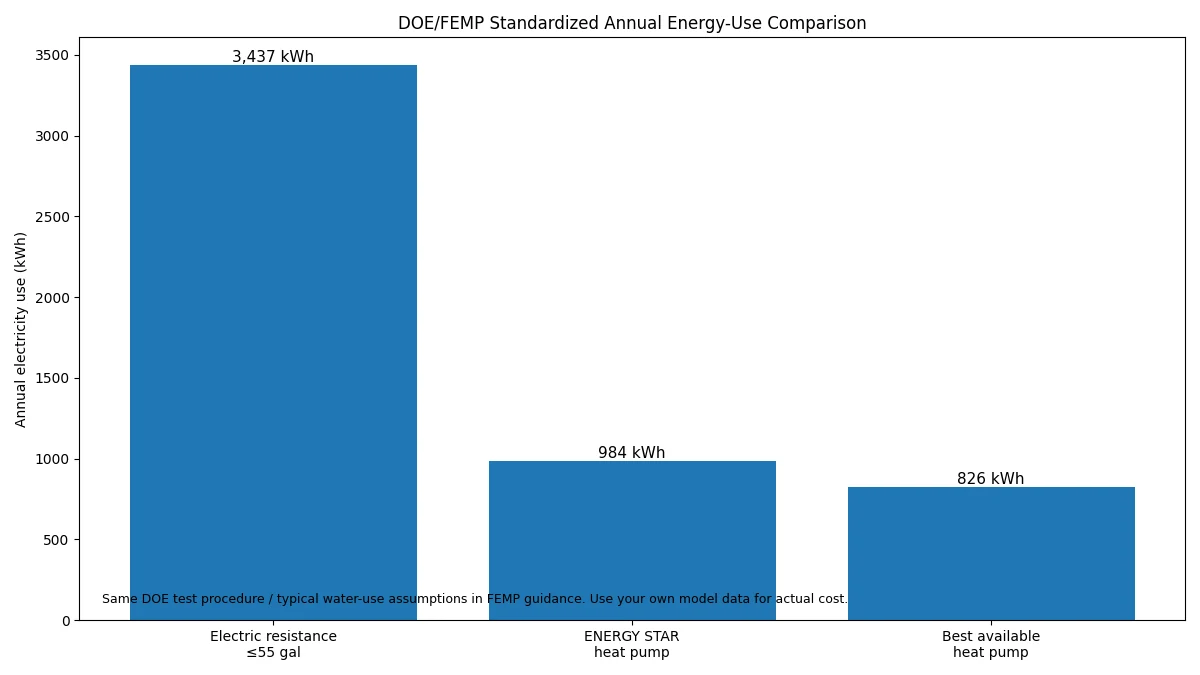
This article focuses on conventional electric resistance water heating, but the efficiency gap with heat-pump water heaters is too large to ignore. In the same DOE/FEMP comparison, the less-efficient electric storage benchmark is 3,437 kWh/year, while the ENERGY STAR heat-pump water-heater example is 984 kWh/year and the best-available model in that table is 826 kWh/year.
Those are standardized comparison values, not guaranteed savings for your house. Heat-pump water heater performance depends on installation conditions, mode, hot-water demand and climate. ENERGY STAR’s current product criteria require a UEF of at least 3.30 for many integrated heat-pump water heaters, compared with the 0.95 electric-resistance benchmark used in the FEMP comparison.
For the dedicated technology guide, see Heat Pump Water Heater Running Cost USA. We will keep the full head-to-head cost comparison in the separate planned guide rather than duplicating it here.
2026 buying context: federal water-heater standards change in 2029
DOE finalized updated residential water-heater efficiency standards in 2024, with compliance beginning in 2029. DOE says the standards for common-size electric storage water heaters are designed around heat-pump technology and are expected to shift much of the new-product market away from conventional resistance-only storage.
That does not make an electric resistance water heater illegal to operate in 2026, and it does not mean every existing unit must be replaced. It means a homeowner comparing replacement options should understand that the federal efficiency baseline for newly manufactured products will change. Running-cost comparisons are therefore especially useful when an existing conventional electric tank is approaching replacement age.
Electric water heater running cost FAQ
How much does a 50-gallon electric water heater cost to run per month?
There is no single cost for every 50-gallon model. DOE/FEMP’s less-efficient electric storage benchmark of 3,437 kWh/year works out to about 286 kWh/month. At 18.31¢/kWh that is about $52 per month, but you should replace both the energy-use figure and tariff with your model and bill data when available.
How much electricity does an electric water heater use per day?
The 3,437 kWh/year DOE test-scenario benchmark averages about 9.4 kWh/day. Actual daily use varies with hot-water demand, inlet-water temperature, tank losses and thermostat setting.
Does a 4,500-watt water heater use 4.5 kWh every hour all day?
No. The element is controlled by a thermostat and cycles rather than running continuously. Nameplate wattage describes power while an element is energized, not 24-hour energy consumption.
Is an electric tankless water heater automatically cheaper to run?
Not automatically. Tankless resistance units avoid storage losses, but they still use electric resistance to heat water. Actual cost depends on hot-water volume, temperature rise, efficiency and tariff. Do not assume “tankless” by itself guarantees a lower annual bill.
Should I use the EnergyGuide dollar estimate or annual kWh?
Use annual kWh with your own electricity rate when possible. FTC says EnergyGuide operating cost is an estimate based on standardized use and an assumed energy price, so your local cost may differ.
What temperature should I set an electric water heater to?
DOE/FEMP guidance says 120°F is appropriate for most residential applications. Follow the manufacturer’s instructions and local requirements for your specific system and household.
Bottom line
A practical 2026 reference for electric water heater running cost USA is the DOE/FEMP standardized electric-storage benchmark of 3,437 kWh/year. Repriced at the July 2026 U.S. residential average of 18.31¢/kWh, it is about $629/year, $52/month or $1.72/day. The better answer for your house is your model’s annual kWh or measured usage multiplied by the rate on your bill. Use the U.S. Hot Water Running Cost Calculator to test your own inputs, and browse more guides in the U.S. Hot Water hub.