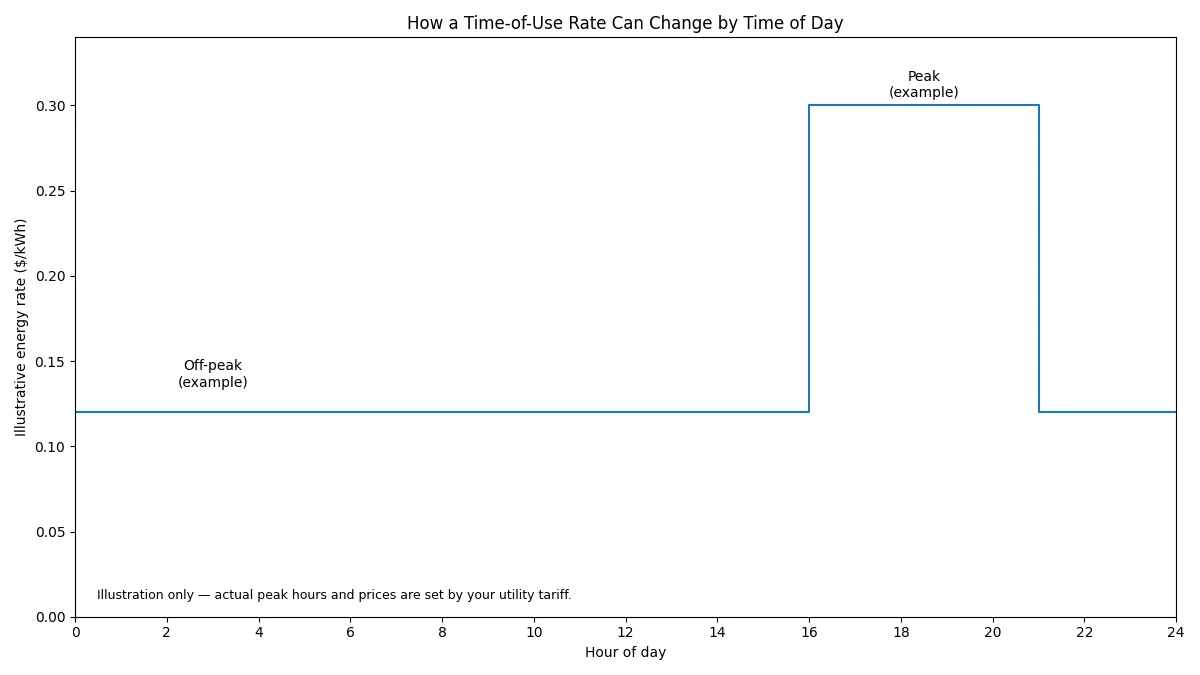
Time-of-use electricity rates USA charge different prices for electricity depending on when you use it. A typical plan has lower off-peak prices when grid demand is lower and higher on-peak prices during busy periods. The exact hours, prices, seasons and rules are set by your utility tariff, so there is no single nationwide “peak time” that applies to every U.S. household.
If you can move flexible loads such as EV charging, dishwashing, laundry or some water heating away from expensive periods, a time-of-use plan may reduce the energy portion of your bill. If most of your electricity use happens during on-peak hours and you cannot shift it, the same plan can cost more than a flat or otherwise structured rate.
Before changing plans, check your utility’s tariff and your own interval-usage data. HomeBillLab’s U.S. Electricity Bill Calculator can help compare scenarios once you know the prices that apply to your plan.
Table of Contents
What are time-of-use electricity rates?
The U.S. Energy Information Administration describes time-of-use or time-of-day pricing as a rate structure where the price per kilowatt-hour depends on when electricity is used. In its energy efficiency and conservation overview, EIA explains that utilities may encourage customers to shift high-usage activities to off-peak periods by charging higher prices during peak demand and lower prices during lower-demand periods.
Under a simple two-period plan, usage may be divided into on-peak, the higher-price period, and off-peak, the lower-price period. Some plans also include mid-peak or super off-peak periods. The tariff table, not the label, tells you the exact cents per kWh and hours that apply.
Peak vs off-peak electricity: what is the difference?
EIA’s electricity price explanation notes that electricity demand is often highest in the afternoon and early evening and that utilities may offer time-of-day pricing to encourage conservation and reduce peak demand. The cost to supply power can be higher during high-demand periods because additional generation and grid resources may be needed.
But “peak” on a residential bill is a tariff definition, not simply any moment when national electricity demand is high. Your utility may define different peak windows for summer and winter, weekdays and weekends, or specific rate plans.
Why do utilities use time-of-use rates?
Electricity systems must balance supply and demand continuously. When many customers use large loads at the same time, utilities and grid operators may need more generation, transmission and distribution capacity to serve that peak.
A TOU tariff creates a price signal: electricity is more expensive during selected high-demand periods and cheaper at other times. If enough customers move flexible demand, the utility can reduce stress during peak hours.
The California Public Utilities Commission gives a clear regulator-level explanation in its electric-rates guidance: TOU plans use predetermined time periods, with higher prices during peak periods and lower prices off-peak. CPUC also notes that loads such as dishwashers, washing machines and EV charging can sometimes be shifted to lower-price hours.
There is no single U.S. peak-hour schedule
This is one of the most important points in any guide to time-of-use electricity rates USA. EIA does not publish one national list of residential peak and off-peak retail prices because those prices belong to individual utility tariffs.
EIA’s utility-rate FAQ says it does not publish peak or off-peak retail electricity tariffs. Instead, it collects the number of customers enrolled in time-based rate programs through Form EIA-861 and points users to utility tariffs and the DOE-supported rate database for detailed rate structures.
The OpenEI U.S. Utility Rate Database contains thousands of utility rate records, including residential time-of-use plans. It is useful for research, but confirm any result against your utility’s current tariff because availability and prices can change.
How a time-of-use plan changes your electricity bill
On a flat energy rate, every kWh may have the same usage price. On a TOU plan, the same total monthly kWh can produce a different energy charge depending on when those kWh were consumed.
For an intentionally simple illustration, suppose a plan charges 30¢/kWh during peak hours and 12¢/kWh off-peak. A household that uses 600 kWh in a month could see:
| Usage pattern | Peak kWh | Off-peak kWh | Illustrative energy charge |
|---|---|---|---|
| Mostly off-peak | 100 | 500 | $90 |
| Even split | 300 | 300 | $126 |
| Mostly on-peak | 500 | 100 | $162 |
The household used the same 600 kWh in every row. Only the timing changed. These rates are examples, not a real tariff. Fixed monthly charges, taxes, minimum bills, demand charges or other adjustments can also affect the final bill.
How much can shifting electricity use save?
The basic calculation is:
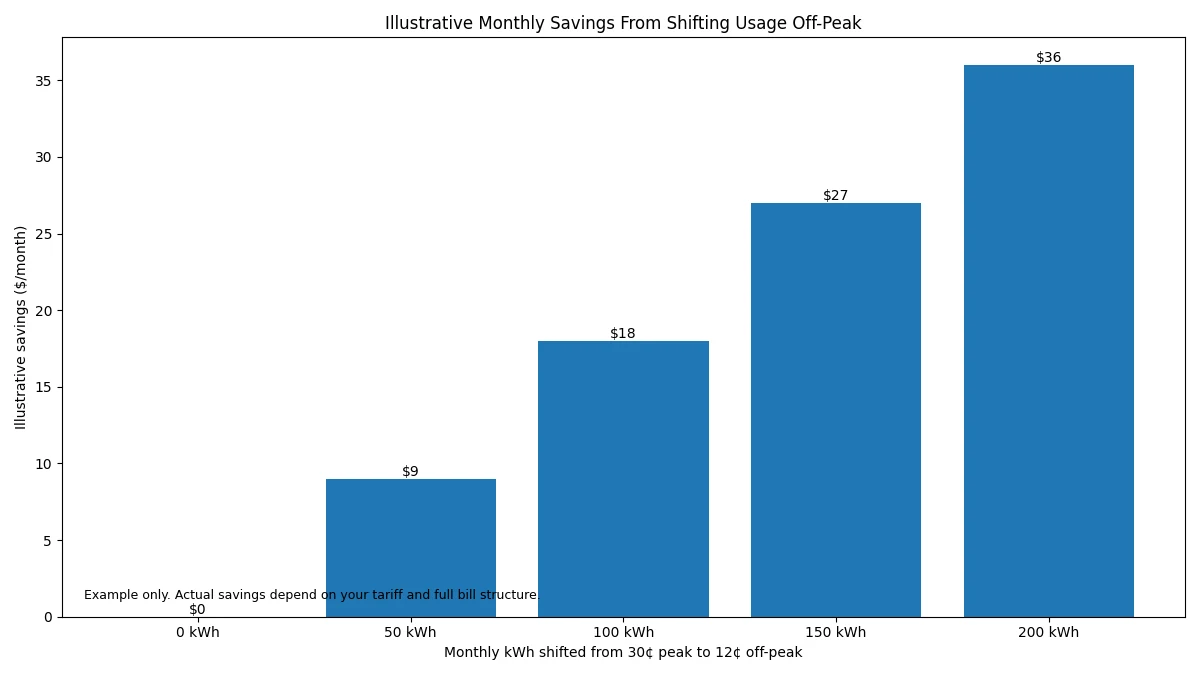
Savings = kWh shifted × (peak rate − off-peak rate).
Using the same illustrative 30¢ peak and 12¢ off-peak prices, shifting 100 kWh per month would reduce the energy charge by about $18/month. Shifting 150 kWh would save about $27/month. Actual savings depend on your tariff and whether that load would otherwise have happened during the expensive period.
The biggest opportunities often come from high-energy loads that can be scheduled: EV charging, electric water heating with controls, clothes drying, dishwashing and some pre-cooling or pre-heating strategies. Comfort, equipment requirements and utility rules still matter.
Who is a good fit for time-of-use electricity rates?
A TOU plan is more likely to work well when a meaningful share of your electricity use is flexible. Households that can charge an EV overnight, run laundry outside peak hours, schedule a dishwasher, or shift some water heating may have more opportunity to benefit.
California regulators make the same point for EV drivers. CPUC’s EV electricity-rate guidance describes residential TOU plans designed to encourage charging during lower-cost periods.
TOU can also work well if your household is naturally away from home during peak periods and much of your usage already occurs overnight or in the morning.
When can a time-of-use plan cost more?
A time-of-use plan can increase your bill if a large share of consumption falls into expensive periods and you cannot move it. This can happen when air conditioning, cooking, laundry and EV charging all coincide with the same evening peak window.
Before switching, download several weeks of hourly or 15-minute interval data from your utility account if available. Calculate how many kWh would have landed in each tariff period. For a stronger decision, repeat the exercise across hot and cold seasons because both your load shape and the tariff schedule may change.
Do not compare only the advertised off-peak price. Check the whole tariff: on-peak price, super off-peak price, seasonal changes, fixed charges, minimum bills, demand charges, credits and enrollment conditions.
TOU vs real-time pricing, critical-peak pricing and rebates
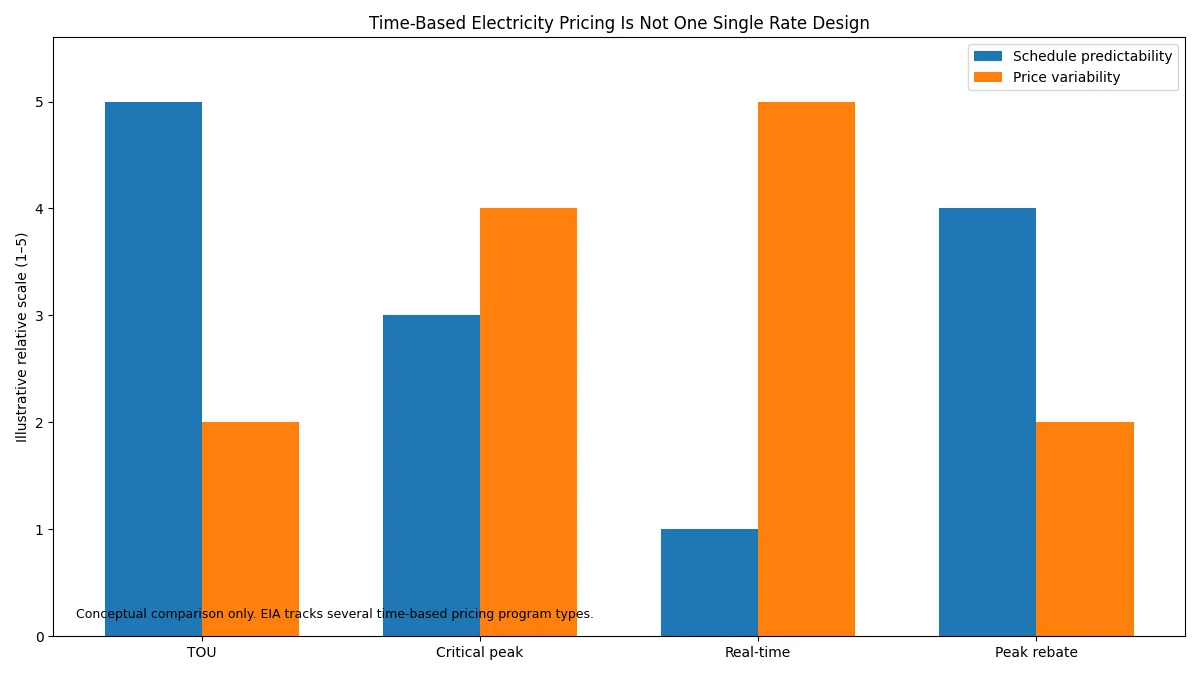
“Time-based pricing” is broader than ordinary TOU. EIA groups several program types in its Form EIA-861 dynamic-pricing data, including time-of-use, real-time, variable-peak and critical-peak pricing, as well as critical-peak rebate programs.
- Time-of-use: prices are predetermined by recurring time blocks.
- Critical-peak pricing: a much higher price may apply during a limited number of declared high-stress events.
- Real-time pricing: prices can change much more frequently, often tracking market conditions.
- Critical-peak rebate: customers may receive a credit for reducing usage during designated events rather than paying a higher event price.
Most residential users asking about peak and off-peak electricity are thinking about standard TOU. Do not assume one time-based plan follows the rules of another.
How to check your actual time-of-use plan
- Find the official tariff name. Your bill or online account should identify the rate plan.
- Write down every price period. Include peak, off-peak, mid-peak and super off-peak if applicable.
- Check seasonal dates. Summer and winter schedules may differ.
- Check weekday, weekend and holiday rules. Peak hours may apply only on certain days.
- Check fixed and demand charges. A low off-peak energy price does not describe the whole bill.
- Download interval usage. Map your actual kWh to the tariff periods before switching.
- Re-check current tariff data. Utility rates can change after regulatory approval.
If you first need to understand the difference between a kWh price and the total bill, see Electricity Cost per kWh USA. For a state-level bill benchmark, see Average Electricity Bill in the USA. To compare your usage with a national benchmark, see How Much Electricity Does a House Use per Day & Month?.
HomeBillLab’s treatment of tariff data, source dates and calculation assumptions is documented in the HomeBillLab Methodology.
Time-of-use electricity rates USA FAQ
What time is electricity cheapest in the USA?
There is no single nationwide cheapest time. Off-peak hours are defined by each utility tariff and can vary by season, weekday, weekend and rate plan.
Are peak hours always 4 p.m. to 9 p.m.?
No. Some utilities use a late-afternoon or evening peak window, but the hours are not nationally standardized. California has well-known 4–9 p.m. examples on some plans, but another utility or state can use different periods.
Can time-of-use rates save money?
Yes, when enough usage can be shifted from expensive periods to cheaper periods. They can also cost more if most consumption stays on-peak. The answer depends on your interval usage and exact tariff.
Do weekends have off-peak rates?
Many TOU plans treat weekends differently, but not all do. Some have all-day off-peak weekends; others retain several price periods. Use the official tariff.
Is a smart meter required?
A utility needs a way to measure how much electricity was consumed during each billing period. Modern residential TOU programs commonly rely on interval-capable smart meters, but metering requirements are utility-specific.
Does shifting usage reduce total kWh?
Not necessarily. Moving 5 kWh from 6 p.m. to midnight keeps total usage at 5 kWh but may reduce cost if midnight is cheaper. Conservation reduces total kWh; load shifting changes when the kWh are used.
Bottom line
Time-of-use electricity rates USA can lower electricity costs when a household can move meaningful energy use away from expensive peak periods. The key is not a national rule of thumb but your own tariff and interval usage. Confirm the current peak and off-peak schedule, calculate how many kWh land in each period, and compare the full bill structure before switching. Use the U.S. Electricity Bill Calculator to test your rate assumptions, and browse the U.S. Electricity hub for related guides.