
Electricity supply vs delivery charges are two different parts of the electric bill. The supply side pays for the electricity itself — the energy that is generated or purchased for you. The delivery side pays for moving that electricity through the grid and local utility system to your home, plus certain utility services and regulated charges.
In a bundled utility market, the same company can provide both supply and delivery. In an unbundled or retail-choice market, you may be able to choose a separate supplier for the supply portion while your local utility continues to provide delivery. Changing suppliers does not make the poles, wires, substations, meters or regulated delivery charges disappear.
If you want to reconstruct your own bill, use the HomeBillLab U.S. Electricity Bill Calculator. This guide explains which bill lines usually belong to supply and which belong to delivery before you enter the numbers.
Table of Contents
Electricity supply vs delivery charges: the quick difference
| Bill component | What it generally pays for | Can the provider be different? |
|---|---|---|
| Supply | Electricity generation or wholesale/retail energy procurement | Yes, in some retail-choice markets |
| Delivery | Transmission, distribution, local poles and wires, meters, billing and other regulated utility services | Usually no; the local utility remains the delivery company |
The U.S. Department of Energy defines a bundled rate as a rate where the same provider supplies the electricity and delivers it. DOE defines an unbundled rate as one where electric supply and electric delivery are provided by different providers. These can appear on one consolidated bill or on separate bills.
See DOE/FEMP’s utility rate glossary and rate-evaluation guidance for those definitions.
What is the electricity supply charge?
The supply charge is the cost of the electricity commodity or the cost of procuring power for customers. Depending on the market, the supply may come from your local utility’s default service, a competitive retail supplier, a community aggregation program, or another approved arrangement.
Massachusetts’ Department of Public Utilities explains supply in simple terms: it is the portion tied to the electricity used during the month, and customers in its restructured market can receive supply from the local electric company or a competitive supplier. Its current electric-bill guide was updated in July 2026.
Supply prices can be fixed for a contract term, variable, indexed, seasonal or time-based depending on the tariff or retail agreement. In competitive markets, contract terms can matter as much as the headline cents-per-kWh rate, so check expiration dates, cancellation terms and whether the rate can change.
What is the electricity delivery charge?
Delivery is the utility-system side of the bill. It generally includes the cost of moving electricity through high-voltage transmission and the local distribution network, plus utility services such as metering and billing.
Massachusetts DPU’s electric service overview says the delivery component is the transportation of electricity to the home or business and also includes metering, billing and customer service. The same page explains that customers must continue to receive delivery service from their electric utility even when they choose a competitive supplier for supply.
Delivery can contain more than one line. Depending on the state and utility, you may see distribution, transmission, customer charges, transition charges, public-policy charges, energy-efficiency charges, storm-related charges or other regulated adjustments.
Bundled vs unbundled electricity service
In a bundled market, you may see one utility rate structure where supply and delivery are provided together. The bill can still show separate line items, but you do not choose a separate retail supplier.
In an unbundled market, the supply provider and delivery utility can be different. DOE says an unbundled arrangement can produce either one bill containing both charges or two separate bills. For a household, this means the company name printed at the top of the bill does not always tell you who supplied the electricity.
The OpenEI U.S. Utility Rate Database reflects this distinction directly: its current records include service types such as Bundled, Delivery, and Delivery with Standard Offer. The database contains more than 63,000 listed U.S. rate records, so rate structure varies widely across utilities and customer classes.
Example: how supply and delivery combine on one bill
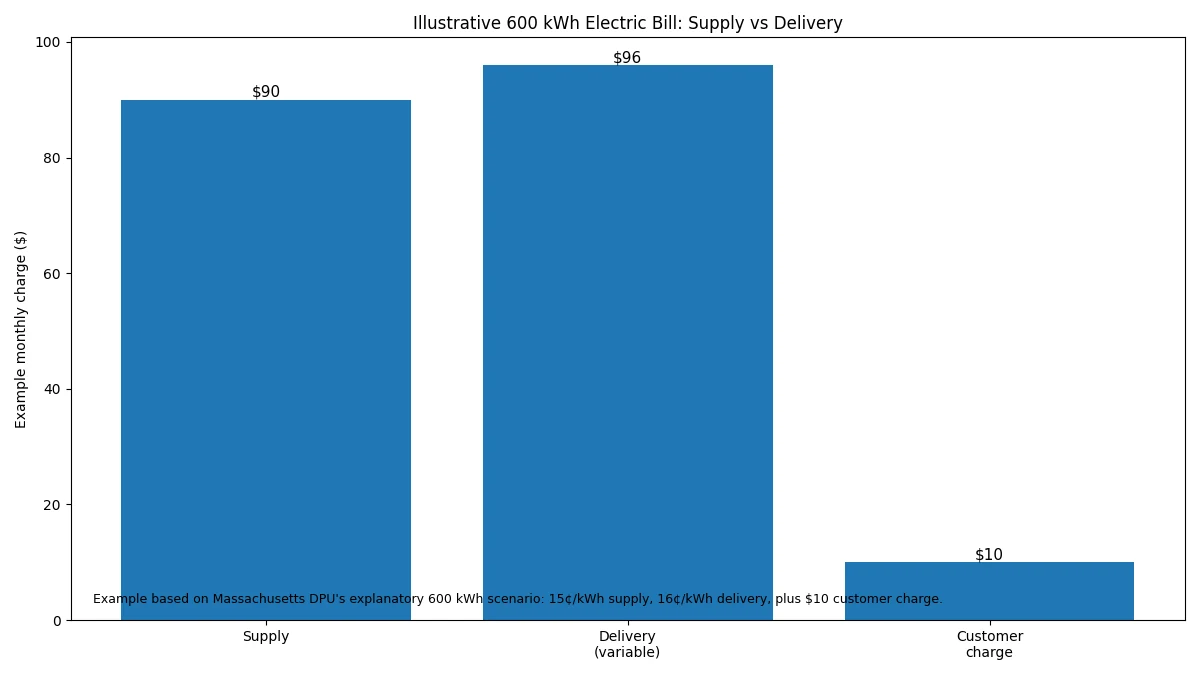
Massachusetts DPU gives an easy-to-follow example using a customer who consumes 600 kWh in a month. In that example, the total energy-related price is 31¢/kWh: 15¢/kWh for supply and 16¢/kWh for delivery, plus a $10 customer charge.
| Example component | Calculation | Amount |
|---|---|---|
| Supply | 600 kWh × $0.15 | $90 |
| Delivery | 600 kWh × $0.16 | $96 |
| Customer charge | Fixed | $10 |
| Total | $196 |
This is a state regulator’s educational example, not a national tariff. The useful lesson is structural: even if the supply charge changes, the delivery part can remain substantial.
What changes if you switch electricity suppliers?
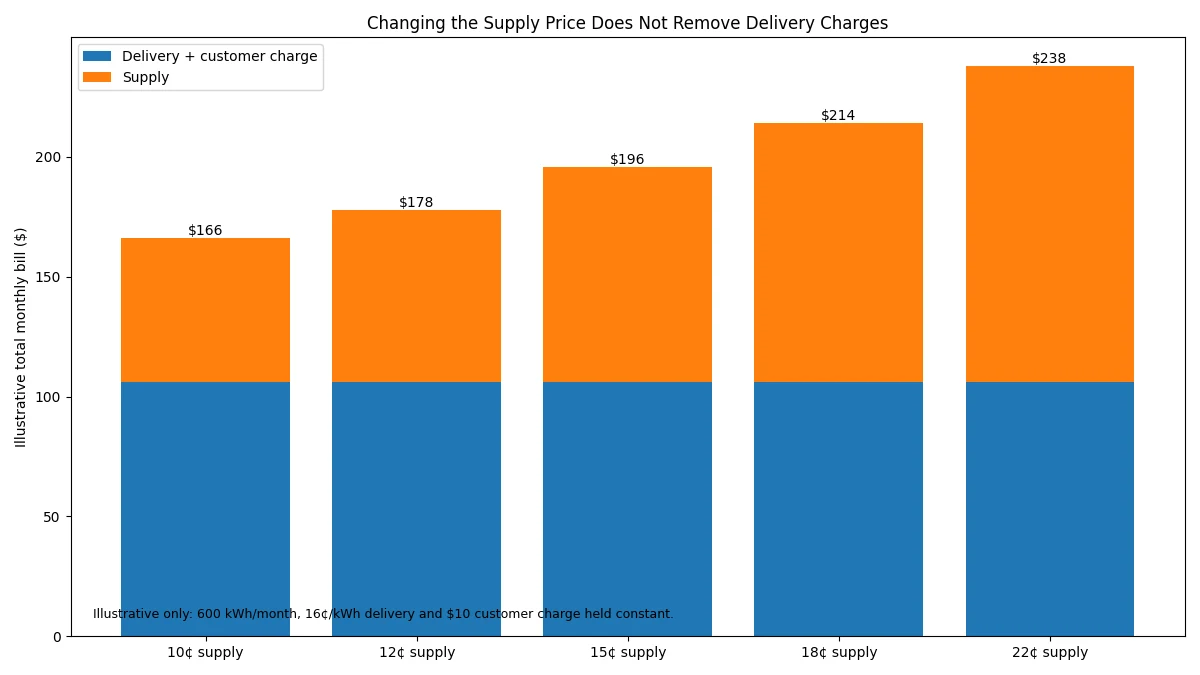
In a retail-choice market, switching suppliers generally changes the supply part of the bill. The local electric utility still owns or operates the delivery network and continues to charge for delivery.
Using the 600 kWh example above, suppose delivery remains 16¢/kWh plus the $10 fixed customer charge. If supply falls from 15¢ to 12¢/kWh, the supply charge drops from $90 to $72. The bill would fall by $18, not by the full difference between the old total rate and the new supply rate.
This is why supplier advertisements should be compared against your current supply price, not against the total average cents per kWh on your full bill.
New York’s Department of Public Service gives the same basic distinction: its energy-pricing guidance says the delivery charge is the regulated cost of transporting energy through the utility system, while the supply charge is the commodity cost determined in a competitive marketplace.
Who regulates supply and delivery charges?
The answer depends on the market and the specific charge. Delivery utility rates are generally regulated by state public utility commissions, while interstate transmission rates fall under federal jurisdiction. Competitive retail supply prices can be market-based in states that allow customer choice.
Massachusetts DPU, for example, says transmission charges are regulated by the Federal Energy Regulatory Commission, while the DPU sets or reviews base distribution and customer charges for the distribution companies it regulates. It licenses competitive suppliers but does not set their retail supply product prices.
That is one reason the same bill can contain charges governed by different rules. A change in wholesale energy prices may affect supply, while a utility rate case can change delivery charges on a different schedule.
Why delivery includes both fixed and per-kWh charges
Delivery charges do not always scale one-for-one with kWh. A bill may include a monthly customer charge plus one or more per-kWh delivery rates. Some customer classes can also have demand charges or other tariff components.
In Massachusetts DPU’s explanation, the distribution company bills delivery through both a fixed monthly customer charge and a per-kWh distribution rate. This means reducing usage lowers the variable delivery portion but does not eliminate the fixed charge.
If you are comparing two months, separate the fixed charges from the usage-based charges before deciding whether your electricity rate changed.
Why your total cents per kWh can be higher than the supply rate
The EIA’s electricity sales and price FAQ explains that its published average retail electricity price includes the costs of delivered electricity: generation, transmission, distribution, taxes and fees. EIA obtains that average by dividing retail electricity revenue by retail kWh sales.
EIA also explicitly says its average retail electricity price is not the same as an individual utility rate. An individual bill may have separate rates for electricity supply, delivery and other services.
That is why a bill can show a 13¢/kWh supply rate but still have an effective total cost of 20¢, 25¢ or more per kWh after delivery, fixed charges, taxes and riders are included.
For a broader explanation of delivered cost per kWh, see Electricity Cost per kWh USA.
Do time-of-use rates affect supply, delivery or both?
It depends on the tariff. A time-of-use plan can apply different energy prices by hour, and some utilities can also have time-dependent delivery or demand components. Do not assume that “off-peak” refers only to supply unless the tariff says so.
The U.S. Utility Rate Database includes many rate structures with bundled, delivery-only and time-of-use components. Read the exact tariff definition rather than applying another utility’s peak schedule to your bill.
For the dedicated topic, see Time-of-Use Electricity Rates USA.
How to identify supply and delivery on your own electric bill
- Find your rate plan. Look for a tariff name, rate class or supplier name.
- Locate the kWh supply line. It may be called generation, energy, electric supply, standard offer or supplier service.
- Locate delivery lines. Look for transmission, distribution, delivery, customer or meter-related charges.
- Check the provider name. A competitive supplier may be listed separately from the local utility.
- Separate fixed and variable charges. Not every delivery dollar falls when kWh falls.
- Check credits and riders. They can sit outside the simple supply/delivery split.
- Confirm the current tariff. Utility websites and state regulators are the best source for current rate definitions.
If the bill itself is confusing, start with How to Read an Electric Bill in the USA. For a benchmark of how much households pay overall, see Average Electricity Bill in the USA.
HomeBillLab’s treatment of electricity rates, bill components, source dates and illustrative examples is documented in the HomeBillLab Methodology.
Electricity supply vs delivery charges FAQ
Can I avoid delivery charges by switching suppliers?
No. In a retail-choice market, switching suppliers changes the supply provider, but your local utility still provides delivery service and bills its applicable regulated charges.
Why is my delivery charge higher than my supply charge?
That can happen because delivery may include transmission, distribution, customer charges and regulated riders in addition to the basic per-kWh distribution rate. The relative size of supply and delivery varies by utility and period.
Does the utility make electricity if I use a competitive supplier?
Not necessarily. A competitive supplier can be responsible for the supply contract, while the local utility continues to deliver electricity through its network and handle metering, outages and other distribution services.
Are transmission charges part of supply or delivery?
They are generally part of the delivery side in consumer bill explanations such as Massachusetts DPU’s. Exact bill labels vary by utility, so check your tariff.
Why does my supplier rate look lower than my total cost per kWh?
Because the supplier rate covers only the supply portion. Delivery charges, fixed customer charges, taxes, riders and other fees can raise the total effective cost per kWh substantially.
Bottom line
Electricity supply vs delivery charges answer two different questions: supply pays for the electricity itself, while delivery pays for transporting and serving that electricity through the utility system. In states with retail choice, you may be able to change the supply provider, but the local utility normally remains responsible for delivery. Compare supplier offers against the supply portion of your existing bill, not against the total bill rate. Use the U.S. Electricity Bill Calculator to model your own numbers and browse the U.S. Electricity hub for related guides.