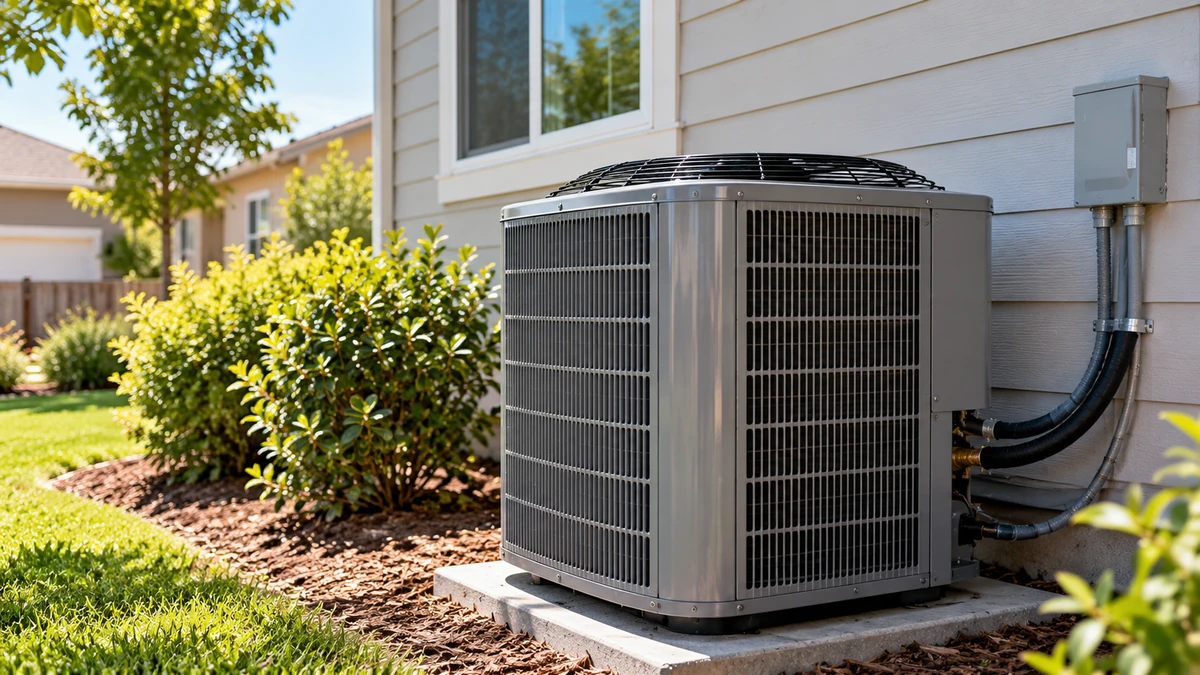
SEER2 explained in one sentence: it is a seasonal cooling-efficiency rating that tells you how much cooling an air conditioner or heat pump delivers for each unit of electricity used under the federal test procedure. A higher SEER2 means less electricity is needed to provide the same standardized seasonal cooling load.
SEER2 is not a direct prediction of your electric bill. Real running cost also depends on climate, thermostat setting, system size, duct losses, installation quality, humidity, part-load operation and your electricity price. For 2026 national context, the U.S. Energy Information Administration reports a residential average electricity price of 18.31¢/kWh for July 2026.
Use the HomeBillLab U.S. Air Conditioner Running Cost Calculator when you want to turn your own watts, runtime or seasonal kWh into dollars. This guide focuses on what the SEER2 number itself means.
Table of Contents
SEER2 explained: what does the rating mean?
SEER2 stands for Seasonal Energy Efficiency Ratio 2. ENERGY STAR defines it as the total heat removed from the conditioned space during the annual cooling season, measured in Btu, divided by the total electrical energy consumed during that season, measured in watt-hours.
The current ENERGY STAR heat pump criteria page uses that definition and lists SEER2 alongside EER2 and HSPF2. The “2” matters because SEER2 uses the newer DOE test procedure rather than the older SEER test method.
A rating of 18 SEER2 therefore means the tested system delivers more seasonal cooling per watt-hour than a 14 SEER2 system. It does not mean the system is “18% efficient.” SEER2 is a ratio in Btu per watt-hour, not a percentage.
The SEER2 formula
The simplified relationship is:
SEER2 = seasonal cooling output in Btu ÷ seasonal electrical input in watt-hours.
Rearrange that formula to estimate rating-based electricity use for a fixed cooling load:
Seasonal electricity in kWh = seasonal cooling load in Btu ÷ SEER2 ÷ 1,000.
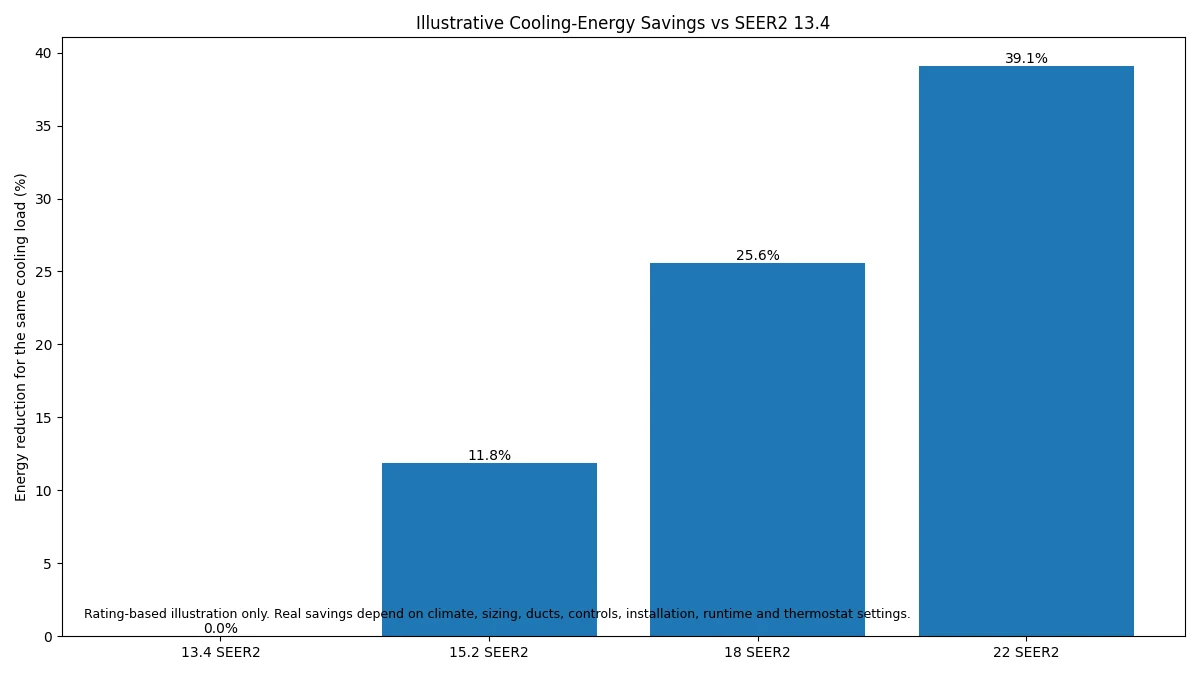
That inverse relationship is the reason higher SEER2 lowers kWh for the same cooling load. If the cooling requirement stays fixed, moving from 13.4 to 15.2 SEER2 reduces the simplified rating-based electricity requirement by about 11.8%.
SEER2 explained for AC running cost
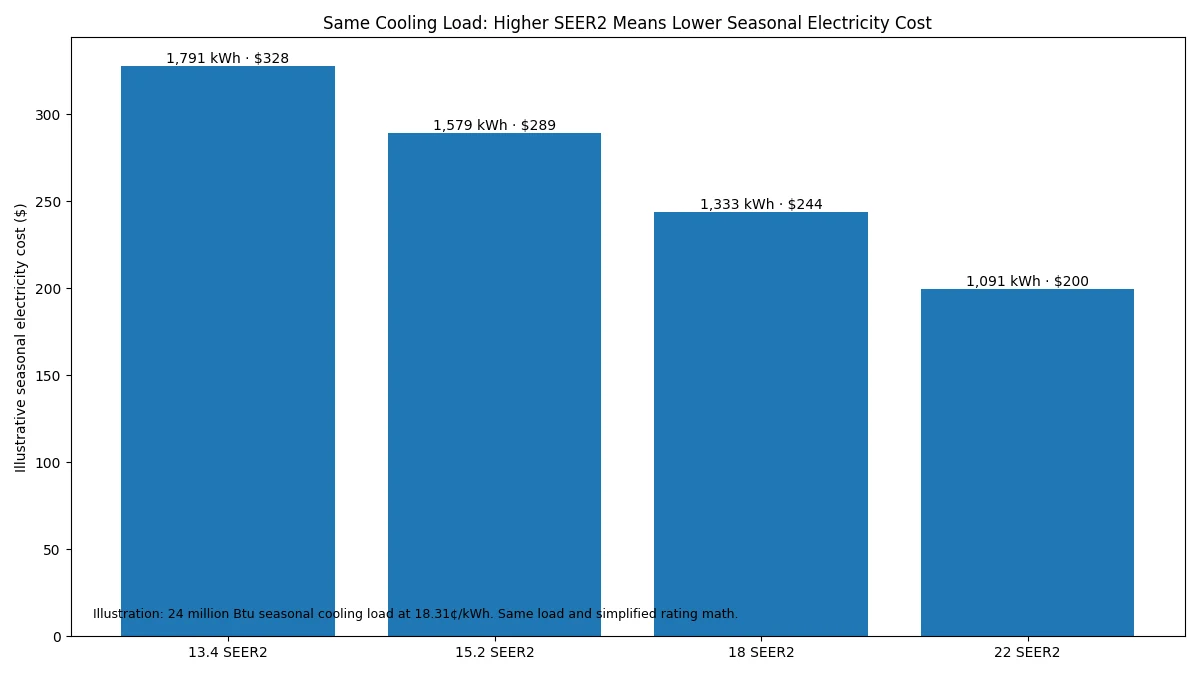
For an illustrative seasonal cooling load of 24 million Btu and an electricity rate of 18.31¢/kWh:
| SEER2 | Illustrative seasonal electricity | Illustrative electricity cost |
|---|---|---|
| 13.4 | 1,791 kWh | $328 |
| 15.2 | 1,579 kWh | $289 |
| 18.0 | 1,333 kWh | $244 |
| 22.0 | 1,091 kWh | $200 |
This table is intentionally simple. It holds the cooling load constant so you can isolate the effect of the efficiency rating. It does not include duct leakage, blower differences, standby power, climate-specific part-load behavior or installation defects.
The U.S. EIA Electric Power Monthly July 2026 summary reports the national residential average electricity price of 18.31¢/kWh used in this example. Replace it with your own utility rate for a household estimate.
SEER2 explained vs old SEER: why the rating changed
DOE changed the residential central air-conditioner and heat-pump test procedure beginning in 2023. The newer procedure uses the SEER2 and HSPF2 nomenclature and different test conditions designed to better represent installed-system operation.
The DOE/FEMP central air-conditioner guidance explains that, effective January 1, 2023, DOE changed how HVAC systems are tested and introduced SEER2 for cooling efficiency. Its current examples use SEER2 13.4 as a less-efficient comparison level, 15.2 as the ENERGY STAR level used in the December 2024 guidance, and 23.5 as the best-available example at that time.
Because SEER and SEER2 come from different test procedures, do not treat them as interchangeable or assume one universal conversion factor applies to every product. When comparing equipment today, compare SEER2 to SEER2 whenever possible.
Useful current SEER2 reference points
DOE/FEMP’s current residential central-air guidance uses 15.2 SEER2 as the ENERGY STAR efficiency level in its regional examples. ENERGY STAR’s current air-source heat-pump criteria also require 15.2 SEER2 for qualifying split systems.
The DOE/FEMP examples show why a few SEER2 points can matter. In its standardized central-AC scenarios, the 15.2 SEER2 model uses less annual electricity than the 13.4 SEER2 comparison model in Southeast, Southwest and Northern examples.
Those FEMP annual kWh numbers are not national household averages. They are standardized federal purchasing examples based on a 36,000 Btu/h central AC, climate-region assumptions and the referenced DOE test methodology.
SEER2 vs EER2
SEER2 measures seasonal cooling performance across the test season. EER2 measures cooling efficiency at a specified operating condition, so it is more like a point-in-time efficiency snapshot.
This distinction matters in very hot climates. Two systems can have similar SEER2 but different EER2, meaning they may not perform identically under high outdoor temperatures.
DOE’s current Consumer Central Air Conditioners and Heat Pumps page confirms that current federal test procedures measure SEER2 for seasonal cooling and HSPF2 for seasonal heating. The page also tracks DOE’s current test-procedure rulemaking for these products.
What SEER2 means on a heat pump
An air-source heat pump provides both cooling and heating, so one efficiency number is not enough. For cooling, use SEER2 and EER2. For heating, use HSPF2 and, for cold-climate comparisons, low-temperature COP and capacity data.
ENERGY STAR’s current split-system heat-pump criteria require at least 15.2 SEER2, 11.0 EER2 and 7.8 HSPF2. Cold-climate designations add stronger heating requirements, including low-temperature performance tests.
This is why a high SEER2 heat pump is not automatically the best heating option for a cold climate. SEER2 only describes cooling-season efficiency.
Why your real AC savings may differ from the SEER2 math
SEER2 explained in real-world terms means treating it as a laboratory-derived seasonal rating, not a guaranteed bill. Your house is not a laboratory, and real electricity use changes with:
- Climate and weather: hotter summers create more cooling load.
- Thermostat setting: a lower indoor setpoint generally increases runtime.
- Humidity: latent cooling can add workload even when sensible temperature is similar.
- System sizing: oversized equipment can cycle poorly and hurt comfort.
- Part-load performance: variable-speed systems can behave differently from single-stage units.
- Duct leakage: cooled air lost in an attic or crawlspace does not reach the room.
- Airflow and refrigerant charge: poor commissioning can reduce delivered efficiency.
- Building envelope: insulation, windows, shading and air leakage determine the cooling load.
Ducts and installation can erase part of the rating advantage
DOE/FEMP warns that oversizing, improper refrigerant charging and leaky ducts can cause efficiency losses, discomfort and shorter equipment life. That means a correctly installed 15.2 SEER2 system can outperform a poorly installed higher-rated system in the real world.
The same issue matters when comparing ductless and ducted systems. A mini-split avoids central duct leakage, while a central system can perform very well when the ducts are tight, well insulated and mostly inside conditioned space.
See Mini Split vs Central Air for the distribution and zoning side of that comparison.
SEER2 explained for upgrade savings
If you know the current and proposed SEER2 ratings and assume the same cooling load, the simplified energy ratio is:
New kWh ÷ old kWh ≈ old SEER2 ÷ new SEER2.
So moving from 13.4 to 18 SEER2 gives a simplified energy ratio of 13.4 ÷ 18 = 0.744. That means about 25.6% less rating-based cooling electricity for the same seasonal load.
Moving from 15.2 to 22 SEER2 gives 15.2 ÷ 22 = 0.691, or about 30.9% less rating-based cooling electricity. The actual bill savings can be smaller or larger depending on the real installation and usage.
If your old system’s seasonal AC electricity use is known, multiply that kWh by the simplified ratio, then multiply the difference by your electricity rate. This is usually more useful than guessing from tonnage alone.
What to compare when buying a new AC
- Exact matched-system SEER2: not just the highest rating advertised for the product family.
- EER2: especially useful in very hot climates.
- Capacity and load calculation: avoid oversizing.
- Variable-speed capability: can improve part-load operation and comfort.
- Duct condition: repair leakage before expecting label-level savings.
- Installed price: compare the up-front premium with realistic annual kWh savings.
- Warranty and installer quality: a high rating is only useful if the system is commissioned correctly.
For actual cost examples, see Central Air Conditioner Running Cost USA. For ductless equipment, see Mini Split Running Cost USA.
HomeBillLab’s treatment of efficiency ratings, electricity prices and illustrative calculations is documented in the HomeBillLab Methodology. Browse the U.S. Air Conditioning hub for related guides.
SEER2 explained FAQ
Is a higher SEER2 always better?
A higher SEER2 means better tested seasonal cooling efficiency, but it does not automatically make a system the best financial choice. Installation cost, climate, duct condition and expected runtime all matter.
Is SEER2 the same as SEER?
No. SEER2 uses the newer DOE test procedure introduced with the 2023 efficiency transition. Compare SEER2 ratings directly whenever possible rather than applying a universal conversion.
How much cheaper is 18 SEER2 than 14 SEER2?
For the same cooling load, the simplified rating relationship is inverse. Using 14 and 18 as an example, 14 ÷ 18 = 0.778, so the 18 SEER2 system would use about 22.2% less rating-based cooling electricity.
Does SEER2 include heating efficiency?
No. SEER2 is a cooling-season metric. For heat pumps, use HSPF2 and low-temperature heating data to assess heating performance.
Can a high-SEER2 system still have a high bill?
Yes. A very hot climate, large house, low thermostat setting, leaky ducts or high electricity prices can still create a large bill even with efficient equipment.
Bottom line
SEER2 explained simply: higher SEER2 means fewer kWh are needed for the same standardized seasonal cooling load. For a fixed load, electricity use falls roughly in inverse proportion to the rating. Moving from 13.4 to 18 SEER2 cuts the simplified rating-based cooling electricity by about 25.6%; moving from 15.2 to 22 SEER2 cuts it by about 30.9%. Real savings still depend on climate, ducts, sizing and installation. Use the U.S. Air Conditioner Running Cost Calculator to convert your own kWh assumptions into dollars.