
A central AC installation cost USA estimate needs more than the price of the outdoor condenser. A complete central-air project can include the outdoor unit, indoor evaporator coil or air handler, refrigerant lines, electrical work, thermostat, condensate drainage, permits, removal of the old system, duct repairs, and commissioning. If the home has no usable duct system, ductwork can become one of the biggest extra costs.
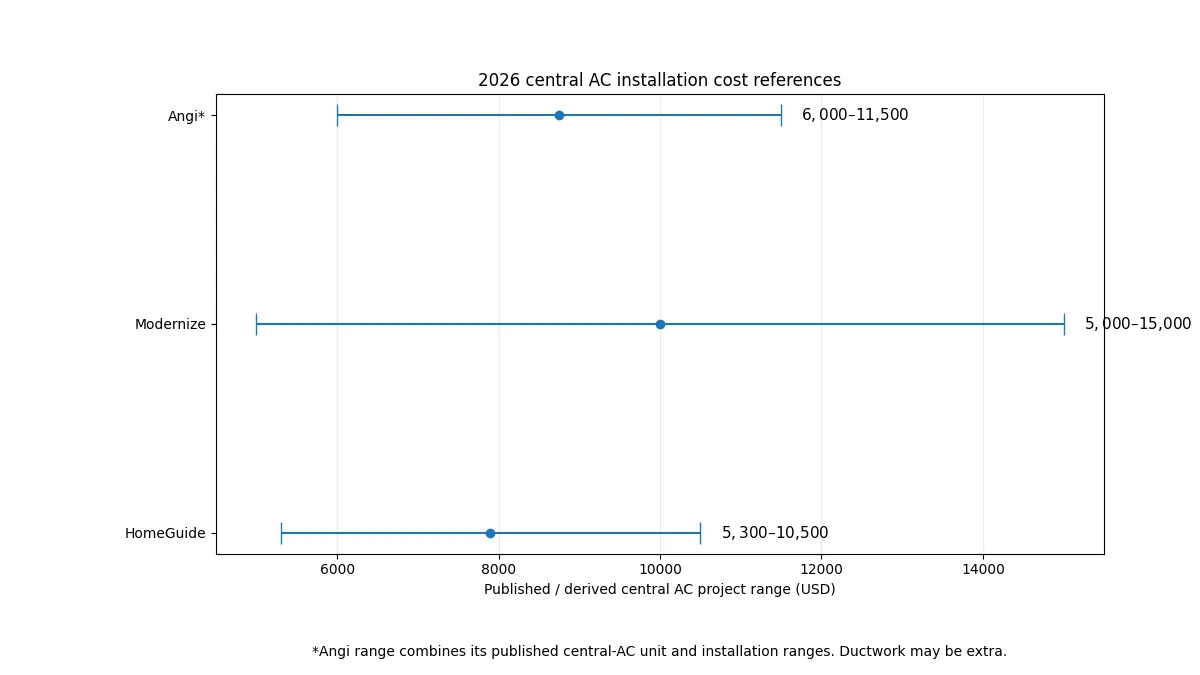
Current 2026 consumer cost guides overlap around a broad $5,000 to $15,000 installed range for many central-air projects before unusually complex work. HomeGuide lists central AC at about $5,300–$10,500 installed. Modernize reports about $5,000–$15,000 for most central AC installations. Angi’s October 2026 guide lists central AC equipment at about $2,500–$4,500 and professional installation at about $3,500–$7,000, implying a rough combined budget of about $6,000–$11,500 before major ductwork or other upgrades. These are market references, not guaranteed quotes.
If your main question is what the new system will cost to operate after installation, keep that calculation separate. Use the HomeBillLab U.S. Air Conditioner Running Cost Calculator and our Central Air Conditioner Running Cost USA guide.
Table of Contents
How much does central AC installation cost in 2026?
| 2026 source | Published cost reference | What it covers |
|---|---|---|
| HomeGuide | $5,300–$10,500 | Central air conditioner total installed cost |
| Modernize | $5,000–$15,000 | Typical central AC system installation, excluding major new ductwork |
| Angi | $2,500–$4,500 equipment + $3,500–$7,000 installation | Central AC unit price and professional installation listed separately |
The range is wide because “install central air” can mean very different projects. Replacing a matched outdoor and indoor system while keeping sound ducts is much simpler than adding central AC to an older house with no ductwork, an undersized electrical service, difficult attic access, or major air-distribution problems.
A simple central AC project budget
For a central AC installation cost USA budget, the cleanest approach is to separate equipment, labor and house-specific extras instead of relying on one national average.
For budgeting, separate the project into line items instead of multiplying a generic cost per ton:
Total project cost = equipment + installation labor + ductwork + electrical + permits + controls + removal/repairs
For example, an $8,000 equipment-and-installation quote can become a five-figure project if damaged or missing ducts add several thousand dollars. Angi’s current guide says ductwork changes can add roughly $3,000–$7,500, while Modernize says adding ductwork can commonly add around $2,000–$10,000 depending on home size and access. HomeGuide lists central AC with ductwork at roughly $9,000–$16,000 installed.
Replacement is usually cheaper than first-time central air
A replacement can reuse parts of the existing infrastructure if they are suitable: ducts, supply registers, return pathways, equipment platform, electrical circuit, drain route and thermostat wiring. Reuse should not be automatic. The contractor still needs to verify airflow, duct leakage, system compatibility, electrical capacity and refrigerant-line requirements.
A first-time central-air installation may require a new duct system or major alterations to an existing heating-only duct system. Finished ceilings, two-story layouts, limited attic or crawlspace access and insufficient return-air paths can all raise labor and material cost.
Do not size a central AC by square feet alone
One of the easiest ways to overspend is to buy more cooling capacity than the house actually needs. ENERGY STAR’s current HVAC Quality Installation guidance says the contractor should size equipment from the actual characteristics of the home instead of using a rule of thumb. Oversized systems can cycle too frequently, reduce comfort, shorten equipment life and provide poor humidity control.
DOE’s Building Science Education sizing guidance likewise points to recognized load-calculation methods such as ACCA Manual J. A load calculation considers factors such as climate, insulation, windows, air leakage, orientation and internal loads. Two 2,000-square-foot homes can legitimately need different cooling capacities.
What does “tons” mean in a central AC quote?
Central air conditioners are commonly described by cooling capacity in tons. One ton equals 12,000 Btu per hour of rated cooling capacity, so a 3-ton system is nominally 36,000 Btu/h. Tonnage affects equipment cost, but it should be the result of a load calculation, not the starting point for choosing the system.
Modernize’s 2026 pricing guide shows equipment and installation costs generally increasing with system size, but a larger unit is not automatically better. Paying for unused capacity can increase upfront cost and can hurt comfort if the equipment is oversized.
Higher efficiency usually raises upfront cost
SEER2 is a seasonal cooling-efficiency metric: higher SEER2 generally means less electricity for the same seasonal cooling load, but higher-efficiency systems usually cost more to buy. Variable-capacity equipment, advanced controls and matched indoor components can also increase the initial price.
For running-cost implications rather than installation price, see our SEER2 Explained guide. It is better to compare the extra installed cost of a higher-efficiency system with the electricity savings expected for your climate and usage rather than assuming that the highest available rating always pays back quickly.
Important 2026 change: ENERGY STAR central AC labeling was sunset
Older buying guides often tell homeowners simply to “look for ENERGY STAR” on a central air conditioner. That advice is now outdated for central AC. EPA’s Central Air Conditioners Sunset page states that the ENERGY STAR specification for central air conditioners was sunset on February 1, 2026. DOE federal efficiency standards still apply to residential central air-conditioning equipment; EPA’s ENERGY STAR labeling change does not mean efficiency requirements disappeared.
DOE’s current Consumer Central Air Conditioners and Heat Pumps page confirms that residential central AC equipment remains covered by federal energy-conservation standards. For a 2026 purchase, compare the model’s current efficiency ratings, matched-system certification, manufacturer documentation and local code requirements rather than relying on an outdated ENERGY STAR central-AC badge.
The old federal central-AC tax credit also ended after 2025
Another common source of outdated 2026 advice is the former federal Energy Efficient Home Improvement Credit for central air conditioners. ENERGY STAR’s central air conditioner tax-credit page states that the credit applied to eligible products purchased and installed between January 1, 2023 and December 31, 2025. It is not a 2026 central-AC tax credit.
If you are replacing both cooling and heating equipment, compare a heat pump as a separate option because current state, utility and Home Energy Rebate programs may treat heat pumps differently. Our Mini Split vs Central Air cost guide can also help if your home is a candidate for ductless or ducted alternatives.
Ductwork can make or break the quote
Existing ducts should be inspected rather than assumed to be usable. ENERGY STAR recommends evaluating ducts and correcting leakage as part of quality HVAC installation. Leaky, undersized or poorly balanced ducts can reduce airflow, increase energy use, create hot and cold rooms and prevent the new equipment from delivering rated performance.
Ask the contractor whether the quote includes duct leakage testing, sealing, return-air improvements, replacement of damaged runs, new registers or new trunk lines. Two bids that look thousands of dollars apart may not be quoting the same duct scope.
Electrical, drain and permit costs
A replacement central AC may need a new disconnect, breaker, conductor size, whip, surge protection, condensate drain, overflow safety switch or thermostat/control wiring. Local code and permit requirements vary. Older homes can also reveal electrical or structural work that was not obvious during an online estimate.
This is why an online central-air estimate should be treated as a screening number. The final quote should be based on an onsite inspection and should state what happens if the electrical panel, refrigerant lines, condensate system or ductwork fails inspection.
What should a good central AC installation quote include?
- exact outdoor unit and indoor coil or air-handler model numbers;
- cooling capacity and the load-calculation method used;
- SEER2/EER2 or other applicable efficiency ratings;
- equipment, labor and warranty terms;
- duct inspection and any required duct repairs;
- refrigerant-line replacement or reuse conditions;
- electrical work and controls;
- condensate drainage and safety devices;
- permit, inspection and old-equipment removal;
- startup, airflow testing and refrigerant-charge verification; and
- the exact exclusions that could increase the price later.
ENERGY STAR’s quality-installation guidance specifically highlights correct equipment sizing, airflow, refrigerant charge and duct evaluation because those factors affect both performance and efficiency. A cheap quote that omits commissioning can become an expensive system to live with.
Central AC installation cost FAQ
What is a reasonable central AC installation budget in 2026?
For many replacement projects with usable ductwork, current 2026 consumer cost guides overlap around roughly $5,000 to $15,000. Projects with major ductwork, electrical upgrades, difficult access or premium equipment can exceed that range.
How much does ductwork add to central AC installation?
Current cost guides commonly show several thousand dollars of additional cost. Angi cites roughly $3,000–$7,500 for ductwork modifications in its 2026 AC guide, while Modernize reports that adding ductwork can run roughly $2,000–$10,000 depending on home size and complexity.
Is a 3-ton AC right for a 2,000-square-foot house?
Not necessarily. Square footage alone is not enough to size central AC. The contractor should perform a cooling-load calculation using the home’s insulation, windows, air leakage, orientation, climate and other characteristics.
Is there a federal central AC tax credit in 2026?
The federal central-air tax credit described on ENERGY STAR’s consumer page applied through December 31, 2025. Do not budget a 2026 central AC project around that expired credit.
Does ENERGY STAR still certify central air conditioners in 2026?
EPA sunset the ENERGY STAR central air conditioner specification on February 1, 2026. Federal DOE efficiency standards still apply, but the old advice to use the ENERGY STAR central-AC label as the main 2026 shopping filter is outdated.
Should I replace central AC with a heat pump instead?
It is worth pricing both when the indoor system and electrical setup can support the choice. A heat pump provides heating as well as cooling and may qualify for incentive programs that do not apply to cooling-only central AC. Compare installed cost, local incentives and expected annual operating cost.
Because central AC installation cost USA estimates vary so much by house and scope, compare itemized local bids rather than choosing only from an online national average. For HomeBillLab’s assumptions, source hierarchy and review process, see our methodology. Browse related guides in the U.S. Air Conditioning hub.