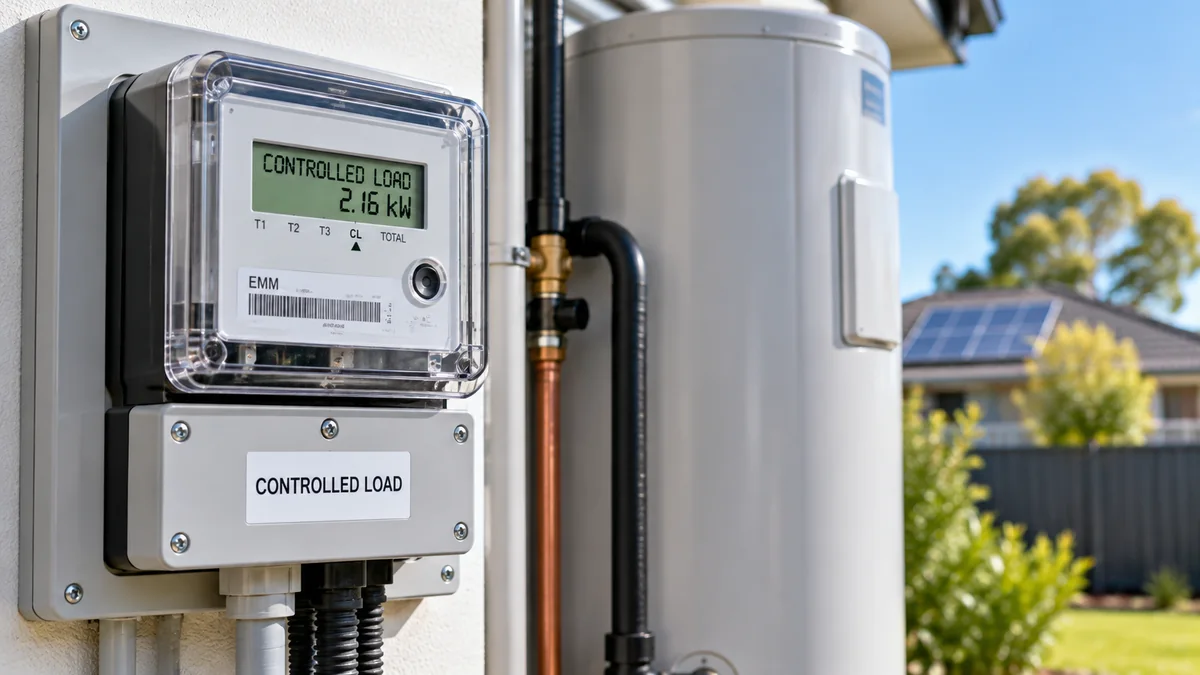
A controlled load is a separate electricity tariff for a specific hard-wired appliance or circuit, most commonly an electric storage hot-water system. The appliance is supplied through a dedicated controlled circuit and may only receive power during times set by the distributor, meter configuration or retailer arrangement. In return, the controlled-load usage rate is often lower than the household’s general-use rate.
For households comparing controlled load electricity in Australia, the most important point is that it is not the same as a normal off-peak period on a time-of-use plan. A time-of-use tariff changes the price for general household electricity by time. A controlled load applies to a particular connected load, often on its own circuit and sometimes separately metered. Use the Electricity Bill Calculator to model your own general-use and controlled-load kWh at the rates shown on your bill.
Table of Contents
What is controlled load electricity?
The Australian Government’s electricity pricing and tariffs guidance describes a controlled load tariff as a tariff for specific appliances connected to a separate meter circuit, with the circuit controlled so the appliance can operate only at certain times. Electric hot water is the most common example, although pool pumps and underfloor heating can also be eligible in some arrangements.
Energy Made Easy’s controlled-load guidance, operated by the Australian Energy Regulator, similarly explains that the large appliance receives electricity on its own circuit and may be separately metered. The restricted availability is the trade-off: you generally pay a special rate for that appliance, but you cannot assume the circuit has power whenever you choose to run it.
- General supply: powers ordinary household circuits and appliances.
- Controlled load: powers an approved appliance or dedicated circuit during controlled availability periods.
- Time of use: changes the rate for eligible general electricity according to peak, shoulder and off-peak time periods.
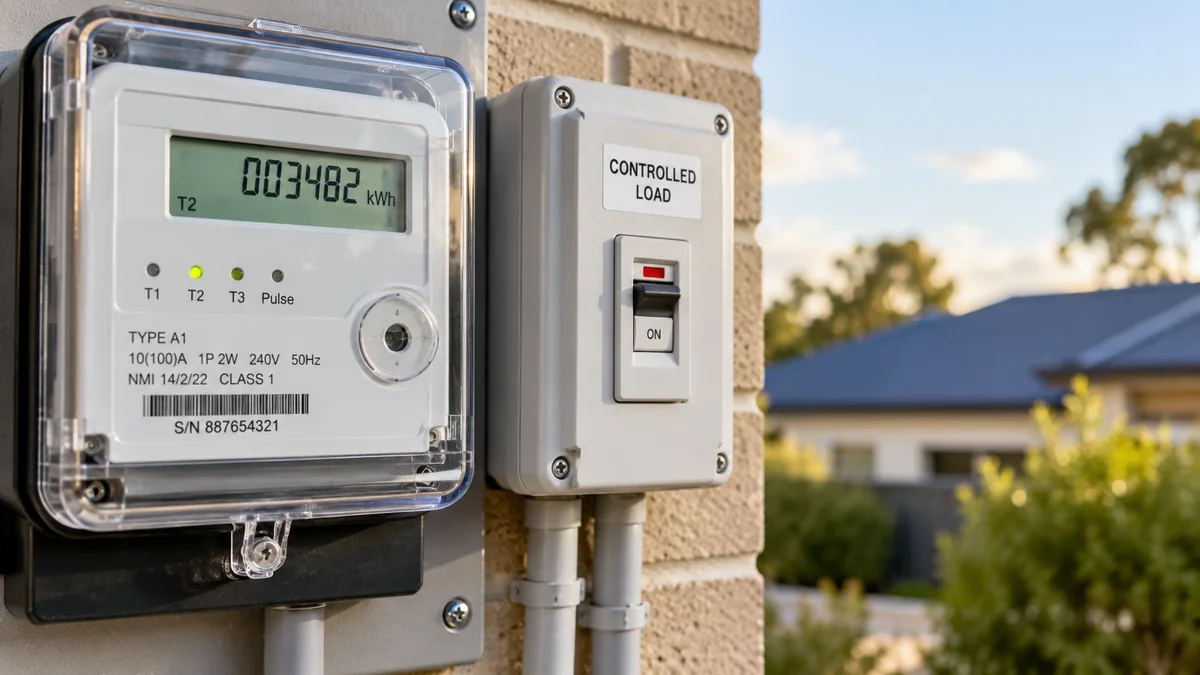
Controlled load vs time of use: the difference that matters
The words off-peak can cause confusion because both arrangements may involve cheaper periods. The billing logic is different. On a time-of-use plan, your meter records when general household electricity is consumed and applies the rate for that period. On a controlled load, the relevant appliance is on a controlled circuit and the applicable controlled-load rate is charged to that separately identified usage.
| Feature | Controlled load | Time of use |
|---|---|---|
| What receives the tariff? | A specific appliance or dedicated circuit | Eligible general household electricity |
| Can you choose when power is available? | Not necessarily; availability is controlled under the network/meter arrangement | You can generally use electricity at any time, but the rate changes by period |
| Common use | Storage hot water, and in some areas other suitable fixed loads | Whole-home consumption measured by time period |
| What to check | Controlled-load rate, any fixed charge, eligible appliance and supply availability | Peak/shoulder/off-peak rates and exact time windows |
If you are deciding between tariff structures more broadly, see Single Rate vs Time of Use Electricity in Australia. A household can also have a general tariff and a controlled-load tariff at the same property, so this is not always an either-or choice.
How controlled load appears on an electricity bill
The Australian Energy Regulator’s bill guidance notes that a bill can contain different variable charges, including a separately metered off-peak tariff for appliances such as storage hot water. On your own bill, look for a line showing controlled-load or off-peak kWh and a separate c/kWh rate. Some plans can also include a controlled-load daily charge or other metering-related costs, so the usage rate alone does not necessarily tell you the total plan cost.
Retailer terminology is not identical across Australia. Energy Made Easy lists common names including Controlled Load 1 and Controlled Load 2 in New South Wales, Tariff 31 and Tariff 33 in Queensland, Controlled Load in South Australia and Tariff 61 or Tariff 63 in Tasmania. Retailers can use different wording, so match the tariff code and rate on your own plan rather than relying on the label alone.
If the line items on your bill are unclear, use our guide to reading an Australian electricity bill before entering the figures in the calculator.
Controlled Load 1 and Controlled Load 2 are not national time schedules
Do not assume that “Controlled Load 1” always means one fixed national overnight window, or that “Controlled Load 2” always uses the same hours everywhere. Network arrangements differ, and modern smart-meter programs can shift controlled demand toward daytime periods when solar generation is abundant.
For example, Ausgrid’s current controlled-load information says its Controlled Load 1 supply is usually available for at least six hours in a 24-hour period, while Controlled Load 2 is usually available for at least sixteen hours and includes some daytime availability. Ausgrid also explains that switching times can vary and that smart-meter controlled-load timing has changed to make greater use of daytime solar generation.
Queensland uses different names and conditions. The Queensland Government electricity-bill guidance describes Economy Tariff 31 as being available for a minimum of eight hours a day on Energex or Ergon networks, while Economy Tariff 33 provides a longer minimum supply period. In South Australia, SA Power Networks’ residential tariff information shows that controlled loads can use limited supply windows and, for interval-meter arrangements, can include off-peak and daytime “solar sponge” periods.
Those examples demonstrate why HomeBillLab does not put one universal controlled-load schedule into the calculator. Confirm the tariff name, c/kWh rate and any availability conditions with your retailer, distributor or current plan document.
How to calculate controlled-load running cost
The energy-charge calculation is simple once you know the controlled-load consumption and rate:
Controlled-load energy cost = controlled-load kWh × controlled-load rate ($/kWh)
For an illustrative example only, suppose a storage hot-water system uses 6 kWh a day. If the controlled-load usage rate on the household’s plan is 18 c/kWh, the energy charge is:
- 6 kWh × $0.18 = $1.08 per day
- $1.08 × 365 = $394.20 per year
If exactly the same 6 kWh were instead billed at an illustrative general-use rate of 34 c/kWh, the energy charge would be $2.04 a day or $744.60 a year. The difference is $350.40 a year before accounting for any separate controlled-load supply charge, metering cost, plan discount or other fee. These rates are deliberately illustrative; they are not an Australian average.
The HomeBillLab Electricity Bill Calculator lets you enter your own controlled-load kWh and c/kWh rate alongside general electricity, supply charges and other bill components. See the HomeBillLab Methodology for how calculator assumptions and annualised estimates are handled.
Is controlled load always cheaper?
Not automatically. A controlled-load usage rate is often lower, but the right comparison is the total plan cost for your actual usage. Check any extra daily controlled-load charge, metering cost, eligibility condition and the general tariff you would otherwise use. A plan with a very attractive controlled-load rate can still be a poor overall fit if the rest of the household rates are high.
Energy Made Easy uses actual controlled-load usage where that data is available when it estimates plan costs. That is a useful reminder to compare plans using your own usage split rather than assuming that every household sends the same proportion of electricity to hot water.
Controlled load, solar and hot water
Historically, controlled hot water was strongly associated with overnight off-peak supply. That is changing in some networks as daytime rooftop solar changes the shape of grid demand. The Australian Government’s solar self-consumption guidance notes that many electric hot-water systems are controlled by distributors and that moving hot water to daytime solar can be useful in some cases, but not always.
Do not disconnect or rewire a controlled-load circuit simply because you have solar. The value depends on your controlled-load rate, general tariff, solar generation, feed-in tariff, hot-water system power, household demand and meter configuration. Electrical changes should be assessed and completed by an appropriately qualified electrician, and tariff changes should be confirmed with the retailer or distributor.
Which appliances can use controlled load?
Electric storage hot water is the classic controlled-load appliance because it can heat a tank during available periods and store the thermal energy until the household needs hot water. Depending on the network and tariff, other fixed or controllable loads can include underfloor or slab heating and some pool equipment. Eligibility is not something to infer from appliance type alone: the device must meet the retailer/network requirements and be connected in the approved way.
For hot-water running-cost scenarios, including direct electric and heat-pump systems, use the Hot Water Running Cost Calculator. Controlled-load tariff mechanics themselves belong here in the Electricity guides rather than being duplicated across every appliance page.
How to check whether you already have a controlled load
- Check the bill: look for a separate controlled-load, off-peak or tariff-code line with its own kWh and c/kWh rate.
- Check the plan information: confirm whether a controlled-load rate and any daily charge apply.
- Ask the retailer: confirm the tariff code and whether your meter data shows controlled-load consumption.
- Confirm the appliance connection: if wiring or metering is uncertain, use a qualified electrician rather than opening or modifying metering equipment yourself.
- Compare the whole plan: use actual annual usage where possible, not just the cheapest advertised controlled-load rate.
FAQ about Controlled Load Electricity
Is controlled load the same as off-peak electricity?
Not exactly. Controlled load is a tariff for a specific controlled circuit or appliance. It often operates in lower-demand periods, so “off-peak hot water” is a common name, but a general time-of-use off-peak rate applies according to when ordinary metered electricity is used rather than to one dedicated circuit.
What is Controlled Load 1 vs Controlled Load 2?
They are controlled-load tariff categories used by some networks, especially in New South Wales, but their availability hours and technical conditions are network-specific. Controlled Load 2 commonly provides a longer supply window than Controlled Load 1 in networks that use those names. Check your distributor and retailer rather than applying one schedule nationally.
Can a heat-pump hot-water system use controlled load?
Potentially, but suitability depends on the system’s controls, recovery needs, circuit arrangement and available tariff. A shorter controlled window that suits a large resistance storage tank may not be the best operating arrangement for every heat pump. Check the manufacturer requirements, retailer/network tariff and installer advice.
Can I move controlled-load hot water to solar hours?
Sometimes, but the economics and technical setup vary. Some networks now include daytime controlled-load availability, while other homes may consider changing the way hot water is controlled. Compare the controlled-load rate with the value of self-consumed solar and any forgone feed-in credit, and do not alter fixed wiring without a qualified electrician.
Why does my controlled-load tariff have a separate daily charge?
Some plans include a fixed controlled-load or metering charge as well as the c/kWh usage rate. That is why a tariff should be compared on total annual cost rather than on the controlled-load energy rate alone.
Use your own bill rates
Controlled load electricity can be a useful way to separate a flexible high-energy appliance from general household usage, but the tariff names, supply windows and charges are not uniform across Australia. Start with the exact controlled-load kWh and rate on your bill, confirm the operating conditions for your network, then compare the complete plan rather than one headline rate.
Run your figures through the Electricity Bill Calculator and browse the Electricity hub for related tariff and bill-reading guides.