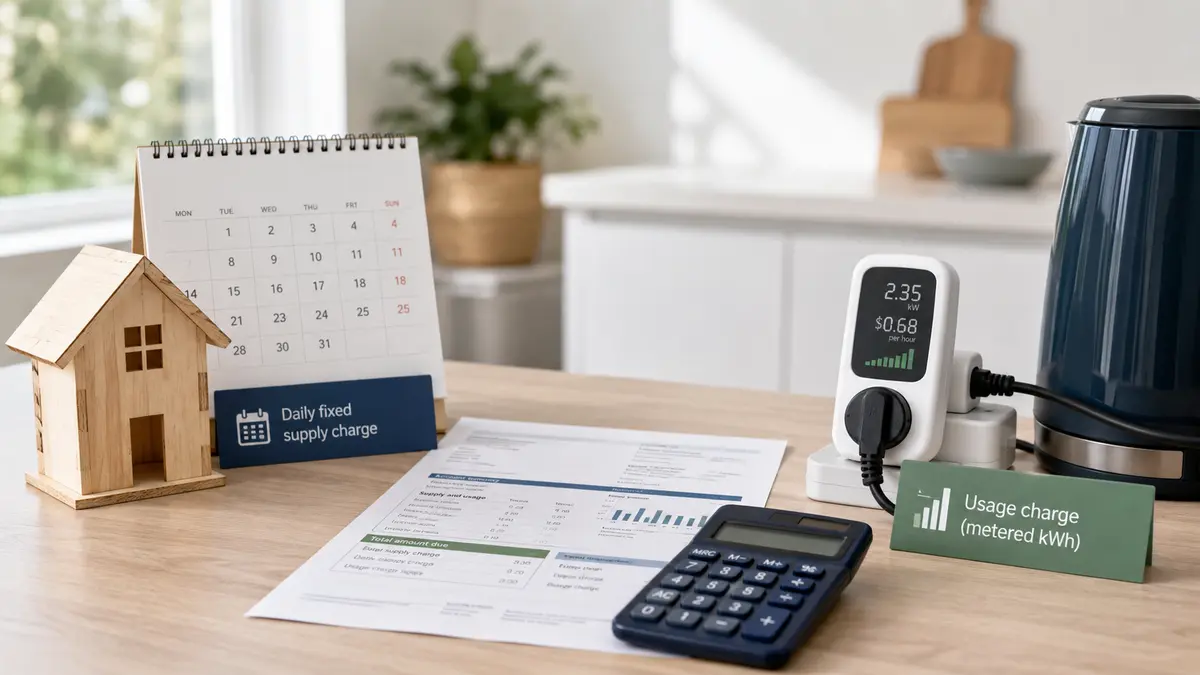
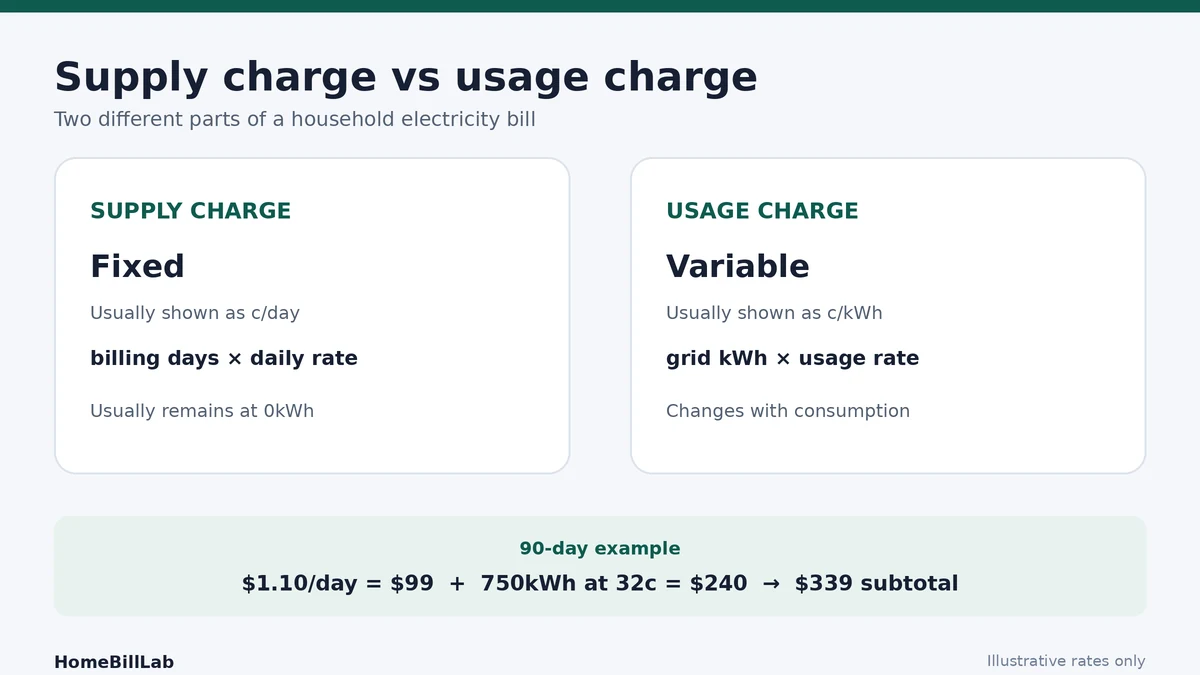
Supply charge vs usage charge: the supply charge is normally a fixed amount applied for each day your property is supplied with electricity, while the usage charge changes with the electricity you take from the grid. One is usually measured in cents per day; the other is measured in cents per kilowatt-hour.
Quick answer: if a 90-day bill has a supply rate of $1.10 per day and 750kWh of usage at 32c/kWh, the supply component is $99 and the usage component is $240. Before credits, discounts, fees or other tariff components, those two charges total $339.
Understanding supply charge vs usage charge helps you read a bill and compare plans fairly. A plan with a lower usage rate can still cost more if its daily charge is high, especially in a low-use home. Enter both figures into the Electricity Bill Calculator Australia instead of comparing only one advertised rate.
Supply charge vs usage charge at a glance
| Feature | Supply charge | Usage charge |
|---|---|---|
| Other common names | Daily supply, service charge, fixed charge, service to property | Consumption charge, variable charge |
| Typical unit | c/day or $/day | c/kWh |
| Main input | Number of billing days | Electricity used from the grid |
| Changes when you use less? | Normally no | Yes |
| Can have multiple rates? | Sometimes, depending on the plan | Yes: single rate, peak, shoulder, off-peak, blocks or controlled load |
The official Energy Made Easy charge guide describes electricity tariffs as having a daily supply charge and a usage charge. It notes that the supply charge can appear as cents per day or as a billing-period total, while electricity usage is generally priced in cents per kWh.
What is an electricity supply charge?
The supply charge is the fixed part of the electricity tariff. It is associated with supplying the connection, rather than the number of kWh the household uses. If the home remains connected for 90 billed days, the daily rate is normally applied for all 90 days—even if grid usage is zero for part of that period.
The Australian Energy Regulator’s energy-bill guide calls this a fixed charge and says it is not based on how much energy you use. The Australian Government also explains that fixed charges can reflect costs associated with grid connection, metering, administration, billing and environmental obligations, although a retail bill may not itemise those elements individually.
The calculation is simple:
Supply cost = daily supply rate ($/day) × billing days
At $1.10 per day, a 30-day period costs $33, a 90-day period costs $99 and a full 365-day year costs $401.50. These are illustrative calculations, not Australian average prices.
What is an electricity usage charge?
The usage charge is the variable part linked to electricity consumed from the grid. It is normally based on kWh and can use one rate or several rates. On a simple single-rate plan:
Usage cost = grid electricity used (kWh) × usage rate ($/kWh)
If the bill records 750kWh at 32c/kWh, convert the rate to $0.32 and calculate 750 × $0.32 = $240. Reducing grid imports by 100kWh at the same rate would reduce this component by $32, before any other plan conditions.
Australian Government guidance on reducing energy bills distinguishes the flat daily connection charge from the variable amount paid for each unit consumed. It also notes that retailer layouts differ and that a bill may show several variable charges.
Worked supply charge vs usage charge example
Assume a household receives a 90-day electricity bill with these inputs:
- Daily supply rate: $1.10/day
- General usage: 750kWh
- Single usage rate: $0.32/kWh
| Component | Calculation | Amount |
|---|---|---|
| Supply charge | 90 days × $1.10/day | $99.00 |
| Usage charge | 750kWh × $0.32/kWh | $240.00 |
| Subtotal | $99 + $240 | $339.00 |
The calculation follows the transparent approach in the HomeBillLab Methodology: rates, units, consumption and time remain visible. The example does not insert a hidden national tariff.
Supply charge vs usage charge for low- and high-use homes
Efficiency measures generally reduce the variable component. Turning off unnecessary appliances, choosing efficient equipment or using less grid electricity does not normally reduce the number of days the property remains supplied. That is why a bill cannot usually fall to zero merely because usage becomes very low.
At $1.10/day, the annual fixed charge remains $401.50 in both of these examples:
- Low grid use: 1,000kWh/year at 32c/kWh creates $320 of usage charges, plus $401.50 supply.
- Higher grid use: 5,000kWh/year at 32c/kWh creates $1,600 of usage charges, plus the same $401.50 supply.
The supply charge therefore represents a larger share of the total in the low-use scenario. This does not mean efficiency is pointless: every avoided kWh still reduces the usage component at the applicable rate.
How tariff type changes supply charge vs usage charge
A simple supply charge vs usage charge comparison can become more detailed when the plan has several variable rows. The official Energy Made Easy tariff guide explains four common electricity structures:
- Single rate: one c/kWh price applies regardless of time.
- Time of use: peak, shoulder and off-peak periods have separate c/kWh prices.
- Controlled load: an eligible appliance on a dedicated circuit has its own rate and may sometimes have an additional supply component.
- Demand tariff: a demand charge is added according to how intensely electricity is drawn in a defined period, commonly measured in kW.
Some plans also use blocks, where successive portions of consumption have different rates. Calculate every row separately. Do not multiply total kWh by the lowest rate on the bill unless that rate genuinely applies to all usage.
Compare two electricity plans using total cost
Consider two illustrative single-rate plans for the same 90-day period:
| Plan | Supply rate | Usage rate |
|---|---|---|
| Plan A | $1.20/day | 28c/kWh |
| Plan B | $0.90/day | 34c/kWh |
At 300kWh for the period, Plan A costs $108 supply + $84 usage = $192. Plan B costs $81 supply + $102 usage = $183. The lower daily charge makes Plan B $9 cheaper.
At 900kWh, Plan A costs $108 + $252 = $360. Plan B costs $81 + $306 = $387. The lower usage rate makes Plan A $27 cheaper. Comparing only 28c with 34c would miss the low-use result; comparing only $1.20 with $0.90 would miss the high-use result.
Calculate the break-even usage between plans
For the two illustrative plans, let x be kWh used over 90 days:
- Plan A total = $108 + $0.28x
- Plan B total = $81 + $0.34x
Set the totals equal: $108 + $0.28x = $81 + $0.34x. The $27 difference in fixed cost divided by the $0.06 difference in usage rate gives 450kWh. Below 450kWh in this 90-day example, Plan B is cheaper; above 450kWh, Plan A is cheaper. At exactly 450kWh, both equal $234.
This break-even method works only after matching the same period and incorporating all relevant tariff rows. Time-of-use, demand charges, controlled loads, discounts and solar feed-in credits can require a more complete comparison.
What changes for a home with solar?
Rooftop solar can reduce electricity imported from the grid, which can lower usage charges. It does not normally remove the daily supply charge while the property remains grid connected. Excess solar exported to the grid may create a separate feed-in credit.
The Australian Government’s guide to electricity pricing plans and tariffs separates fixed charges, variable charges and export credits. When comparing solar plans, include the daily supply rate, import rates, expected exports and feed-in tariff—not just the advertised solar credit.
Which charge can household actions reduce?
Most day-to-day household actions affect the usage charge. For example, reducing air-conditioner runtime or dryer cycles can reduce grid kWh. Use the air-conditioner running-cost guide or clothes-dryer running-cost guide to calculate those variable costs.
The supply charge is changed by the electricity plan, rate and billed period—not by switching off one appliance. When moving house, closing an account or changing connection arrangements, check the retailer’s dates, terms and any separate fees rather than assuming the daily charge stops immediately.
How to compare supply charge vs usage charge between offers
- Use one realistic annual or billing-period consumption figure for every offer.
- Apply each offer’s supply rate to exactly the same number of days.
- Split kWh across peak, shoulder, off-peak or controlled load where required.
- Add demand charges and compulsory fees where applicable.
- Subtract only credits and discounts for which the household is eligible.
- Compare the estimated total, not one headline rate.
- Review benefit periods, expiry dates, payment conditions and what happens after the offer ends.
The Australian Government’s Switch to save guide directs households to official comparison services appropriate to their jurisdiction. A separate government contract checklist recommends asking for the daily supply charge and comparing it over the same number of days as the existing bill.
Common mistakes
- Comparing c/kWh without comparing the daily supply charge.
- Treating a supply charge as if it changes with appliance use.
- Adding a whole-home supply charge to the running cost of one appliance.
- Using one usage rate for a bill containing several tariffs.
- Comparing a 90-day charge with a monthly estimate without converting the period.
- Ignoring GST treatment, fees, expired discounts or conditional benefits.
- Assuming advertised rates are available for every postcode, meter or tariff configuration.
- Subtracting solar credits without checking expected export volume.
If you are checking a real statement, use the companion guide on how to read an electricity bill in Australia to reconcile meter readings, billing days, adjustments and the final amount due.
Frequently asked questions
Do I pay a supply charge if I use no electricity?
Normally yes, while the property remains supplied under the plan. The daily charge is fixed and is not based on kWh consumed. Check the contract and billing dates for the specific account.
Which matters more: supply charge vs usage charge?
No. A higher daily supply charge can offset a lower c/kWh price. Calculate both components using the same number of days and realistic consumption.
Can energy efficiency reduce the supply charge?
Energy efficiency usually reduces the usage component by lowering grid kWh. It does not normally change the daily supply rate, although changing electricity plans may change that rate.
Why are there several usage charges on my bill?
The plan may use time-of-use periods, tariff blocks, a controlled load or different rates before and after a price change. Calculate each line with its matching kWh and rate.
Should an appliance running cost include the supply charge?
Usually no. The supply charge normally remains payable whether that appliance runs or not. For a marginal appliance-cost estimate, use its electricity consumption and the applicable usage rate.
Bottom line
A useful supply charge vs usage charge comparison keeps the fixed and variable parts separate. Multiply the daily rate by billed days, calculate every kWh row at its matching rate, then combine the results with any other plan charges and credits.
Use the Electricity Bill Calculator to test your rates and consumption, or browse the complete Australian electricity guide hub.
Reviewed: 22 August 2026. Examples are transparent scenarios, not live electricity offers or national average rates. Plan availability, tariff names and billing rules can vary by retailer, meter, network area and Australian jurisdiction.