
Solar self consumption explained Australia means using electricity from your rooftop solar system inside your home at the time it is generated, instead of exporting that electricity to the grid. Every kilowatt-hour (kWh) used on site replaces a kWh you would otherwise need to buy from your electricity retailer.
For many Australian households, a self-consumed kWh is worth more than an exported kWh because retail usage rates are commonly higher than solar feed-in tariffs. The exact benefit depends on your electricity plan, when you use energy, your feed-in tariff, solar generation and any export limit. This guide shows how to calculate it without relying on a hidden national tariff.
Reviewed: 2 September 2026. Electricity plans and feed-in tariffs change regularly, so check your current bill and retailer terms before using the examples.
Table of Contents
Solar self-consumption at a glance
| Measure | What it tells you | Simple formula |
|---|---|---|
| Solar generation | Total electricity produced by the solar system | Measured in kWh |
| Solar self-consumption | Solar electricity used at the property as it is generated, or later through a battery | Generation minus exports, adjusted for battery flows where needed |
| Self-consumption ratio | Share of solar generation used on site | Solar used on site ÷ solar generated × 100 |
| Solar self-sufficiency | Share of total household use supplied by solar | Solar used on site ÷ total household use × 100 |
| Solar export | Surplus solar sent to the grid | Recorded by the smart meter |
The Australian Government explains that rooftop solar electricity can be self-consumed, exported, curtailed or used to charge a battery. A household without a battery normally self-consumes solar only when generation and household demand occur at the same time.
Self-consumption versus self-sufficiency
For solar self consumption explained Australia clearly, these two terms must stay separate. The self-consumption ratio asks, “What percentage of my solar generation stayed at the property?” The self-sufficiency ratio asks, “What percentage of my household electricity use was supplied by solar?”
Suppose a home generates 10 kWh of solar during a day, uses 4 kWh of that solar on site and exports 6 kWh. Its self-consumption ratio is 4 ÷ 10 = 40%. If the home used 16 kWh in total that day, its self-sufficiency ratio is 4 ÷ 16 = 25%.
A small system may have a high self-consumption ratio because the household uses nearly everything it produces, yet still have low self-sufficiency because grid imports remain large. A bigger system can produce more total savings while showing a lower self-consumption percentage. Judge system performance using energy amounts, bill value and household goals—not one percentage alone.
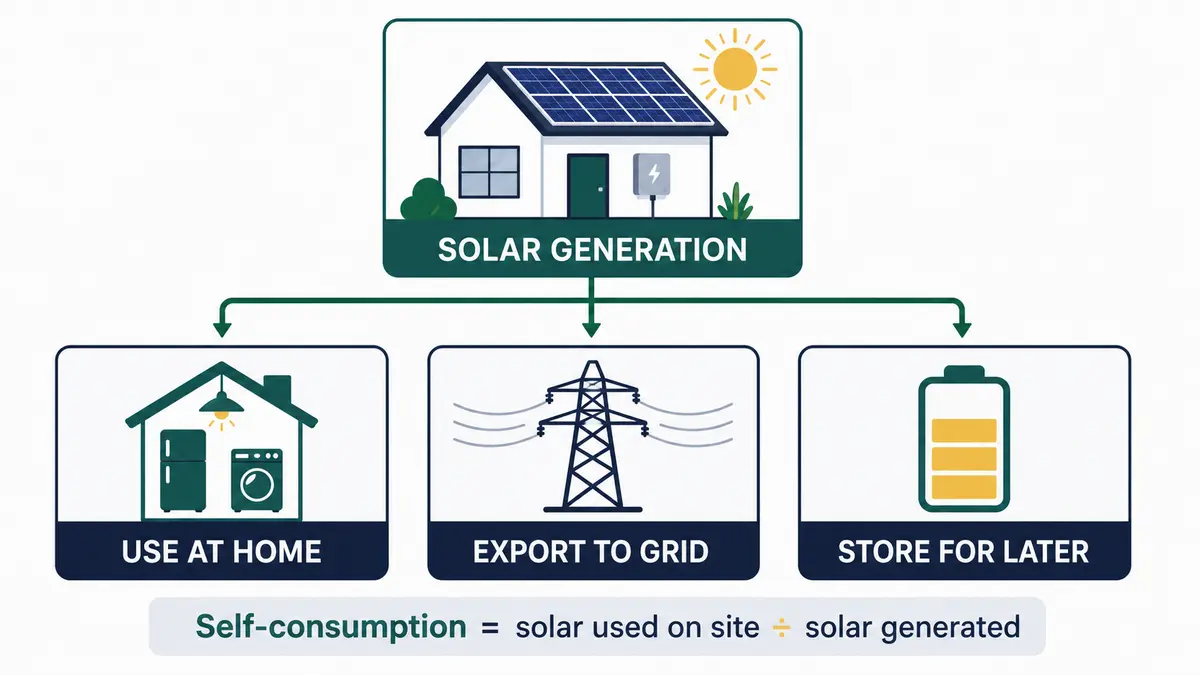
Why using solar at home is often worth more than exporting it
The value of a self-consumed kWh is usually the grid usage charge avoided at that time. The value of an exported kWh is the feed-in tariff credit offered by the electricity plan. Australian Government guidance says feed-in tariffs for new solar customers are generally lower than the retail rate paid for grid electricity, although legacy gross-metering or premium arrangements can work differently.
Value of direct self-consumption = solar used on site × avoided grid rate
Value of exporting = solar exported × feed-in tariff
The Australian Government guide to electricity plans and tariffs also warns that the plan with the highest feed-in tariff is not automatically the best. Supply charges, import rates, time periods, export tiers and eligibility conditions all affect the final bill.
Worked example: shifting four kWh into the solar window
This solar self consumption explained Australia example uses transparent assumptions. The illustrative home generates 20 kWh of solar in one day. Before changing its routine, it directly uses 7 kWh and exports 13 kWh. Its self-consumption ratio is 7 ÷ 20 = 35%.
The household then moves 4 kWh of flexible use—such as a dishwasher, washing machine, pool pump or suitable vehicle charging—from evening to its actual solar-generation window. Direct solar use rises to 11 kWh and exports fall to 9 kWh. The new ratio is 11 ÷ 20 = 55%.
| Illustrative input | Before shifting | After shifting |
|---|---|---|
| Solar generation | 20 kWh | 20 kWh |
| Solar used directly | 7 kWh | 11 kWh |
| Solar exported | 13 kWh | 9 kWh |
| Self-consumption ratio | 35% | 55% |
Assume, only for this example, an avoided import rate of 32 cents per kWh and a feed-in tariff of 6 cents per kWh. Each shifted kWh gains 26 cents in bill value: $0.32 avoided import minus $0.06 of forgone export credit. Shifting 4 kWh therefore adds $1.04 for that day. These rates are not Australian averages or forecasts; replace them with the rates and time periods on your own plan.
Use the Solar & Battery Savings Calculator to test your own imports, exports and tariffs. HomeBillLab calculations follow the transparent assumptions described in the HomeBillLab Methodology.
How to calculate your actual solar self-consumption
For solar self consumption explained Australia with household data, you need solar generation and grid exports for the same period. A solar inverter app may show generation. A smart meter records electricity imported from and exported to the grid. Some monitoring systems combine generation and household consumption in one view.
- Choose a consistent period, such as a complete billing period or calendar month.
- Record total solar generation from the inverter or monitoring platform.
- Record exported solar from the retailer bill, meter portal or monitoring platform.
- For a simple solar-only system, calculate solar used on site as generation minus exports.
- Divide solar used on site by solar generation and multiply by 100.
- Repeat by season because winter and summer results can be very different.
A retailer bill by itself is often not enough. The government’s solar monitoring guidance notes that a bill may show feed-in credits for exports but not the savings created by electricity consumed directly behind the meter. If a battery is present, use a monitoring platform that separately reports solar generation, direct household use, battery charging, battery discharge, grid imports and exports. Simple subtraction can otherwise misclassify battery energy or losses.
Practical ways to increase self-consumption
The aim is not to switch on every appliance at noon. It is to move suitable flexible loads into periods when your panels are producing enough power, without creating unnecessary demand spikes or wasting energy. The Australian Government recommends checking your monitoring app because the best window depends on location, season, weather, orientation and shading.
- Use built-in timers: schedule the dishwasher, washing machine or clothes dryer for a sunny period when the manufacturer allows unattended operation.
- Stagger large loads: run appliances one after another when possible. If simultaneous demand exceeds solar output, the difference still comes from the grid.
- Schedule pool equipment: align a pool-pump timer with reliable solar output while preserving required filtration time.
- Charge an electric vehicle deliberately: use compatible scheduling or smart charging and a rate that does not regularly exceed available surplus solar.
- Pre-cool or pre-heat sensibly: a reverse-cycle air conditioner may use daytime solar, but insulation, thermostat settings and comfort still matter.
- Review electric hot water: solar timing can help some systems, but a controlled-load tariff may already be inexpensive and a high-power element can exceed solar output.
The official guide on getting the most from rooftop solar lists daytime appliance use, monitoring and electricity-plan comparison as key steps. Any change to fixed wiring, hot-water circuits, switchboards or solar equipment should be handled by appropriately licensed professionals; do not alter electrical connections yourself.
How tariffs change the calculation
Tariffs are essential to solar self consumption explained Australia because the same kWh can have a different bill value under different plans. On a single-rate plan, each directly self-consumed kWh generally avoids the same usage rate. On a time-of-use plan, the value depends on the import period displaced. Midday solar might replace a shoulder or off-peak kWh, while stored solar used in the evening might replace a higher peak-rate kWh. Battery losses and purchase cost must still be included.
Demand tariffs need additional care. Solar may reduce a measured demand peak only if it is generating when that peak occurs. Moving several appliances into one short interval can create a new grid demand peak when clouds reduce output. Compare the complete plan, including daily supply charge, all import periods, demand charges, feed-in tariff and any export tiers.
Households in eligible competitive markets can use Energy Made Easy; Victoria has its own government comparison service. When comparing, use a recent bill and realistic import and export data rather than selecting a plan on its headline feed-in tariff alone. The HomeBillLab guide to single rate versus time of use explains the broader tariff trade-off.
Can a battery increase solar self-consumption?
For solar self consumption explained Australia with storage, the important point is that energy moves to a later time rather than becoming free. A battery can store surplus daytime solar for later use, increasing the share of generation consumed at the property. It can also support time-of-use optimisation or backup if the system is designed for those purposes. However, higher self-consumption does not automatically mean the battery is financially worthwhile.
The financial calculation must include net installed cost, usable capacity, charge and discharge power, round-trip efficiency, degradation, warranty conditions, expected cycles, avoided import rates and the export credits given up. The Australian Government’s battery guidance says a battery makes most sense when the household already has enough excess solar to charge it and cautions that cost may outweigh financial benefits for some homes.
Before buying, read the solar battery payback guide and check whether the current Cheaper Home Batteries Program applies to the proposed installation. Treat rebates and battery savings as separate inputs: a discount lowers cost, but it does not guarantee payback.
System size, export limits and curtailment
A larger solar system usually produces more electricity, but it may also export more if daytime household demand is low. That does not automatically make it a bad design: extra generation can still have value, and future electrification or a battery may change the load profile. The official guide to sizing a solar system recommends considering roof space, electricity use and timing, grid prices, feed-in tariffs, climate and budget together.
Network export limits can restrict how much surplus electricity is sent to the grid. Some generation may be curtailed when the limit is reached. Your connection agreement and equipment settings matter; the government’s solar connection guidance explains that a smart meter measures imports and exports and that network approval is part of connecting a system. Ask the installer to explain any fixed or dynamic export limit in writing.
Common mistakes to avoid
- Using the bill’s export figure as total generation: exports exclude solar consumed behind the meter.
- Confusing kW with kWh: kW is power at a moment; kWh is energy over time.
- Assuming a high percentage means maximum savings: a tiny system can have 100% self-consumption but produce little energy.
- Using one national tariff: plans, time periods and feed-in rates vary by location and retailer.
- Ignoring lost export credit: shifting or storing a kWh gains the avoided import value but gives up the feed-in credit it would have earned.
- Buying a battery only to raise the ratio: assess net savings, cost, efficiency and usable throughput.
- Changing fixed electrical equipment yourself: use accredited or licensed professionals where required.
Frequently asked questions
What is a good solar self-consumption percentage?
There is no single target for every Australian home. A useful result is one that improves total bill value without unnecessary consumption or poor tariff choices. Compare kWh, dollars and seasonal patterns as well as the percentage.
Can my electricity bill show solar self-consumption?
Usually not by itself. The bill records grid imports and exports, while electricity used directly from solar stays behind the meter. Combine bill or smart-meter export data with inverter generation data, or use a monitoring system that measures both.
Does exporting solar count as self-consumption?
No. Exported electricity is sent to the grid and may earn a feed-in tariff. Self-consumed electricity supplies the property directly or, under common accounting, returns from a solar-charged battery for on-site use.
Does a battery give 100% self-consumption?
Not necessarily. Battery capacity, power limits, state of charge, losses, household demand, export settings and seasonal generation affect the result. Some surplus may still be exported or curtailed.
Bottom line
Solar self consumption explained Australia comes down to matching household electricity use with rooftop solar generation and valuing each kWh with the correct tariff. Calculate solar used on site, divide it by total generation, and then compare avoided import value with the feed-in credit forgone.
Start with monitoring and low-cost load shifting, compare the whole electricity plan, and test battery economics separately. Use the Solar & Batteries hub for related Australian guides and the calculator for household-specific scenarios.
Reviewed: 2 September 2026. High-freshness guide; review quarterly and sooner after a material electricity-tariff, feed-in-tariff or solar-policy change.