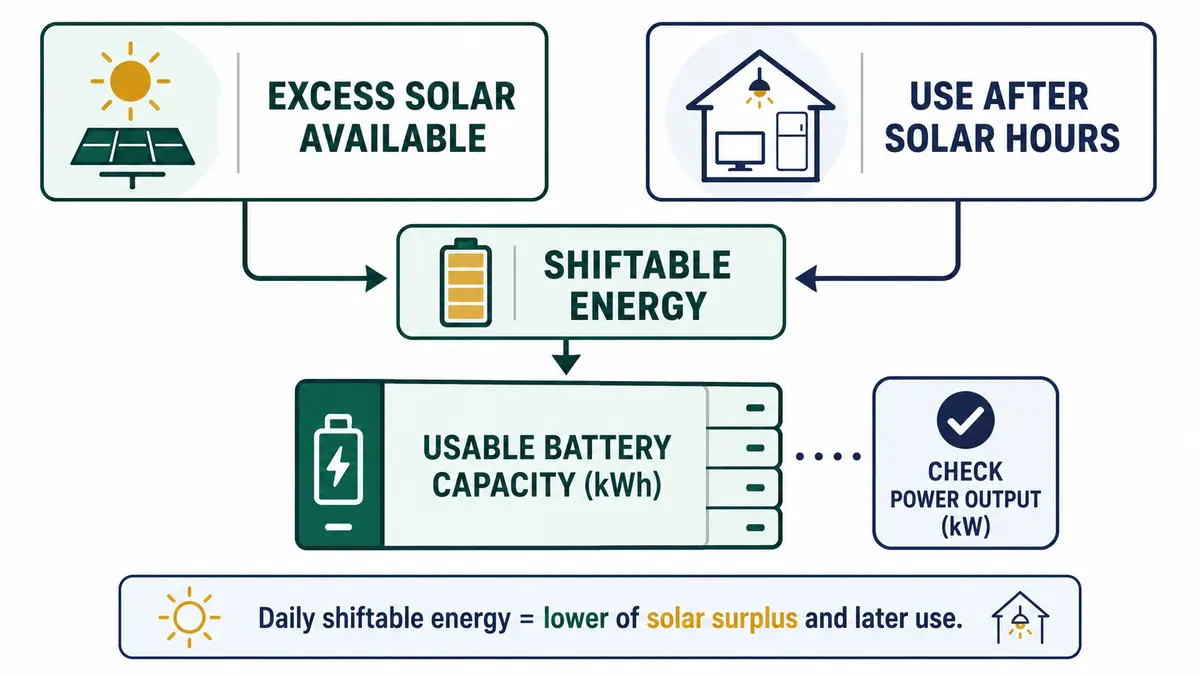
What size solar battery do I need Australia is best answered from your household’s energy timing, not from the size of the home or solar array alone. For bill savings, compare the surplus solar available to charge a battery with the electricity you normally buy after solar generation falls. The useful daily amount is usually limited by the smaller of those two figures.
Battery capacity is measured in kilowatt-hours (kWh), while power output is measured in kilowatts (kW). You need enough usable kWh for the energy you want to shift or reserve, and enough kW to operate the intended appliances at the same time. Backup requirements, tariff strategy, efficiency losses, future electrification and cost can all change the answer.
Reviewed: 2 September 2026. Battery products, incentives and electricity plans change, so verify specifications, program settings and quote assumptions before purchase.
Table of Contents
Battery sizing at a glance
| Question | Why it matters | Best evidence |
|---|---|---|
| How much surplus solar is available? | A solar-charged battery cannot regularly store energy that your system does not produce after household use. | 12 months of exports and solar monitoring |
| How much energy is used later? | Capacity above the electricity you can realistically displace may sit unused on many days. | 15- or 30-minute interval data |
| Is the goal savings or backup? | Backup may require a protected reserve, critical-circuit design and additional hardware. | Written load and outage plan |
| What is the usable capacity? | Nominal capacity is not necessarily the amount available to the home. | Product data sheet and approved-product listing |
| What is the continuous power output? | Capacity can be adequate while the battery still cannot run all simultaneous loads. | System specification and site design |
Australian Government guidance says household batteries commonly have capacity from about 4 kWh to 14 kWh. That describes a typical market range, not a recommendation. The same guidance says a battery is useful only when there is excess electricity to store and that larger morning or evening use may require more capacity. See the official overview of home battery size, power and operation.
Start by deciding what the battery must do
For what size solar battery do I need Australia, write down the primary objective before comparing products. One battery can serve several purposes, but the sizing logic is different for each.
- Increase solar self-consumption: store daytime surplus and use it after solar output falls.
- Reduce peak-rate imports: discharge during expensive tariff periods, whether charged by solar or, where suitable, from low-cost grid electricity.
- Provide backup: reserve energy for selected circuits or whole-home loads during an outage, if the system is designed and configured for backup.
- Reduce demand peaks: provide sufficient power at the right time under a demand tariff.
- Prepare for future loads: account for a planned electric vehicle, heat pump, induction cooking, pool equipment or increased air-conditioning use.
A bill-savings system does not automatically provide blackout protection. The Australian Government notes that batteries need appropriate configuration and that some systems back up only selected circuits or one phase. Ask what will keep operating, for how long, and at what maximum power—not merely whether “backup” is included.
Capacity in kWh versus power in kW
Battery capacity is the energy it can hold, measured in kWh. Battery power output is the rate at which it can deliver that energy, measured in kW. A water-tank analogy helps: capacity is the tank volume, while power is the flow rate through the outlet.
Suppose a battery has 10 kWh of usable capacity and a continuous output of 5 kW. It may have enough stored energy for several hours of modest household use, but simultaneous appliances demanding more than 5 kW will require grid support in normal grid-connected operation or may overload the backup system during an outage. Check continuous power, short-duration surge capability, per-phase limits and whether quoted power is shared with the solar inverter.
Capacity also does not determine duration by itself:
Approximate operating time = available battery energy (kWh) ÷ average load (kW)
For example, 6 kWh available to a steady 1 kW load is a simple six-hour energy estimate. Real results change with inverter losses, varying loads, reserve settings, temperature, battery controls and minimum state of charge.
Usable capacity versus nominal capacity
Nominal capacity is the maximum energy stored at full charge. Usable capacity is the portion the system allows to be discharged after accounting for its permitted depth of discharge. For sizing comparisons, usable capacity is generally the more relevant consumer figure.
The Australian Government’s Cheaper Home Batteries Program eligibility guidance gives a clear example: a 10 kWh nominal battery at 90% depth of discharge has 9 kWh usable capacity. The YourHome battery guide also distinguishes nominal capacity, usable capacity, depth of discharge and round-trip efficiency. Compare like with like because product data may report values at the battery-module, DC or AC system boundary.
Do not subtract depth of discharge twice. If a quote already states usable capacity, that figure normally incorporates the permitted depth of discharge. A separate backup reserve or minimum state-of-charge setting can then reduce how much of that usable capacity is available for everyday tariff shifting.
The best data: 12 months of interval usage
For a defensible what size solar battery do I need Australia estimate, use 12 months of 15- or 30-minute interval data where possible. A quarterly bill’s average daily consumption does not reveal whether electricity was used while solar was generating or later when a battery could help.
The government’s solar-sizing guidance recommends requesting 12 months of interval data from the distribution network service provider. It explains that smart meters record both how much electricity is used and when. Review the official advice on using interval data and considering future electricity needs.
- Download at least 12 months of interval imports and exports, if available.
- Collect matching solar generation data from the inverter or monitoring platform.
- For each day, total surplus solar exported during the likely charging window.
- Total grid imports during the period you want the battery to cover, such as late afternoon through morning.
- For bill-saving solar shifting, take the lower of available surplus and later grid use as the starting daily shiftable energy.
- Review the distribution across days and seasons rather than relying only on one annual average.
- Adjust scenarios for efficiency, backup reserve, tariff periods and realistic operating controls.
The official guide to monitoring solar and batteries explains that detailed systems can show generation, battery charge and discharge, household use, grid imports and exports. Confirm whether the exported and imported data are measured on the same time basis and whether any existing battery flows are already included.
A worked battery-sizing example
This example demonstrates the method; it is not an Australian recommendation. A solar home reviews a full year of interval data. Across a representative group of usable days, it often exports about 8 kWh after meeting daytime household demand and imports about 6 kWh from late afternoon to the next solar window.
| Input | Illustrative value | Meaning |
|---|---|---|
| Surplus solar available | 8 kWh/day | Maximum charging source before battery losses |
| Later grid imports | 6 kWh/day | Energy the household may be able to displace |
| Starting shiftable energy | 6 kWh/day | Lower of surplus and later use |
| Illustrative round-trip efficiency | 90% | Requires about 6.67 kWh charging energy to deliver 6 kWh |
| Optional backup reserve | 20% | Leaves 80% of usable capacity for routine cycling |
If the household wants 6 kWh available for routine discharge while preserving 20% of usable capacity for backup, the simple capacity screen is 6 ÷ 0.80 = 7.5 kWh usable. It could compare products around that usable-capacity point, then model alternatives above and below it. The battery also needs enough charge power to absorb the intended surplus and enough discharge power for the chosen loads.
Now test value. Assume an import rate of 32 cents/kWh, a feed-in tariff of 6 cents/kWh and 90% round-trip efficiency. Delivering 6 kWh avoids $1.92 of imports but requires about 6.67 kWh of solar charging energy, giving up about $0.40 of export credit. The simplified gross daily gain is about $1.52. These are demonstration rates, not national averages, and the estimate excludes standing losses, degradation, finance, maintenance and future tariff changes.
Enter your own energy and tariff assumptions in the Solar & Battery Savings Calculator. The HomeBillLab Methodology explains why scenarios should show inputs instead of hiding them inside one promised saving.
Size for bill savings, not maximum storage
For savings, a battery that regularly charges and discharges useful energy can be more valuable per dollar than a larger unit that remains partly empty or full. Oversizing can increase upfront cost without proportionally increasing displaced imports. Undersizing may leave evening imports and excess solar available, but a smaller system can still have stronger utilisation and payback.
Australian Government guidance on how batteries reduce bills notes that a battery can increase self-consumption and use time-of-use price differences, but may not repay its cost within its lifetime for every household. Read the HomeBillLab solar self-consumption guide first, then use the solar battery payback guide to test net installed cost and lifetime assumptions.
Sizing for backup power
Backup sizing begins with an essential-load plan, not total household daily use. List the circuits or appliances that must operate, estimate their energy use over the intended outage duration, and identify the highest likely simultaneous power. Decide whether solar can recharge the battery during an outage and whether the system can operate as an islanded system.
Backup energy required ≈ essential-load kWh × desired duration, adjusted for reserve and system losses
A battery with enough kWh may still be unable to start or run high-power equipment. Three-phase homes also need a clear written explanation of which phases and circuits are backed up. Whole-home backup, selected-circuit backup and solar-recharge capability are materially different designs with different hardware and costs. Have an accredited battery designer and licensed electrician verify the load calculation and installation.
Future loads and modular expansion
Future electrification can increase both energy and power needs. Estimate the expected timing of electric-vehicle charging, hot water, heating, cooling and cooking rather than adding an arbitrary percentage. Some new loads can run directly from daytime solar and may not need extra battery capacity; others occur after sunset and may increase the useful storage opportunity.
Modular systems can offer flexibility, but later expansion is not guaranteed. Check module compatibility, maximum stack size, inverter limits, warranty treatment, installer costs and whether adding modules requires re-certification. Current federal support rules also matter: the DCCEEW guidance says support is generally available only the first time a battery is installed, added to or replaced at a premises. See the current Cheaper Home Batteries Program guide before assuming a future module will receive another discount.
How rebates should affect the decision
A rebate changes net price; it does not change the household’s underlying load profile. Do not choose a larger system solely because more supported capacity appears available. As reviewed on 2 September 2026, eligible federal-program systems can range from 5 to 100 kWh nominal capacity, while STCs are limited to the first 50 kWh of new or added usable capacity. Those are program boundaries, not household-sizing recommendations.
The Clean Energy Regulator’s solar-battery SRES guidance and the DCCEEW eligibility page should be checked near installation. Product, installer, solar-connection and certification requirements can affect eligibility independently of whether the size suits your energy use.
Questions every battery quote should answer
- What 12-month usage, export and solar-generation data were used?
- What goal does the proposed size serve: savings, backup, tariff shifting or future loads?
- What are nominal capacity, usable capacity and the everyday usable amount after any backup reserve?
- What are continuous charge and discharge power, surge capability and phase limitations?
- What round-trip efficiency boundary is quoted: cell, DC system or AC system?
- How many full-equivalent cycles and how much annual throughput are assumed?
- How often is the model expected to reach full charge and minimum state of charge by season?
- Which circuits operate during an outage, and can solar recharge the battery while islanded?
- What tariff, feed-in rate, degradation and future-price assumptions underpin the savings?
- What switchboard, inverter, gateway, metering, network and installation work is included?
The government’s guide to choosing a solar retailer and installer recommends obtaining quotes from at least three suppliers and comparing the proposed size with an independent estimate. It also says quotes should identify equipment, site design, costs, rebates, expected output or savings, assumptions, payback, network limits and warranties.
You can obtain an independent solar-and-battery estimate from SunSPOT, which is a not-for-profit calculator developed by photovoltaic engineers and supported by Australian Government partnership. Use it as a cross-check, then ask each supplier to explain material differences in writing.
Common sizing mistakes
- Matching battery kWh to solar-panel kW: these measure different things and do not create a direct one-to-one sizing rule.
- Using total daily consumption: daytime loads may already be supplied directly by solar and may not need battery energy.
- Using one sunny day: cloudy periods, winter generation and seasonal loads can produce a different result.
- Ignoring power output: adequate stored energy does not guarantee the system can run simultaneous loads.
- Confusing nominal and usable capacity: compare the amount actually available under the proposed settings.
- Ignoring efficiency and export credits: charging requires more energy than is later delivered and uses solar that may otherwise earn a feed-in tariff.
- Assuming backup is automatic: blackout operation requires suitable equipment, configuration and circuit design.
- Buying to maximise a rebate: incentive limits are not evidence of the right household size.
Frequently asked questions
What size solar battery do I need Australia for a 6.6 kW solar system?
The panel rating alone is not enough. Two homes with 6.6 kW solar can have very different exports, evening use, shading, climate, tariffs and backup goals. Use 12 months of interval imports, exports and generation to estimate daily shiftable energy.
Should battery capacity equal my average daily electricity use?
Usually not as a simple rule. Some daily use occurs while solar is generating and may already be self-consumed. Size the bill-saving portion against surplus solar and the grid imports the battery can realistically displace.
Is a bigger solar battery always better?
No. More capacity can support greater loads or backup, but may cost more and cycle less fully. Compare several usable-capacity scenarios by annual value, backup performance and net installed cost.
How much battery capacity should I reserve for backup?
There is no universal percentage. The reserve depends on essential loads, desired outage duration, local outage risk, whether solar can recharge during an outage and how much everyday bill saving you are willing to give up.
Bottom line
What size solar battery do I need Australia is a household-data question. For solar shifting, start with the lower of surplus solar and later grid use, examine seasonal distributions, adjust for usable capacity, efficiency and reserve, and verify that the battery’s kW output meets intended loads.
Model more than one size, compare net installed cost and do not treat common capacity ranges or rebate limits as recommendations. Browse the Solar & Batteries hub for related guides and have the final design checked by an appropriately accredited installer and licensed electrician.
Reviewed: 2 September 2026. High-freshness guide; review quarterly and sooner after a material battery-program, product-market or electricity-tariff change.