Electric hot water running cost depends on the system’s electricity use, the tariff that applies and the amount of hot water the household uses. The most reliable shortcut is annual kWh from a model document, meter or defensible estimate multiplied by the relevant electricity rate.
Quick answer: a conventional electric system using 2,500kWh per year costs $800 at 32c/kWh or $500 at 20c/kWh. Those are illustrative tariff scenarios, not national averages. Actual consumption can be higher or lower because of tank heat loss, climate, water use, temperature settings, pipe losses and system control.
Use the Hot Water Running Cost Calculator Australia to calculate electric hot water running cost from either known annual energy or daily water use. Enter your own tariff rather than accepting a hidden national price.
Electric hot water running cost examples
The table holds annual energy at 2,500kWh and changes only the electricity tariff. This isolates the price effect.
| Electricity tariff | Annual energy | Annual cost | Monthly equivalent |
|---|---|---|---|
| 20c/kWh | 2,500kWh | $500 | $41.67 |
| 25c/kWh | 2,500kWh | $625 | $52.08 |
| 32c/kWh | 2,500kWh | $800 | $66.67 |
| 40c/kWh | 2,500kWh | $1,000 | $83.33 |
A lower controlled-load rate can reduce the cost of the same kWh, but it may come with separate supply components, metering conditions or restricted heating times. Compare the whole plan and confirm that the system is connected to the tariff being used.
First identify the type of electric hot water system
“Electric hot water” can describe different technologies. Do not give them the same efficiency or running-cost assumption.
- Conventional electric storage: a resistive element heats water in an insulated tank. Energy is also required to replace heat lost while water is stored.
- Electric instantaneous: high electrical power heats water as it flows. There is no tank standing loss, but tariff access and demand charges may differ.
- Heat pump: electricity runs a refrigeration cycle that moves heat into the water. This is not equivalent to direct resistance heating.
- Solar hot water with electric boost: the booster is only part of the system’s energy balance and should not be treated as a conventional electric-only tank.
The Australian Government’s hot-water systems guide distinguishes storage and instantaneous designs and states that heat pumps use much less electricity than conventional electric hot water. This guide focuses mainly on direct electric resistance systems; heat-pump calculations need their own energy or performance inputs.
Method 1: calculate from known annual kWh
If a model document, submeter, controlled-load register or credible monitoring record gives annual kWh, use:
Annual cost = annual electricity use (kWh) × tariff ($/kWh)
For 2,500kWh/year at 32c/kWh: 2,500 × $0.32 = $800/year. At 20c/kWh: 2,500 × $0.20 = $500/year. The $300 difference comes from the tariff assumption; annual energy is unchanged.
Known annual kWh is often the cleaner input because it can already reflect reheating and storage behaviour. Check what the figure includes, the test or monitoring period and whether it represents the same climate, household pattern and control schedule.
Method 2: calculate from daily hot-water use
When annual electricity use is unknown, estimate the heat delivered to the water:
Thermal energy (kWh) = litres × temperature rise (°C) × 4.186 ÷ 3,600
Then account for the assumed delivered-system factor:
Electrical input (kWh) = thermal energy ÷ assumed factor
For an illustrative 150L/day heated through 40°C, thermal energy is about 6.98kWh/day. With a 90% delivered-system factor, electrical input is about 7.75kWh/day. At 32c/kWh, that is approximately $2.48/day, $74.40 for 30 days and $905.20 across 365 days.
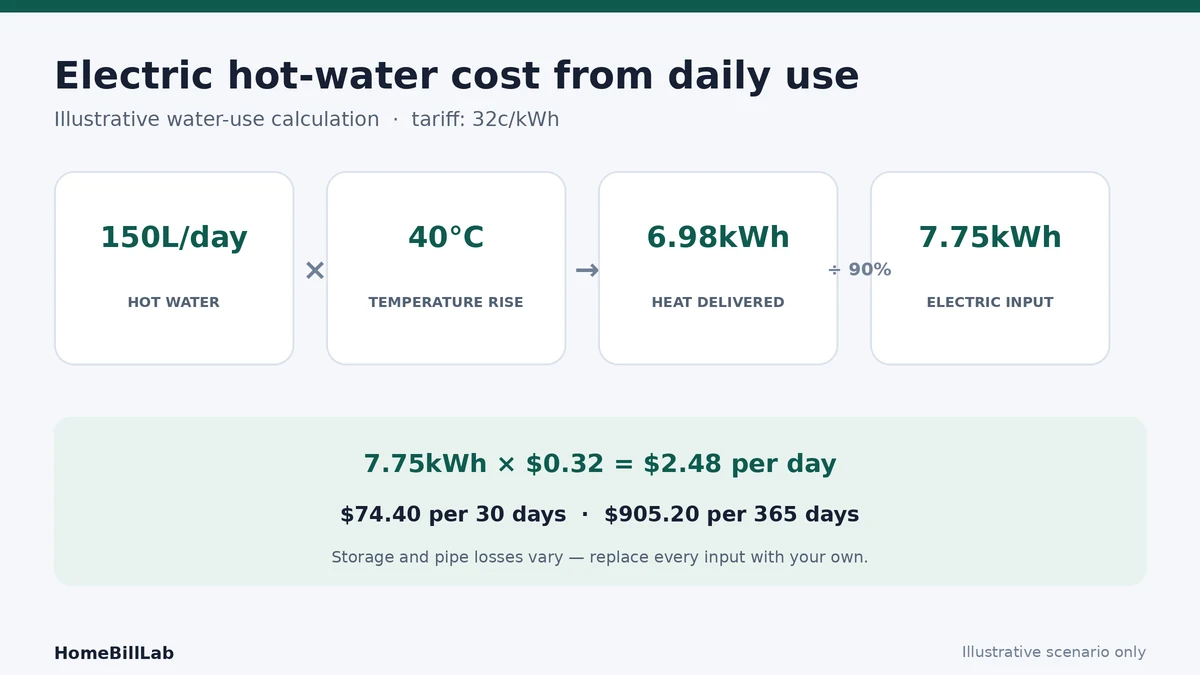
The 90% factor is an example, not a universal rating. A real storage system has standby and distribution losses, and household draws are not perfectly uniform. Use the calculator to test a range rather than presenting one estimate as guaranteed electric hot water running cost.
Why storage-tank losses matter
A resistive element can turn electrical input into heat efficiently at the element, yet the whole service can still consume substantially more electricity than the useful heat delivered at the taps. Heat escapes from the tank, fittings and hot-water pipes, and cold replacement water must be reheated.
The official Energy Rating water-heating guide explains that electric storage tanks reheat after draw-off and temperature loss. It also notes that electric storage water heaters must meet Minimum Energy Performance Standards but do not have to display an Energy Rating Label.
YourHome hot-water guidance says heat loss from a storage tank and associated fittings and pipes can be up to one third of total system energy consumption. Do not automatically add one third to every model; treat it as evidence that storage loss is material and use model-level or measured data where possible.
Rated power is not the same as daily energy
A tank might have a 3.6kW heating element, but 3.6kW is power at a point in time—not daily consumption. If the element draws that power for two total hours, it uses 7.2kWh. If it operates for four hours, it uses 14.4kWh.
Thermostats cycle the element according to water temperature and availability of power. Restricted tariffs may permit heating only during selected periods. Unless runtime is measured or reliably estimated, rated power multiplied by 24 hours will badly overstate typical energy use.
Controlled load and off-peak hot water
A controlled load places an eligible appliance, often electric storage hot water, on a dedicated circuit that may be separately metered. The retailer supplies that circuit during defined periods, often at a lower usage rate than general household electricity.
Energy Made Easy’s current controlled-load guide says these charges normally appear separately on the bill and use different names across states and retailers. It also warns that changing metering or wiring may involve a cost and requires qualified electrical work.
The Australian Government’s energy-bill reduction guide notes that larger electric storage systems may use off-peak heating, but availability depends on the system and provider. Use the exact controlled-load rate and any related daily charge from the plan.
Find hot-water charges on the electricity bill
If hot water is separately metered, look for labels such as controlled load, dedicated circuit, off-peak or a jurisdiction-specific tariff name. Multiply that row’s kWh by its own rate. Do not use the general usage rate merely because it is easier to find.
The Australian Energy Regulator’s bill guide explains that separately metered storage hot water can appear as an off-peak tariff. It also separates variable usage charges from the fixed daily supply charge.
Do not allocate the whole-home supply charge to electric hot water running cost unless the connection exists only for that service. For an appliance-level estimate, count charges that change because the hot-water system runs. The guides on how to read an electricity bill and supply charge vs usage charge explain the distinction.
Storage vs instantaneous electric hot water
Instantaneous electric systems avoid tank standing losses because they heat only when water flows. That does not guarantee a lower bill. They can have very high power demand and may be unable to use a storage-style controlled-load schedule.
YourHome states that electric instantaneous systems can require high electrical input and may need three-phase supply. On a demand tariff, a high simultaneous draw can also affect demand charges. Compare annual kWh, applicable tariff, connection requirements and household flow needs—not tank loss alone.
How rooftop solar changes the calculation
If a controllable storage system heats during solar production, some electricity may come directly from rooftop PV instead of the grid. Separate the energy into solar self-consumption and grid imports. Value grid imports at the applicable retail rate and consider the feed-in credit forgone when solar is diverted from export.
“Powered by solar” does not automatically mean zero economic cost or zero grid use. Cloud, season, control settings, household demand and tank reheating times affect the mix. Use measured solar and grid data where possible.
What changes electric hot water running cost?
- Hot-water volume: more litres require more heat.
- Temperature rise: colder incoming water or a higher target increases energy required.
- Tank and pipe losses: location, insulation, fittings and pipe length affect heat loss.
- System type: resistance, instantaneous and heat-pump technologies use electricity differently.
- Tank size and draw pattern: oversizing can increase standing loss, while undersizing may cause shortages or boost operation.
- Tariff: general, time-of-use and controlled-load rates can produce different costs for the same kWh.
- Solar timing: heating while solar is available can reduce grid imports.
- Condition and maintenance: faults, sediment, damaged insulation or control issues can affect performance and safety.
Practical ways to reduce electric hot water running cost
- Reduce unnecessary hot-water use and repair leaking hot taps.
- Use a suitable water-efficient showerhead to reduce both water and heating demand.
- Choose a system sized for the household, climate and usage pattern.
- Check whether a controlled-load or solar-aligned schedule is compatible with the system and plan.
- Insulate accessible hot-water pipes where appropriate and permitted.
- Maintain the system according to manufacturer instructions and use qualified tradespeople.
- Compare annual kWh and total ownership cost before replacement.
- Plan replacement before an urgent failure forces a rushed purchase.
The Australian Government’s quick-wins guide recommends water-efficient showerheads and planning an efficient replacement. It also gives safety-related temperature guidance. Do not alter thermostats, wiring, valves or plumbing as a DIY cost-saving experiment; follow the manufacturer and use appropriately licensed tradespeople.
Compare replacement options fairly
Running cost is only one part of a replacement decision. Compare installed cost, annual energy, tariff access, household size, climate suitability, noise, space, maintenance, warranty and expected service life. Rebate eligibility and amounts can change, so check the current official program before treating support as confirmed.
Conventional electric storage may have a lower purchase price but higher electricity use. A heat pump can use much less electricity but has different upfront cost, operating conditions and installation requirements. Keep the inputs for each option consistent and avoid claiming a universal payback.
Frequently asked questions
How do I calculate electric hot water running cost?
Multiply annual electricity use in kWh by the applicable tariff in dollars per kWh. If annual energy is unknown, estimate energy from litres, temperature rise and a clearly stated system-loss assumption.
Is electric storage hot water always on?
The tank keeps water available, but the element does not necessarily draw full power continuously. A thermostat cycles heating, and a restricted tariff may allow operation only during selected periods.
Can I use the element’s kW rating as daily consumption?
No. The kW rating is power while the element operates. Daily kWh requires total operating time, or preferably measured or model-level energy data.
Is controlled-load electricity always cheaper?
The usage rate is often lower, but access, heating windows, metering and additional charges vary. Compare the complete plan and confirm the hot-water system is actually connected to that circuit.
Does rooftop solar make electric hot water free?
Not automatically. Solar may reduce grid imports, but generation timing, other household loads and foregone export credits still matter. Measure or model the solar and grid portions separately.
Bottom line
A defensible electric hot water running cost uses annual kWh where available, or a transparent water-use calculation with explicit temperature and loss assumptions. Apply the correct general or controlled-load tariff and do not confuse rated power with daily energy.
Use the Hot Water Running Cost Calculator, review the calculation rules in the Methodology, or browse the complete Australian hot-water guide hub.
Reviewed: 22 August 2026. The scenarios are calculation examples, not quotes, national averages or installation advice. Electrical and plumbing work must be performed by appropriately qualified and licensed professionals.