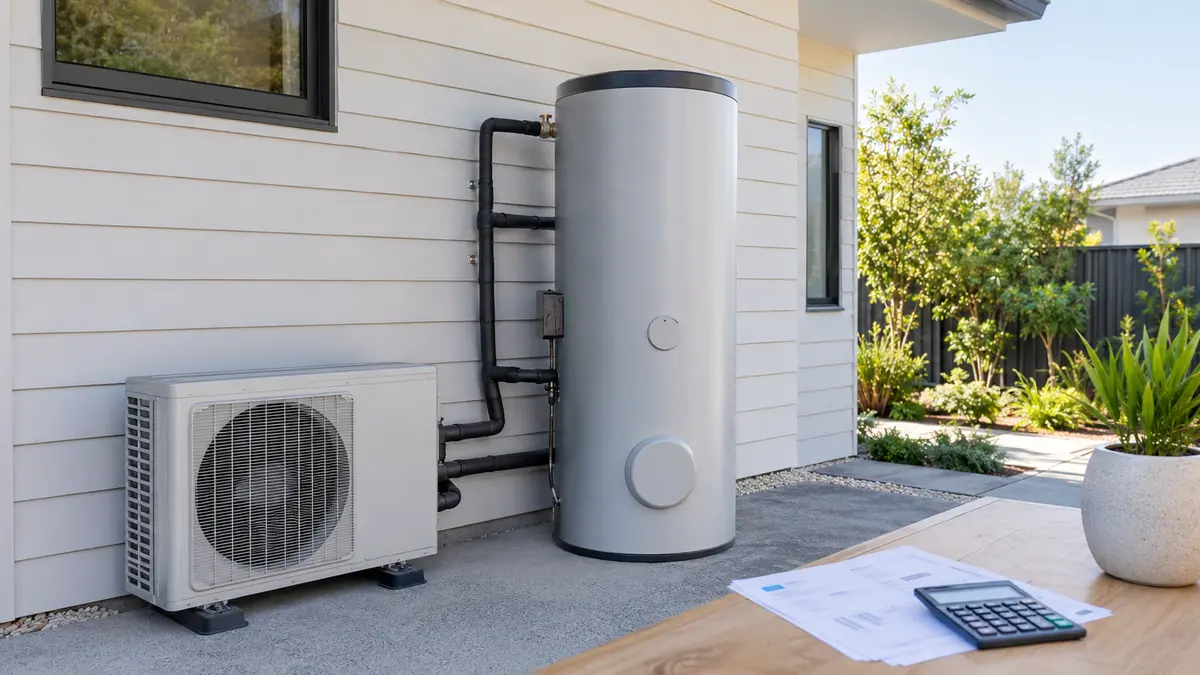
Heat pump hot water running cost depends on annual electricity use, the tariff that applies and how much the compressor and any electric booster actually operate. The cleanest calculation is measured or model-level annual kWh multiplied by the relevant electricity rate.
Quick answer: a heat-pump water heater using 900kWh per year costs $288 at 32c/kWh, $225 at 25c/kWh or $180 at 20c/kWh. These are tariff scenarios, not Australian averages or promises about a particular product. Your result may differ with climate, hot-water demand, tank loss, controls and booster use.
Use the Hot Water Running Cost Calculator Australia to calculate heat pump hot water running cost from known annual electricity use or daily water use. Enter your own tariff and test more than one scenario when the annual kWh is uncertain.
Heat pump hot water running cost examples
The table changes both annual electricity use and tariff so you can see which input drives the result. It does not represent a national household average.
| Annual electricity use | At 20c/kWh | At 32c/kWh | At 40c/kWh |
|---|---|---|---|
| 600kWh | $120/year | $192/year | $240/year |
| 900kWh | $180/year | $288/year | $360/year |
| 1,200kWh | $240/year | $384/year | $480/year |
A lower tariff reduces the cost of every kWh, but a cheap rate cannot compensate for a poorly sized system, frequent resistance boosting or unusually high hot-water use. Compare energy and tariff assumptions separately.
How a heat-pump water heater uses electricity
A conventional resistive element produces heat directly from electricity. A heat pump instead runs a refrigeration cycle that collects heat from the surrounding air and transfers it into stored water. Electricity powers the compressor, fan, pumps, controls and, when fitted and activated, a resistive boost element.
The Australian Government’s hot-water systems guide says heat pumps use about 30% of the energy of a conventional electric hot-water system. It also distinguishes integrated units, where the tank and compressor are combined, from split units with separate components. Treat the 30% statement as broad technology guidance, not a model-specific annual-use figure.
The official Energy Rating water-heating guide explains the same principle: heat is absorbed from the air and pumped into the water. Because conditions and products vary, the rated input power alone is not enough to predict a household bill.
Method 1: calculate from known annual kWh
Use annual electricity consumption from reliable product documentation, monitoring or a dedicated meter when it is available:
Annual running cost = annual electricity use (kWh) × tariff ($/kWh)
For 900kWh/year at 32c/kWh: 900 × $0.32 = $288/year. The monthly equivalent is $24, but actual monthly use may not be even because inlet-water temperature, weather and household demand change through the year.
Check whether the annual figure includes boost-element electricity and whether its test climate and draw pattern resemble the installation. If monitoring covers only the compressor circuit or only part of the year, label the limitation rather than presenting the result as complete heat pump hot water running cost.
Method 2: estimate from water use and COP
When annual kWh is unknown, first estimate the thermal energy delivered to the water:
Thermal energy (kWh) = litres × temperature rise (°C) × 4.186 ÷ 3,600
Then apply an explicitly stated coefficient of performance:
Heat-pump electricity (kWh) = thermal energy ÷ assumed COP
For an illustrative 150L/day heated through 40°C, the water receives about 6.98kWh of heat. At an assumed COP of 3.0, compressor electricity is about 2.33kWh/day. At 32c/kWh, that is approximately $0.74/day, $22.33 for 30 days and $271.68 across 365 days.
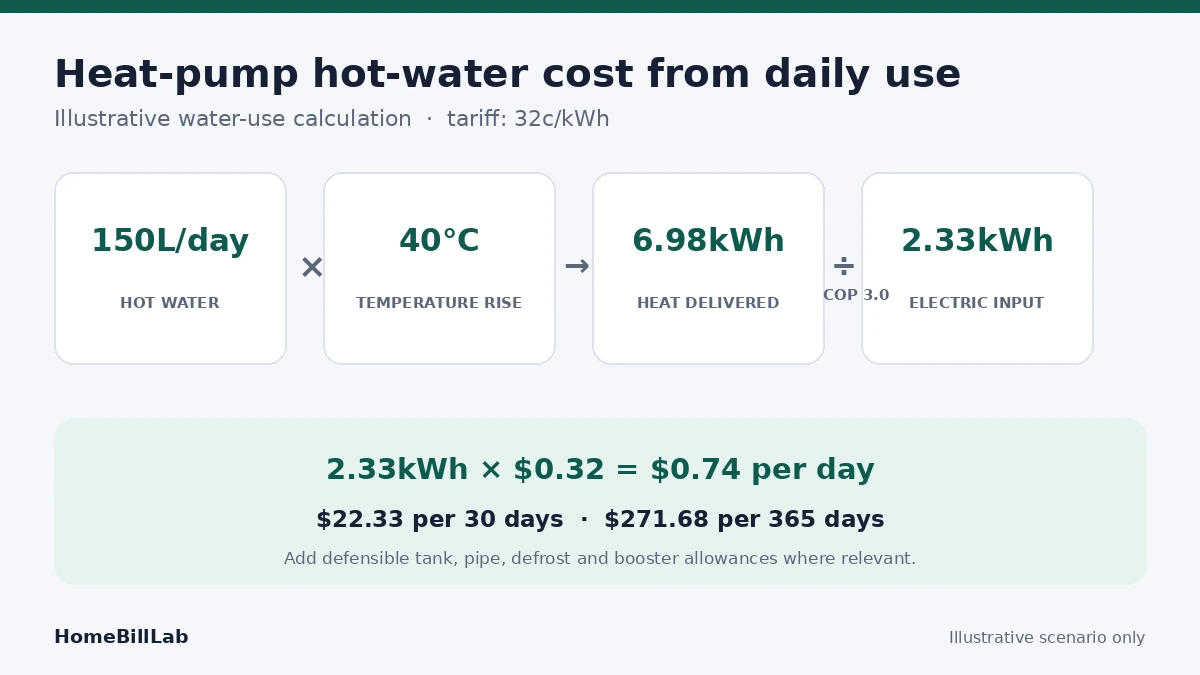
This simplified example does not automatically include tank and pipe losses, defrost energy, controls or resistance boosting. COP 3.0 is an assumption for illustrating the method, not a universal rating. Add defensible estimates for omitted loads or use measured annual kWh.
Why COP is not one fixed number
COP compares heat delivered with electrical input at stated conditions. A COP of 3 means three units of heat are delivered per unit of electricity during that test or operating point. It does not mean the system will maintain exactly 3.0 every hour of the year.
- Ambient temperature: extracting heat can be harder in colder air.
- Water temperature: a larger lift to the target temperature can reduce efficiency.
- Humidity and defrost: operating conditions can change compressor energy and cycle behaviour.
- Draw pattern: several large draws can produce different reheating behaviour from smaller, spaced draws.
- Installation: restricted airflow, poor siting or unsuitable pipework can affect performance.
- System control: schedules and boost settings determine when each heating mode runs.
YourHome’s hot-water guidance notes that heat-pump efficiency can fall in colder conditions, although cold-climate models are available. Use seasonal or annual product data that matches the climate where possible, rather than selecting a favourable peak COP.
The boost element can change the result
Many systems include a resistance element for rapid recovery, high demand, low-temperature conditions or backup. Electricity used by that element does not receive the heat pump’s COP benefit. Frequent boosting can therefore increase total kWh substantially.
Do not assume the booster never operates merely because the product is sold as a heat pump. Check the operating mode, controller history, installer settings and product documentation. If monitoring separates compressor and boost energy, add both:
Total electricity = compressor and fan electricity + boost-element electricity + controls
YourHome warns that frequent boost-element use can raise running costs. It is a reason to verify system sizing and climate suitability, not a reason to disable safety or temperature controls.
Climate, tank size and standing losses
A heat pump usually stores hot water, so tank and distribution losses still matter. An oversized tank may store more heated water than the household needs, while an undersized system may run out of hot water or call on boosting more often. Long uninsulated pipes also lose heat before water reaches the tap.
The Australian Government notes that not every model is designed for locations that regularly fall below 5°C. The correct response is product selection for the local climate, not applying one cold-weather penalty to every system. Check the manufacturer’s operating range, recovery data and installer advice.
Solar Victoria’s heat-pump hot-water guidance says the technology can use around 60% to 75% less electricity than conventional electric hot water. Again, use that as a broad comparison range; a cost calculation still needs the chosen product’s energy use and the household tariff.
Tariffs, controlled loads and time of use
The correct rate is the one that applies when the system imports electricity. This may be a general single rate, a time-of-use period or a controlled-load tariff. Do not automatically use the cheapest rate shown on the bill.
Energy Made Easy explains that controlled loads use a dedicated circuit, are often separately metered and operate during retailer-defined periods. A heat pump’s controller, recovery requirements and circuit arrangement must be compatible with those supply windows.
The Australian Energy Regulator’s bill guide distinguishes usage rates in c/kWh from fixed daily supply charges. For appliance-level heat pump hot water running cost, normally count variable electricity charges caused by the system. Include a separate fixed charge only if it exists because of that circuit or plan.
See how to read an electricity bill and supply charge vs usage charge before selecting the tariff input.
Using rooftop solar without claiming free hot water
A timer or smart controller may move heating into solar-production hours. Separate annual electricity into solar self-consumption and grid imports. Grid electricity is valued at the applicable retail rate; solar used on site may carry the opportunity cost of the feed-in credit that would otherwise have been earned.
Solar does not guarantee zero grid use. Weather, season, tank recovery, other household loads and the size of the PV system all affect the result. Use inverter, circuit-monitoring or smart-controller data where available.
What changes heat pump hot water running cost?
- Annual hot-water demand: more litres and a larger temperature rise require more heat.
- Seasonal efficiency: product design and operating conditions change electricity per unit of heat.
- Boost-element use: resistance heating can raise electricity consumption.
- Tank and pipe losses: stored and distributed heat is not all delivered at the tap.
- Climate: ambient conditions affect air-source heat-pump performance.
- System sizing: tank capacity and recovery rate should suit the household pattern.
- Controls: timers, modes and solar integration affect when electricity is used.
- Tariff: general, time-of-use and controlled-load rates can value the same kWh differently.
- Installation and maintenance: airflow, pipework, commissioning and condition affect operation.
Ways to reduce heat pump hot water running cost
- Reduce avoidable hot-water use and repair leaking hot taps.
- Use a suitable water-efficient showerhead.
- Choose a model and tank size suited to the household and climate.
- Keep required airflow clear and follow the manufacturer’s maintenance schedule.
- Review controller and boost behaviour with the installer if energy use is unexpectedly high.
- Schedule operation for a suitable tariff or solar window only when compatible with the product and household demand.
- Compare measured annual kWh before and after changes instead of relying only on short-term bill totals.
Do not modify refrigerant components, wiring, temperature controls, pressure valves or plumbing as a DIY efficiency experiment. Use the manufacturer instructions and appropriately licensed tradespeople.
Compare purchase price and running cost separately
A lower annual bill does not by itself prove a short payback. Compare net installed price, annual electricity, maintenance, warranty, expected life, noise, space, climate suitability and any electrical or plumbing work. Use the same household demand and tariff assumptions for every option.
The Australian Government’s buying guidance recommends comparing installation, maintenance, warranty and running costs before replacement. Rebates and eligibility can change by location and program date, so check the current official rebates and assistance finder rather than hard-coding support into the running-cost result.
The guide to electric hot water running cost provides a direct-resistance comparison. Keep its annual energy assumption separate from the heat-pump figure; do not compare two tariff totals unless the household demand basis is consistent.
Frequently asked questions
How do I calculate heat pump hot water running cost?
Multiply annual electricity use in kWh by the applicable tariff in dollars per kWh. If annual energy is unknown, estimate water-heating energy from litres and temperature rise, divide by a clearly stated seasonal COP, then add defensible tank, pipe and booster allowances.
Can I calculate cost from the compressor’s kW rating?
Only if runtime and operating behaviour are also known. Rated kW is power while operating; kWh measures energy over time. Annual product data or measured consumption is usually more defensible.
Does a heat pump use electricity in cold weather?
Yes. The compressor and fan use electricity, and some products may use defrost or resistance boost modes. Cold-climate performance varies by model, so check its operating range and product data.
Should I run a heat-pump water heater during the day?
Daytime operation may align with warmer ambient air or rooftop solar, but the best schedule depends on tariff periods, solar availability, tank capacity, noise considerations and household demand. Follow product and installer guidance.
Are rebates part of running cost?
No. A rebate may reduce upfront cost but does not change the kWh consumed or the tariff. Treat installed cost, annual running cost and financial support as separate inputs.
Bottom line
A reliable heat pump hot water running cost starts with measured or product-level annual kWh and the tariff that actually applies. If estimating from water use, state the temperature rise, COP, storage losses and booster assumptions. Test a range, document every input and use the HomeBillLab methodology for transparent calculation principles.
Browse the complete Australian hot-water guide hub for related system comparisons and practical household-energy guidance.
Reviewed: 22 August 2026. This guide provides transparent calculations and illustrative scenarios, not a quote, national average or installation recommendation. Electrical and plumbing work must be performed by appropriately qualified and licensed professionals.