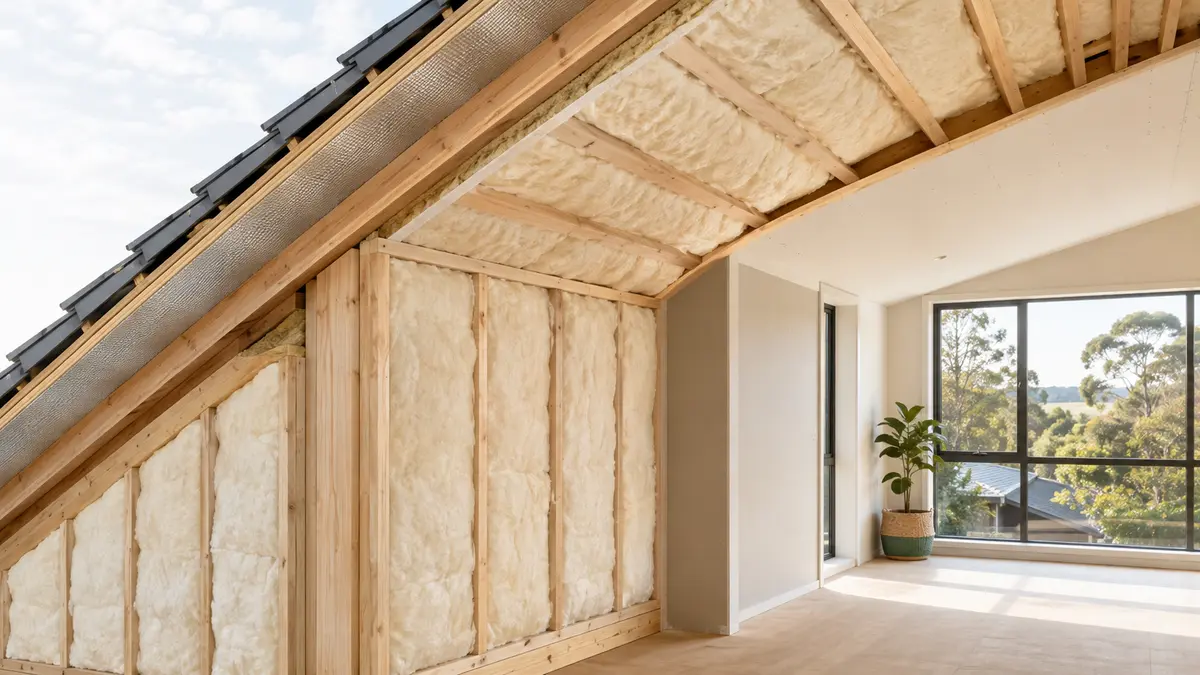
What is R-value insulation Australia? R-value measures how strongly a material or building assembly resists heat flow. A higher R-value means greater thermal resistance, so less heat passes through under the same conditions. It works in both directions: insulation can slow indoor heat escaping in winter and outdoor heat entering in summer.
The number does not describe whole-home comfort or guaranteed bill savings by itself. Climate, total construction, gaps, compression, thermal bridges, draughts, glazing and heating or cooling behaviour all matter. Australian R-values are metric and should not be compared directly with larger-looking US R-values.
Use the Insulation R-Value Calculator to compare R-values, simplified U-values and conductive heat flow using your own area, temperature difference and operating time. It is a scenario tool, not an NCC compliance calculator.
What R-value measures
R-value is thermal resistance: the resistance a layer or complete assembly provides to heat moving through it. In Australian product information it is normally expressed in square metre kelvins per watt, written m²·K/W. The everyday label is usually shortened to R2.5, R4, R5 and similar values. YourHome’s passive-heating guidance explains how temperature difference and a material’s R-value affect conductive heat flow.
In a simple comparison, doubling the R-value halves conductive heat flow when area and the temperature difference stay the same. That relationship is why an R5 assembly resists twice as much conductive heat flow as an R2.5 assembly under identical assumptions.
However, what is R-value insulation Australia readers see on a batt or board is often the product R-value, not automatically the performance of the whole roof, ceiling, wall or floor. That distinction matters when comparing products or interpreting an energy assessment.
Product R-value versus total R-value
Product R-value describes the tested resistance of the insulation product at its specified thickness and installation conditions. A batt labelled R4 is not a statement that every square metre of the finished ceiling will perform as an uninterrupted R4 layer.
Total R-value describes the resistance of the complete building assembly. For a wall, that can include the internal surface film, plasterboard, insulation, cavity or air layer, structural elements, cladding and external surface film. The official YourHome insulation guidance explains that the resistances of assembly components contribute to the total, including relevant air gaps.
- Product R-value: one insulation product at its stated thickness.
- Total R-value: the combined roof and ceiling, wall or floor assembly.
- Effective performance: what the real assembly delivers after framing, junctions, gaps, compression and installation quality are considered.
This is a central answer to what is R-value insulation Australia: use the product number to compare suitable products, but use total assembly performance when assessing a building element. Reflective systems can also depend on heat-flow direction and a correctly formed adjacent air gap.
Australian metric R-values and heat-flow direction
Australia uses metric R-values in m²·K/W. United States publications commonly use a different imperial R-value scale, so a US number can look much larger without representing a better product. For a what is R-value insulation Australia comparison, use the metric value supplied for Australian conditions and check that the product documentation refers to the system you intend to build. The Sustainability Victoria insulation-materials guide is another official Australian reference for product types and thermal resistance.
Bulk insulation generally provides similar resistance whichever way heat travels through it. Reflective systems are different because their performance relies on radiant surfaces, emissivity and an adjacent still-air space. Roof, ceiling and floor systems that include reflective insulation may therefore publish upward and downward total R-values.
The direction labels describe heat flowing upward or downward through the assembly; they do not simply mean “winter product” and “summer product”. Check the construction details, air-gap requirement and manufacturer instructions. A reflective sheet pressed against another material may not deliver the system R-value shown for a correctly formed air space.
R-value and U-value
R-value describes resistance. U-value describes how readily heat passes through an element. Higher R is better resistance; lower U is lower heat transfer. For the simplified conductive comparison used in this guide:
U-value = 1 ÷ R-value
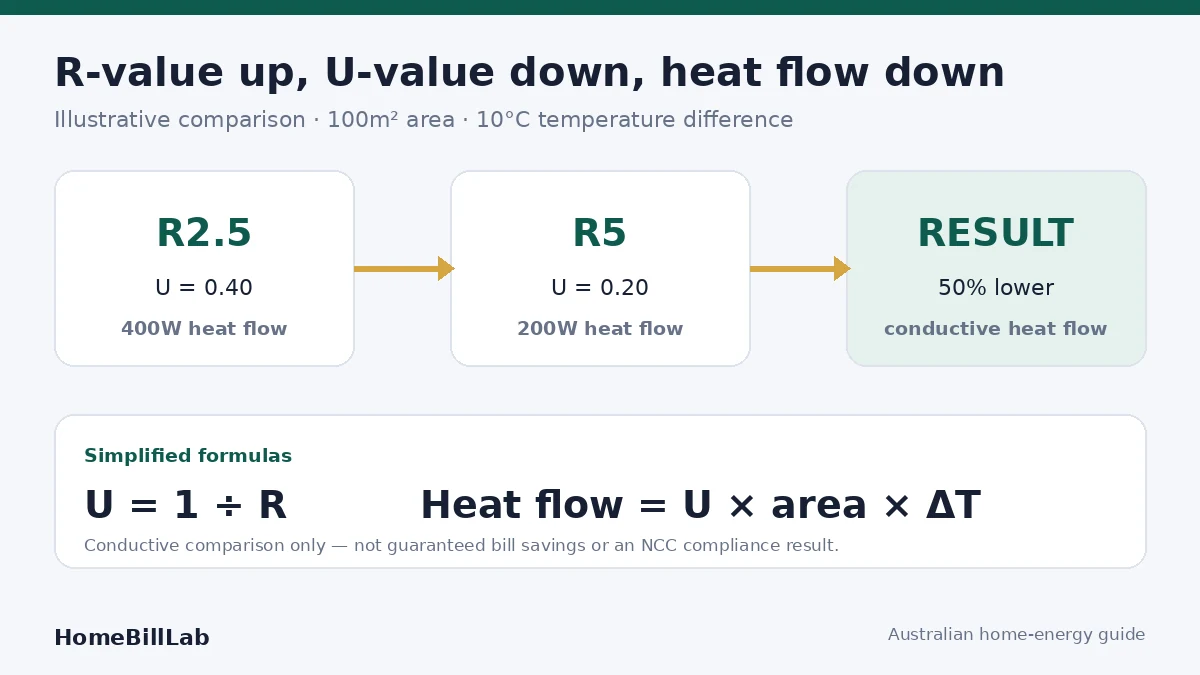
An R2.5 assembly has a simplified U-value of 0.40W/m²·K. An R5 assembly has a U-value of 0.20W/m²·K. Under the same area and temperature difference, the R5 example permits half as much steady conductive heat flow.
The relationship is useful for transparent scenarios, but a building model may require more detailed methods. The YourHome glazing guide uses U-value, area and temperature difference to explain conductive heat flow through a building element. Framing paths, junctions, thermal bridges and changing conditions can make a real assembly behave differently from an ideal, uninterrupted layer.
Worked R2.5 versus R5 heat-flow example
The following what is R-value insulation Australia example uses the same 100m² area and 10°C temperature difference for both assemblies. It compares conductive heat flow only.
Heat flow (W) = U-value × area (m²) × temperature difference (°C)
- R2.5: U = 1 ÷ 2.5 = 0.40. Heat flow = 0.40 × 100 × 10 = 400W.
- R5: U = 1 ÷ 5 = 0.20. Heat flow = 0.20 × 100 × 10 = 200W.
- Change: conductive heat flow falls by 200W, or 50%, under these fixed assumptions.
This is not a claim that energy bills will fall by 50%. The example excludes air leakage, ventilation, solar gain, thermal mass, windows, occupancy, weather variation and heating or cooling system efficiency. It also assumes the stated total R-value applies continuously across the full area.
Why installed performance can be lower
A product can have a strong laboratory rating yet deliver weaker whole-assembly performance when installed poorly. The answer to what is R-value insulation Australia therefore needs to include continuity and workmanship, not just the number printed on the pack.
- Gaps: uncovered areas create easier heat-flow paths around the insulation.
- Compression: squeezing bulk insulation into an undersized cavity can reduce its effective resistance.
- Thermal bridges: timber, steel, concrete and structural junctions can bypass the insulated path.
- Discontinuity: downlights, access hatches, services and edges can interrupt coverage.
- Moisture or damage: condition and compatibility can affect whether existing insulation continues to perform as intended.
- Reflective air gaps: reflective insulation needs the specified adjacent air space to deliver its rated system performance.
YourHome recommends professional installation and careful assessment of existing homes, including electrical, fire, moisture and access risks. This guide explains thermal performance; it is not a do-it-yourself installation instruction.
Higher R-values and diminishing heat-flow returns
A higher R-value always provides more resistance in the simplified model, but equal R-value increments do not produce equal absolute changes in U-value. The first increases can reduce heat flow sharply; later increases still help, but by smaller amounts.
| R-value | Simplified U-value | Heat flow for 100m² and ΔT 10°C | Reduction versus R2 |
|---|---|---|---|
| R2 | 0.500 | 500W | Baseline |
| R2.5 | 0.400 | 400W | 20% |
| R4 | 0.250 | 250W | 50% |
| R5 | 0.200 | 200W | 60% |
| R6 | 0.167 | 167W | about 67% |
For what is R-value insulation Australia decisions, this table explains the maths rather than telling every household to select the highest number. Available space, construction type, climate, moisture design, installed cost and total assembly details affect the practical choice.
What R-value does not measure
R-value is not the same as thermal mass, airtightness or a whole-home energy rating. Thermal mass describes the ability of materials such as concrete or brick to absorb and release heat. Airtightness describes uncontrolled air movement through gaps. Both can influence comfort and energy use, but neither is contained in a product’s R-value number.
R-value also does not reveal the performance of windows, shading, ventilation, orientation or the heating and cooling equipment. A complete what is R-value insulation Australia assessment uses R-value for one defined part of the heat-flow problem, then considers the other building and household factors separately. This prevents an insulation calculation from being presented as a whole-home forecast.
Does climate change the R-value you need?
Yes. Australia covers hot humid, hot dry, temperate, cool and alpine conditions. The purpose of insulation can vary between keeping outdoor heat out, retaining indoor heat or doing both across the year. Roof colour, shading, ventilation, airtightness, glazing, condensation control and construction type also interact with insulation.
The YourHome design-for-climate guidance explains why passive-design responses need to match local conditions. Current regulatory requirements belong in the official National Construction Code and relevant state or territory pathways.
This foundational guide deliberately does not reproduce minimum R-value tables. A separate recommendation guide should handle climate- and compliance-adjacent questions with a current review date. For a project, consult the applicable code, building approval pathway and a suitably qualified professional.
Use the calculator without confusing heat flow and bill savings
The HomeBillLab calculator can add R-values or compare an existing R-value with an upgrade. In upgrade mode it converts R to simplified U, applies area and temperature difference, and shows the change in conductive heat flow. It can also compare illustrative conductive kWh over an entered period.
Enter values that describe the assembly you are assessing, not an unrelated product label. Keep the same area and temperature difference when comparing options. Read the result as an idealised conductive comparison, then consider thermal bridges, installation, air leakage, glazing and HVAC operation separately.
Try the Insulation R-Value Calculator, review the calculation methodology, and use the Energy Rebate & Upgrade Cost Calculator only after you have a confirmed quote and confirmed support amount.
Frequently asked questions
Is a higher R-value always better?
A higher R-value means greater resistance to heat flow. The best practical specification also depends on climate, construction, available space, moisture design, cost and the performance of the total assembly. Higher is not a substitute for correct installation.
What is total R-value?
Total R-value is the combined thermal resistance of the complete roof and ceiling, wall or floor assembly. It is broader than the rating of one insulation product and can include other layers and relevant air gaps.
What is the difference between R-value and U-value?
R-value measures resistance to heat flow, so higher is better. U-value measures heat transfer through an element, so lower is better. In the simplified comparison, U equals 1 divided by R.
Can R-values be added together?
The resistances of suitable layers can contribute to total R-value. Real assemblies still need correct assessment because framing, junctions, thermal bridges, reflective air gaps and installation details can change whole-element performance.
Does R-value tell me my bill savings?
No. R-value describes resistance to heat flow. Bills also depend on weather, thermostat settings, heated or cooled area, air leakage, windows, occupancy, appliance efficiency, tariffs and how the home is operated.
Bottom line
The short answer to what is R-value insulation Australia is simple: it measures resistance to heat flow, and a higher number means greater resistance. The useful answer goes further. Compare product R-value with total assembly performance, convert R to U for transparent heat-flow scenarios, and account for gaps, compression and thermal bridges before drawing conclusions.
Browse the Australian insulation guides and use HomeBillLab calculations as scenario estimates, not compliance findings or guaranteed bill savings.
Reviewed: 22 August 2026. This guide explains thermal-resistance concepts and illustrative heat-flow scenarios. It is not installation, compliance or building-design advice.