
How much does an air conditioner cost to run in Australia? There is no single price that fits every home. The cost is determined by the electricity the system draws, how long it operates and the usage rate on your electricity plan. A useful estimate starts with those three inputs rather than a national average.
Quick answer: at an illustrative electricity tariff of 32c/kWh, an air conditioner averaging 0.8kW of electrical input costs about 26 cents per hour. At 1.5kW it costs about 48 cents per hour, and at 2.5kW it costs about 80 cents per hour. These are transparent calculation scenarios, not typical prices for particular unit sizes.
For a result based on your home, enter the electrical input, tariff and operating schedule in the Air Conditioner Running Cost Calculator. The calculator also has an Energy Label mode for annual cooling and heating figures.
Air conditioner running cost Australia: example table
The table holds the tariff and operating time constant so you can see how average electrical input changes the result. Every row uses 32c/kWh, four hours per day and 30 days of operation.
| Average electrical input | Cost per hour | Cost for 4 hours | Cost for 30 days |
|---|---|---|---|
| 0.8kW | $0.26 | $1.02 | $30.72 |
| 1.5kW | $0.48 | $1.92 | $57.60 |
| 2.5kW | $0.80 | $3.20 | $96.00 |
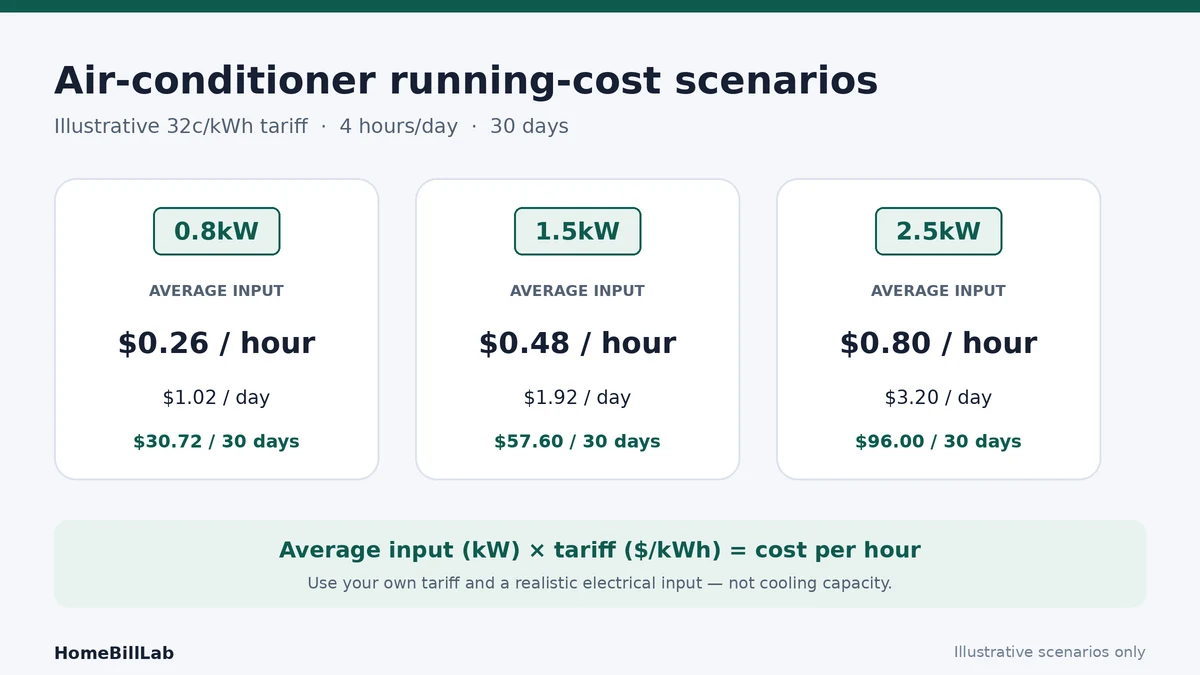
Do not map these rows directly to advertised 2.5kW, 5kW or 7kW air conditioners. The prominent kW figure in a product name usually describes cooling capacity, while this calculation needs electrical input. Our guide to how much electricity an air conditioner uses explains that distinction in detail.
How to calculate the cost of running an air conditioner
The basic method has two stages:
- Energy used (kWh) = average electrical input (kW) × operating time (hours)
- Running cost = energy used (kWh) × electricity tariff ($/kWh)
For example, an air conditioner averaging 1.5kW for four hours uses 6kWh. At 32c/kWh, convert the tariff to $0.32/kWh and multiply: 6kWh × $0.32 = $1.92. If that schedule happens on 30 days, the scenario costs $57.60.
This method follows the transparent formulas in the HomeBillLab Methodology. Keep the power, time, days and tariff visible so the estimate can be checked and updated.
Use the electricity rate from your own bill
The Australian Energy Regulator explains that a bill’s variable or consumption charge is shown in cents per kilowatt-hour. Some households have more than one variable charge. The AER guide to energy bills is a useful reference when identifying the rate.
Copy the rate that applies when the air conditioner is operating. On a single-rate plan, that may be one general usage rate. On a time-of-use plan, separate peak, shoulder and off-peak scenarios are more informative. Energy Made Easy’s charges guide explains these usage-rate names.
The daily supply charge is normally excluded from an appliance running-cost comparison because it is a fixed account cost that generally remains payable when the air conditioner is off. Include only additional charges that genuinely change with the appliance’s operation.
Find a realistic electrical input
Look for rated input, cooling input, heating input or power consumption in the manufacturer’s technical specifications. Check that the figure is an electrical input in watts or kilowatts, not cooling or heating capacity.
An inverter air conditioner can change compressor speed as the room load changes, so one nameplate figure may not describe every hour. Rated input is useful for a consistent scenario, while measured or average input may better reflect a particular operating period. Maximum input can be tested as a deliberately high scenario, but it should not be presented as normal continuous use.
For a focused explanation of inverter behaviour and per-hour inputs, see the separate split-system running cost guide. This page owns the broader all-air-conditioner cost question rather than repeating that technical comparison.
Hourly, daily, monthly and seasonal estimates
An hourly result is the building block, not a complete bill forecast. Extend it using a schedule that represents how you actually operate the system:
- Per hour: average input × tariff.
- Per day: hourly cost × operating hours.
- Per week: daily cost × days used.
- Average month: annual result ÷ 12, or use a clearly defined 30-day scenario.
- Cooling season: daily cost × the days on which that schedule occurs.
Avoid multiplying one extreme hot-day result across the whole year. Weather, occupancy and operating time change by season. Run low, middle and high scenarios when you are unsure. The range is usually more useful than false precision.
Check the estimate against your electricity data
A calculator scenario is more useful when it can be compared with real household data. If your retailer or meter portal provides daily or interval usage, compare similar-weather periods when the air conditioner was used and not used. Keep other large loads in mind: electric hot water, pool pumps, ovens, clothes dryers and electric vehicles can move the total at the same time.
A simple test is to record the thermostat setting, rooms conditioned, start and stop times and outdoor conditions for several days. Run the calculator with the input you expected, then compare the predicted additional kWh with the change visible in your data. One day is not enough to prove the appliance’s exact consumption, but a repeated pattern can show whether the original assumption is too low or too high.
Whole-home bill totals are not a substitute for dedicated appliance measurement. If a compatible energy monitor is used, follow its instructions and do not work on switchboards or fixed wiring yourself. The goal is to refine the estimate safely, not to claim laboratory precision from household data.
Cooling and heating need separate scenarios
A reverse-cycle air conditioner can cool in summer and heat in winter, but the same input assumption should not automatically be used for both modes. Heating input, cooling input, climate, thermostat setting and seasonal label figures can differ. Build separate cooling and heating estimates with the relevant specification or Zoned Energy Rating Label number.
Separating the modes also makes the annual result easier to audit. Add the cooling scenario and heating scenario only after each has its own kWh, tariff and operating schedule. This prevents one convenient hourly figure from being stretched across two different seasons and operating conditions.
How system type changes running cost
The calculation formula stays the same, but system type influences the electrical input and the area being conditioned.
- Wall-mounted split system: often conditions one room or zone. Its cost depends on actual electrical input and inverter operation.
- Multi-split system: connects multiple indoor units to one outdoor unit. The combination of zones operating matters.
- Ducted refrigerated system: may condition a larger area and use a larger fan. The Australian Government’s heating and cooling guidance notes that ducted systems can lose energy through ductwork and are more expensive to run than wall units.
- Window or wall unit: is generally intended for a smaller room or home, but its efficiency and input still need to be checked model by model.
- Evaporative cooler: uses a different cooling process and water as well as electricity. Do not reuse a refrigerated-air-conditioner assumption without the product’s own fan, pump and operating information.
System names alone do not produce a reliable dollar figure. Compare the area cooled, energy input, efficiency and schedule. If the practical choice is between air movement and active cooling, the air conditioner vs fan running-cost guide covers that narrower decision.
Use the Zoned Energy Rating Label for annual estimates
When comparing labelled air conditioners, the Zoned Energy Rating Label provides estimated annual cooling and heating energy use for hot, average and cold climate zones. The official Zoned Energy Rating Label guide explains that the ratings reflect different climates across Australia and New Zealand.
The annual calculation is straightforward: label energy use in kWh × your tariff in dollars per kWh. If the relevant cooling figure is 500kWh and your tariff is $0.32/kWh, the estimated annual cooling cost is $160. Use the climate zone relevant to your location and keep cooling and heating figures separate when that helps the decision.
The label is designed for standardised model comparison, not a guarantee of the bill in your home. Your weather, thermostat, room size, insulation and operating pattern can differ from the label assumptions. The Energy Rating heating and cooling page provides more label and product-comparison guidance.
What makes air conditioner running cost rise or fall?
- Outdoor conditions: hotter, colder or more humid conditions can increase the load.
- Thermostat setting: demanding a greater difference from the outdoor temperature generally requires more energy.
- Area conditioned: cooling one closed room is different from conditioning several open zones.
- Heat entering the home: direct sun, unshaded glass, appliances and occupants add load.
- Insulation and draughts: weak thermal performance can allow conditioned air and heat to move more quickly.
- System sizing and efficiency: compare models suitable for the same space and climate rather than comparing star ratings across unsuitable sizes.
- Maintenance and airflow: follow the manufacturer’s filter and servicing instructions and keep indoor and outdoor airflow unobstructed.
- Tariff timing: the same kWh can cost more during peak time on a time-of-use plan.
Practical ways to reduce cooling cost
- Use the air conditioner only when needed and avoid over-cooling.
- Close windows, external doors and unused internal zones while the system is operating.
- Use curtains, blinds or external shading to reduce direct summer sun.
- Consider a fan when air movement is enough, or use one to support a moderate thermostat setting.
- Schedule operation around occupied periods instead of conditioning an empty home unnecessarily.
- Compare several realistic inputs in the calculator before treating one estimate as final.
Australian Government summer energy guidance recommends a cooling setting between 25°C and 27°C and says every degree higher can save 5% to 10% on energy costs. That is general guidance, not a guaranteed saving for every system or household.
Frequently asked questions
How much does an air conditioner cost to run per hour?
Multiply average electrical input in kW by your tariff in dollars per kWh. At 32c/kWh, inputs of 0.8kW, 1.5kW and 2.5kW cost about $0.26, $0.48 and $0.80 per hour. They are calculation examples, not size-based averages.
Does a 5kW air conditioner cost 5kWh every hour?
Not necessarily. The 5kW figure commonly refers to cooling capacity, not electrical input. Check the model specifications for an input or power-consumption figure before calculating cost.
Should I include the daily supply charge?
Usually no. The supply charge is generally payable even when the air conditioner is off, so it is not an incremental running cost for that appliance. Use the variable electricity charge that applies to the energy consumed.
Is the Energy Rating Label more accurate than a per-hour calculation?
They answer different questions. The label provides a standardised annual estimate for model and climate-zone comparison. A per-hour calculation uses a chosen electrical input, runtime and tariff to test a household scenario. Neither guarantees the exact bill.
Can solar make the air conditioner free to run?
Solar may reduce the grid electricity purchased while the system is operating, but “free” can ignore foregone feed-in credits, system costs and times when solar output is insufficient. Compare grid imports, self-consumed solar and export value separately.
Bottom line
The most defensible air conditioner running cost Australia estimate uses a realistic electrical input, actual operating time and the usage rate from your own bill. Use the Air Conditioner Running Cost Calculator to compare low, middle and high scenarios, then check the Zoned Energy Rating Label when comparing annual model performance. Browse the air-conditioning guide hub for related explanations and comparisons.
Reviewed: 22 August 2026. This guide provides transparent calculations and illustrative scenarios, not a quote for a specific air conditioner, electricity plan or household.