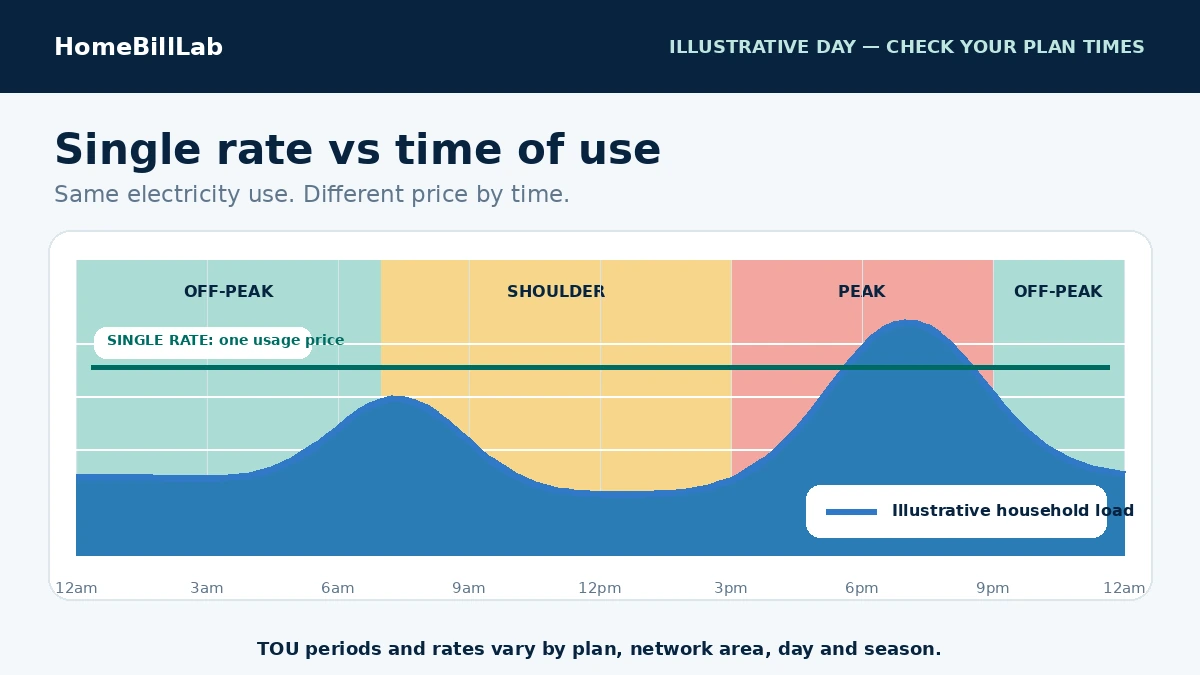
Single rate vs time of use electricity Australia: neither tariff is automatically cheaper. A single-rate plan charges one usage rate at all times, while a time-of-use plan changes the usage rate across peak, shoulder and off-peak periods. Time of use can cost less when enough consumption is moved out of expensive peak periods; an evening-heavy household can pay more even if its total daily consumption is unchanged.
The fair test is to apply both plans to the same meter data, billing days and supply-charge treatment. Do not choose from the lowest advertised off-peak rate alone. The Australian Government’s Energy Made Easy tariff guide confirms that actual periods and prices depend on the plan, so always use its Basic Plan Information Document or written summary.
For a quick personal comparison, enter the rates from your bill or offer into the Electricity Bill Calculator. The examples below use illustrative rates to explain the method; they are not Australian averages or a forecast of your bill.
Single rate vs time of use electricity Australia: quick answer
| Tariff | How usage is priced | May suit | Main risk |
|---|---|---|---|
| Single rate | One cents-per-kWh usage rate regardless of time | Households with high evening use or little ability to shift loads | The anytime rate may be higher than a TOU off-peak rate |
| Time of use | Different peak, shoulder and off-peak rates at specified times | Households that can use more electricity in cheaper periods | Peak consumption can outweigh off-peak savings |
How a single-rate tariff works
A single-rate tariff—also called flat, standard or anytime pricing—applies the same usage rate to every kilowatt-hour consumed. Running a dishwasher at 2 pm or 8 pm costs the same per kWh. Your bill can still change with consumption, billing days, discounts and the daily supply charge.
Single rate is straightforward and reduces exposure to expensive peak windows. It does not mean the entire bill is one fixed amount. The Australian Government pricing guide separates the fixed supply charge from variable usage charges, and a retailer offer may include other fees or conditions.
How a time-of-use tariff works
A time-of-use, or TOU, tariff assigns different usage prices to defined periods. Peak is normally the most expensive, off-peak the least expensive, and shoulder sits between them. Some plans use two periods rather than three, and windows may change by weekday, weekend or season. A period shown in one network area must never be copied into a national comparison.
TOU does not reduce the electricity required by an appliance. It changes the price applied when that electricity is recorded. The plan can therefore reward flexible loads such as laundry, dishwashing, electric-vehicle charging, pool pumps or some hot-water operation, provided shifting them is practical and consistent with manufacturer and safety instructions.
Who may suit each tariff?
A single-rate plan may suit you when
- cooking, heating, cooling and entertainment create a large evening load;
- work, school or caring routines leave little flexibility;
- you prefer predictable usage pricing over time-based management;
- the complete single-rate offer is competitive after supply charges, discounts and fees.
A time-of-use plan may suit you when
- a meaningful share of consumption already occurs outside peak periods;
- timers or automation can move flexible loads without inconvenience;
- daytime solar reduces grid imports during the plan’s expensive periods;
- your interval data shows that the lower-priced periods outweigh peak exposure.
The key to a fair single rate vs time of use electricity Australia comparison is your load shape: not only how many kWh you use, but when they occur.
Worked comparison: the same 20 kWh per day
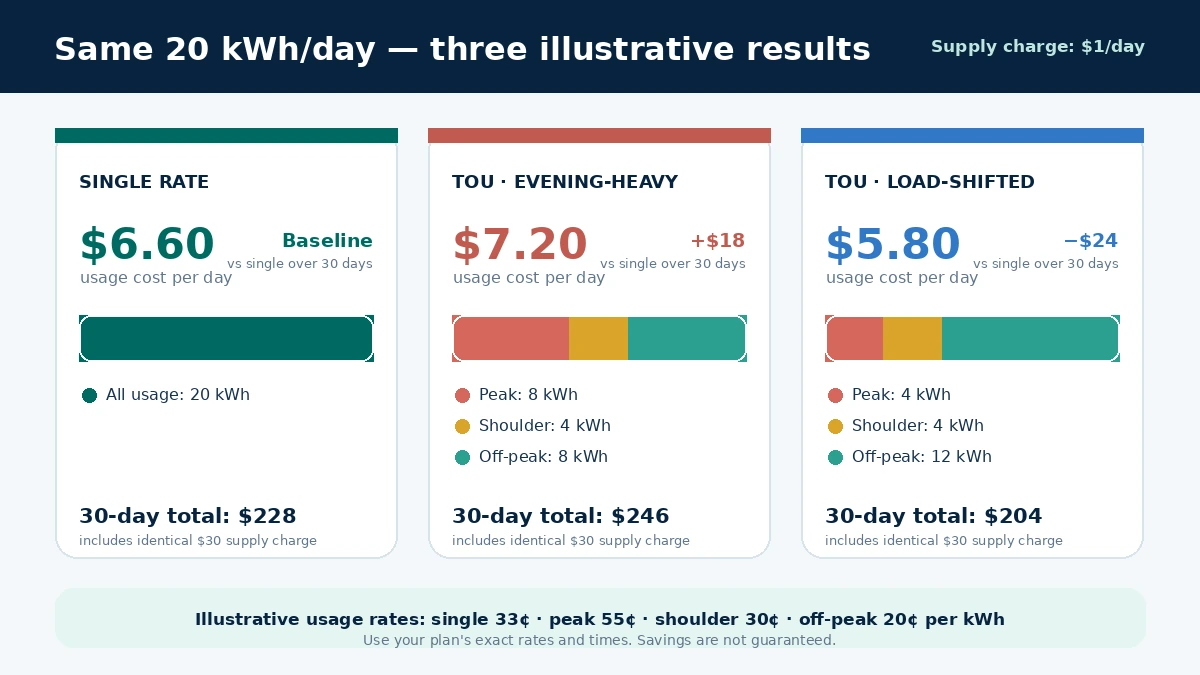
For this single rate vs time of use electricity Australia worked example, two households both import 20 kWh per day. To isolate timing, the example uses the same 30 billing days and a $1.00-per-day supply charge on every option. Illustrative usage rates are:
- Single rate: $0.33/kWh
- TOU peak: $0.55/kWh
- TOU shoulder: $0.30/kWh
- TOU off-peak: $0.20/kWh
These rates are illustrative only. Replace them with the rates in your offer, keeping the units and GST treatment consistent.
Single-rate baseline
20 kWh × $0.33 = $6.60 usage per day. Add the $1.00 daily supply charge for a $7.60 daily total, or $228 over 30 days.
Scenario 1: evening-heavy TOU household
This load shape uses 8 kWh in peak, 4 kWh in shoulder and 8 kWh in off-peak:
(8 × $0.55) + (4 × $0.30) + (8 × $0.20) = $7.20 usage per day
With the same $1.00 supply charge, the daily total is $8.20 and the 30-day total is $246. That is $18 more than the single-rate example even though total consumption is identical.
Scenario 2: load-shifted TOU household
This household moves 4 kWh from peak to off-peak, producing 4 kWh peak, 4 kWh shoulder and 12 kWh off-peak:
(4 × $0.55) + (4 × $0.30) + (12 × $0.20) = $5.80 usage per day
After the same supply charge, the daily total is $6.80 and the 30-day total is $204—$24 below the single-rate example. The result changed because timing changed, not because consumption fell.
| Illustrative option | Peak / shoulder / off-peak | Usage per day | Total per day | 30-day total |
|---|---|---|---|---|
| Single rate | Not applicable | $6.60 | $7.60 | $228 |
| TOU evening-heavy | 8 / 4 / 8 kWh | $7.20 | $8.20 | $246 |
| TOU load-shifted | 4 / 4 / 12 kWh | $5.80 | $6.80 | $204 |
Illustrative peak-share break-even point
If shoulder use stays at 4 kWh and total use stays at 20 kWh, these example rates break even when peak use is about 6.3 kWh per day—roughly 31% of the total. Above that point, this particular TOU example costs more than the single rate; below it, TOU costs less. This threshold is not transferable to another plan because changing any rate or usage share changes the answer.
A break-even result is useful for testing a decision, but it should not be treated as a target that guarantees savings. Household timing changes across seasons, school holidays, working arrangements and heating or cooling demand. Test a normal month and a high-use month, then check whether the preferred plan remains competitive. If the result changes with a small adjustment, the offers are close enough that simplicity, contract conditions and the risk of future rate changes deserve more weight.
Supply charge, controlled load and solar
A plan with cheaper usage can still lose after its daily supply charge or fees are included. Energy Made Easy explains electricity supply and usage charges, while HomeBillLab’s supply charge vs usage charge guide shows how to compare them over the same billing period.
A controlled load is not simply another TOU off-peak period. It normally supplies eligible equipment on a separate circuit, often electric hot water, under its own access times and rate. Check the official controlled-load explanation and compare that charge separately.
Solar changes grid-import timing. A solar household may import little in the middle of the day but more in the evening. Compare the import profile after solar generation, then consider feed-in credits separately. A battery can shift imports too, but savings depend on efficiency, usable capacity, operating settings and the tariff difference; they are not guaranteed.
Do you need a smart meter for time of use?
You will generally need a meter that records consumption by time interval for a TOU offer. The Australian Government advises households to check smart-meter eligibility when considering time-varying pricing. Its guide to finding the best energy deal also recommends comparing supply charges, fees and terms rather than one headline rate.
When interval data is available, Energy Made Easy can map consumption to each plan’s periods. Its plan-search methodology explains that less-detailed bill or meter information can require assumptions. For a robust single rate vs time of use electricity Australia decision, download interval data from your retailer or distributor where available.
In parts of New South Wales, South Australia and south-east Queensland, eligible smart-meter households may also encounter the optional Solar Sharer Offer, which includes a free daytime electricity window under specified conditions. It is not a universal Australian TOU rule; confirm availability, eligibility, times and the rest of the offer before switching.
How to compare single rate vs time of use electricity Australia plans
- Collect the complete rates. Record daily supply, single or period usage rates, controlled load, discounts, fees and benefit periods.
- Use the same timeframe. Compare the same number of days and the same consumption profile.
- Get interval data. Prefer several representative weeks or, better, a full year that captures seasonal heating and cooling.
- Match every interval to the plan. Apply the retailer’s actual weekday, weekend and seasonal periods.
- Calculate usage by period. Multiply kWh in each period by its rate, then add the supply charge and relevant fees.
- Test a realistic shift. Move only flexible loads you could maintain. Do not assume all peak use can disappear.
- Check contract details. Note rate-change terms, expiry dates, payment conditions and exit fees.
- Compare official plan information. The Australian Energy Regulator’s bill guide helps identify charges; our electricity-bill guide shows where to find the inputs.
Keep assumptions visible and follow the HomeBillLab methodology. Then rerun both offers in the Electricity Bill Calculator using your own usage and current plan documents.
Common comparison mistakes
- Comparing TOU off-peak with a single-rate price while ignoring TOU peak.
- Using different kWh totals or billing days across plans.
- Leaving the supply charge, controlled load, discounts or fees out of only one option.
- Assuming one network’s peak times apply across Australia.
- Using one unusually mild week instead of representative data.
- Counting solar exports as though they were avoided grid imports.
- Assuming behavioural changes will continue every day.
Frequently asked questions
Is time-of-use electricity always cheaper?
No. TOU is cheaper only when the value of lower-priced consumption exceeds the extra cost of peak consumption and any differences in supply charges, fees or discounts. A sound single rate vs time of use electricity Australia test uses the same consumption data and complete charges for both offers.
Who benefits most from a TOU tariff?
Households with low peak imports or flexible loads may benefit. The result should be demonstrated with interval data and the complete offer, not inferred from lifestyle alone.
Do I need a smart meter?
TOU generally requires a meter capable of recording usage by time interval. Ask the retailer which tariffs your current meter supports and whether changing tariff involves a meter, fee or timing condition.
Are peak times the same across Australia?
No. Periods can differ by retailer offer, distribution area, day type and season. Use the exact times in the current plan document.
Is controlled load the same as off-peak TOU?
No. Controlled load commonly supplies specific equipment on a separate circuit and tariff. TOU applies time-based rates to general usage recorded by the relevant meter.
Bottom line
The winner in a single rate vs time of use electricity Australia comparison depends on the complete prices and your actual timing. Single rate can protect an evening-heavy household from high peak prices. TOU can reward a household that already uses—or can reliably move—enough electricity into cheaper periods. Compare identical usage, include every charge, and treat any savings as an estimate rather than a promise.
Explore more practical tariff guidance in the Electricity hub.
Reviewed: 30 August 2026. High-freshness guide; review monthly and when tariff rules, official comparison methods or the Solar Sharer Offer change.