Solar battery payback Australia does not have one universal number. Payback depends on the battery’s net installed cost, how much energy it actually shifts, round-trip efficiency, the retail electricity avoided, the feed-in income forgone and how those values change over time.
Quick answer: a battery can be financially useful when a household regularly has surplus solar to store and substantial evening or peak-period demand. It may produce a long payback—or fail to repay its cost within the relevant ownership period—when usable cycling is low, the tariff spread is small or the system is oversized.
Use the Solar & Battery Savings Calculator Australia to test solar battery payback Australia with your own quote, usable energy, efficiency, tariffs and operating days. The calculator reports simple payback, not a guaranteed investment return.
Solar battery payback Australia has no standard answer
The Australian Government’s guide to how batteries reduce bills says a battery may not repay its upfront cost as quickly as solar alone and may not pay for itself within its lifetime. That is why a national-average payback claim is not enough for a purchase decision.
A useful estimate needs household-specific answers:
- What is the complete installed price after confirmed discounts?
- How many kWh can be charged and discharged on a typical useful day?
- Is charging energy surplus solar, low-cost grid electricity or a mixture?
- Which retail rate will discharge avoid?
- Which feed-in credit will be lost when solar charges the battery?
- What round-trip efficiency, degradation and operating limits apply?
- How many days per year can the assumed cycle actually occur?
Simple payback formula
Simple payback divides the upfront net cost by estimated annual savings:
Simple payback (years) = net installed cost ÷ annual battery savings
If net installed cost is $8,500 and annual savings are $673.20, simple payback is about 12.6 years. This calculation does not discount future cash flows or automatically include degradation, finance, maintenance or replacement costs.
For solar battery payback Australia research, simple payback is a transparent first screen. It should be followed by a sensitivity range and a comparison with warranty terms and the period you expect to own the property.
Value stored solar correctly
A solar-charged battery avoids grid purchases later, but the solar used for charging may otherwise have earned a feed-in credit. Round-trip losses also mean the energy delivered is lower than the energy charged.
Energy delivered = solar energy charged × round-trip efficiency
Daily net value = (energy delivered × avoided retail rate) − (solar charged × feed-in tariff)
The official guide explains that solar self-consumption avoids the retail purchase rate, while exported solar earns the plan’s feed-in tariff. It also notes that batteries can create more value when stored energy replaces expensive time-of-use imports.
Worked solar-charging example
Assume 8kWh of surplus solar charges the battery on each useful day, round-trip efficiency is 90%, the avoided retail rate is 35c/kWh and the feed-in tariff is 6c/kWh.
- Delivered energy: 8kWh × 90% = 7.2kWh.
- Avoided grid purchase: 7.2kWh × $0.35 = $2.52.
- Forgone solar export: 8kWh × $0.06 = $0.48.
- Net daily value: $2.52 − $0.48 = $2.04.
- At 330 useful days: $2.04 × 330 = $673.20/year.
- At $8,500 net installed cost: $8,500 ÷ $673.20 = 12.6 years.
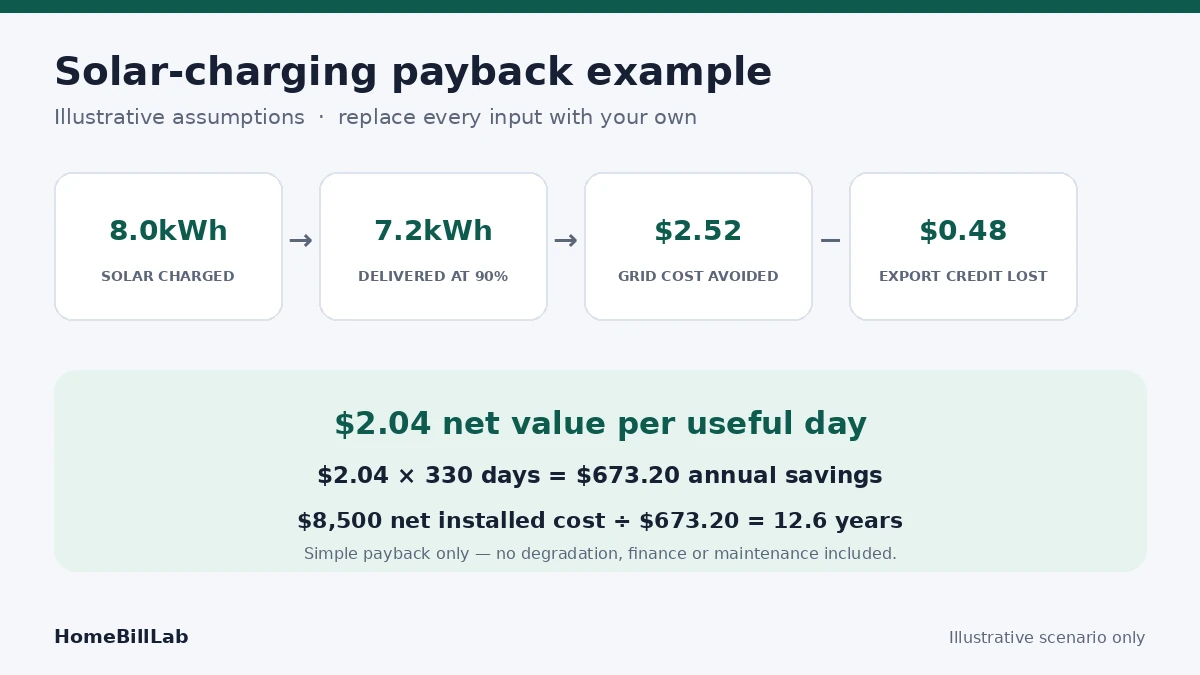
This is an illustrative solar battery payback Australia scenario, not a market forecast. It assumes the full 8kWh charge is available on 330 days and the home can use all 7.2kWh delivered. Cloud, seasonal generation, state of charge, export limits and household demand can reduce actual cycling.
Conservative, base and high-value scenarios
The table keeps net installed cost at $8,500 and changes energy value and usage. These are calculation tests, not predictions for a particular household.
| Scenario | Solar charged/day | Efficiency | Retail / feed-in | Useful days | Annual savings | Simple payback |
|---|---|---|---|---|---|---|
| Conservative | 4kWh | 88% | 30c / 8c | 300 | $220.80 | 38.5 years |
| Base | 8kWh | 90% | 35c / 6c | 330 | $673.20 | 12.6 years |
| High-value use | 10kWh | 92% | 40c / 4c | 340 | $1,115.20 | 7.6 years |
The wide spread is the point: solar battery payback Australia can change substantially when only a few inputs move. Do not select the high-value row simply because it produces the shortest answer. Choose inputs that can be supported by interval data, bills, system specifications and the household’s actual schedule.
Off-peak grid-charging example
A battery may charge from the grid during a low-price period and discharge during a higher-price period. For 8kWh charged at 18c/kWh with 90% efficiency, charging costs $1.44 and 7.2kWh is delivered. If that replaces 42c/kWh peak electricity, avoided imports are $3.02, leaving about $1.58 net per cycle.
At 250 genuinely useful cycles, that is about $396/year before other costs. Do not add this to the solar-charging example for the same battery capacity and same day unless the operating schedule can complete both cycles without double counting energy or breaching product and warranty limits.
Energy Made Easy’s tariff guide explains peak, shoulder and off-peak structures and warns that time windows are retailer-specific. The Australian Government’s electricity pricing guide also covers time-varying import and feed-in tariffs.
Use net installed cost, not the advertised battery price
The payback numerator should be the complete amount the household must fund after confirmed support. Include the battery, compatible inverter or inverter upgrade, gateway or backup equipment, switchboard work, installation, approvals and other required site work. Subtract only discounts confirmed in the quote.
Do not compare a battery-only catalogue price with projected whole-system savings. If finance is used, calculate loan interest and fees separately or use a discounted-cash-flow method. Use the Energy Rebate & Upgrade Cost Calculator to separate project cost, confirmed support and out-of-pocket cost.
Audit the assumptions in a battery quote
A quote may show a short payback without making every assumption obvious. Ask the provider for the battery’s usable capacity, expected round-trip efficiency, warranted throughput or cycles, estimated annual discharge and the tariff used in the calculation. The model should also state whether the battery is charged from surplus solar, the grid or both.
Check how the quote treats exported solar. If one stored kWh would otherwise have earned a feed-in credit, that lost credit belongs in the calculation. Also confirm whether VPP payments, demand-charge reductions or backup value are included. These benefits should appear on separate lines so they can be removed or changed without rebuilding the whole estimate.
Finally, compare the provider’s assumed cycling with your interval data. A large battery can look attractive on paper while spending many days partly charged or unable to discharge because overnight demand is too low. A defensible solar battery payback Australia estimate should show energy flows, prices and useful days separately. If the provider cannot explain those inputs, reproduce the calculation with your own bill and a conservative scenario.
Federal battery rebate 2026: use current official rules
“Federal battery rebate” is common search language, but the Cheaper Home Batteries Program operates through small-scale technology certificates. The Clean Energy Regulator’s current battery page sets eligibility, product, capacity, VPP-capability and installer requirements.
As reviewed on 22 August 2026, the CER says only the first 50kWh of usable capacity can receive STCs and only one battery system per premises is eligible. From 1 May 2026, the support factor tapers by capacity: 100% through 14kWh, 60% for the portion above 14kWh through 28kWh, and 15% for the portion above 28kWh through 50kWh. Its 2026 change notice says factors adjust every six months.
Do not hard-code a dollar rebate into solar battery payback Australia. STC value, system eligibility and quote treatment can change. Use the current post-discount installed quote and check the official rebates and assistance finder for other programs. Confirm whether federal and state support can be combined.
What drives solar battery payback Australia?
- Evening and peak demand: the household needs enough load when solar is unavailable.
- Surplus solar: an oversized battery cannot charge economically if little solar remains after daytime use.
- Retail minus feed-in value: a larger spread generally increases the value of shifting solar.
- Usable capacity: nominal capacity is not always the energy available for discharge.
- Round-trip efficiency: losses reduce the electricity returned to the home.
- Power rating: kW limits determine which simultaneous loads the battery can serve.
- Cycle frequency: unused capacity does not create savings.
- Degradation: available capacity can fall over time.
- Tariff structure: flat, time-of-use, demand and dynamic plans create different value.
- Export limits: storing otherwise curtailed solar can add value, although the government guide says curtailment savings are often modest.
- VPP terms: payments may add value, but control, extra cycling, backup reserve and warranty implications matter.
Usable capacity, efficiency and sizing
YourHome’s battery guide distinguishes nominal capacity from usable capacity and identifies depth of discharge, efficiency, cycle life and operating temperature as important specifications. Use usable kWh in the daily model.
Size should follow interval consumption, surplus generation and the desired backup reserve. A 13kWh battery does not save more than an 8kWh battery if only 5kWh can be economically charged and discharged most days. Conversely, a small battery may miss high evening demand or reach its power limit.
Backup is not automatic. The Australian Government’s battery guide explains that a system must be configured for outage supply and not every battery provides it. Treat backup resilience as a separate benefit unless it replaces a measurable cost.
VPP income and demand-charge savings
Count VPP income only when a current contract specifies the payment, fees, export behaviour and control rights. The government warns that VPP operation may increase cycling, affect backup availability or interact with warranty conditions. Test the contracted net benefit separately from ordinary self-consumption.
Some household plans include demand charges. A battery may reduce the measured peak, but savings depend on the exact demand window and whether the battery has enough power and stored energy at that moment. Use bill and interval data, not a generic demand-saving percentage.
Limits of simple payback and battery ROI
Simple payback is easy to audit but assumes annual savings remain constant. A fuller battery ROI or discounted-cash-flow analysis may include:
- capacity degradation and changes in round-trip efficiency
- retail tariff and feed-in tariff changes
- maintenance, repair and inverter replacement
- finance interest, fees and the time value of money
- warranty limits, throughput limits and expected service life
- changes in household load, solar generation, EV charging or electrification
- VPP income and additional cycling
- residual value at the end of the analysis period.
If simple payback is close to or longer than the warranty period, the uncertainty deserves attention. Do not convert a 12.6-year simple payback into a guaranteed annual percentage return by taking its reciprocal.
Measure actual savings after installation
The Australian Government’s solar monitoring guide recommends tracking charge, discharge, imports, exports and operating status. A bill shows feed-in credits but may not show the value of solar self-consumed behind the meter.
Compare at least several representative months and separate weather effects from battery operation. Recalculate annual savings when the electricity plan changes. Use the Electricity Bill Calculator, bill-reading guide and supply vs usage guide to keep variable energy value separate from fixed connection charges.
Battery decision checklist
- Download interval data and identify evening, peak and overnight demand.
- Measure or estimate surplus solar by season.
- Compare several complete installed quotes after confirmed support.
- Record usable capacity, power, round-trip efficiency, warranty and operating-temperature limits.
- Model conservative, base and high-use cases.
- Check tariff, feed-in, VPP and export-limit rules.
- Confirm whether backup is included and what circuits it can serve.
- Compare simple payback with warranty and expected ownership period.
- Use an accredited installer and verify product and program eligibility.
YourHome says battery installation and maintenance must be completed by appropriately licensed and accredited professionals. Do not open, relocate, rewire or alter battery equipment yourself. Installation location, protection, isolation and emergency labelling must comply with current requirements.
Frequently asked questions
What is a good solar battery payback Australia result?
There is no universal threshold. Compare the calculated payback with warranty, expected ownership period, degradation assumptions and alternative uses of the money. Also decide how much non-financial value you place on backup or greater energy independence.
Is a home battery worth it in Australia?
It can be worth it when usable daily cycling and the tariff spread create sufficient annual value relative to the net installed cost. It may not be financially worthwhile for a home with little surplus solar, low evening demand or an oversized system.
Should I use nominal or usable battery capacity?
Use usable capacity for energy available to the household, then apply an appropriate round-trip efficiency or measured delivered energy. Confirm how the manufacturer defines both figures.
Does a battery make exported solar free?
No. Solar used to charge a battery may forgo a feed-in credit, and some energy is lost during charging and discharging. Include both effects.
Should rebate savings be counted as annual battery savings?
No. Confirmed assistance reduces the upfront net cost. It does not increase annual kWh savings. Keep the numerator and annual benefit separate.
Bottom line
A reliable solar battery payback Australia estimate uses net installed cost and measured or defensible energy shifting. Value avoided imports, subtract forgone feed-in income, apply efficiency and test realistic useful days. Then compare several scenarios with warranty, degradation and ownership period instead of accepting a single sales estimate.
See the HomeBillLab methodology for transparent calculation rules and browse the Solar & Batteries guide hub for related Australian household-energy decisions.